AI Coding Live News

Microsoft makes MAI-Image-2.6 and MAI-Image-2.6-Flash generally available in Foundry as MAI-Image-2.7-Preview reaches #3 in Image Edit Arena

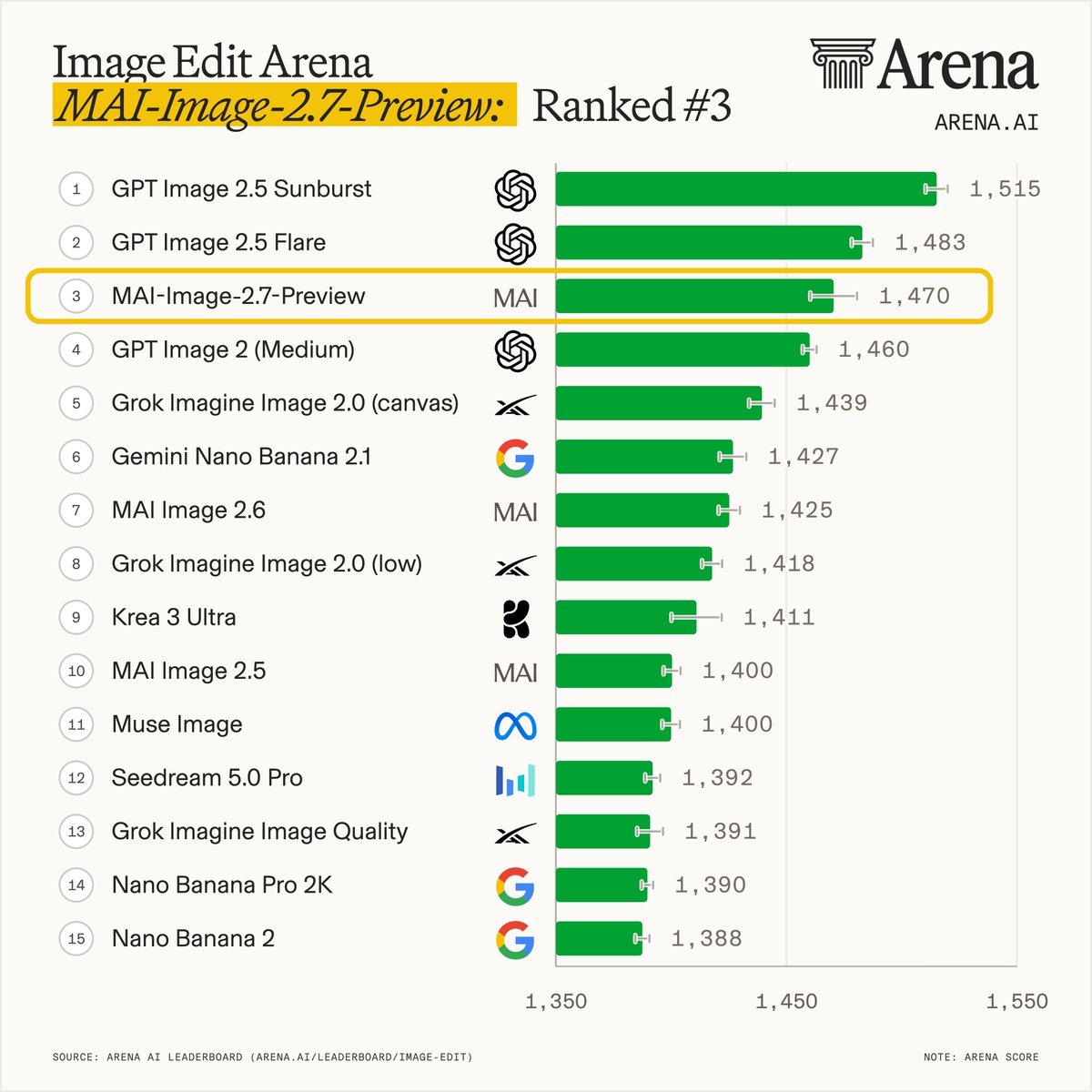
Microsoft AI announced on Oct 27 that MAI-Image-2.6 and MAI-Image-2.6-Flash are generally available in Microsoft Foundry, with multi-reference editing from up to five images, Bing web grounding, output up to 1.5K and published per-token pricing. The same day its next image editing model, MAI-Image-2.7-Preview, reached #3 overall in Arena's Image Edit leaderboard at 1470 points, 45 points above 2.6; for now it is available only for editing in MAI Playground.
Microsoft makes MAI-Image-2.6 and MAI-Image-2.6-Flash generally available in Foundry as MAI-Image-2.7-Preview reaches #3 in Image Edit Arena

Key Takeaways

  • MAI-Image-2.6 and MAI-Image-2.6-Flash are generally available in Microsoft Foundry, and Microsoft says 2.6 is coming soon to Adobe Firefly
  • Official pricing: 2.6 costs $5 text input, $8 image input and $38 image output per 1M tokens; Flash costs $1.75, $2.50 and $19
  • 2.6 supports multi-reference editing with up to five images, Bing web grounding, dynamic aspect ratios and output up to 1.5K
  • Per Arena, MAI-Image-2.7-Preview is #3 overall in Image Edit Arena at 1470 points, 45 points above 2.6 (#7), putting Microsoft AI #2 among labs
  • Per Artificial Analysis, 2.7-Preview is #2 on AA-Image-Editing v2.1 and beats 2.6 on all 7 editing actions, ranking #1 on 4 of them
Read full story
Linked Models & Agents:
⚡ MAI-Image-2.6⚡ MAI-Image-2.6-Flash⚡ MAI-Image-2.7-Preview🌐 Microsoft🌐 Microsoft AI

Krea 3 image-editing model lands on three leaderboards: Ultra ranks #4 on Arena Multi-Image Edit, behind only three OpenAI models

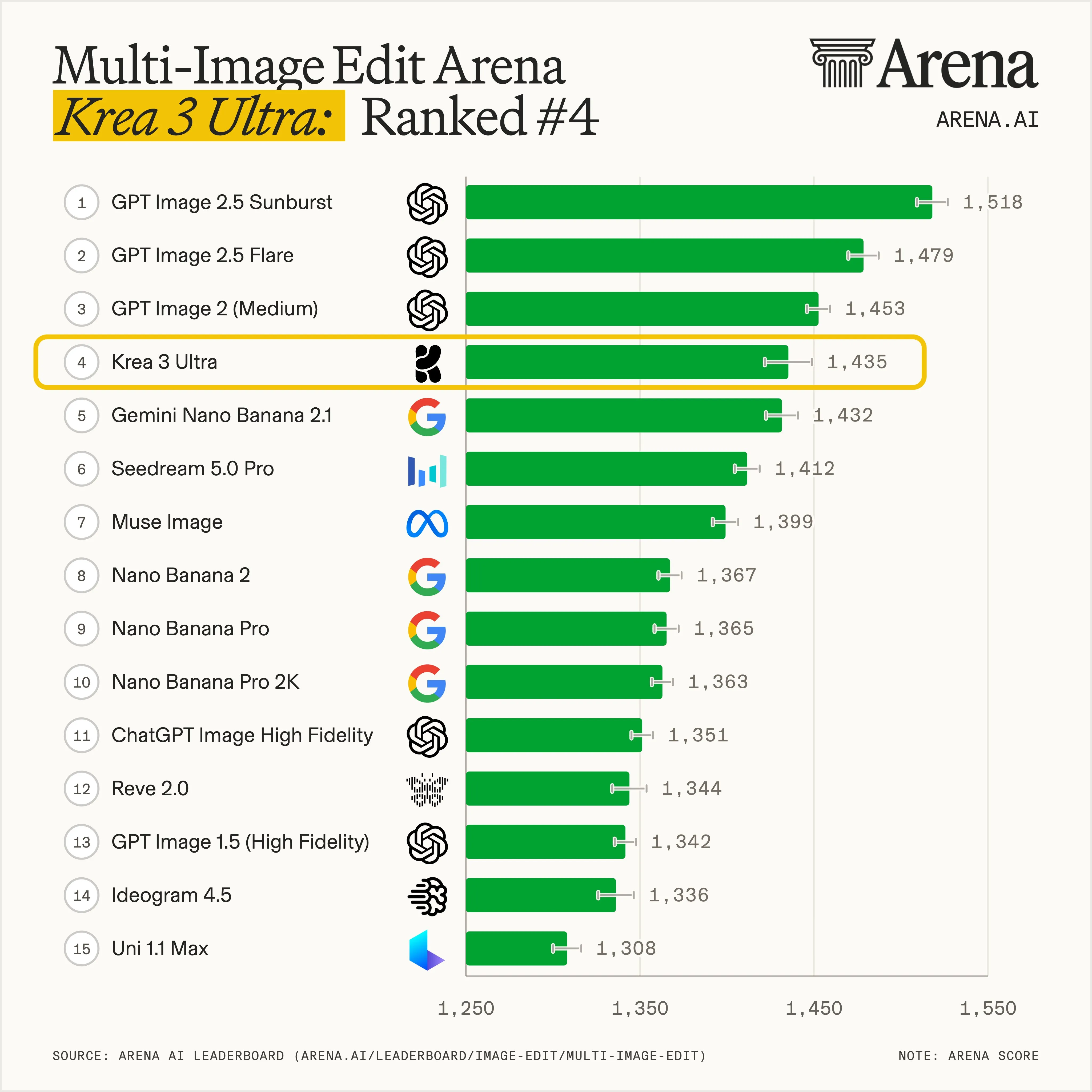
On Oct 20, Krea said Krea 3, the image-editing model it released on Oct 15, has entered several third-party leaderboards. On Arena's Multi-Image Edit board, Krea 3 Ultra ranks #4 at 1435±11 (preliminary, 2,991 votes), behind three OpenAI models; it is #8 on single-image editing. On Artificial Analysis, Ultra scores 1151 Elo (#5) and Fast scores 1125 (#11). Krea 3 edits at native 2K, returns most edits in under 8 seconds and costs $0.06 per image.

Krea 3 image-editing model lands on three leaderboards: Ultra ranks #4 on Arena Multi-Image Edit, behind only three OpenAI models

Key Takeaways

  • Arena Multi-Image Edit: Krea 3 Ultra is #4 at 1435±11 on 2,991 votes, marked preliminary; the top 3 are two GPT-Image-2.5 variants and GPT-Image-2
  • Arena single-image Image Edit: Krea 3 Ultra is #8 at 1411±11 on 2,619 votes
  • Artificial Analysis Image Editing v2.1: Ultra is #5 at 1151 Elo (statistically tied for #3 with Nano Banana 2.1 and MAI-Image-2.6); Fast is #11 at 1125
  • Design Arena Image Editing: #4 of 51 models at 1298 Elo
  • Vendor figures: most edits under 8 seconds, native 2K, $0.06 per image, up to 6 reference images
Read full story
Linked Models & Agents:
⚡ Krea 3 Ultra⚡ Krea 3 Fast⚡ GPT-Image-2.5⚡ Nano Banana 2.1⚡ MAI-Image-2.6🌐 Krea🌐 Arena🌐 Artificial Analysis

Bria releases Fibo 2.0: an 8B open-weights model that unifies image editing and generation, #1 open-weights on Artificial Analysis image editing, trained only on licensed data

On Oct 20 Bria released Fibo 2.0, putting image editing and text-to-image into a single 8B model for the first time, with two open-weight checkpoints: Fibo 2.0 Dev (full base for fine-tuning) and Fibo 2.0 Edit Turbo (4-step distilled editing). Artificial Analysis ranks it #1 among open-weights models on AA-Image-Editing v2.1 and statistically tied with Qwen-Image-2.1 for the open-weights lead on AA-Image-T2I v2.1. Weights are CC BY-NC 4.0 (commercial use needs a Bria agreement); the Bria API costs $32 per 1k images.

Bria releases Fibo 2.0: an 8B open-weights model that unifies image editing and generation, #1 open-weights on Artificial Analysis image editing, trained only on licensed data

Key Takeaways

  • 8B parameters; one model covers editing, masked edits, up to 4-image multi-reference composition and text-to-image
  • Two open checkpoints: Dev is the non-distilled base (vendor recommends 50 steps, guidance 5.0); Edit Turbo is distilled to 4 steps with no CFG, editing only
  • Third-party (Artificial Analysis): #1 open-weights on AA-Image-Editing v2.1, tied with Qwen-Image-2.1 for the open-weights lead on AA-Image-T2I v2.1
  • Pricing per AA: $32 per 1k images on the Bria API, vs $100 for Luma UNI 1 Max and $75 for Qwen Image 2.0 Pro
  • License: CC BY-NC 4.0 non-commercial, gated on Hugging Face, commercial use via a separate Bria agreement; vendor says training data is 100% licensed
Read full story
Linked Models & Agents:
⚡ Fibo 2.0 Dev⚡ Fibo 2.0 Edit Turbo⚡ Qwen-Image-2.1🌐 Bria🌐 Artificial Analysis🌐 fal

ControlNet Author Team Releases MTEdit: Packed Trajectories Beat Sequential Rollouts with 2.69M Multi-Turn Edits

ControlNet creator Lvmin Zhang and researchers from Stanford and CUHK unveiled MTEdit (arXiv:2610.23751). To resolve the visual degradation and cumulative error drift inherent in conventional sequential rollout for multi-turn image editing, the team introduced Packed Trajectory Canvas (PTC). MTEdit constructs a landmark dataset of 500K trajectories and 2.69M editing turns (averaging 5.38 turns, up to 8 turns), demonstrating stable instruction following and ambient identity consistency across 8 consecutive edits.

ControlNet Author Team Releases MTEdit: Packed Trajectories Beat Sequential Rollouts with 2.69M Multi-Turn Edits

Key Takeaways

  • ControlNet author Lvmin Zhang's team released MTEdit (arXiv:2610.23751), introducing Packed Trajectory Canvas (PTC) to eliminate visual drift in multi-turn image editing
  • Packs four progressive edits into a single 2x2 canvas, generating the full trajectory in one diffusion pass to enforce ambient consistency
  • Constructs the largest multi-turn dataset with 500K trajectories and 2.69M edits spanning up to 8 turns (averaging 5.38 turns per trajectory)
  • Maintains superior fidelity through Turn 8 with a 7.63 score, with full code and datasets released on GitHub
Read full story
Linked Models & Agents:
ADSponsored

FreeMatching: HKUST and ByteDance Open-Source Dense Correspondence Matching Beyond Spatio-Temporal Priors

Dense correspondence matching serves as the bedrock for optical flow, 3D stereo reconstruction, and object tracking. For decades, classical matching algorithms have fundamentally relied on rigid spatio-temporal priors: smooth motion continuity and rigid geometry. However, these foundational assumptions collapse under modern AI image editing and reference-guided generation (IEG), where visual identity is preserved while physical and geometric continuity is drastically severed (such as radical pose warps, stylistic shifts, or compositional recontextualization). Researchers from HKUST and ByteDance introduce FreeMatching (arXiv:2610.12421, code: github.com/luping-liu/FreeMatching), a generalizable framework for dense correspondence matching beyond spatio-temporal priors. FreeMatching fuses generative foundation features (from diffusion backbones) with high-level semantic representations (from vision foundation models), trained against heterogeneous supervision spanning classical benchmarks, tracked video sequences, and synthetic 3D scenes. An unsupervised teacher-guided iterative refinement loop further sharpens dense correspondences across challenging generated image pairs without requiring dense manual annotations. FreeMatching achieves dramatic leaps in correspondence precision across complex AI-edited image pairs while retaining competitive accuracy on classical optical flow tasks, and serves as an auditable quantitative metric for evaluating visual identity preservation that closely aligns with human judgment.

Key Takeaways

  • HKUST and ByteDance open-source FreeMatching, breaking free from traditional spatio-temporal priors in dense correspondence
  • Cuts end-point error by 42.6% and raises PCK by 31.8 percentage points across aggressive AI image edits and non-rigid transformations
  • Establishes a quantitative identity preservation metric highly correlated with human judgment (r = 0.88), fully available on GitHub
Read full story
Linked Models & Agents:

Unsloth Ships v0.1.815 & Prebuilt CUDA 13 Wheels: Run Qwen-Image-2.1 Locally with Claude-Compatible Agent Skills

Unsloth AI released version v0.1.815-beta alongside official prebuilt Linux x86_64 CUDA 13 wheels for Flash-Attention 2.8.4, Causal-Conv1D 1.7.0, and Mamba-SSM 2.3.2.post1 targeting PyTorch 2.13/2.14 on Python 3.13. The release enables fast local deployment of Alibaba's Qwen-Image-2.1 across both consumer and datacenter GPUs using Fast FP8 and GGUF quantization (defaulting to Q4_K_M) for combined image generation and precise image editing. Crucially, the Unsloth workspace introduces custom Agent Skills compatible with Claude Code and .agents formats, featuring @skill tagging in chat and 2x faster reasoning blocks (boosting UI rendering from 30 FPS to 60 FPS).

Unsloth Ships v0.1.815 & Prebuilt CUDA 13 Wheels: Run Qwen-Image-2.1 Locally with Claude-Compatible Agent Skills

Key Takeaways

  • Official CUDA 13 prebuilt wheels: instant binaries for Flash-Attention 2.8.4 and Mamba-SSM on PyTorch 2.13/2.14, eliminating compilation errors
  • Local Qwen-Image-2.1 execution: Fast FP8 and GGUF Q4_K_M support for both high-fidelity image generation and interactive image editing
  • Claude Code skill interoperability: native support for importing and executing custom skills from .agents and Claude Code folders with @skill
  • 60 FPS reasoning blocks: doubled chain-of-thought rendering performance from 30 FPS to 60 FPS with reworked UX
  • Expanded platform support: in-app Debian upgrades and a dedicated installer for Ubuntu 24.04+ on ARM64 architectures
Read full story
Linked Models & Agents:

Alibaba Open-Sources Qwen-Image-2.1: Unified 7B Weights for Generation & Editing with Native RGBA

Alibaba's Qwen team (@Alibaba_Qwen) open-sourced Qwen-Image-2.1, a 7B-parameter image model. It unifies text-to-image generation and natural language image editing in a single model checkpoint, while introducing native RGBA 4-channel alpha transparency for direct UI and game asset workflows.

Alibaba Open-Sources Qwen-Image-2.1: Unified 7B Weights for Generation & Editing with Native RGBA

Key Takeaways

  • Unifies text-to-image synthesis and localized instruction-driven image editing in a single 7B checkpoint.
  • Generates native RGBA outputs with authentic alpha transparency, removing manual background removal workflows.
  • Runs efficiently on consumer GPUs (e.g. RTX 4090 / 24GB VRAM) for quantized inference and LoRA tuning.
  • Model weights and inference code are openly available on ModelScope and Hugging Face.
Read full story
Linked Models & Agents:
⚡ Qwen Image 2.1⚡ qwen-2.5🌐 alibaba