AI Coding Live News

Factory launches Droid 1.0: programmatic tool calling by default, hundreds of tool calls per model request, leads native harnesses on its own Terminal-Bench 4 runs

AI coding agent company Factory announced Droid 1.0 on X and its blog at 22:31 UTC on Oct 29, calling it the largest update yet to its agent harness. The key change makes programmatic tool calling (PTC) the default: the model writes a JavaScript program that runs up to hundreds of tool calls in a sandbox in one model request. In Factorys own Terminal-Bench 4 runs, Droid scored 57.6% with GPT-6.1 Sol ($0.79 per passed task) and 65.2% with Claude Opus 5.5 ($4.73), ahead of Codex, Claude Code, Cursor, OpenCode and Devin on the same models.

Factory launches Droid 1.0: programmatic tool calling by default, hundreds of tool calls per model request, leads native harnesses on its own Terminal-Bench 4 runs

Key Takeaways

  • Programmatic tool calling is now the default: the model writes JavaScript that runs in a sandbox with no file, network or system access of its own, making up to hundreds of tool calls per request, with independent calls run concurrently
  • Factory example: moving and verifying 151 Linear issues took 312 tool calls; direct calls needed about 36 requests and 3.1M input tokens, a Script needed 2 requests and 61K tokens
  • Terminal-Bench 4 (Factory runs, Oct 23-28, three trials per task): with GPT-6.1 Sol, Droid 57.6% vs Codex 54.0%, OpenCode 51.0%, Devin 45.0%; with Opus 5.5, Droid 65.2% vs Cursor and OpenCode 62.1%, Devin 59.6%, Claude Code 57.6%
  • The first request shrank from 20,887 to 13,055 tokens (-37%) and up-front tool definitions went from 11 to 2; newly loaded MCP tools are appended to keep the prompt cache intact, and a typical production request reads 98% of input from cache
  • Available now as a macOS and Windows desktop app, a terminal UI and the Droid SDK (@factory/droid-sdk); the benchmarks are vendor-run with no third-party reproduction yet
Read full story

NVIDIA and UC Berkeley Unveil Post-Training Performance Predictors for Coding Agents from Base Checkpoints

Agentic post-training (scaling multi-turn RL and SFT) requires massive GPU investments, but AI labs lack reliable heuristics to predict which base model checkpoint possesses the highest potential before committing to multi-million-dollar post-training runs. Cold-start zero-shot evaluations on SWE-bench fail because unaligned base checkpoints cannot emit formatted tool invocations, while single-turn patch benchmarks ignore multi-step state management. Researchers from NVIDIA and UC Berkeley (including Bryan Catanzaro and Ashish Vaswani) present a lookahead evaluation framework (arXiv:2610.10478). By replaying successful post-trained trajectories and rerunning unit tests after every edit, they isolate the 'decisive step' that flips a repository from failing to passing. They introduce three lightweight evaluation screens at this decisive step that require zero cold-start tool calling: Decisive-Action Bits Per Byte (BPB), Patch MCQ, and prefix-conditioned pass@K. Across ten pairs of public base and post-trained models, these screens rank candidate checkpoints in tight agreement with final post-trained SWE-bench Verified pass@1 scores, establishing a low-cost lookahead methodology for model selection.

Key Takeaways

  • NVIDIA and UC Berkeley introduce lookahead screens to predict post-training coding agent performance from base checkpoints
  • Isolates the 'decisive step' that flips test suites to passing, introducing Decisive-Action BPB, Patch MCQ, and prefix-pass@K
  • Ranks base model potential in tight agreement with post-trained SWE-bench Verified pass@1 across 10 model pairs
Read full story
Linked Models & Agents:

Aleph Alpha open-sources Kolibri-1: 78B MoE (3.46B active), bilingual DE/EN Apache-2.0; SWE-Verified 66.4

On 3 Oct 2026, Aleph Alpha released open-weight Kolibri-1 (HF, Apache-2.0): 78B MoE / ~3.46B active, bilingual DE/EN, 262k native context (1M extrapolated), reasoning effort + tools. Official card: LiveCodeBench v6 85.9, SWE-Bench Verified 66.4, TerminalBench 2.1 27.7. Serve via aleph-alpha-inference + vLLM.

Aleph Alpha open-sources Kolibri-1: 78B MoE (3.46B active), bilingual DE/EN Apache-2.0; SWE-Verified 66.4

Key Takeaways

  • Shipped 2026-10-03; weights Aleph-Alpha/Kolibri-1 Apache-2.0; blog on aleph-alpha.com
  • 78B total / ~3.46B active; ~78GB FP8; native 262k context (validated to 1M)
  • Official card: LiveCodeBench v6 85.9 · SWE-Verified 66.4 · TerminalBench 2.1 27.7 · HumanEval+ 92.7
  • Serve: aleph-alpha-inference + vllm serve Aleph-Alpha/Kolibri-1 with kolibri1 parsers
  • Sovereign DE/EN on-prem focus — not a Terminal-Bench leader vs denser peers
Read full story
Linked Models & Agents:
⚡ Kolibri-1⚡ Kolibri⚡ Kolibri Origin🌐 Aleph Alpha

CorrGRPO Solves Multi-Reward Imbalance in GRPO: Pearson Correlation Normalization Boosts Code & Tool Calling

Group Relative Policy Optimization (GRPO) forms the reinforcement learning foundation for reasoning models like DeepSeek-R1 by normalizing group rewards to derive advantage estimates. However, practical LLM alignment requires balancing multiple competing rewards, such as code execution correctness, format compliance, tool-calling precision, and safety. Standard GRPO computes advantage normalization across aggregate variance, causing large-scale, highly correlated reward components to overshadow critical fine-grained signals. HKUST researchers propose CorrGRPO (Correlation-Normalized GRPO), which normalizes reward covariances into Pearson correlation coefficients. Across code generation, tool invocation, and agent safety benchmarks spanning 0.5B to 8B models, CorrGRPO systematically outperforms standard GRPO.

CorrGRPO Solves Multi-Reward Imbalance in GRPO: Pearson Correlation Normalization Boosts Code & Tool Calling

Key Takeaways

  • Addresses multi-reward scale imbalances in DeepSeek-R1 style GRPO using Pearson correlation coefficient normalization
  • Lifts HumanEval/MBPP code generation Pass@1 by 3.2 to 4.8 percentage points over standard GRPO baselines
  • Balances performance and guardrails, lifting tool-calling completion by 5.4% and safety defense from 82.1% to 93.7%
Read full story
ADSponsored

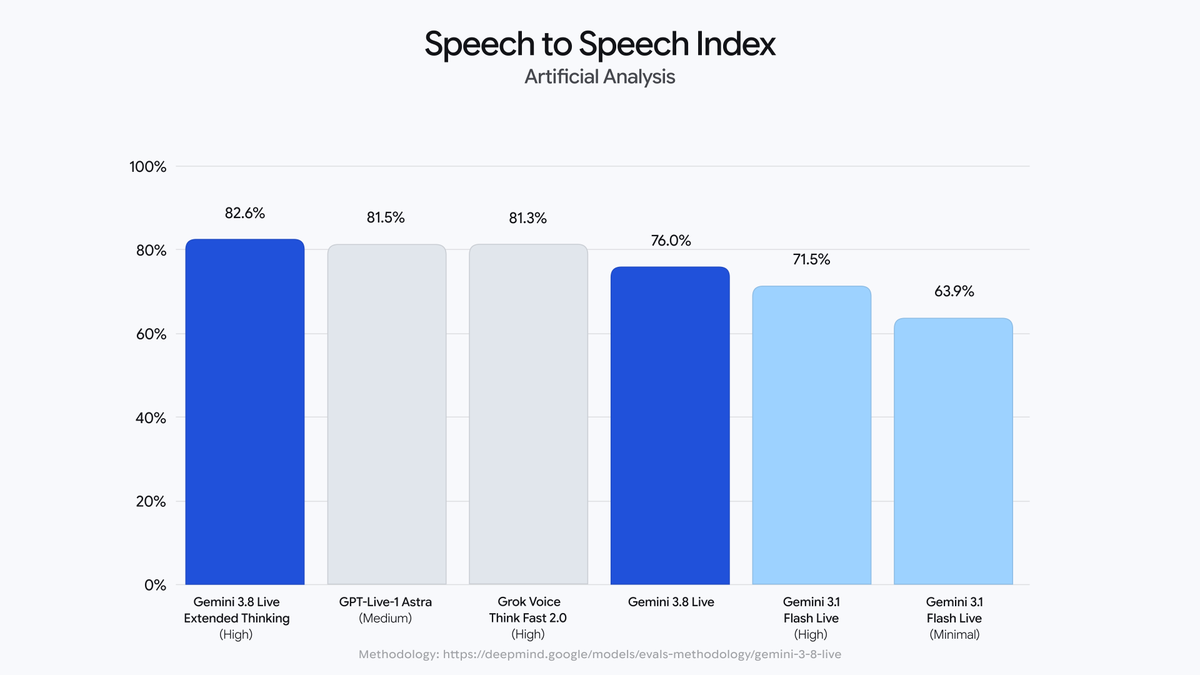
Google DeepMind Introduces Gemini 3.8 Live and Extended Thinking

Google DeepMind introduced Gemini 3.8 Live and 3.8 Live Extended Thinking, calling them its best conversational AI. Both models add upgraded reasoning, near real-time visual understanding, automatic detection for 97 languages, and background tool calling without interrupting chat. Extended Thinking narrates task progress for harder work. The models are available in Gemini Live in the Gemini app and via the Gemini API in Google AI Studio.

Google DeepMind Introduces Gemini 3.8 Live and Extended Thinking

Key Takeaways

  • Google DeepMind introduced Gemini 3.8 Live and 3.8 Live Extended Thinking, calling them its best conversational AI. Both models add upgraded reasoning, near real-time visual understanding, automatic detection for 97 languages, and background tool calling without interrupting chat. Extended Thinking narrates task progress for harder work. The models are available in Gemini Live in the Gemini app and via the Gemini API in Google AI Studio.
Read full story
Linked Models & Agents:

OpenRouter ships Ling 3.0 Flash VL: 124B MoE (5.5B active) with image/video agents

OpenRouter listed Ling 3.0 Flash VL (served by novita_labs): a 124B MoE with ~5.5B active params, native image/video input, visual agent capabilities, hybrid instant/reasoning modes, and tool calling, including a free route.

Key Takeaways

  • Ling 3.0 Flash VL is live on OpenRouter (incl. a free route).
  • 124B MoE with 5.5B active; native image/video + visual agents.
  • Hybrid instant/reasoning modes with tool calling.
Read full story
Linked Models & Agents:
⚡ Ling 3.0 Flash Vl🌐 openrouter🌐 ant-group

OpenAI: GPT-Live-1 live in the API—full-duplex voice agents that listen while speaking

OpenAI Developers said GPT-Live-1 is available in the API: bring ChatGPT’s natural back-and-forth into your app with voice agents that listen while they speak, using the models and harness you choose. OpenAI’s Tibo also noted builders can use the same full-duplex voice stack shipped to ~1B ChatGPT users, with solid tool calling.

Key Takeaways

  • GPT-Live-1 is live in the OpenAI API for full-duplex voice agents.
  • Agents can listen while speaking and pick model + harness.
  • Same voice stack as ChatGPT; strong fit for tool-calling voice apps.
Read full story
Linked Models & Agents:
⚡ GPT Live 1🌐 OpenAI

vLLM: day-0 MiniCPM5-2B on stable — 131K context, Think/No-Think, tool calling

vLLM (@vllm_project) announced day-0 support for OpenBMB MiniCPM5-2B on stable vLLM: 2.6B dense with native 131K context, Think/No-Think from one checkpoint, and tool calling via vLLM’s minicpm5 parser. Built on stock LlamaForCausalLM with training data opened alongside weights.

Key Takeaways

  • Engine: day-0 MiniCPM5-2B on stable vLLM.
  • Capabilities: native 131K context; Think/No-Think from one checkpoint; tool calling via minicpm5 parser.
  • Ecosystem: stock LlamaForCausalLM; training data opened with weights.
Read full story
Linked Models & Agents:
⚡ Openbmb Minicpm5 2b🌐 vllm🌐 openbmb