

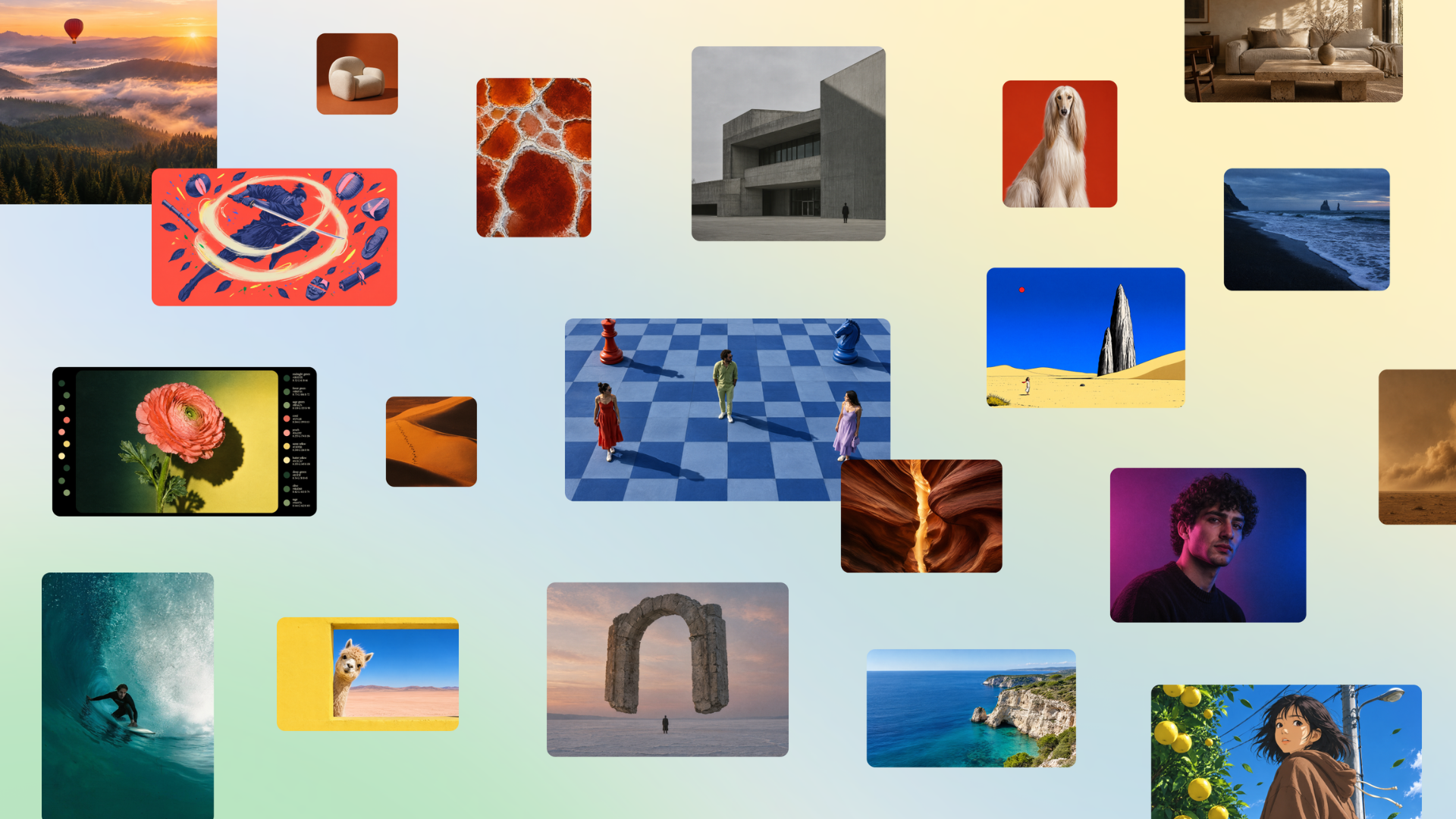
On Oct 22 Canva released Canva Craft, the first image-generation foundation model trained from scratch by its in-house lab, Canva Research. It works in two stages: a planning model writes out the composition (elements, spatial relationships, hierarchy and any text), then a rendering model produces the image at up to 2K across more than 30 aspect ratios. Training leaned heavily on millions of human-made templates from Canva's library, such as posters, social posts, slides and infographics. Canva says it debuted 4th overall on the crowdsourced DesignArena leaderboard and 1st in the People & Portraits and Landscapes & Nature categories. It is available now to all Canva users in Dream Lab and to developers through the Connect API as craft_v1_2k, with Canva MCP access coming soon.
Key Takeaways
- ✓Two-stage design: a planning model writes the composition (elements, relative scale, hierarchy, text), then a rendering model outputs up to 2K across 30+ aspect ratios (announcement)
- ✓Vendor-reported ranking: 4th overall on DesignArena, 1st in People & Portraits (of 87 models) and Landscapes & Nature (of 85), 2nd in Abstract & Patterns and 4th in Products
- ✓Training emphasized millions of human-made Canva templates; designers judged more than 25,000 head-to-head image pairs against leading models
- ✓For developers: POST /v1/image-generations on the Connect API with model set to craft_v1_2k, which spends the user's AI credits (API docs)
- ✓Prompts work in any language and in-image text covers 55 languages; the faster, cheaper Craft-fast and Craft-ultrafast variants and MCP access are not out yet
Key Decision Metrics at a Glance
Turn your technical choice into a development budget
Compare 40 dev plans & simulate token costs vs $20/mo subscriptions
Project Links & Resources
Direct AccessIn-Depth Technical Analysis
Background and pain point
Image models have improved fast, but for design work such as posters, social posts and flyers they still misspell text, place elements unpredictably and redraw the whole image when you change one thing. Canva has more than 250 million users and until now leaned on outside image models such as Lucid Origin. Canva Craft is the first foundation model Canva Research trained from scratch, aimed squarely at design rather than general photo generation.
What changed under the hood
Craft does not go straight from prompt to pixels. First, an image planning model turns the prompt into a detailed composition plan: which elements appear, their spatial relationships, relative scale, visual hierarchy and any text. Then a dedicated rendering model draws that plan at up to 2K across more than 30 aspect ratios. Canva says planning first gives more legible text, more precise placement and edits that touch only the part you want changed. Training leaned on millions of human-made templates from Canva's library, including posters, social posts, slides, infographics and menus, followed by supervised fine-tuning and reinforcement learning with feedback from professional designers. To cut cost, Canva used distillation to reduce inference steps to a fraction of the original and built a custom inference engine for the planning stage, which it says is an order of magnitude faster than its first internal version. TechCrunch reports that Leonardo.ai researchers also contributed.
Benchmarks
All figures are vendor-reported. On DesignArena, a crowdsourced design leaderboard, Craft debuted 4th overall, making Canva the second-ranked lab for image generation there. By category it ranks 1st in People & Portraits (of 87 models) and Landscapes & Nature (of 85), 2nd in Abstract & Patterns and 4th in Products. Internally, designers and researchers compared more than 25,000 image pairs against leading models. Canva has not published per-model scores against named competitors or an API price.
How to try it
Canva users open Dream Lab from the bottom-left panel; Canva says it is available to all users worldwide. Developers call the Connect API image endpoint POST /v1/image-generations with model set to craft_v1_2k; it needs the asset:write scope, spends the user's AI credits, and sits next to Lucid Origin and Z Image Turbo in the model list. Outputs are designed to work with Magic Layers for conversion into editable layers. Canva MCP access and the faster, cheaper Craft-fast and Craft-ultrafast variants are not out yet, so teams building agents can test their prompts through the API for now.
Benchmark side-by-side against alternatives, or calculate monthly token cost vs subscription break-even.
Discussion & Comments
0Sign in to join the discussion
Connect with AI developers to exchange benchmark insights.