
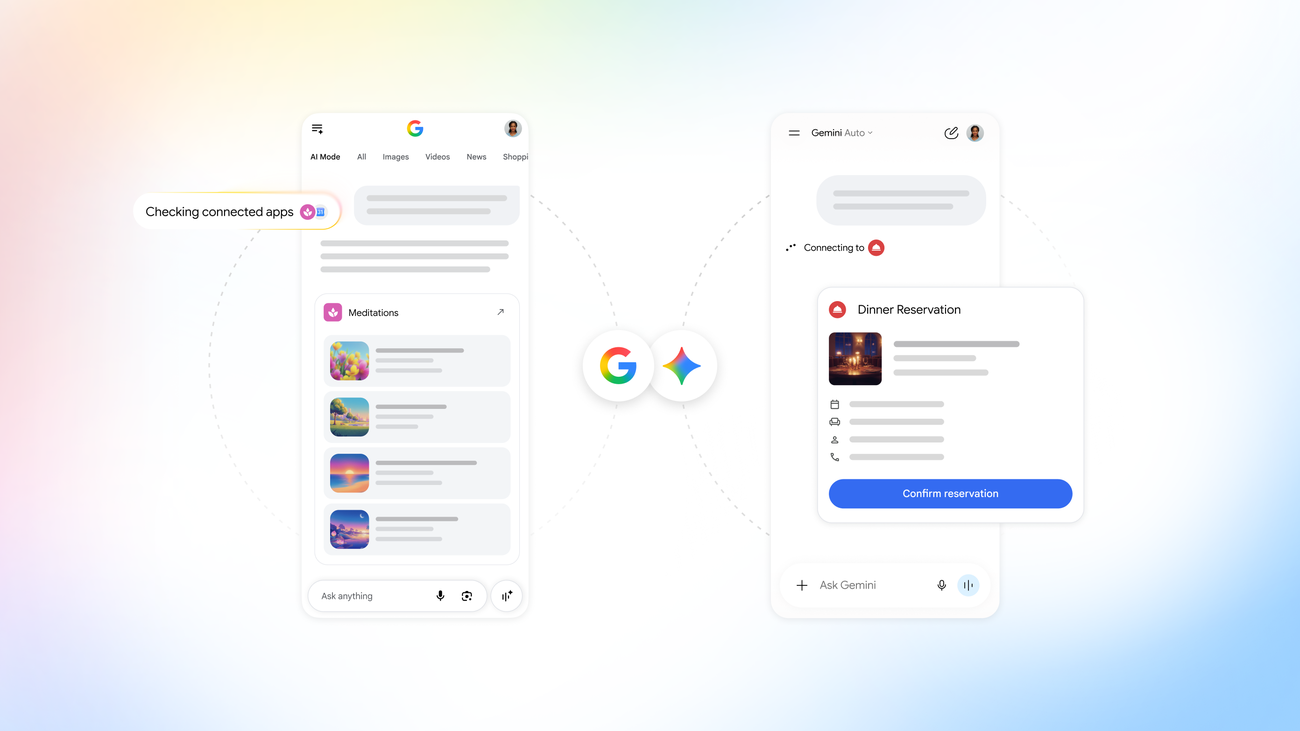
On Oct 28 Google launched a preview of its Connected Apps Platform. Developers integrate through a cloud-hosted MCP server or Android MCP (Jetpack AppFunctions), then register, test and submit for review in Google Connected Console, choosing whether the app goes live in Search, the Gemini app, or both. Access is phased and currently limited to US developers who apply.
Key Takeaways
- ✓Two integration paths: a cloud-hosted remote MCP server (authorized with OAuth 2.1), or Jetpack AppFunctions on Android (Android MCP), where tools run on the device
- ✓One console: Google Connected Console handles tool registration, testing, review and publishing, and shows traffic, latency and error rates once live
- ✓Distribution choice: before review, pick Search, the Gemini app, or both
- ✓Today: more than 50 Connected Apps across Search and Gemini; Adobe, Experian, Localiza and Peloton are live in Gemini and come to Search in the coming weeks, and Calm launches on both
- ✓Limits: phased preview for US developers who apply; Google has not said when it opens broadly
Key Decision Metrics at a Glance
Turn your technical choice into a development budget
Compare 40 dev plans & simulate token costs vs $20/mo subscriptions
Project Links & Resources
Direct AccessIn-Depth Technical Analysis
Background and pain points
Until now, getting a service into Gemini or the AI features in Google Search mostly meant a bespoke partnership and custom integration, with no self-serve path for ordinary developers. On Oct 28 the official @Google account announced a preview of the Connected Apps Platform on X. The blog post, signed by Group Product Managers Chips Mistry (Search) and Mai Lowe (Gemini app), describes it as a single place to build and manage apps for Search and the Gemini app.
Architecture and how it works
The platform standardizes two integration paths. The first is a cloud-hosted remote MCP server: you expose tools and user-authorized data over the Model Context Protocol, the developer docs require OAuth 2.1 so Gemini can act on the user's behalf, and you can build interactive UI with MCP Apps. The second is Android MCP: the Jetpack AppFunctions SDK exposes Android app features to Gemini, and tools run locally on the user's phone. The Android path links each connected app to one Play app, and the connection type and category cannot be changed after creation. Everything is managed in Google Connected Console: tool registration, testing, review submission and publishing, plus traffic, latency and error-rate monitoring and control over verified logos and authenticated accounts. Before review, developers choose Search, the Gemini app, or both.
Benchmarks and numbers
This is a platform and distribution launch; there are no model or performance benchmarks, and none were published. Confirmed numbers: more than 50 Connected Apps are live across Search and Gemini, spanning productivity, event ticketing, and health and fitness. Adobe, Experian, Localiza and Peloton are live in Gemini and reach Search in the coming weeks, and Calm launches on both. The official X post had about 480 likes and 94,000 views at crawl time.
What developers should do
Teams that already run a remote MCP server should add OAuth 2.1 authorization, apply for the preview at developers.google.com/connected-apps, then register and test in Connected Console. Individual users can already test connectivity by adding a custom MCP server URL in the Gemini web app (currently US only, 18+, personal accounts, English). Android teams should follow the AppFunctions guide and use a separate test Play app during development. Access is phased and reviewed, and Google has not given a date for broad availability; once live, track completed tasks and error rates rather than raw call counts.
Benchmark side-by-side against alternatives, or calculate monthly token cost vs subscription break-even.
Discussion & Comments
0Sign in to join the discussion
Connect with AI developers to exchange benchmark insights.