

During GitHub Universe on Oct 28, Microsoft put the Microsoft Copilot harness, the shared agent execution layer behind Copilot Code, Copilot Studio, the GitHub Copilot app, the CLI and VS Code, into Foundry Agent Service as a public preview. Microsoft runs the agent loop and sandbox while developers supply instructions, skills, tools and model choice; Microsoft says it works across 20+ frontier models plus bring-your-own-key. Long-running resilience for hosted agents also reached GA. Harness runtime usage is free until Dec 1.
Key Takeaways
- ✓Microsoft says the harness spans 20+ frontier models plus bring-your-own-key, so you can swap models without rewriting orchestration (official blog)
- ✓Preview building blocks: reusable skills, Foundry and MCP tools with explicit auth and approvals, file and code execution with built-in subagent delegation, and source-controlled agent definitions
- ✓Pricing: harness runtime is free until Dec 1; after that sandbox compute is USD 0.0994 per vCPU-hour and 0.0118 per GiB-hour, with model inference billed separately (Foundry blog)
- ✓Long-running resilience for hosted agents went GA the same week: interrupted work restarts with its original input, and your app saves checkpoints
- ✓Limits: you pick the harness only when creating a new agent; existing agents are unchanged and switching later is not supported yet
Key Decision Metrics at a Glance
Turn your technical choice into a development budget
Compare 40 dev plans & simulate token costs vs $20/mo subscriptions
Project Links & Resources
Direct AccessIn-Depth Technical Analysis
Background and the problem
Teams building agents spend a lot of effort on the same plumbing: coordinating model and tool calls, keeping working context, managing files, and deciding how a multi-step task continues. Models change fast, so keeping a homegrown harness and model router current is hard. On Oct 28, during GitHub Universe, Microsoft put the Microsoft Copilot harness, built by GitHub engineers and already shared by Copilot Code, Copilot Studio, the GitHub Copilot app, the CLI and VS Code, into Foundry Agent Service as a public preview. Satya Nadella also posted on X that the unified Copilot harness is now in Foundry.
Architecture and how it works
Microsoft runs the agent loop and sandbox; developers define agents declaratively and bring instructions, skills, tools and a model. The preview has four building blocks: reusable skills (SKILL.md procedures), Foundry and MCP tools with explicitly configured auth and approvals, file and code execution with built-in subagent delegation, and agent definitions you can keep in source control. Microsoft says the harness works across 20+ frontier models plus bring-your-own-key, and its runtime was recently ported to Rust. Long-running resilience for hosted agents went GA the same week.
Benchmarks
Microsoft has not published benchmarks for the harness itself. Its blog says the Rust port cut session overhead and time-to-first-token but gives no figures (vendor claim). It also has not published comparisons against homegrown harnesses or other managed agent platforms.
Getting started
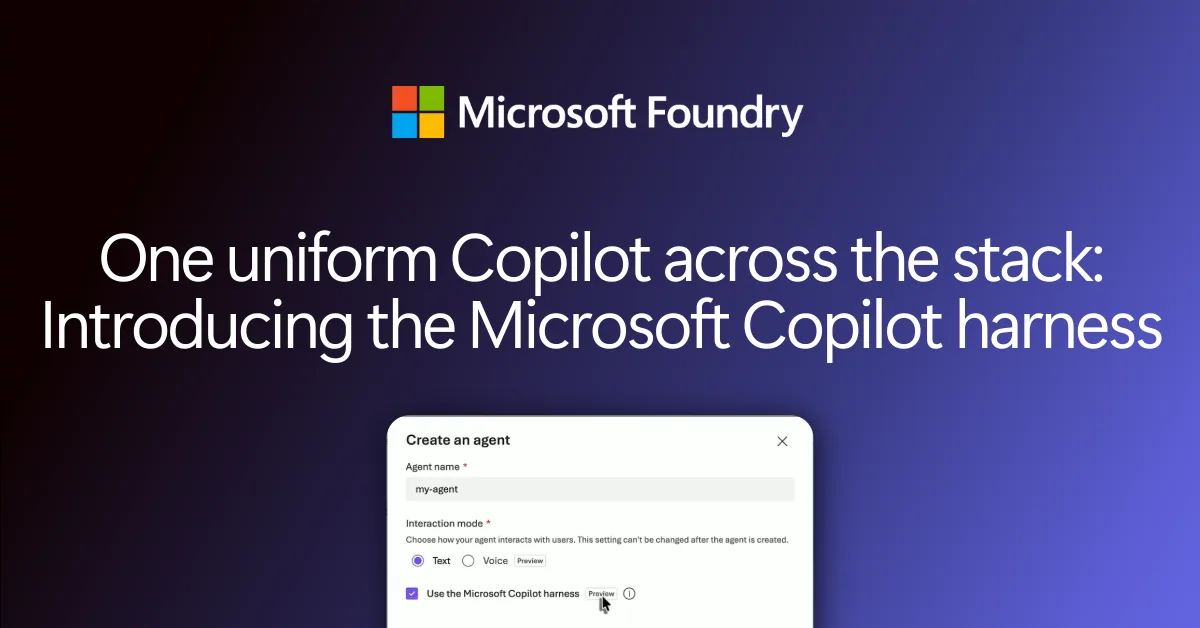
Select the Microsoft Copilot harness when creating a new prompt agent (existing agents are unchanged and switching later is not supported yet). You can use the Foundry portal, Foundry Toolkit for VS Code, or the preview azd flow (harness type microsoft_copilot_preview in azure.yaml). Harness runtime is free until Dec 1; after that sandbox compute is USD 0.0994 per vCPU-hour and 0.0118 per GiB-hour, with model inference billed separately. Teams that need their own framework or agent loop can still use hosted agents.
Benchmark side-by-side against alternatives, or calculate monthly token cost vs subscription break-even.
Discussion & Comments
0Sign in to join the discussion
Connect with AI developers to exchange benchmark insights.