
On November 4, Justin Uberti, Head of Realtime AI at OpenAI, said the GPT-Live outbound telephony API is generally available: Live voice agents can dial through any SIP trunk such as Telnyx or Twilio, with HD Voice and bidirectional DTMF. Official docs describe Live API + SIP transport; Greg Brockman amplified the note.
Key Takeaways
- ✓Justin Uberti (Head of Realtime AI, OpenAI): GPT-Live outbound telephony API is GA via any SIP trunk
- ✓Official docs: Live API POST /v1/live/sessions with transport.type=sip; HD Voice and bidirectional DTMF
- ✓Trunks need TLS (sips:) signaling and SDES-SRTP; examples cite Telnyx and Twilio
- ✓Documented limits: ~3 minutes ringing and ~2 hours connected call duration
- ✓Amplified by Greg Brockman; frame as a first-hand employee note, not an @OpenAI press post
Key Decision Metrics at a Glance
Turn your technical choice into a development budget
Compare 40 dev plans & simulate token costs vs $20/mo subscriptions
Project Links & Resources
Direct AccessIn-Depth Technical Analysis
Core Background & Industry Pain Points
Voice agents have long been stronger at answering calls than placing them: builders had to glue STT-LLM-TTS bridges onto SIP trunks and phone menus. On November 4, 2026, Justin Uberti, Head of Realtime AI at OpenAI, said the GPT-Live outbound telephony API is now generally available, so Live voice agents can dial through any SIP trunk provider such as Telnyx or Twilio. Greg Brockman later amplified the post. This is a first-hand employee note pointing at official Telephony/SIP docs, not an @OpenAI main-account press blast.
Architecture Highlights & Internals
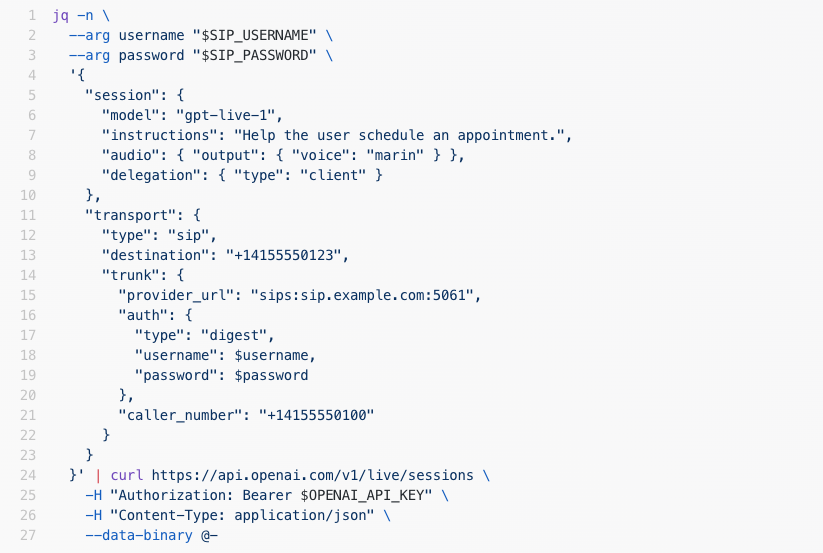
Outbound calls use Live API POST /v1/live/sessions with transport.type: "sip" and an E.164 destination. Trunks need TLS signaling (sips:) and SDES-SRTP media, with Digest auth and a caller number. After creation, attach a sideband WebSocket for events and tools while SIP carries audio. Docs state outbound SIP is available to all organizations through the Live API, not the Realtime API call-creation endpoint, and calls support HD Voice plus bidirectional DTMF.
Authoritative Benchmarks & Measured Scores
No separate outbound-call speech benchmarks were published. Documented hard limits: ringing up to 3 minutes and connected calls up to 2 hours, neither configurable on create. Invalid session config fails synchronously; transport setup may return 502 and initialization timeouts 504; watch transport.failed for async failures.
Developer Hands-on Guide
Provision a TLS+SRTP SIP trunk, then create a Live session with transport.type=sip from your backend (example model gpt-live-1) and attach the sideband immediately so you do not miss early events outside the ~3-second replay window. Send keypad tones with transport.dtmf.send, transfer with /refer, and hang up with /hangup. Keep API keys and SIP credentials server-side; do not put credentials or private IPs in the provider URL. EU residency can use sip-eu.api.openai.com. Attribute the news to Justin Uberti's first-hand post plus official docs, amplified by Greg Brockman.
Benchmark side-by-side against alternatives, or calculate monthly token cost vs subscription break-even.
Discussion & Comments
0Sign in to join the discussion
Connect with AI developers to exchange benchmark insights.