

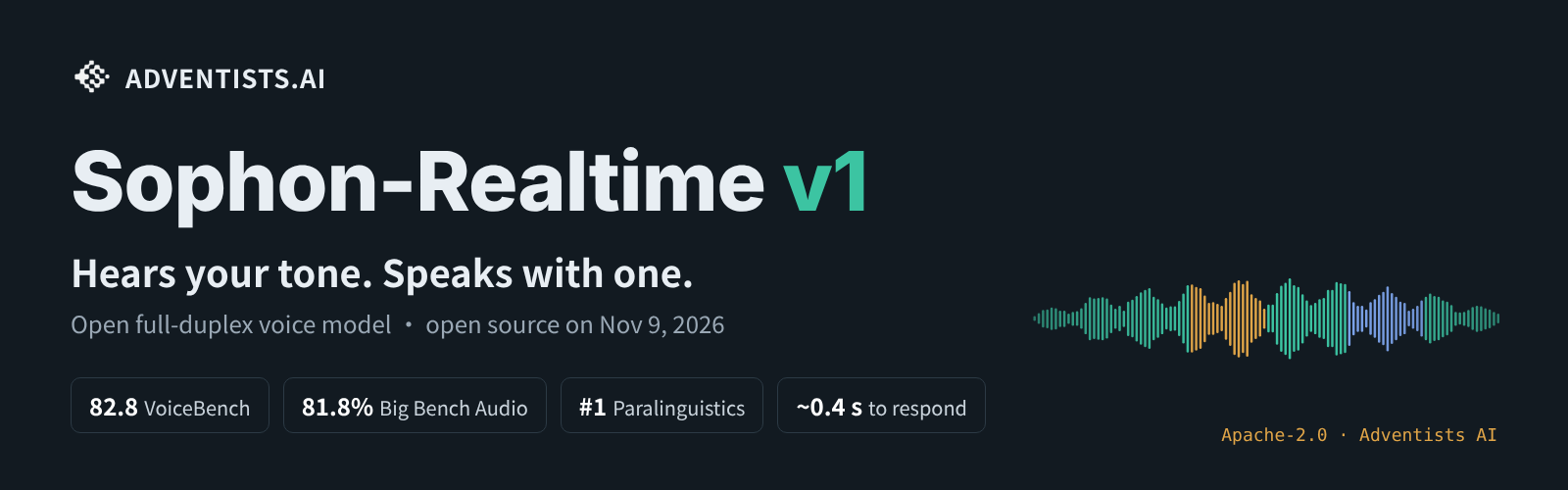
On November 8, Adventists AI released the Sophon-Realtime v1 family of full-duplex voice models on GitHub, Hugging Face, ModelScope and PyPI, with Apache 2.0 code and weights that allow commercial use. All three builds share one 32B brain, adapted from Qwen3-VL-32B-Instruct, that listens continuously, decides turns and writes the reply; they differ only in how the reply becomes sound. The recommended Tag build is the most expressive, Flash reaches first audio in 0.31 s with up to 40 concurrent users per GPU, and E2E is a research preview that needs two 80 GB GPUs. Vendor-reported scores are VoiceBench 82.8 and Big Bench Audio 81.8%, first among open full-duplex models; all benchmarks are self-run by the team.
Key Takeaways
- ✓Scores (vendor-reported, self-run; see the GitHub README): VoiceBench 82.8 and Big Bench Audio 81.8%, first among open full-duplex models and level with GPT-4o-mini-Audio on VoiceBench
- ✓Tone understanding: paralinguistic score 48.6, ahead of Gemini 3.8 Flash (46.9) and Qwen3-Omni (44.6); Full-Duplex-Bench v3 tool calling Pass@1 48% versus 43% for Grok
- ✓Three builds: Tag about 0.6 s to first audio and 16 users per GPU; Flash 0.31 s and 40 users per GPU; E2E about 1 s on two 80 GB GPUs (measured on one H100, vendor-reported)
- ✓Quick start:
pip install sophon-realtimethensophon-realtime servedownloads the ~42 GB Tag weights on first run and serves an OpenAI Realtime-style WebSocket on port 8000 (see PyPI) - ✓License and bases: Apache 2.0 code and weights; the Tag thinker derives from Qwen3-VL-32B-Instruct quantized to FP8, and the voice derives from Fun-CosyVoice3-0.5B (see Hugging Face)
Key Decision Metrics at a Glance
Not enough VRAM? Compare cloud API and self-hosting costs
Compare 40 dev plans & simulate token costs vs $20/mo subscriptions
Project Links & Resources
Direct AccessIn-Depth Technical Analysis
Background and the problem
Voice agents are moving from half-duplex turn-taking to full duplex, where the model can be interrupted and back-channel like a phone call. Closed options include OpenAI GPT-Live and the GPT-4o voice APIs; open options have included Moshi, MiniCPM-o and Freeze-Omni, and we have also covered Block's Dessa and Boson AI's Higgs Realtime Duplex. Open models have usually had a weak brain, little sense of tone, and poor multi-user serving on one GPU.
Architecture and how it works
All three Sophon-Realtime v1 builds share one 32B brain. At each pause it decides in a single token whether the user has finished, is still talking, is back-channeling or is thinking, and it drafts a reply from the first pause, dropping the draft if the user keeps talking. On barge-in it stops at once and keeps only the part the user actually heard in the history. The brain also marks where to laugh, sigh, breathe or stress a word, and the voice performs those marks instead of reading them. Tag uses an expressive TTS derived from Fun-CosyVoice3-0.5B, Flash swaps in a lighter voice with one forward pass per 80 ms frame, and E2E puts the talker inside the 32B model.
Benchmarks
All figures are self-run by the team (vendor-reported): VoiceBench 82.8 and Big Bench Audio 81.8%, first among open full-duplex models; paralinguistic understanding 48.6 versus 46.9 for Gemini 3.8 Flash; Full-Duplex-Bench v3 tool calling Pass@1 48% versus 43% for Grok. On NVV-SuperBench for non-verbal sounds, Tag scores 0.86 in Chinese and 0.80 in English. The team says sigh and laugh-while-speaking tags are still weak, Mandarin is slightly less clear than English, and replies longer than about a minute exceed the training range. There is no independent third-party evaluation yet.
Getting started
You need Linux, CUDA, Python 3.12 and one 80 GB GPU (H100, H800 or A100 80G). The fastest path is pip install sophon-realtime followed by sophon-realtime serve, which exposes a full-duplex ws://HOST:8000/v1/realtime endpoint and POST /v1/chat/completions. The repo's Live mode gateway speaks the OpenAI GPT-Live protocol, so existing GPT-Live clients only change the URL and key. You can also LoRA-tune persona and domain knowledge on one GPU with ms-swift. Try Flash first for high-concurrency uses such as customer service or in-car, Tag for companion and character apps, and test barge-in and Mandarin quality on your own recordings before shipping.
Benchmark side-by-side against alternatives, or calculate monthly token cost vs subscription break-even.
Discussion & Comments
0Sign in to join the discussion
Connect with AI developers to exchange benchmark insights.