
On November 8 (morning of November 9 in Singapore), independent evaluator Artificial Analysis released version 2 of its Decision Index for decision models. The headline metric is now a Decision Score that rewards both correct answers and well-calibrated confidence, the private-data share rises from 25% in v1 to 45%, and two new evaluations are added: AA-Paperclip with 1,500 private documents and AA-Symmetry for answer consistency. Among decision models, Nace AI's Drex Max v1.1 and Fastino Labs' GLiDE v1.2 both score 73, with Drex Max narrowly ahead, and Base Labs' Mammoth 27B scores 72. General LLMs score higher, with Claude Haiku 5.5 (Max) at 77 and GPT-6 Luna (Max) at 76, but cost $6,240 and $1,530 per 1M tasks versus $102 for Drex Max.
Key Takeaways
- ✓New metric (official leaderboard): per-question score = 50 x (1 + c - (p - c)^2), equal overall to 50 x (1 + accuracy - Brier score); right answers always score above 50 and wrong ones below 50, with confidence spreading scores within each half
- ✓New weights: AA-Paperclip 30%, AA-Symmetry 15%, EvalSafe-O*NET-AA 15%, AA-Omniscience-Decision v1.1 15%, HLE-MultiChoice v1.1 15%, NVIDIA When2Call 10% (down from 25%); the saturated WildGuardTest was removed
- ✓Top decision models (vendor-run evaluation): Drex Max v1.1 73, GLiDE v1.2 73, Mammoth 27B 72; general LLMs Claude Haiku 5.5 (Max) 77 and GPT-6 Luna (Max) 76
- ✓Cost gap above 60x: Celeris-1.1 Decision $14 per 1M tasks, Drex Max v1.1 $102, Clef $859; GLiDE v1.2 bills a document's input for every question and costs $780, about 8x Drex Max
- ✓Speed: Celeris-1.1 Decision takes 56 ms per task and Elephant 9B 70 ms, versus 11.34 s for GPT-6 Luna (Max) and 32.65 s for Claude Haiku 5.5 (Max)
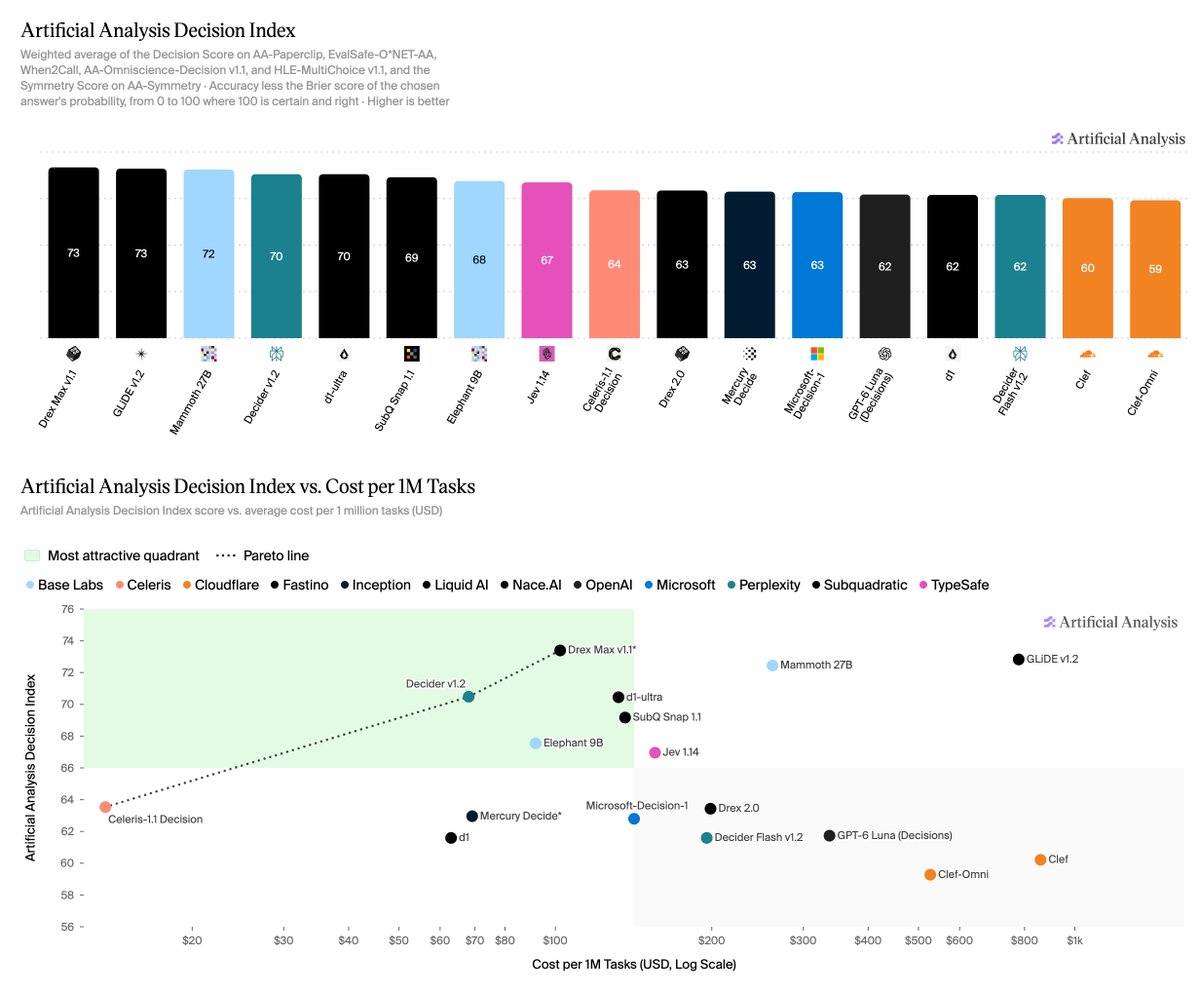
Key Decision Metrics at a Glance
Turn your technical choice into a development budget
Compare 40 dev plans & simulate token costs vs $20/mo subscriptions
Project Links & Resources
Direct AccessIn-Depth Technical Analysis
Background and pain points
"Decision models" are small models that skip long-form text and directly return an option plus a probability for classification, extraction, tool-call and allow/deny questions, often as routers and reviewers inside agent pipelines. What matters in production is whether a stated 90% confidence is trustworthy, because systems use confidence thresholds to decide whether to act automatically or escalate to a person or a stronger model. Artificial Analysis v1 mostly measured accuracy and used 75% public data, which invites benchmark gaming. Version 2, released on November 8, rebuilds the index around both issues.
Key design changes
The new Decision Score gives each question 0-100 points: right answers score above 50, wrong answers below 50, and confidence sets the position within each half. Overall it equals 50 x (1 + accuracy - Brier score), the average payoff across all thresholds, so it does not depend on one cutoff. New AA-Paperclip (30% weight) has 1,500 private documents (resumes, receipts, invoices, papers), each with 5 decisions and 10 extractions, and a document only passes if all 15 are right. AA-Symmetry (15%) uses 120 base questions and 440 variations (reordered options, swapped labels, negated questions) to test stability. Private data rises from 25% to 45%.
Benchmark results
All figures are Artificial Analysis results. Drex Max v1.1 (Nace AI) and GLiDE v1.2 (Fastino Labs) both score 73 and Mammoth 27B (Base Labs) 72, yet GLiDE leads on raw accuracy (60 vs 58), so calibration changes the ranking. On AA-Paperclip, Claude Haiku 5.5 (Max) passes 92% of documents; Drex Max v1.1 gets 97% of individual answers right but passes only 63% of documents. Mammoth 27B scores 96 on AA-Symmetry and picks the same answer across variations on 99% of questions.
Practical guidance
If you use small models for routing or review in agents, toggle "Include language models" on the leaderboard to compare cost and speed: Drex Max v1.1 costs $102 per 1M tasks at about 275 ms per task, while GPT-6 Luna (Max) is only about 3 points higher at roughly 15x the cost and 40x the latency. Watch billing too: GLiDE v1.2 re-bills document input for every question, so a list price only 33% higher ends up nearly 8x the total cost of Drex Max. Systems that rely on confidence thresholds should look at the Decision Score rather than accuracy alone.
Benchmark side-by-side against alternatives, or calculate monthly token cost vs subscription break-even.
Discussion & Comments
0Sign in to join the discussion
Connect with AI developers to exchange benchmark insights.