
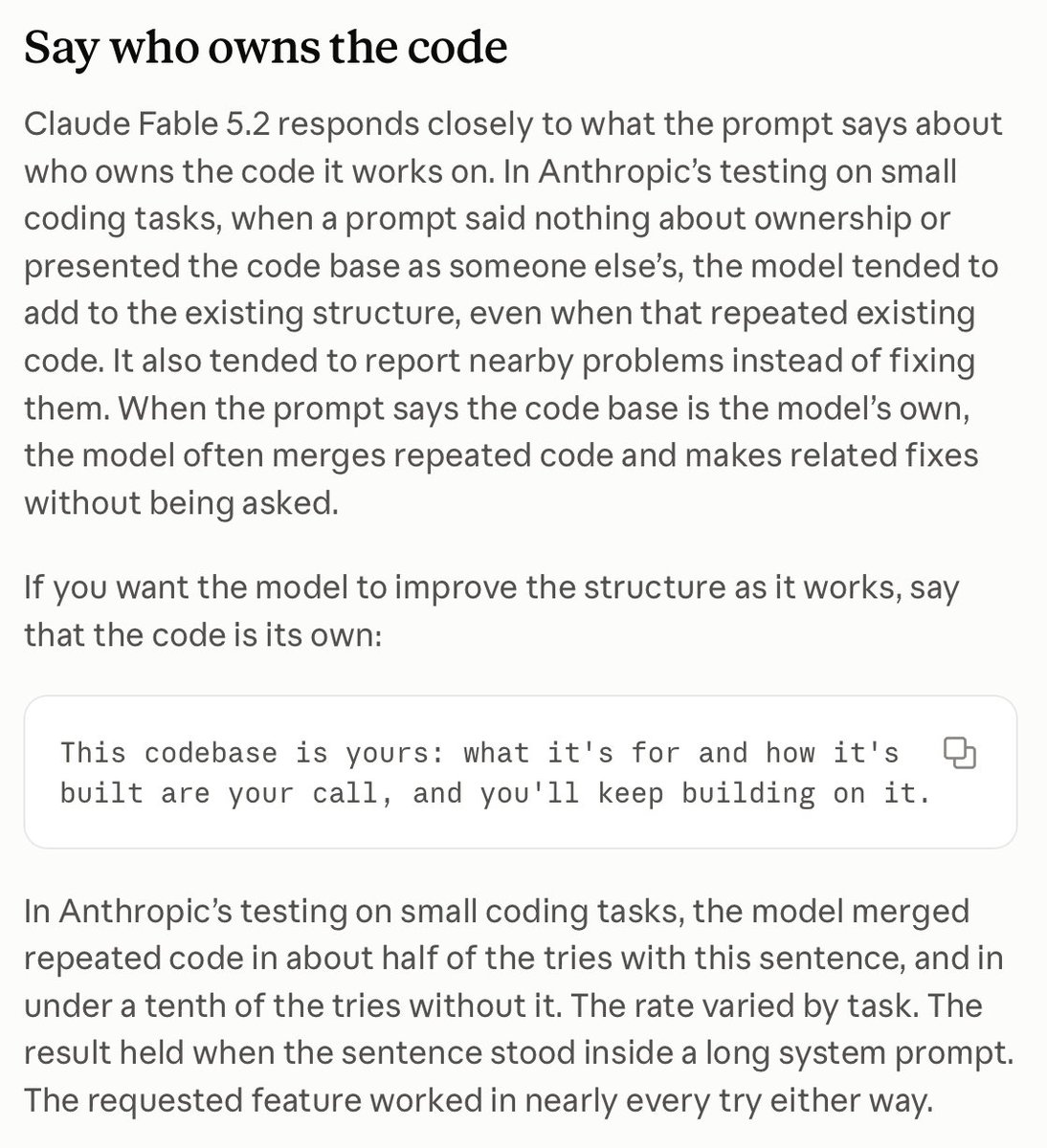
Anthropic has published "Prompting Claude Fable 5.2" in the Claude developer docs, covering where Fable 5.2 behaves differently from earlier models. On November 10, Simon Willison highlighted one tip: tell the model in the system prompt that "this codebase is yours," and it becomes more willing to merge duplicate code and fix related problems. The guide also offers text that stops the model from ending turns before the work is done, ways to keep users informed during long agentic turns, advice on limiting subagents, and a warning to clean up instructions written for Fable 5.1 and Opus 5.5. All figures in the guide come from Anthropic's own testing (vendor figures).
Key Takeaways
- ✓Code ownership: on small coding tasks, adding "This codebase is yours" made the model merge duplicate code in about half of tries vs under a tenth without it, but output tokens rose to about 1.5x and roughly 1 in 6 to 10 tries changed how an existing feature behaves
- ✓Finishing the task: replaying agentic coding sessions at medium effort, the official "Finishing work" text cut sessions that ended with doable work left by about half, with about 30% more output tokens
- ✓Progress updates: Fable 5.2 returns mid-turn updates as thinking blocks whose text is empty at the default display of "omitted"; a harness reminder that the user has not heard from the model roughly halved the longest silent stretch
- ✓Migration cleanup: lines such as "answer directly without deliberating" no longer stop thinking at medium and above, so lower effort instead; harnesses that edit earlier turns invalidate thinking blocks and get a 400 error
- ✓Effort: the API default is high, where most of the capability gain already appears; use xhigh only where evals show a gain, and max for ceiling tests or open-ended math and science problems
Key Decision Metrics at a Glance
Heavy Claude Code use: compare subscription limits and API bills
Compare 40 dev plans & simulate token costs vs $20/mo subscriptions
Project Links & Resources
Direct AccessIn-Depth Technical Analysis
Core Background and Industry Pain Points
After Claude Fable 5.2 launched on November 9, many teams carried over system prompts, skills, and harnesses tuned for Fable 5.1 or Opus 5.5, and hit problems: turns that end before the work is done, long silent agentic runs, too many subagents, and needless approval requests. Anthropic responded with a dedicated Fable 5.2 prompting guide in its developer docs; Simon Willison's post recommending it drew more than 130 bookmarks.
Architecture Highlights and Underlying Mechanisms
The guide is organized by symptom. Fable 5.2 reacts strongly to what the prompt says about who owns the code: with no statement, or when the code is someone else's, it tends to add to the existing structure and report nearby problems without fixing them; told the codebase is its own, it restructures. It also follows cautious rules that pile up in memory and notes, so Anthropic advises deleting stale notes and naming steps that need no approval. Fable 5.2 uses preserved thinking, so editing history invalidates thinking blocks.
Authoritative Benchmarks and Measured Results
All figures are Anthropic's own testing (vendor figures) and have not been reproduced by third parties: the ownership sentence raised duplicate-code merging to about half of tries from under a tenth, at about 1.5x output tokens; the "Finishing work" text cut sessions ending with doable work left by about half, at about 30% more output tokens; opening and recap text made the model speak before its first tool call every time, at about 20% more tokens; and a new subagent tool description cut delegation by about a third with the same task success.
Developer Playbook and Getting Started
Anthropic's suggested migration order: set effort to high explicitly, then also run evals at medium and xhigh; read the system prompts, skills, memory, and notes you carry over and remove "think less" and standing delegation lines; run your longest agentic tasks and note early stops, silence, and over-delegation; then apply the matching guidance one change at a time and measure its token cost. Leave out the ownership sentence when users want minimal changes, and review the diff rather than only the summary.
Benchmark side-by-side against alternatives, or calculate monthly token cost vs subscription break-even.
Discussion & Comments
0Sign in to join the discussion
Connect with AI developers to exchange benchmark insights.