

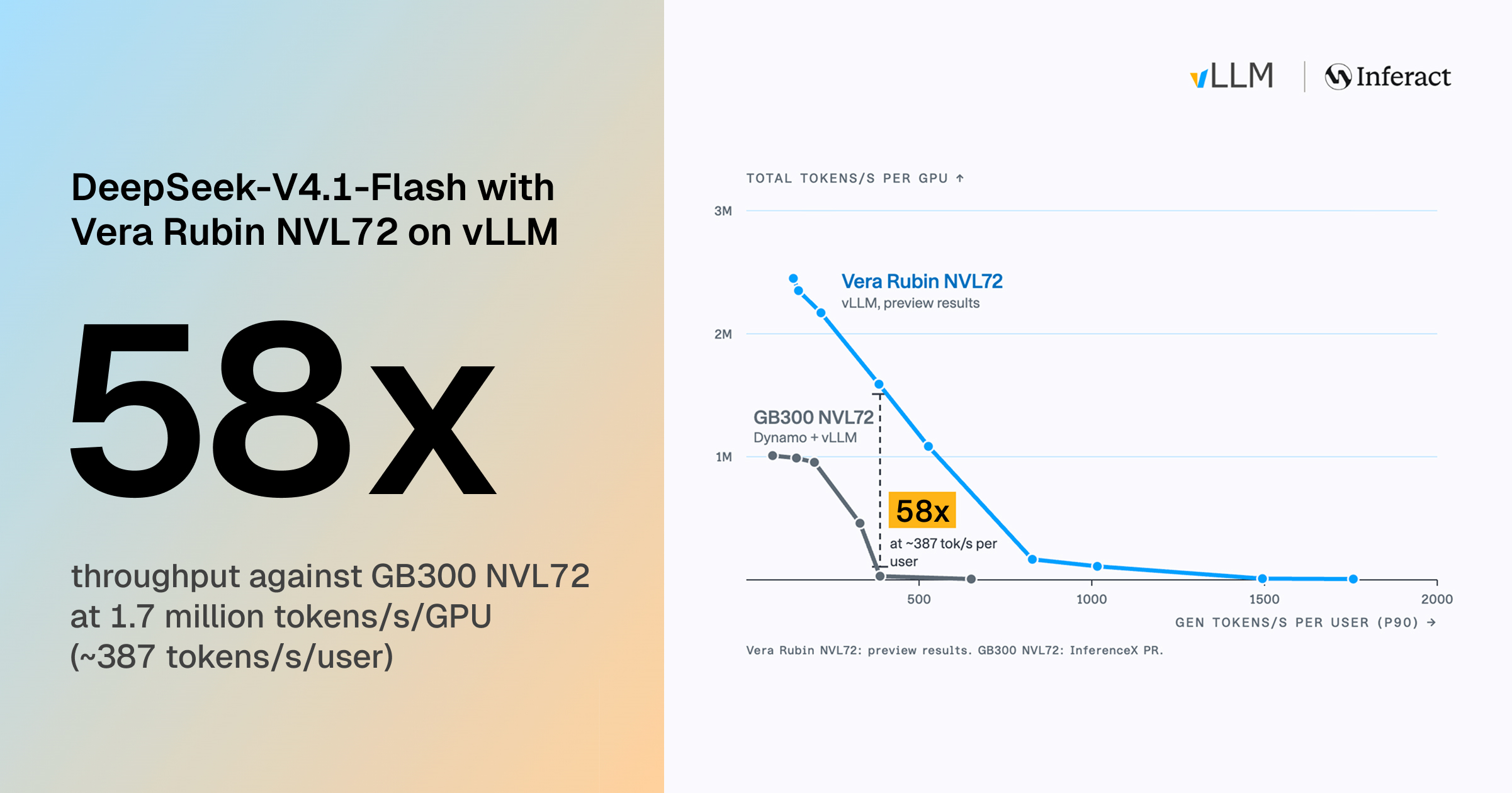
On November 12, vLLM published the third post in its DeepSeek-V4.1-Flash series, led by Inferact. On one Vera Rubin NVL72 rack running the SemiAnalysis AgentX workload, it measured 1.7M total tokens/s per GPU at a P90 of 387 tokens/s per user, 58x GB300 NVL72 at the same interactivity, and 2.52M tokens/s per GPU at peak throughput, 2.7x GB300. The 58x figure applies only at that high-interactivity point, and the Rubin numbers are preview results.
Key Takeaways
- ✓Keep the two multiples apart (vLLM figures): 1.7M tokens/s per GPU at 387 tokens/s per user is 58x GB300; 2.52M tokens/s per GPU at peak throughput is 2.7x GB300
- ✓Single-user latency: a specialized TP8 decode path spanning two compute trays reaches 1,810 tokens/s at P90 with one concurrent session, and P50 rose from 1,117 to 1,844 tokens/s
- ✓Rewritten kernels: tuned for Rubin's two memory domains and SM107's new MMA instructions, DEP2 prefill steps are about 28% faster and DEP decode steps about 25% faster
- ✓Rack-scale memory pools: the Mooncake KV pool extends from DRAM to spare HBM and Engram tables are sharded across GPU HBM; at concurrency 4,800 requests served rise 68% and TTFT P50 falls from 29.8 s to 4.2 s
- ✓Nature of the data: Rubin results are preview numbers, GB300 comparisons come from an InferenceX PR, and some points are interpolated
Key Decision Metrics at a Glance
Not enough VRAM? Compare cloud API and self-hosting costs
Compare 40 dev plans & simulate token costs vs $20/mo subscriptions
Project Links & Resources
Direct AccessIn-Depth Technical Analysis
Background and the problem
Agent workloads mean many sessions, long prefixes and high output speed for every user. In this high-interactivity range, throughput on older racks collapses, which is a core inference-cost problem. vLLM had already done PD disaggregation and Wide-EP on GB300 NVL72, and this post moves the same stack to NVIDIA's new Vera Rubin NVL72.
Architecture and how it works
Each Rubin GPU has two memory domains and SMs read their own much faster, so vLLM splits MoE weights and the residual stream by domain. SM107 adds a K64 FP8xFP4 MMA that does twice the work per instruction, giving MegaMoE 8-11% more throughput at 8K+ tokens per rank. All 72 GPUs share one NVLink domain, so TP8 can span two trays at almost no extra all-reduce cost. Dynamo routes requests by uncached work, keeping the prefix hit rate at 96.5-97%.
Benchmarks and measured results
All figures are vLLM's own, on the SemiAnalysis AgentX workload: 1.7M tokens/s per GPU at a P90 of 387 tokens/s per user (58x GB300), 2.52M tokens/s per GPU at peak (2.7x), and 1,810 tokens/s for a single session. The 58x reflects how sharply GB300 throughput drops at high interactivity, not a 58x overall speedup. Rubin numbers are preview results with no third-party replication yet.
Getting started for developers
Vera Rubin is not yet widely available, so most teams cannot use this setup soon. The methods still transfer: pick an operating point from a per-user-speed versus per-GPU-throughput curve for your session load, replace session affinity with a shared KV pool plus workload-aware routing, and start with vLLM's PD disaggregation and Wide-EP recipes on GB300 or B300.
Benchmark side-by-side against alternatives, or calculate monthly token cost vs subscription break-even.
Discussion & Comments
0Sign in to join the discussion
Connect with AI developers to exchange benchmark insights.