

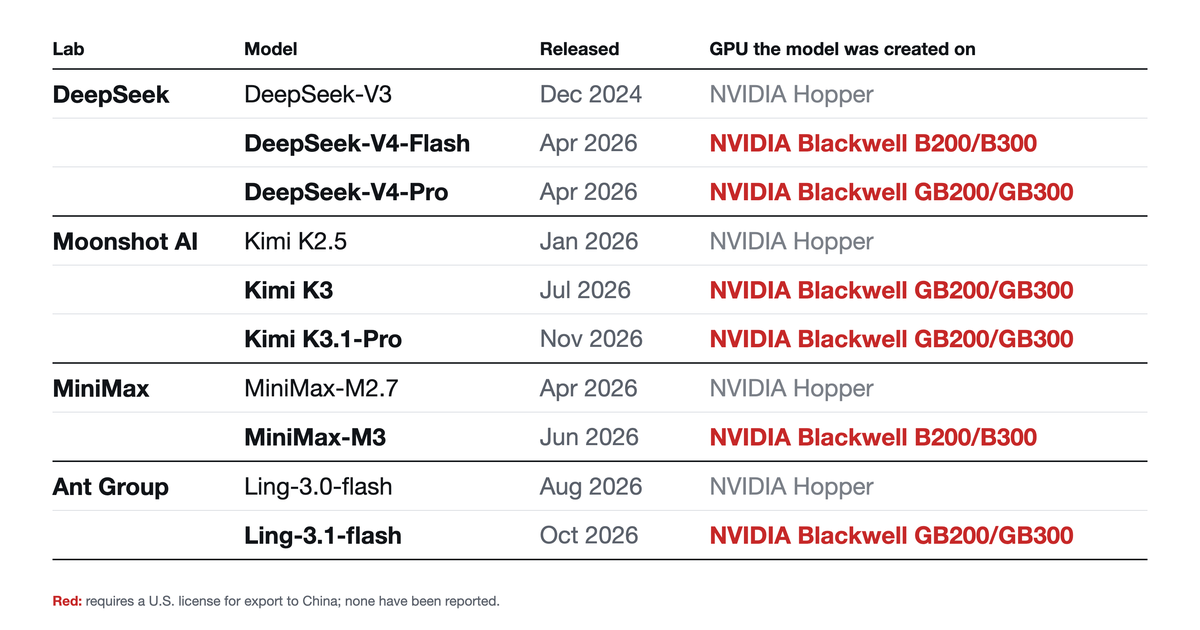
On November 12, former OpenAI researcher Will DePue posted on X and published a report claiming that leftover random-initialization patterns in public weights show six models (DeepSeek-V4-Flash/Pro, Kimi K3/K3.1-Pro, MiniMax-M3 and Ling-3.1-flash) were initialized on NVIDIA Blackwell, while earlier models from the same labs match Hopper. The post drew about 2.05 million views and 20,000 likes. This is an individual research claim, not an official finding, and the report itself says it cannot establish where the chips were, how access was obtained, or whether export controls were violated.
Key Takeaways
- ✓Six models read as Blackwell-initialized (author's claim): DeepSeek-V4-Flash and MiniMax-M3 match B200/B300 (148 SMs); DeepSeek-V4-Pro, Kimi K3, Kimi K3.1-Pro and Ling-3.1-flash match GB200/GB300 (152 SMs)
- ✓Method: PyTorch fills initial weights with Philox random numbers split across threads, and the thread count depends on the GPU's SM count; the author searched about 6 trillion seed-and-layout combinations against public weights
- ✓Statistical strength (author's figures): chance matches top out around 8 sigma, while the strongest evidence for the six models ranges from 49 to 1,385 sigma; on 24 models whose developers disclosed training hardware, the method agreed every time
- ✓Not every Chinese lab: the report says the newest Qwen, GLM, Tencent, Xiaomi and StepFun models still read as Hopper, and Meituan's LongCat-2.0 shows no NVIDIA fingerprint
- ✓Scale estimates are uncertain: the author estimates about 12,000 Blackwell GPUs across five runs (range 7,000-20,000) and says he is not confident in these figures; the claim that senior OpenAI and Anthropic researchers independently verified the work is his own statement
Key Decision Metrics at a Glance
Turn your technical choice into a development budget
Compare 40 dev plans & simulate token costs vs $20/mo subscriptions
Project Links & Resources
Direct AccessIn-Depth Technical Analysis
Core Background and Industry Pain Points
Blackwell is NVIDIA's most advanced data-center GPU, and exporting it to China requires a U.S. license. U.S. officials and press reports had alleged that some Chinese labs were using Blackwell, but without public technical evidence. On November 12, former OpenAI researcher Will DePue published "Top Chinese Frontier AI Models Carry the Fingerprint of Export-Controlled NVIDIA Blackwell GPUs." His X post drew about 2.05 million views, 20,000 likes and nearly 3,000 reposts, making it one of the most discussed AI posts of the past 12 hours.
Architecture Highlights and Underlying Mechanism
The idea: PyTorch generates initial weights with cuRAND's Philox algorithm and splits the work across threads, and the total thread count depends on the GPU's SM count. Hopper (H100/H200/H800) has 132 SMs, B200/B300 has 148 and GB200/GB300 has 152. The same seed puts its random numbers in different positions on different chips. Some vocabulary rows never touched in training keep nearly their initial values, so the seed and chip type can be recovered. The author says a B300 reproduced DeepSeek-V4-Flash's initial weights bit for bit from the recovered seed.
Authoritative Benchmarks and Measured Comparisons
There are no model benchmarks here, only the author's statistics: across about 6 trillion combinations, chance matches reach about 8 sigma, while the six models' strongest evidence ranges from 49 to 1,385 sigma; the method agreed with all 24 models whose developers disclosed training hardware, including NVIDIA's Nemotron-3 Ultra. These are the author's figures, and the companies named have not publicly confirmed them.
Developer Guide and Getting Started
Keep three points in mind. First, the fingerprint shows which class of chip initialized the weights; the author writes that it supports, without proving, that training also ran on Blackwell. Second, the report cannot establish where the chips were, how they were obtained, or whether any rules were broken. Third, the author says he is not confident in his GPU-count and cost estimates. For developers, these open weights remain available as before; the bigger significance is that tracing training hardware from public weights has been done systematically for the first time and may be used for model provenance work.
Benchmark side-by-side against alternatives, or calculate monthly token cost vs subscription break-even.
Discussion & Comments
0Sign in to join the discussion
Connect with AI developers to exchange benchmark insights.