
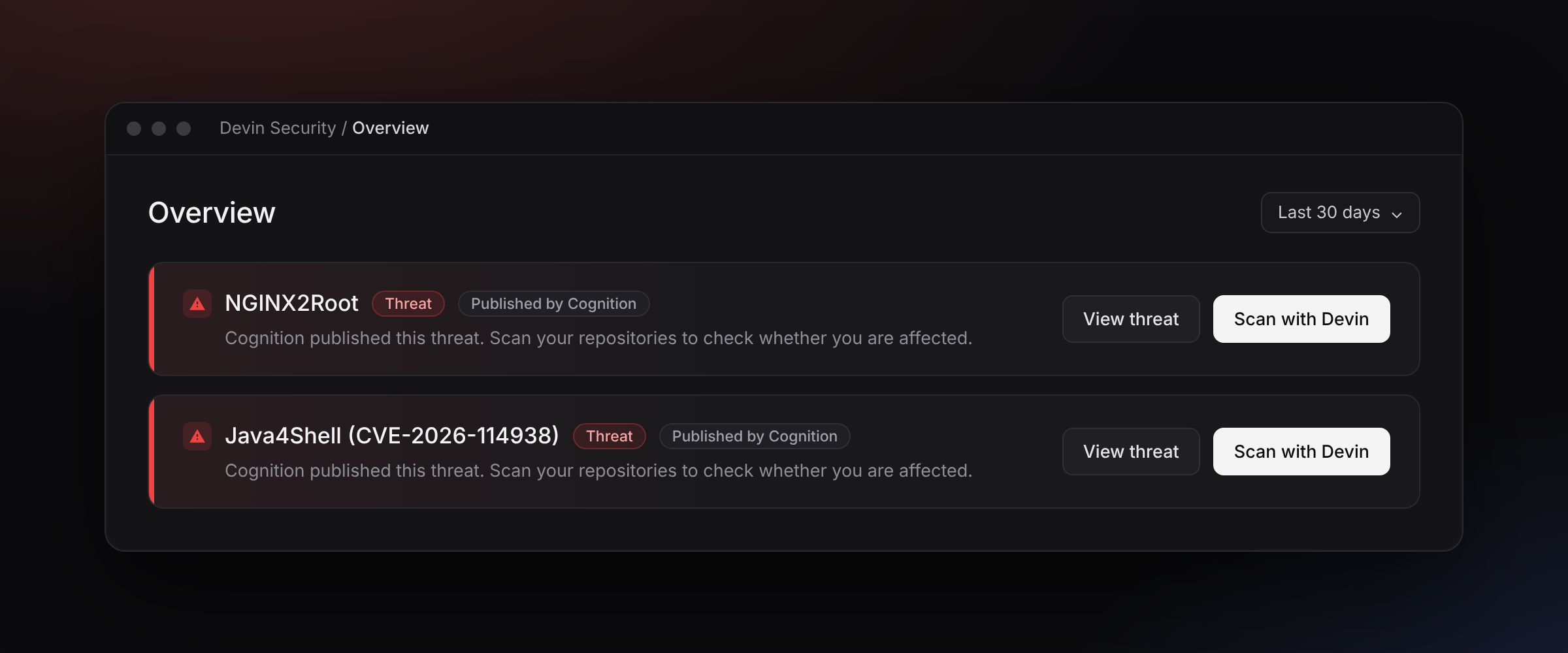
On November 19 Cognition announced Devin Security Threats on X: a managed index of newly disclosed vulnerabilities, wired into Devin so teams can scan their repositories in one click and get fix pull requests. The first threats cover this week's Java4Shell (a Java runtime flaw that can lead to memory disclosure and remote code execution) and NGINX2Root (five memory-corruption bugs in nginx). With Auto-triage on, Devin scans chosen repositories whenever a new threat is published, and teams can also create their own threats.
Key Takeaways
- ✓Official: Cognition blog post (dated November 18) and an @cognition post on November 19
- ✓How it works: each threat describes what is affected, how an attacker would use it and what fixes it; "Scan with Devin" scans selected repositories with the Agentic MapReduce process
- ✓Findings are ranked against the team's threat model and can be assigned to Devin, which opens fix pull requests for review
- ✓Auto-triage scans chosen repositories above a minimum severity for each new threat and can auto-dismiss threats with no findings; teams can add threats from bug bounty reports or vendor notices
- ✓Open-source Markdown skills fix-nginx-vuln and fix-java-vuln ship in the devin-vuln-fixes plugin and can be handed to other coding agents
Key Decision Metrics at a Glance
Turn your technical choice into a development budget
Compare 40 dev plans & simulate token costs vs $20/mo subscriptions
Project Links & Resources
Direct AccessIn-Depth Technical Analysis
Background
AI is speeding up vulnerability discovery, and this week alone two sets of flaws in foundational software were disclosed: Java4Shell on November 17, a Java runtime bug that can lead to memory disclosure and remote code execution, and NGINX2Root on November 18, five memory-corruption bugs in nginx that can also lead to remote code execution. The hard part for security teams is working out quickly which of their repositories are affected and getting fixes in.
How it works
Devin Security Threats is an index maintained by Cognition. Each threat describes what is affected, how an attacker would use it and what fixes it. "Scan with Devin" checks the selected repositories with the same Agentic MapReduce process as any Devin Security scan, ranks findings against the team's own threat model, and lets the team assign them to Devin, which opens pull requests for human review. With Auto-triage on, teams pick repositories and a minimum severity, and Devin scans them for every newly published threat; threats with no findings can be dismissed automatically. Teams can also create their own threats from bug bounty reports, vendor notices or incident reviews.
Benchmarks
Cognition published no detection rate, false-positive rate or fix success rate, and no comparison with other security scanners.
What developers should do
Both threats are live at app.devin.ai/security. To fix through a Devin session instead, install the devin-vuln-fixes plugin from the Devin Marketplace (devin plugins install CognitionAI/devin-marketplace#plugins/devin-vuln-fixes); its fix-nginx-vuln and fix-java-vuln skills are open-source Markdown that also work as checklists or for other coding agents. Teams without Devin should still check their nginx and Java runtime versions now and upgrade per vendor advisories.
Benchmark side-by-side against alternatives, or calculate monthly token cost vs subscription break-even.
Discussion & Comments
0Sign in to join the discussion
Connect with AI developers to exchange benchmark insights.