

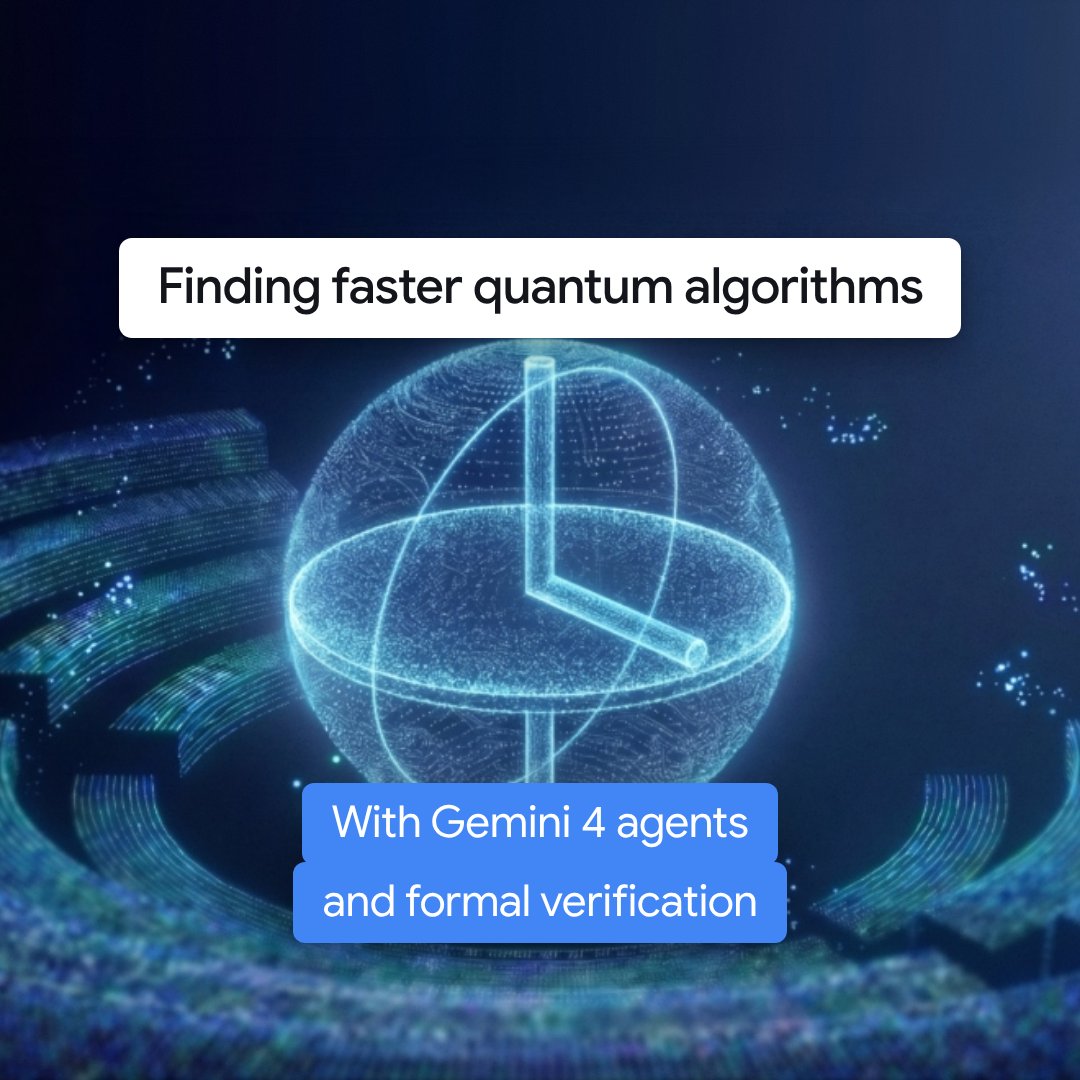
On November 23, Google DeepMind and Google Quantum AI described how independent teams of Gemini 4 agents improved well-known quantum algorithms, with every result checked for correctness and cost in the Lean theorem prover. Highlights: an 11.8x lower computing cost for a circuit used in inertial confinement fusion simulation, with error-corrected qubits cut from 5,650 to 4,338; 8x cheaper simulation of a light-sensitive molecule; a 2.5x gain for Cytochrome P450; a 2.57x speedup for a specific Grover implementation; and a 290x speedup for the arcsin routine. The Lean library, problem specifications and verified solutions are open source on GitHub.
Key Takeaways
- ✓Source: the official Google DeepMind blog and @GoogleDeepMind post (November 23, 2026); the paper is arXiv 2611.09822, a collaboration between Google DeepMind and Google Quantum AI
- ✓Method: separate Gemini 4 agent teams searched for algorithmic improvements, each idea was verified in Lean before entering a shared notebook, and teams met every four hours at a virtual conference to trade and debate ideas
- ✓Fusion: the computing cost (a metric combining qubits and operations) of a circuit for inertial confinement fusion dropped 11.8x, and error-corrected qubits fell from 5,650 to 4,338
- ✓Chemistry and core routines: 8x cheaper simulation of a light-sensitive molecule, a 2.5x gain for Cytochrome P450 with qubits cut from 481 to 333, a 2.57x speedup for a specific Grover implementation and 290x for arcsin
- ✓Caveat: DeepMind says these simulations still need more resources than the first error-corrected quantum computers are likely to offer; the Lean library, problem specs and verified solutions are open source
Key Decision Metrics at a Glance
Turn your technical choice into a development budget
Compare 40 dev plans & simulate token costs vs $20/mo subscriptions
Project Links & Resources
Direct AccessIn-Depth Technical Analysis
Background
Quantum computers could one day solve problems beyond classical supercomputers, but even the best quantum algorithms still need more resources than early hardware will offer for many important applications. Worse, these large circuits cannot be tested on classical computers or today's small quantum processors, so they have to be proven correct mathematically. On November 23, the Google DeepMind blog and @GoogleDeepMind shared results from using agents plus formal verification to improve quantum algorithms.
How it works
The team built a quantum program library in the Lean theorem prover. Independent teams of Gemini 4 agents synthesized new programs against formal problem specifications, and Lean verified their correctness and cost before ideas entered a shared notebook. Every four hours, agents from each team met at a virtual conference to trade and debate ideas, and costs kept falling over time. Researchers chose the problems and supervised progress.
Results
Per the official blog: an 11.8x lower computing cost for an inertial confinement fusion circuit, with error-corrected qubits cut from 5,650 to 4,338; 8x cheaper simulation of a light-sensitive molecule; a 2.5x gain for Cytochrome P450 with qubits down from 481 to 333; a 2.57x speedup for a specific Grover implementation; and 290x for the arcsin routine. These are resource estimates against published baselines, not runs on real hardware.
What it means for developers
The Lean library, problem specifications and verified solutions are open source on GitHub, and the paper is arXiv 2611.09822. For developers working on AI for science or formal verification, it is a full reference for a multi-agent workflow where a proof assistant acts as the gatekeeper.
Benchmark side-by-side against alternatives, or calculate monthly token cost vs subscription break-even.
Discussion & Comments
Sign in to join the discussion
Connect with AI developers to exchange benchmark insights.