
AI Coding Live News

Inworld Inference opens to all developers: an open-model inference API built for consumer AI, with Gemma 4 26B p95 first token 7.8x faster than the median OpenRouter provider

On 2026-10-14 Inworld AI opened Inworld Inference to every developer, positioning it as an inference service for consumer apps (companions, tutors, voice, interactive fiction). Instead of listing thousands of models it builds a per-model serving stack for open models such as Gemma 4, GLM 5.3 Flash, DeepSeek and MiMo: draft-and-verify (speculative) decoding, a rewritten split-KV verify attention kernel, KV-aware routing and eval-gated low precision. Vendor-reported: Gemma 4 26B p95 first token of 0.31 s, 7.8x faster than the median OpenRouter provider; up to 90% of prompts from cache; 99.999% success over 20M+ GLM 5.3 Flash requests in 30 days. The API is OpenAI-compatible with Flex/Default/Priority/Fast tiers per request.
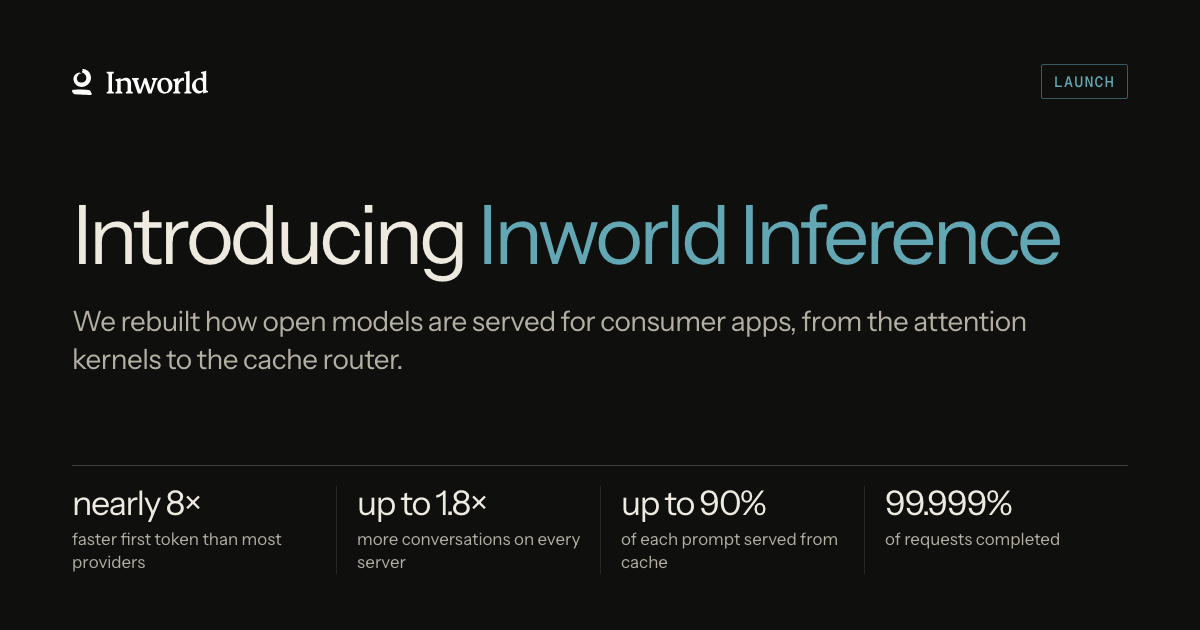
Inworld Inference opens to all developers: an open-model inference API built for consumer AI, with Gemma 4 26B p95 first token 7.8x faster than the median OpenRouter provider

Key Takeaways

  • Gemma 4 26B first token: p50 0.17 s / p95 0.31 s, 3.6x / 7.8x faster than the median OpenRouter provider (blog, vendor-reported snapshot, not a matched workload)
  • Pricing: Gemma 4 26B at $0.07 input, $0.035 cached, $0.34 output per 1M tokens, nearly 40% below the median no-training provider
  • Rewritten verify attention: 3.4–7.5x faster per layer, attention share of a decode step 27.5%→16.5%, p50 TTFT 154→117 ms at equal eval scores
  • KV-aware routing: GLM 5.3 Flash cache hits 25%→47%, DeepSeek V4.1 Flash 11%→33%; cached MiMo 2.6 Pro input costs 99% less
  • Reliability: 98 failures across 20M+ GLM 5.3 Flash requests in 30 days (~4.8 per million); per-request service_tier of Flex/Default/Priority/Fast
Read full story

Vercel AI SDK: [email protected]–7.0.126 speech telemetry + tool-approval clear; @ai-sdk/openai ultrafast service tier

Vercel shipped [email protected] (speech/transcription telemetry) through [email protected] (clear tool approvals on addToolOutput) on 2026-09-30—22 commits since covered [email protected]. Same day @ai-sdk/[email protected] adds OpenAI serviceTier: 'ultrafast' (docs: access-controlled, gpt-5.6-sol), plus Azure MAI speech/transcribe and MCP OAuth conditional invalidation patches in the tree.

Vercel AI SDK: ai@7.0.124–7.0.126 speech telemetry + tool-approval clear; @ai-sdk/openai ultrafast service tier

Key Takeaways

Read full story

Vercel AI SDK [email protected]: idle SSE heartbeats; prune tool content when retaining zero messages; user messages supersede pending tool approvals

Vercel shipped [email protected] on 2026-09-30 (compare): optional SSE heartbeats keep idle UI message streams open; prune all tool content when retaining zero trailing messages; ignore pending tool approvals superseded by user messages; preserve partial reasoning tags at streamed text ends. Build migrates tsup→tsdown with gateway/provider/utils bumps.

Vercel AI SDK ai@7.0.123: idle SSE heartbeats; prune tool content when retaining zero messages; user messages supersede pending tool approvals

Key Takeaways

Read full story

Vercel AI SDK: `@ai-sdk/openai` 3.0.121 / 2.0.132 add native GPT-6.1 Sol support

Vercel AI SDK shipped @ai-sdk/[email protected] and @ai-sdk/[email protected] on 2026-09-30, adding native GPT-6.1 Sol (gpt-6.1-sol) support on the v5/v6 provider lines (#21747, backport #21749). Official pricing: $2/$10 per 1M tokens (cached input $0.10), 1.05M context, 128k max output.

Vercel AI SDK: `@ai-sdk/openai` 3.0.121 / 2.0.132 add native GPT-6.1 Sol support

Key Takeaways

  • Shipped @ai-sdk/[email protected] and @2.0.132 with GPT-6.1 Sol (#21747 / #21749)
  • Model id gpt-6.1-sol; specs $2/$10 per 1M, cached input $0.10, 1.05M context, 128k max out
  • Mid-tier coding/computer-use path vs Astra; aligns with Codex defaulting to Sol
  • Upgrade: npm i @ai-sdk/[email protected] (or 2.0.132 on v5 line)
  • Docs: OpenAI provider
Read full story
ADSponsored

Vercel AI SDK @ai-sdk/openai 4.0.78: GPT-6 Sol/Luna allow reasoningEffortUpdate 'none'

Vercel AI SDK shipped @ai-sdk/[email protected] on 2026-09-26: request-level and positioned system-message reasoningEffortUpdate now accept 'none' so GPT-6 Sol/Luna conversations can turn reasoning off mid-thread. Updates are validated against each model’s supported efforts—unsupported request-level updates warn and omit; unsupported historical/message-level updates reject. Companion @ai-sdk/[email protected] and @ai-sdk/[email protected] pick up the dependency.

Vercel AI SDK @ai-sdk/openai 4.0.78: GPT-6 Sol/Luna allow reasoningEffortUpdate 'none'

Key Takeaways

  • Shipped: @ai-sdk/[email protected] / npm 4.0.78
  • Feature: reasoningEffortUpdate 'none' for GPT-6 Sol/Luna (#21518)
  • Validation: warn+omit unsupported request-level; reject unsupported historical updates
  • Companions: Azure 4.0.82, Bedrock 5.0.97; see OpenAI provider docs
  • Install: npm i @ai-sdk/[email protected]
Read full story

@ai-sdk/perplexity 5.0.0: breaking migrate from Sonar Chat Completions to Perplexity Agent API

Vercel AI SDK shipped @ai-sdk/[email protected] (2026-09-26), a breaking migration from Sonar Chat Completions to Perplexity Agent API. Replace Sonar model IDs and provider options with Agent API presets, models, and tools; request/response metadata, raw stream events, and usage/cost shapes change; Sonar PDF input and image/video results are unsupported. Follow-up fixes recover terminal text, accept native tool traces (e.g. finance), and dedupe URL citation sources while preserving search-result IDs.

@ai-sdk/perplexity 5.0.0: breaking migrate from Sonar Chat Completions to Perplexity Agent API

Key Takeaways

  • Shipped: @ai-sdk/[email protected] on GitHub Releases / npm 5.0.0
  • Breaking: language generation moves to Perplexity Agent API; rewrite Sonar model IDs and provider options to presets/models/tools
  • Dropped: Sonar PDF input and image/video results; usage/cost and raw stream metadata shapes change
  • Streaming: recover missing text from terminal events/output items (incl. incomplete) without duplicating deltas
  • Citations: emit each source URL once while keeping search-result IDs; accept native Agent API tool traces (e.g. finance) without web-search validation
Read full story
Linked Models & Agents:

Open Managed Agents open-sources a self-hosted managed-agent platform for Node, Docker, or Cloudflare

@DanKornas highlighted Open Managed Agents (github.com/openma-ai/open-managed-agents), an Apache-2.0 self-hosted platform for builders who want managed-agent workflows without vendor lock-in: durable sessions, sandboxed tools, memory, encrypted credentials, and crash recovery on Node+Docker or Cloudflare Workers, with Claude Managed Agents API and OpenAI SDK paths via /openai/v1.

Key Takeaways

  • Self-host managed-agent workflows with durable sessions, memory, and crash recovery.
  • Supports sandboxed tools, private tools, and MCP; bring your own model keys.
  • Runs on Node/Docker or Cloudflare Workers; Claude Managed Agents API and OpenAI SDK compatible.
Read full story

Google AI Studio and Speakeasy open-source the SDK generator behind GenAI Interactions, Agents, and Webhooks clients

Google AI Studio announced a partnership with Speakeasy to open-source the OpenAPI client-generation suite used for the Google GenAI SDKs. The tooling covers the Interactions, Agents, and Webhooks APIs and is designed to generate maintainable multi-language clients, CLIs, and agent tools as APIs evolve.

Key Takeaways

  • The open-source suite comes from the production migration and shipping workflow for Google GenAI SDKs.
  • It targets the Interactions, Agents, and Webhooks APIs and can generate clients, CLIs, and agent tools across languages.
  • Open tooling reduces supply-chain risk from relying on a proprietary SDK generator that can shut down.
Read full story

TypeSafe Jev now live on Vercel AI Gateway as a probabilistic decision model

TypeSafe AI said Jev is now available on Vercel AI Gateway. Jev is a probabilistic decision model for software: state goes in, declared questions are evaluated in parallel, and typed Choice, Score, and Boolean answers come back with probabilities—skipping generate-then-parse. TypeSafe reports up to 193.6× faster and 444.6× cheaper than LLMs on its workflow evaluations. Use cases include choosing the next tool or subagent, continue/retry/ask/stop, urgency/risk scoring, and output guardrails. AI SDK 7 (7.0.105+) exposes it via experimental evaluate with model typesafe-ai/jev; Zero Data Retention and No Training can be enabled per request, and calls appear in Gateway logs and budgets.

Key Takeaways

  • Jev is live on Vercel AI Gateway: parallel typed Choice/Score/Boolean answers with probabilities
  • TypeSafe reports up to 193.6× faster and 444.6× cheaper than LLMs on workflow evals
  • AI SDK 7 evaluate API uses typesafe-ai/jev; per-request ZDR/No Training; counts toward Gateway budgets
Read full story
Linked Models & Agents: