AI Coding Live News

X discussion: FT chief data reporter John Burn-Murdoch says the US productivity jump "doesn't look like AI" and is mostly tech layoffs, while Gavin Baker argues it shows "ROI on AI"

On November 1, John Burn-Murdoch, a Financial Times columnist and chief data reporter, posted a long X thread with his FT piece arguing that the productivity rise in AI-adopting US sectors began in 2020, before AI agents existed, shows up only in the US, and comes mainly from tech layoffs and hiring pullbacks rather than AI. The thread opener has about 1,344 likes, 306 reposts and 186K views. Gavin Baker, managing partner and CIO of Atreides Management, quoted the FT charts and said it is hard not to see some evidence of "ROI on AI," citing a16z and EPB Research data; his post has about 793 likes and 102K views. Burn-Murdoch replied that he is "slightly on the fence" and that the data cannot rule out a role for AI. These are two readings of the same data, not a settled finding.

X discussion: FT chief data reporter John Burn-Murdoch says the US productivity jump "doesn't look like AI" and is mostly tech layoffs, while Gavin Baker argues it shows "ROI on AI"

Key Takeaways

  • Opener: John Burn-Murdoch's thread, posted 2026-11-01 15:04 UTC, with about 1,344 likes, 306 reposts and 186K views; his X bio says he is an FT columnist and chief data reporter
  • His core argument: the productivity rise in AI-adopting US sectors started in 2020, and even a 2022 re-acceleration is "too early to be AI. Back then it was chatbots, not agents"; other rich countries use AI just as widely but show no similar jump
  • Splitting productivity into output and headcount, he argues the US acceleration since 2022 is mainly a tech layoffs story: output stayed on trend while employment fell
  • Counterpoint: Gavin Baker's reply, with about 793 likes and 102K views; citing EPB Research, he says the 3 industries that adopted AI most went from 2.2% to 5% productivity growth, and that the US is 72% of Anthropic revenue (figures he cites from third parties; AICoder has not verified them)
  • Replying to Baker, Burn-Murdoch said he is "slightly on the fence": the "this looks like AI" case is overstated, but the data cannot rule out a role for AI either

Read full story
Linked Models & Agents:

NVIDIA says AI agents now steer the SETI Allen Telescope Array, calibrating it and analyzing up to 2.4 Tbps of live radio data from plain-language requests

An Oct 30 NVIDIA blog post says Breakthrough Listen and the SETI Institute have brought agents into daily SETI work at the Allen Telescope Array (ATA, 42 dishes of 6 m each) in Northern California: from a single natural-language request, agents can steer the antennas, calibrate and focus, fix data errors, and run AI models on the live stream. Holoscan's DAQIRI library pulls sensor data straight into GPU memory, the SETI Institute's CyberEther handles signal processing, and the web-based orchestrator Nexus acts as the agent harness, handling up to 2.4 Tbps on premises on RTX PRO 6000 Blackwell GPUs. The pipeline has made the first real-time AI detection of a pulsar in the Crab Nebula, and the team is evaluating open models such as Nemotron. The @NVIDIAAI Halloween post on Oct 31 drew about 274 likes.

NVIDIA says AI agents now steer the SETI Allen Telescope Array, calibrating it and analyzing up to 2.4 Tbps of live radio data from plain-language requests

Key Takeaways

  • Throughput: up to 2.4 Tbps of radio data on NVIDIA RTX PRO 6000 Blackwell GPUs, with inference running on premises next to the instrument (NVIDIA blog, vendor-reported)
  • Three layers: DAQIRI moves sensor data straight into GPU memory, CyberEther does the signal math with cuFFT and cuBLAS, and Nexus serves as the agent harness for instrument state, compute, and pipelines
  • Capability: one plain-language request can steer the ATA's 42 six-meter dishes, calibrate and focus, fix data errors, and plot results; NVIDIA says this compresses weeks or years of human work into hours
  • Milestone: the first real-time AI detection of a pulsar in the Crab Nebula; no false-positive rates or other metrics were published, and no extraterrestrial signal has been found
  • Next: evaluating open models such as Nemotron for observatories where data locality matters, possibly one day running offline on the far side of the Moon
Read full story

OpenAI Agents API ships Auto Review, async compaction, experimental time awareness and mid-session tool updates

The OpenAI Developers account shared a post by Steve (@stevendcoffey), who works on the API at OpenAI, listing five Agents API updates this week: Codex-style Auto Review of commands before execution, compaction that runs in the background, an experimental time-awareness feature, updating a session's tools at any time, and automatic caching of system prompts across all sessions. As of writing, the official API changelog does not list these items yet.

Key Takeaways

  • Five updates: Auto Review, async compaction, time awareness (experimental), updating session tools at any time, and automatic cross-session system prompt caching
  • Auto Review mirrors the Codex mechanism and evaluates commands for potential bad behavior before they run
  • Time awareness lets the model act on time-boxed instructions such as "timebox CI fixes to 10 minutes"
  • The Agents API entered public beta on September 10, and this is another round of features within 7 weeks (after computer use on Sep 29, sandbox prewarming on Oct 9 and Ultrafast mode on Oct 16)
  • OpenAI has published no latency or cost-saving numbers, and the changelog has not listed these items yet
Read full story

X discussion: Box CEO Aaron Levie says under 1% of enterprise workflows really use AI agents, echoing Sarah Guo's "early Claude Code era" take

Conviction founder Sarah Guo posted on Oct 27 that enterprise workflow automation is "in the autocomplete / early claude code era", "but not for long", drawing about 80K views and nearly 500 likes. Box CEO Aaron Levie quoted it the next day and argued that most enterprise workflows have not had agents applied in any meaningful way, putting deployment at probably under 1%, mainly because of AI capability itself; he says computer use, long-running agents and agent swarms are changing that. His post has about 635 likes, 486 bookmarks, 63K views and 150+ replies. These are opinions and rough estimates, not measured statistics.

Key Takeaways

  • Sarah Guo (Conviction founder): enterprise workflow automation is still in the "autocomplete / early claude code era", but not for long
  • Aaron Levie (Box CEO): most enterprise workflows have not had agents applied meaningfully, and deployment across the economy is "probably < 1%", which is his estimate
  • Levie says the main bottleneck is AI capability itself, with enterprise adoption speed a smaller factor
  • He points to computer use, long-running agents, harness improvements and agent swarms as what now makes more complex workflows workable for agents
  • His view: the shift is less about users prompting agents and more about organizations re-engineering workflows, with the biggest impact in finance, life sciences, healthcare and other information-heavy fields
Read full story
ADSponsored

Anthropic study: 50 professional data analysts working with Claude Code followed the agent's secretly assigned lean on 86% of key judgment calls

On Oct 27 Anthropic's Alignment team published a randomized controlled trial, "How AI agents shape experts' judgment calls", shared on X by researcher Alex Tamkin. Fifty analysts experienced in causal inference used Claude Code (Claude Opus 4.8) to evaluate a program for a fictional farming cooperative, and on each analytical decision the agent's lean was set by coin flip without the analyst being told. Their choices matched the agent's lean 86% of the time (about 50% would mean no effect), and 77% later repeated the agent's arguments while only 15% credited the agent.

Anthropic study: 50 professional data analysts working with Claude Code followed the agent's secretly assigned lean on 86% of key judgment calls

Key Takeaways

  • Agreement with the agent's lean was 92%, 82%, 81% and 90% on the four analytical decisions, 86% overall; the final rollout recommendation shifted too (54% recommended rollout when the agent leaned that way vs 36% when it leaned against)
  • In 38 cases where analysts stated a preference first, they switched 60% of the time when the agent disagreed vs 6% when it agreed (small sample; 95% CI 24 to 82 percentage points)
  • The four coin-flip leans alone let a statistical model predict 82% of final recommendations (61% baseline); none of 10 traits such as experience, education or trust in AI reliably predicted who deferred
  • 52% of analysts called the final recommendation more their own than the agent's, and their confidence was about the same as everyone else's (71 vs 73)
  • 6 of 11 analysts who skipped the agent made serious methodological errors vs 3 of 50 who used it, though the groups differed in experience; the study covers one task and one model, with the agent's lean deliberately strengthened
Read full story

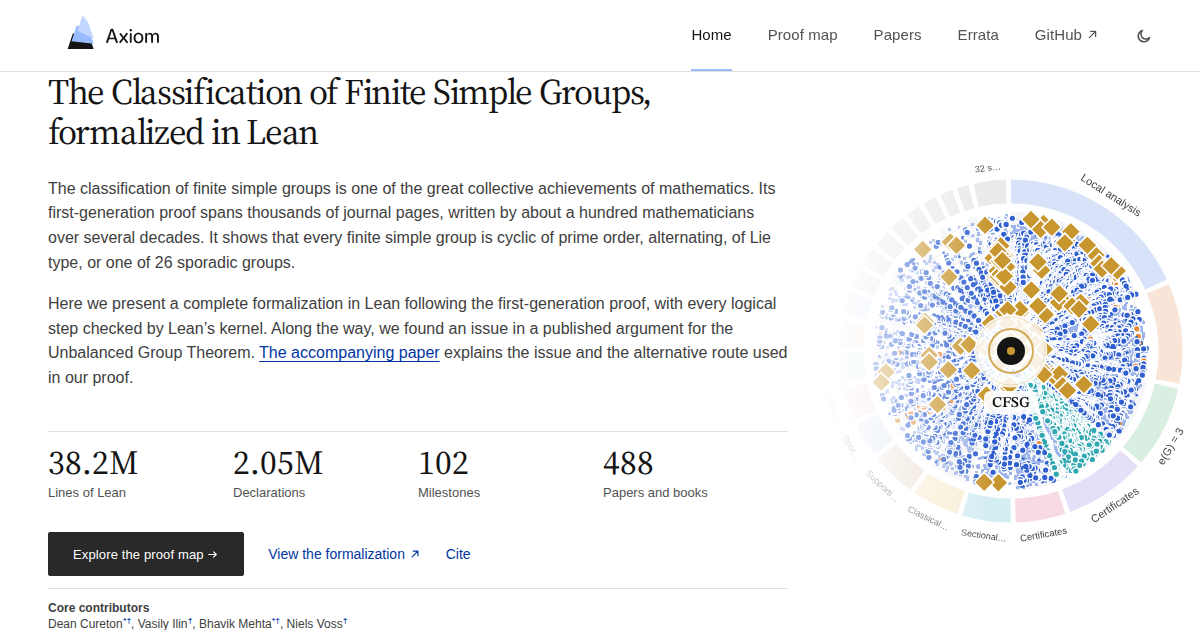
Axiom uses AI agent swarms to fully formalize the Classification of Finite Simple Groups in Lean in 24 days: about 43.1M lines, the first complete computer-checked proof of the longest proof in math history

AI math company Axiom announced on Oct 27 that swarms of dozens of AI agents formalized the Classification of Finite Simple Groups (CFSG; the original proof runs about 15,000 pages across 500+ articles by about 100 mathematicians) in the Lean proof assistant in 24 days, producing about 43.1M lines of Lean and 2.05M declarations, with the repo public on GitHub. The work surfaced 34 noteworthy deviations from the published record, and AxiomProver produced a new alternative argument for the Unbalanced Group Theorem.

Axiom uses AI agent swarms to fully formalize the Classification of Finite Simple Groups in Lean in 24 days: about 43.1M lines, the first complete computer-checked proof of the longest proof in math history

Key Takeaways

  • Per Axiom: 24 days and swarms of dozens of AI agents produced about 43.1M lines of Lean, 2.05M declarations and 100 milestones, drawing on 715 papers and books
  • The original CFSG proof spans about 15,000 pages in 500+ articles by about 100 mathematicians; this is the first time it has been fully computer-checked
  • Formalizing it exposed 34 noteworthy deviations from the literature, the biggest a closure assertion in Walter's 1986 Unbalanced Group Theorem argument, with explicit counterexamples such as PSL2(49)
  • AxiomProver produced an alternative argument built on Solomon's 1976 theory and proved a new theorem, "Preservation of simple tops", published on Hexagon (2610.00575)
  • Humans stayed essential: original CFSG group theorists including Richard Lyons and Ronald Solomon were consulted, and an errata list will be published with an advisory board
Read full story
Linked Models & Agents:
⚡ AxiomProver🌐 Axiom

Apple Creator Studio adds AI assistants built on Apple models and OpenAI to Logic Pro, Keynote, Pages and Numbers, plus MCP support so external agents can edit iWork documents

On October 27 Apple announced a major Apple Creator Studio update: Logic Pro for Mac plus Keynote, Pages and Numbers gain beta intelligent assistants that Apple says are powered by a combination of Apple-built models and OpenAI and understand document context. Keynote, Pages and Numbers also add Model Context Protocol (MCP) support, letting external AI agents read content, make edits and run automated actions inside the apps. Pixelmator Pro adds natural-language Generate Fill, and Keynote introduces the open JSON-based .keyx format. The update ships free to existing subscribers on the App Store in November; pricing stays $12.99 per month or $129 per year.

Apple Creator Studio adds AI assistants built on Apple models and OpenAI to Logic Pro, Keynote, Pages and Numbers, plus MCP support so external agents can edit iWork documents

Key Takeaways

  • Logic Pro for Mac, Keynote, Pages and Numbers gain beta assistants that Apple says run on a combination of Apple-built models and OpenAI
  • Keynote, Pages and Numbers support MCP so external AI agents can read content, edit and automate actions (requires macOS 27 or later)
  • Keynote adds the open JSON-based Keynote Interchange Format (.keyx), designed to be readable by external tools and AI agents
  • Assistants are U.S. English only and need an Apple Intelligence-capable device on iOS, iPadOS or macOS 27; free update for subscribers in November
  • Pricing unchanged at $12.99 per month or $129 per year, $2.99 per month for education
Read full story

X discussion: Zerodha CEO Nithin Kamath asks what traders are building with free Kite APIs and AI coding agents

On Oct 26, Zerodha founder and CEO Nithin Kamath asked on X how people are using Kite APIs with AI agents now that they are free, and what they have built. He said AI coding agents such as Claude Code and Codex have made it much easier for traders and investors to build their own tools without much coding experience, and that Zerodha is seeing more Kite API usage because of these agents. Within about 10 hours the post drew more than 2,200 likes, over 2,000 bookmarks and 200+ replies. This is an X discussion and the CEO's own view, not a new product launch.

X discussion: Zerodha CEO Nithin Kamath asks what traders are building with free Kite APIs and AI coding agents

Key Takeaways

  • Engagement (as of 2026-10-26 21:08 UTC, public X API metrics): about 183K views, 2,256 likes, 2,039 bookmarks, 219 replies and 113 reposts
  • Source of the view: an original post by Zerodha founder and CEO Nithin Kamath (@Nithin0dha), who says coding agents are driving more Kite API usage; Zerodha has not published how much
  • Pricing (per the official Zerodha API page): the Personal tier is free with orders, GTT, alerts, margin computation and portfolio management; the Connect tier costs ₹500/month and adds realtime WebSocket streaming and historical candles
  • Official SDKs cover 8 languages (Python, Java, Node.js, C#/.NET, Go, Rust, PHP and C++), so coding agents can generate client code directly
  • The debate: AI coding agents make it common for non-programmers to build their own trading tools, which also puts risk control and automated order placement in individual hands
Read full story

Oracle unveils the Fusion Claw runtime with 25 agentic apps at AI World, and Fusion Companion lets employees run ERP and HCM work from ChatGPT

At Oracle AI World in Las Vegas on Oct 26, Oracle announced Oracle Fusion Claw, a new execution runtime for agents, and 25 Claw-powered Agentic Applications now available across ERP, HCM, supply chain (SCM) and customer experience (CX). It also introduced Fusion Companion and Fusion Agentic Home: employees describe a goal in natural language in supported AI tools such as ChatGPT or in the native Fusion interface, and the system picks and coordinates the transactions, workflows, approvals and AI agents needed, within existing identity, permission and approval controls. Oracle has not published pricing, benchmarks or a detailed rollout schedule.

Oracle unveils the Fusion Claw runtime with 25 agentic apps at AI World, and Fusion Companion lets employees run ERP and HCM work from ChatGPT

Key Takeaways

  • Runtime: Fusion Claw is a new agent execution runtime that Oracle says supports larger-scale and longer-running work, continuous replanning, deterministic execution and governed autonomy (press release)
  • Scale: 25 Claw-powered Agentic Applications are available now across the ERP, HCM, SCM and CX suites, including Ledger, Workforce Orchestration, Payroll Activity Workspace and Procurement Spend
  • Access: Fusion Companion works through supported AI tools such as ChatGPT and customer- or partner-built interfaces, with Fusion Agentic Home as the native entry point (Fusion Companion release)
  • Governance: all execution stays within existing identity, permissions, policies and approval controls, and decisions needing human judgment are escalated
  • Not disclosed: Oracle has not published pricing, benchmarks or a per-app rollout schedule
Read full story

X discussion: Thorsten Ball's "How I work with Agents" lists 15 habits for coding with AI agents and draws nearly 4K bookmarks

At 15:58 UTC on 2026-10-25, developer Thorsten Ball (@thorstenball) published an X article, "How I work with Agents" (post), summarizing how he works with coding agents "as of October 2026": use only the latest and strongest models, prompt for what you want rather than how to do it, make the whole development lifecycle from deploys to production logs visible to the agent, ask agents for "irrefutable proof", and review only code with a high blast radius. When we pulled it, the post had about 1,935 likes, 143 reposts, 92 replies, 3,981 bookmarks and 137K views, and it reached X's trending stories. This is a personal account of practice presented as opinion, not a verified conclusion.

X discussion: Thorsten Ball's "How I work with Agents" lists 15 habits for coding with AI agents and draws nearly 4K bookmarks

Key Takeaways

  • Main post: post, published 15:58 UTC on 10-25, with about 1,935 likes, 143 reposts, 92 replies, 3,981 bookmarks and 137K views when we pulled it; bookmarks are about twice the likes, suggesting many readers saved it as a checklist
  • Models: the author says to use only the latest and strongest models, because when a model is wrong 10% of the time you do not know which 10%, so you end up retrying
  • Prompting: describe the outcome, for example "Make the bytecode compiler and VM AS FAST AS YOU CAN. Do not stop until it's 2x faster."
  • Verification and review: ask agents for end-to-end walkthroughs, demo videos and before/after numbers as proof; the author personally reviews only high-blast-radius changes such as fewer than 5 central files and database migrations
  • Workflow: do not wait for agents, let them wait on you; the author calls schedules, wake-ups and heartbeats a "killer feature" and says context compaction works well enough that manual token management is wasted effort
Read full story
Linked Models & Agents:
ADSponsored

Walmart opens up to AI shopping agents: an MCP-based Agent Gateway enters developer beta, and Agent Profiles with spending limits such as $50, $100 or $200 arrive next month

On October 21 Walmart announced Agent Profiles, the Walmart Agent Gateway and terms for AI agents. The Gateway lets agents search and buy across Walmart and Sam's Club over MCP, starting with a beta for companies and developers. Agent Profiles, due next month, let shoppers authorize each agent separately, see its orders apart from their own, set a spending limit or approve every purchase, and revoke access at any time. Agents never receive payment-card data and are blocked if they break the terms. TechCrunch reports Amazon is moving the other way and blocking third-party shopping agents.

Walmart opens up to AI shopping agents: an MCP-based Agent Gateway enters developer beta, and Agent Profiles with spending limits such as $50, $100 or $200 arrive next month

Key Takeaways

  • Access: the Walmart Agent Gateway uses MCP (Model Context Protocol), opening first as a beta for companies and developers, instead of agents clicking through the website in a browser
  • Agent Profiles arrive next month: one profile per agent, orders listed separately, spending limits such as $50, $100 or $200 (Walmart's examples) or approval for every purchase
  • Terms: purchases need customer approval by default, agents never get payment-card data or change payment methods, see only the data the task needs, and are blocked if they break the rules
  • Pricing (vendor statement): agents see the same prices a person sees on Walmart.com; per Reuters no Walmart+ membership is required
  • Walmart already integrates with Muse, ChatGPT, Gemini and others for conversational shopping; TechCrunch reports Amazon is blocking third-party shopping agents
Read full story

NVIDIA launches OpenShell Reference Architecture at GTC Berlin: Vera Rubin, Vera CPUs and BlueField-4 Sentry for hardware-enforced safe AI agents

At GTC Berlin on Oct 21, NVIDIA announced the OpenShell Reference Architecture: building on the open-source OpenShell secure runtime, it pairs Vera Rubin for inference, Vera CPUs for agent harnesses, and BlueField-4 DPUs running NVIDIA Sentry for in-silicon policy enforcement, so enterprises can build, contain, observe and govern agents on-prem and at the edge. NVIDIA says it is available now; partners named include Anthropic, OpenAI, Meta, Microsoft and ServiceNow. The software is Apache 2.0.

NVIDIA launches OpenShell Reference Architecture at GTC Berlin: Vera Rubin, Vera CPUs and BlueField-4 Sentry for hardware-enforced safe AI agents

Key Takeaways

  • Full stack: Vera Rubin for model inference, Vera CPUs for agent harnesses/tool use, BlueField-4 + Sentry for in-silicon policy and quarantine (vendor claims)
  • Vendor claims: Vera Rubin NVL72 about 30x throughput per megawatt on agentic workloads; Sentry can quarantine a boundary-breaking agent in milliseconds and boost agent capacity by up to 20%
  • Runtime: deny-by-default, enforcement outside the agent process; sandboxes have no direct network, syscalls are filtered in-kernel, credentials are injected only onto allowed requests
  • Stated agent paths include Claude Code, Codex, GitHub Copilot CLI, OpenCode, OpenClaw, LangChain Deep Agents; deploy with Docker, Podman or Kubernetes via Helm
  • Start: curl install script then openshell sandbox create; docs at docs.nvidia.com/openshell; GitHub NVIDIA/OpenShell (Apache 2.0) and PyPI package openshell
Read full story

humans& releases its first model, Ampersand v0.1: a group-collaboration model trained from GLM 5.3, now open via its Agents API

On Oct 20, AI startup humans& released its first model, Ampersand v0.1, pitched as a collaborator that helps groups reach individual and shared goals rather than an assistant that completes tasks alone. It is trained from Z.ai's GLM 5.3 (about 744B total, about 40B active parameters) with long-horizon multi-party RL against simulated users played by humans&'s own user model, Persimmon. It is available now, with no waitlist, through an API compatible with OpenAI's Agents API.

humans& releases its first model, Ampersand v0.1: a group-collaboration model trained from GLM 5.3, now open via its Agents API

Key Takeaways

  • Base: GLM 5.3 MoE with about 744B total and about 40B active parameters and a 1,048,576-token context (official model card)
  • Long-term collaboration simulation (vendor figures): 12.94 for Ampersand versus 9.89 for base GLM 5.3
  • Collaborative Intelligence teamwork 59.1% (GLM 5.3: 54.3%); CooperBench cooperative success 39.0% versus 17.3% for GLM 5.3
  • Trade-off: SWE-bench Pro v2 (Hard-51) 82.4%, slightly below the base model's 84.3%; humans& also admits it sometimes over-coaches
  • Access: model ID ampersand-v0.1, usable with the official OpenAI SDK pointed at the humans& base URL
Read full story
Linked Models & Agents:

Kuaishou’s Kling 4.0 goes fully available: native 30-second clips, 15-asset Omni Reference, 10 keyframes, and MCP/CLI access for agents

Kling AI made Kling 4.0 fully available on Oct 15, confirmed by a Kuaishou press release on Oct 16. It natively generates up to 30 seconds per pass; Omni Reference combines up to 15 assets (≤10 images, 5 videos, 7 subjects) with up to 10 keyframes, 8,000-token prompts and 21:9 output. Kling 4.0 is also wired into Kling MCP and CLI so AI agents can call it. 10-bit HDR at 4K/1080p and enterprise/developer API access are marked "coming soon". No quantitative benchmarks were published.

Kuaishou’s Kling 4.0 goes fully available: native 30-second clips, 15-asset Omni Reference, 10 keyframes, and MCP/CLI access for agents

Key Takeaways

  • Native 3–30 s generation per pass; video extension up to 2 minutes is marked coming soon
  • Omni Reference: up to 15 assets per task — ≤10 images, 5 videos (≤30 s total), 7 subjects
  • Up to 10 keyframes anywhere on the timeline; prompts up to 8,000 tokens
  • Available via MCP and CLI (npm i -g @klingai/cli-global); agents can call omni_ref_video and more
  • 10-bit HDR (4K/1080p) and enterprise/developer API are still coming soon; no quantitative benchmarks published
Read full story
Linked Models & Agents:

Self-Evolving Agent Harness (Harness-RSI): Formalizing Fixed-Weight Agent Scaffolding Evolution with Continual PAC-Learning Bounds

Can AI agents recursively self-improve while keeping underlying model weights completely fixed? Researchers introduce the Self-Evolving Agent Harness (Harness-RSI) framework, formalizing feedback-driven revisions across prompts, memory, workflows, executable tools, and repository-level control logic. Backed by continual PAC-learning generalization bounds, historical regression budgets, and high-probability admission rules, the 66-page treatise and codebase are open-sourced on GitHub.

Self-Evolving Agent Harness (Harness-RSI): Formalizing Fixed-Weight Agent Scaffolding Evolution with Continual PAC-Learning Bounds

Key Takeaways

  • Formalizes fixed-weight agent evolution (Harness-RSI): evolves prompts, memory, workflows, executable tools, and repo-level control logic without updating model weights
  • Continual PAC-learning guarantees: derives expected generalization bounds, historical regression retention bounds, and high-probability admission rules
  • Open-source 66-page treatise and framework: provides actionable safeguards for model-harness co-design, distributed execution, and plugin reuse
Read full story