

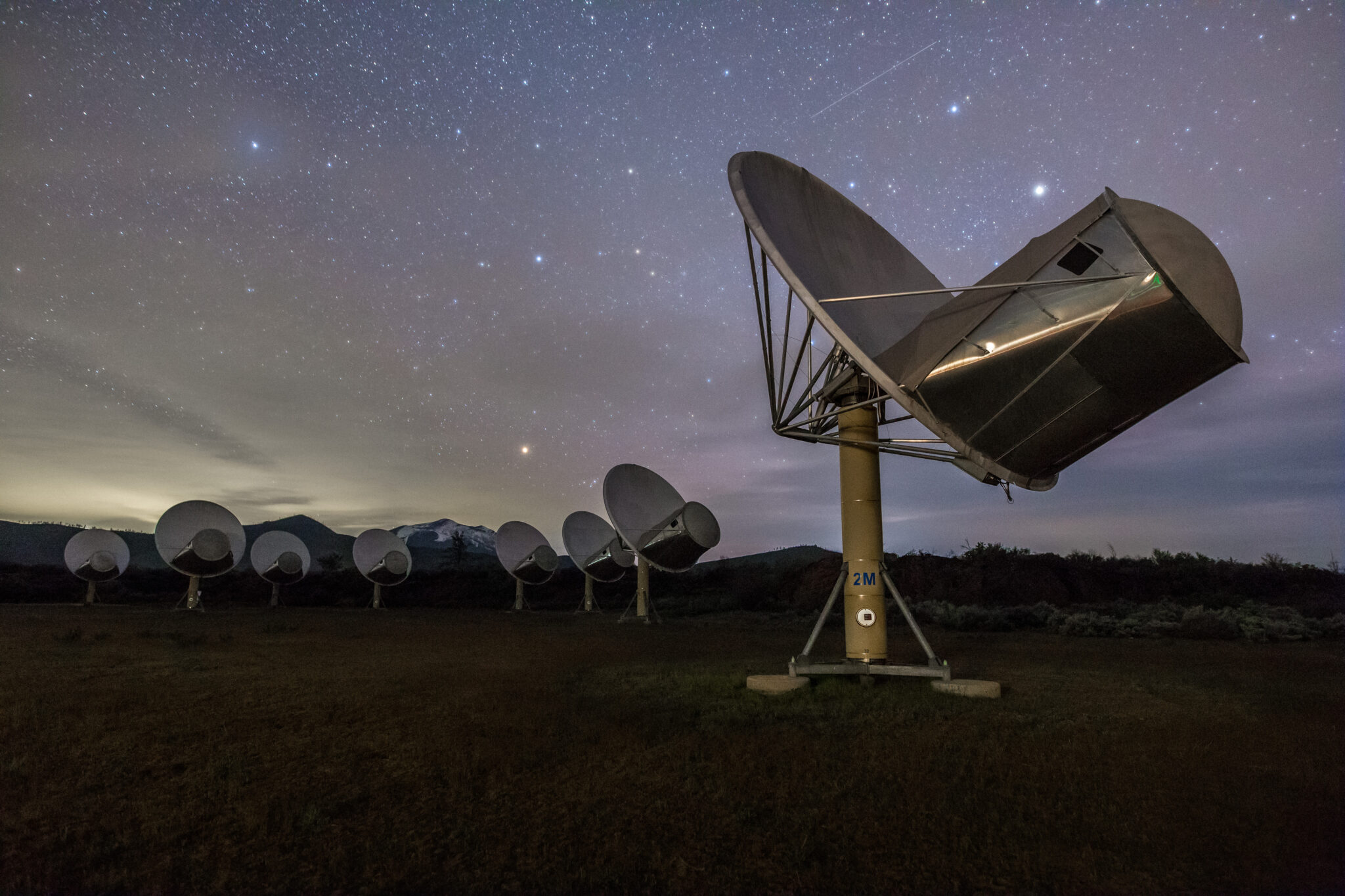
An Oct 30 NVIDIA blog post says Breakthrough Listen and the SETI Institute have brought agents into daily SETI work at the Allen Telescope Array (ATA, 42 dishes of 6 m each) in Northern California: from a single natural-language request, agents can steer the antennas, calibrate and focus, fix data errors, and run AI models on the live stream. Holoscan's DAQIRI library pulls sensor data straight into GPU memory, the SETI Institute's CyberEther handles signal processing, and the web-based orchestrator Nexus acts as the agent harness, handling up to 2.4 Tbps on premises on RTX PRO 6000 Blackwell GPUs. The pipeline has made the first real-time AI detection of a pulsar in the Crab Nebula, and the team is evaluating open models such as Nemotron. The @NVIDIAAI Halloween post on Oct 31 drew about 274 likes.
Key Takeaways
- ✓Throughput: up to 2.4 Tbps of radio data on NVIDIA RTX PRO 6000 Blackwell GPUs, with inference running on premises next to the instrument (NVIDIA blog, vendor-reported)
- ✓Three layers: DAQIRI moves sensor data straight into GPU memory, CyberEther does the signal math with cuFFT and cuBLAS, and Nexus serves as the agent harness for instrument state, compute, and pipelines
- ✓Capability: one plain-language request can steer the ATA's 42 six-meter dishes, calibrate and focus, fix data errors, and plot results; NVIDIA says this compresses weeks or years of human work into hours
- ✓Milestone: the first real-time AI detection of a pulsar in the Crab Nebula; no false-positive rates or other metrics were published, and no extraterrestrial signal has been found
- ✓Next: evaluating open models such as Nemotron for observatories where data locality matters, possibly one day running offline on the far side of the Moon
Key Decision Metrics at a Glance
Turn your technical choice into a development budget
Compare 40 dev plans & simulate token costs vs $20/mo subscriptions
Project Links & Resources
Direct AccessIn-Depth Technical Analysis
Background and the problem
Radio telescopes produce huge data volumes. The usual approach writes everything to disk and analyzes it later, so researchers can wait weeks to learn whether an observation held anything worth following up, and steering, calibration, and packet-loss debugging depend on a few engineers who know the instrument. The Allen Telescope Array (ATA) at Hat Creek Radio Observatory in Northern California has 42 dishes of 6 m each and was the first radio telescope designed for SETI. NVIDIA's case study brings a coding-agent style of work to a real scientific instrument.
Architecture and how it works
According to NVIDIA's blog, the system has three layers. DAQIRI, a Holoscan platform library, pulls terabits per second of sensor data straight into GPU memory so it is processed in flight rather than written to disk first. CyberEther, a signal-processing framework from the SETI Institute, does the math with CUDA-X libraries such as cuFFT and cuBLAS. Nexus, a web-based observatory orchestrator, acts as the agent harness and gives agents one source of truth for instrument state, compute, and pipelines. Researchers can check packet loss, read live spectrograms, and rewrite processing blocks in natural language.
Benchmarks and reported results
Only two figures are given, both vendor-reported: up to 2.4 Tbps on RTX PRO 6000 Blackwell GPUs, and the first real-time AI detection of a pulsar in the Crab Nebula. NVIDIA did not publish detection accuracy, false-positive rates, or comparisons with the old pipeline, and "weeks or years compressed into hours" is a qualitative claim. No extraterrestrial signal has been found.
What developers can do with it
For agent builders, the useful part is the harness design: Nexus exposes hardware state and pipelines through one interface agents can read and write, much like giving a coding agent tools, memory, and checks. To build something similar, start with the NVIDIA Holoscan SDK and DAQIRI docs, and look at the open CyberEther project for signal processing. The team is next evaluating open models such as Nemotron for local or offline inference.
Benchmark side-by-side against alternatives, or calculate monthly token cost vs subscription break-even.
Discussion & Comments
0Sign in to join the discussion
Connect with AI developers to exchange benchmark insights.