AI Coding Live News

DeepSeek Harness Launches Creator Mode: Describe a Plugin in Chat and the Agent Builds It, With 7 Official Demo Prompts

DeepSeek Harness, DeepSeek's open-source, MIT-licensed agent app, announced Creator Mode on its official X account on November 2: users describe the plugin they want in plain language, and the agent turns it into a plugin they can use. Demos include a 3D landmark gallery, a 3D Transformer visualizer, a video editing workbench and a paper reader. DeepSeek also published seven bilingual demo prompts on cdn.deepseek.com, cautioning that some plugins took several rounds of conversation, so a single prompt may not reproduce the video exactly. The post drew about 20,000 likes and 1.69 million views. No benchmarks were published.
DeepSeek Harness Launches Creator Mode: Describe a Plugin in Chat and the Agent Builds It, With 7 Official Demo Prompts

Key Takeaways

  • Creator Mode: describe the plugin you want in natural language and the agent turns it into a usable plugin, from a design workspace to a sandbox game or a 3D LLM visualizer.
  • DeepSeek published 7 demo prompts: a 3D landmark gallery, a 3D Transformer demo, a five-style app theme switcher, a poster workbench, a video editor, a paper reader and a token-usage statistics plugin.
  • The entry point shipped in v0.2.1-rc.5 (Oct 30 pre-release): plugin management gained a "Let Agent create a plugin" button that opens Creator mode and keeps the draft.
  • The GitHub repo has about 270,000 stars under the MIT license; Harness is still in preview.
  • No benchmarks or success rates were published; the announcement drew about 20,000 likes and 1.69 million views.
Read full story
Linked Models & Agents:

Nous Research opens the official Hermes Agent mobile beta: iOS via TestFlight, Android via Firebase, connecting your phone to your own gateway to approve tools and manage bots and routines

During NousCon 2026 in New York on Oct 30, Nous Research released an official mobile beta of Hermes Agent and put up a sign-up page at hermes-agent.nousresearch.com/mobile: iOS users join the "Hermes Agent - Mobile" beta through TestFlight, and Android users join through Firebase App Distribution. The TestFlight page says the app connects to your own Hermes gateway so you can chat with streaming, approve tool calls, and manage bots and routines from anywhere. Teknium, co-founder and lead engineer of Hermes Agent, confirmed on X that the iPhone and Android betas launched together. Nous has not announced a general release date or any benchmarks.

Key Takeaways

  • Entry point: the official page hermes-agent.nousresearch.com/mobile covers 2 platforms, iOS through TestFlight and Android through Firebase App Distribution
  • Positioning: the TestFlight description says the app connects to your own gateway for streaming chat, tool-call approval, and managing bots and routines; it is a client, not a separate agent running on the phone
  • Confirmation: Teknium, co-founder and lead engineer of Hermes Agent, confirmed in a reply on X that the iPhone and Android betas both launched on NousCon day
  • Watch for clones: several third-party Hermes phone clients already exist, so only use the links on the official page; Nous has not published a general release date or benchmarks
Read full story

Suhail launches Particle and its first model, Particle-1: a DeepSeek V4.1 Flash post-train that uses about 45% fewer tokens on coding tasks

On Oct 28, Mixpanel founder Suhail Doshi announced his new company Particle on X, with its first model, Particle-1, live now. Particle's blog says it is a reinforcement-learning post-train of DeepSeek V4.1 Flash that uses 28.4% to 52.2% fewer output tokens and costs 34.4% to 51.6% less per task across four coding and data engineering benchmarks, with pass rates inside the base model's confidence intervals. It is available through the Particle API, OpenRouter and Vercel AI Gateway; Particle's docs list $0.25 input and $1.00 output per million tokens with a 1,048,576-token context window.

Suhail launches Particle and its first model, Particle-1: a DeepSeek V4.1 Flash post-train that uses about 45% fewer tokens on coding tasks

Key Takeaways

  • Across four benchmarks (Terminal-Bench 2.1, ReactBench, ADE Bench, DeepSWE 1.1), 28.4% to 52.2% fewer output tokens and 34.4% to 51.6% lower cost per task (vendor-reported)
  • Particle's summary table: $0.2211 per task versus $0.3368 for DeepSeek V4.1 Flash and $0.6523 for GLM 5.3 Flash; 59,580 mean output tokens versus 83,246 and 98,155
  • Task pass rate 72.57% versus 71.15% for the base model and 66.82% for GLM 5.3 Flash; GPQA Diamond 90.40% (base 90.91%), MMLU 86.08% (base 85.98%)
  • Training: a rank-64 LoRA on the experts in all layers, about 1.25% of the model's parameters, trained with sequence-level GSPO in two RL stages
  • Pricing: Particle docs currently list $0.25 input, $0.03 cached input and $1.00 output per million tokens, a 1,048,576-token context and a 131,072-token output ceiling
Read full story

Liquid AI releases LFM3, six open-weight ~2B models spanning text, vision, audio, omni and decision tasks

On Oct 27 Liquid AI released LFM3, a new generation of foundation models built on a tri-hybrid architecture of gated short convolutions, sliding-window attention and global attention, pre-trained on 22T tokens. The first six models all branch from LFM3-1.7B-Base at around 2B parameters, with weights on Hugging Face under the LFM Open License v1.0. Liquid says the text model LFM3-1.7B needs about 1 GB at 4-bit, supports 256K context and beats models several times its size on several agent benchmarks.

Liquid AI releases LFM3, six open-weight ~2B models spanning text, vision, audio, omni and decision tasks

Key Takeaways

  • Six models: LFM3-1.7B (text), VL-2B (vision/video), Audio-2B, Omni-2B, plus decision models d1-2B and d1-Omni-2B
  • Architecture: of 24 layers, 13 gated short convolutions, 5 sliding-window attention (256-token window) and 6 global attention; 22T pre-training tokens
  • Vendor-reported: LFM3-1.7B scores 43.40 on SWE-bench Verified (OpenCode) vs 41.20 for Qwen3.5-4B and 51.20 for Qwen3.5-9B
  • Vendor-reported: 38.42 on WebArena-Verified and 41.29 on AutomationBench, both above Qwen3.5-9B (28.94 / 15.10)
  • A full 128K context needs about 1.6 GB of KV cache; one B300 with SGLang can produce about 3.6B tokens per day (vendor figure)
Read full story
Linked Models & Agents:
⚡ LFM3-1.7B⚡ LFM3-VL-2B⚡ LFM3-Audio-2B⚡ LFM3-Omni-2B⚡ d1-2B⚡ d1-Omni-2B⚡ Qwen3.5-9B⚡ Gemma 4 E4B🤖 Hermes Agent🤖 OpenClaw🌐 Liquid AI🌐 AMD🌐 Qualcomm🌐 Hugging Face
ADSponsored

Google DeepMind unveils Genie 4 world model: built on Gemini Omni, first with native real-time audio and dialogue, in research preview for trusted testers

Google DeepMind announced Genie 4 on Oct 27, calling it its most realistic and interactive world model yet. Built on Gemini Omni, it improves physics and human motion, natively generates ambient audio and interactive character dialogue for the first time, and uses Gemini 3.8 Flash in the loop to plan complex events. It is a research preview for trusted testers for now, coming soon to Google AI Ultra (Project Genie) and early access partners in the Gemini API and AI Studio; no quantitative benchmarks were published.

Google DeepMind unveils Genie 4 world model: built on Gemini Omni, first with native real-time audio and dialogue, in research preview for trusted testers

Key Takeaways

  • Per Google DeepMind, Genie 4 is its most realistic and interactive world model yet, with Gemini Omni anchoring real-world appearance and behavior
  • It is DeepMind's first real-time world model with native audio: ambient sound, music and character dialogue are generated with the world, and characters respond live
  • Gemini 3.8 Flash acts as a guiding agent in the loop, splitting goals into steps and checking frames; a demo pairs Gemini 4 Argon with Genie 4 to simulate an Apollo humanoid
  • Official limitations: only a few minutes of continuous interaction and drift over longer sessions; no quantitative benchmarks were published
  • Trusted testers only for now; coming soon to Google AI Ultra (Project Genie) and Gemini API / AI Studio early access partners, with SynthID on all outputs
Read full story
Linked Models & Agents:

Entire, led by ex-GitHub CEO Thomas Dohmke, launches a Git forge for agent-human collaboration: Trails replace PRs, pushes up to 89x faster than GitHub per its benchmarks

On Oct 26, Entire co-founder and CEO Thomas Dohmke announced on X and the company blog that Entire is live as "the Git forge for agent-human collaboration." It has three parts: Trails, which replace diff-based review with eval scores computed on every push; Git-compatible distributed hosting that can replicate across regions or mirror from GitHub; and Continuous Memory, which stores agent sessions in the repo. Buildkite and Depot are the first CI integrations, and it is open to any developer today.

Entire, led by ex-GitHub CEO Thomas Dohmke, launches a Git forge for agent-human collaboration: Trails replace PRs, pushes up to 89x faster than GitHub per its benchmarks

Key Takeaways

  • Push speed (vendor-reported, open-source benchmark): Entire 418 pushes/s vs Cursor Origin 65, Pierre 15, GitLab 10, GitHub 4.7, i.e. up to 89x faster than GitHub and 6x faster than Cursor Origin
  • Trails: on every push, several review agents score the change independently in cloud sandboxes (defaults include Security, Slop and Human Review Required), showing the last 5 runs plus the current one; per-repo Gates can require human approval and passing CI before merge
  • Continuous Memory: two open-source, local-first plugins, entire-graph and entire-brain; entire-graph saved up to 71% of tokens in Entire's testing
  • Regions at launch: US, EU, Australia and India; repos can be mirrored from GitHub with GitHub kept as the source of truth
  • Pricing: not stated in the launch post
Read full story

Cursor launches Agent SDK: agents as code with Markdown prompts, TypeScript tools, built-in evals, and hosted or self-run deployment

On Oct 26 Cursor announced that its Agent SDK is generally available. An agent's system prompt is written in Markdown and its tools in TypeScript; agents can be deployed on Cursor's hosted infrastructure or run on your own machines, and built-in evals measure every change. Cursor's docs say it uses the same Cursor SDK harness that powers Bugbot, Security Review, Approval Bot and Rollouts, can be triggered from source-control events, issue trackers, Slack or schedules, and is managed under Deployed Agents after deployment. Cursor has not published pricing or benchmarks.

Cursor launches Agent SDK: agents as code with Markdown prompts, TypeScript tools, built-in evals, and hosted or self-run deployment

Key Takeaways

  • Same harness: Cursor's docs say Agent SDK runs on the harness behind four of its own agents: Bugbot, Security Review, Approval Bot and Rollouts
  • Project layout: bot/instructions.md is the required always-on system prompt, each bot/tools/*.ts file is one typed tool, with folders for skills, MCP connections, subagents, channels, hooks and schedules, and evals live in evals/*.eval.ts
  • Triggers and deployment: runs can be triggered from source control, issue trackers, Slack, webhooks or schedules; deploy on Cursor-managed hosting or self-host, then manage under Deployed Agents
  • CLI: agent-sdk validate, run and eval check the project, run a real turn and run evals; Cursor says only run and eval need a Cursor credential
  • Cursor has not published pricing or benchmarks
Read full story
Linked Models & Agents:

Oracle unveils the Fusion Claw runtime with 25 agentic apps at AI World, and Fusion Companion lets employees run ERP and HCM work from ChatGPT

At Oracle AI World in Las Vegas on Oct 26, Oracle announced Oracle Fusion Claw, a new execution runtime for agents, and 25 Claw-powered Agentic Applications now available across ERP, HCM, supply chain (SCM) and customer experience (CX). It also introduced Fusion Companion and Fusion Agentic Home: employees describe a goal in natural language in supported AI tools such as ChatGPT or in the native Fusion interface, and the system picks and coordinates the transactions, workflows, approvals and AI agents needed, within existing identity, permission and approval controls. Oracle has not published pricing, benchmarks or a detailed rollout schedule.

Oracle unveils the Fusion Claw runtime with 25 agentic apps at AI World, and Fusion Companion lets employees run ERP and HCM work from ChatGPT

Key Takeaways

  • Runtime: Fusion Claw is a new agent execution runtime that Oracle says supports larger-scale and longer-running work, continuous replanning, deterministic execution and governed autonomy (press release)
  • Scale: 25 Claw-powered Agentic Applications are available now across the ERP, HCM, SCM and CX suites, including Ledger, Workforce Orchestration, Payroll Activity Workspace and Procurement Spend
  • Access: Fusion Companion works through supported AI tools such as ChatGPT and customer- or partner-built interfaces, with Fusion Agentic Home as the native entry point (Fusion Companion release)
  • Governance: all execution stays within existing identity, permissions, policies and approval controls, and decisions needing human judgment are escalated
  • Not disclosed: Oracle has not published pricing, benchmarks or a per-app rollout schedule
Read full story

Cursor launches Computer Use: agents can control your computer and drive desktop apps like the iOS Simulator to test what they build

On 2026-10-23 (15:59 UTC) the official Cursor account @cursor_ai announced "Cursor can now control your computer": agents can drive desktop apps such as the iOS Simulator to test the features they build. A follow-up post says Computer Use lets agents click and type across any app on your computer, not just the browser. Cursor turns it on by itself when a task needs it, and you can also request it by @-mentioning Computer Use in your prompt; updating Cursor is enough to try it. A community changelog in September mentioned Computer Use on Mac in version 3.20.21, and this is the official launch. Supported platforms, the permission model and benchmarks were not published.

Cursor launches Computer Use: agents can control your computer and drive desktop apps like the iOS Simulator to test what they build

Key Takeaways

  • Cursor officially says its agents can now control your computer and drive desktop apps like the iOS Simulator to test the features they build
  • Computer Use lets agents click and type across any app, not just the browser
  • Cursor uses it automatically when a task needs it, and you can request it by @-mentioning Computer Use in a prompt
  • Update Cursor to try it; supported platforms, the permission model and benchmarks were not published
Read full story

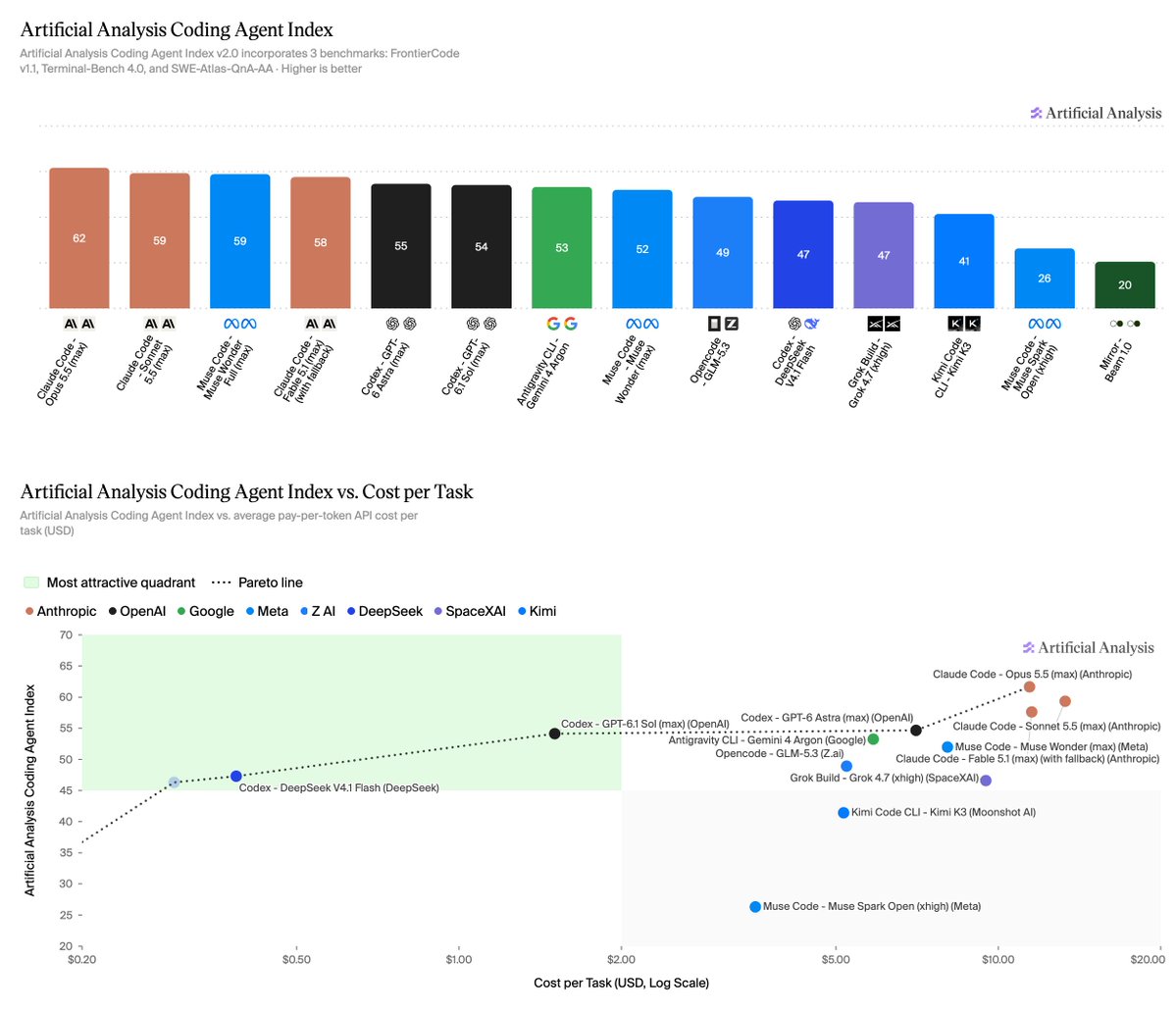
Artificial Analysis launches Coding Agent Index v2.0: FrontierCode from Cognition replaces DeepSWE, and Claude Code with Opus 5.5 leads at 61.7

On 2026-10-23 Artificial Analysis launched Coding Agent Index v2.0, which scores model-plus-harness combinations across 290 tasks with three equally weighted benchmarks: FrontierCode v1.1 from Cognition (100 tasks on real open-source repos, graded on whether a maintainer would merge the change) replaces DeepSWE v1.1, SWE-Atlas-QnA becomes the stricter SWE-Atlas-QnA-AA, and Terminal-Bench 4.0 is unchanged. Claude Code with Claude Opus 5.5 (max) leads at 61.7, ahead of Sonnet 5.5 at 59.3 and Muse Wonder Full at 58.9. Scores fall across the board: the 21 configurations measured on both versions drop from a mean of 54.8 to 47.4.

Artificial Analysis launches Coding Agent Index v2.0: FrontierCode from Cognition replaces DeepSWE, and Claude Code with Opus 5.5 leads at 61.7

Key Takeaways

  • Top of the index: Claude Code with Claude Opus 5.5 (max) 61.7, Claude Sonnet 5.5 (max) 59.3, Muse Code with Muse Wonder Full (max) 58.9, Claude Fable 5.1 (max with fallback) 57.6 (Artificial Analysis figures)
  • On FrontierCode v1.1, Opus 5.5 scores 56.0%, ahead of Codex with DeepSeek V4.1 Flash at 52.6%; 15 of 24 configurations sit between 43% and 49%
  • Version shift: 21 configurations average 54.8 on v1.5 and 47.4 on v2.0, with 20 of 21 moving down; the same set averages 45.1% on FrontierCode versus 65.6% on DeepSWE
  • Four points on the cost frontier: DeepSeek V4.1 Flash 47.3 at $0.39 per task, GPT-6.1 Sol 54.1 at $1.50, GPT-6 Astra 54.7 at $7.04, Opus 5.5 61.7 at $11.42 (pay-per-token API costs, not subscriptions)
  • SWE-Atlas-QnA-AA rewords 127 of 1,306 rubric criteria and uses GPT-6 Luna (xhigh) as judge with five votes per criterion; dataset and judge config are on Hugging Face
Read full story
ADSponsored

Artificial Analysis Benchmarks DeepSeek Search API: $0.75/1K Searches Delivers +36 Point Score Lift

Independent AI evaluation platform Artificial Analysis (@ArtificialAnlys) officially benchmarked DeepSeek's web search API (DeepSeek Search). Augmenting the base model with DeepSeek Search boosted its Search Index score from 33 to 69—an impressive +36 point leap (ranking 17th among 27 tested search APIs). DeepSeek Search established a market-leading price-performance ratio, priced at just $0.75 per 1,000 searches (~$0.032 per completed task), making it the most cost-effective paid search API evaluated. It recorded 70% accuracy on AA-Omniscience and 63% on BrowseComp, highlighting an optimal balance between factual grounding and operational economics.

Artificial Analysis Benchmarks DeepSeek Search API: $0.75/1K Searches Delivers +36 Point Score Lift

Key Takeaways

  • Artificial Analysis independently benchmarked DeepSeek Search API, lifting Search Index score to 69 (+36 pts over base model)
  • Industry-leading cost efficiency: priced at $0.75 per 1,000 searches (~$0.032 per task), the cheapest paid search API on the market
  • Scores 70% accuracy on cross-domain factual QA benchmark AA-Omniscience (ranking 10th out of 27 configurations)
  • Achieves 63% accuracy on long-horizon web navigation benchmark BrowseComp, offering high-ROI grounding for agent developers
Read full story

Letta releases FrontierMemory 1.0, a benchmark that scores agent memory by downstream task success; Opus 5.5 and GLM-5.3 tie for first at 73.3%

On October 21 Letta released FrontierMemory 1.0. Instead of quizzing agents on facts such as birthdays or hobbies, it gives an agent a set of past trajectories, has it write memory or skills, and scores that memory by how many coding and knowledge-work tasks a task agent then solves. Version 1.0 has 15 tasks adapted from public benchmarks such as DeepSWE, SkillsBench and APEX-Agents. On the model board (memory written in Letta Dream, tasks run in Letta Code) Opus 5.5 and GLM-5.3 both score 73.3% and Grok 4.7 scores 33.3%; on the harness board Letta's own Letta Dream ranks first. All numbers are Letta's own.

Letta releases FrontierMemory 1.0, a benchmark that scores agent memory by downstream task success; Opus 5.5 and GLM-5.3 tie for first at 73.3%

Key Takeaways

  • Model board (vendor-run, top effort): Opus 5.5 73.3% (about $2.80 per task), GLM-5.3 73.3% ($3.58), Kimi K3 66.7%, GPT-6.1 Sol 60.0% ($0.77, cheapest), Gemini 4 Argon 60.0%, Muse Wonder 46.7%, Grok 4.7 33.3%
  • Harness board: Letta Dream 73.3%, Prime Agent 60.0%, OpenAI Agents SDK 40.0%, Claude Managed Agents 33.3%, Hermes Agent 26.7%
  • Version 1.0 has 15 tasks; only 219 of 665 source trajectories are relevant, so the agent has to find the useful experience itself
  • Letta says 53% of the source tasks it kept had broken verifiers, which it repaired; memory generation is capped at 6 hours with no web access
  • Memory comes in three kinds (task conventions, user preferences, environment facts); outside models and harnesses can be submitted
Read full story

FrontierRefactor Introduces First Code Performance Benchmark: 41% of Agent Patches Pass Tests with Zero Gain or Regressions

Published in arXiv:2610.25834, FrontierRefactor establishes the industry's first evaluation benchmark targeting autonomous coding agents on multi-scale, performance-oriented codebase refactoring. Unlike traditional benchmarks like SWE-bench that measure only functional pass rates, FrontierRefactor spans seven programming languages and 60 Amdahl-qualified tasks ranging from kernels to full repositories (10^1 to 10^4+ LOC). Initial evaluations reveal that over 41% of agent patches pass functional equivalence suites yet yield zero verified speedup—with 19.3% triggering severe runtime performance regressions, highlighting the vital need for multi-turn profiling feedback.

FrontierRefactor Introduces First Code Performance Benchmark: 41% of Agent Patches Pass Tests with Zero Gain or Regressions

Key Takeaways

  • FrontierRefactor (arXiv:2610.25834) introduces the first multi-scale performance-oriented codebase refactoring benchmark across 7 languages and 60 tasks
  • Reveals acute blindspot: over 41% of agent submissions pass functional tests but deliver zero verified acceleration (19.3% regress, 21.9% noise)
  • Cross-language rewrites offer high theoretical speedups but suffer contract collapse; in-place optimizations preserve contracts but fail without profiling
  • Multi-turn execution-timing feedback serves as the decisive lever, multiplying strict success rates across complex codebases
Read full story

Ollama Natively Supports Recursive Flint 40B: 2.5B Active MoE Coding Agent Delivering 125+ tok/s on MacBook Pro

Recursive, founded by Richard Socher, has officially open-sourced Flint (RecursiveSI/flint), a 39.8B Mixture-of-Experts (MoE) coding agent model under Apache 2.0 with day-zero Ollama support (ollama run flint). Activating just 2.5B parameters per token across 47 MoE layers with a 262K context window, Flint hits 125+ tokens/sec on an M4 Pro MacBook Pro. It sets new benchmarks for sub-50B local models, scoring 74.2% on SWE-bench Verified and 89.7% on SWE-bench Pro v2.

Ollama Natively Supports Recursive Flint 40B: 2.5B Active MoE Coding Agent Delivering 125+ tok/s on MacBook Pro

Key Takeaways

  • Flint employs a 49-layer architecture (2 dense + 47 MoE layers) with 39.8B total and 2.5B active parameters per token
  • Native 262,144-token (256K) context window supports end-to-end repository indexing and cross-file debugging
  • Blazing local inference speed: 125+ tokens/sec on M4 Pro MacBook Pro and 150+ tokens/sec on RTX Spark
  • Scores 74.2% on SWE-bench Verified, 89.7% on SWE-bench Pro v2, and 80.3% on LiveCodeBench v6 with instant 'ollama run flint' execution
Read full story
Linked Models & Agents:

OverSeer: Multi-Agent World Models Beyond What Agents See via Joint Auxiliary Streaming

Researchers introduced OverSeer in arXiv:2610.28554, pioneering a new class of multi-agent world models operating beyond the field of view of individual agents. Standard video world models collapse in multi-agent environments because individual agents operate under partial observability; naive frameworks feeding external global map inputs suffer severe spatial inconsistency and state hallucination. OverSeer resolves this by jointly predicting auxiliary spatial representation streams alongside the agents' first-person camera streams. In comprehensive Minecraft benchmarks, OverSeer achieves decisive state-of-the-art results across physical grounding, long-horizon spatial memory, and cross-view consistency.

OverSeer: Multi-Agent World Models Beyond What Agents See via Joint Auxiliary Streaming

Key Takeaways

  • OverSeer introduced in arXiv:2610.28554, establishing the first scalable multi-agent video world model framework
  • Replaces external static map inputs with auxiliary spatial streams jointly predicted alongside agents' egocentric perspectives
  • Achieves state-of-the-art performance across spatial grounding, long-horizon memory, and multi-view consistency in Minecraft
  • Provides an ungrounded simulation backbone for multi-robot swarm collaboration, multiplayer game AI, and embodied multi-agent fleets
Read full story
Linked Models & Agents: