AI Coding Live News

NVIDIA says AI agents now steer the SETI Allen Telescope Array, calibrating it and analyzing up to 2.4 Tbps of live radio data from plain-language requests

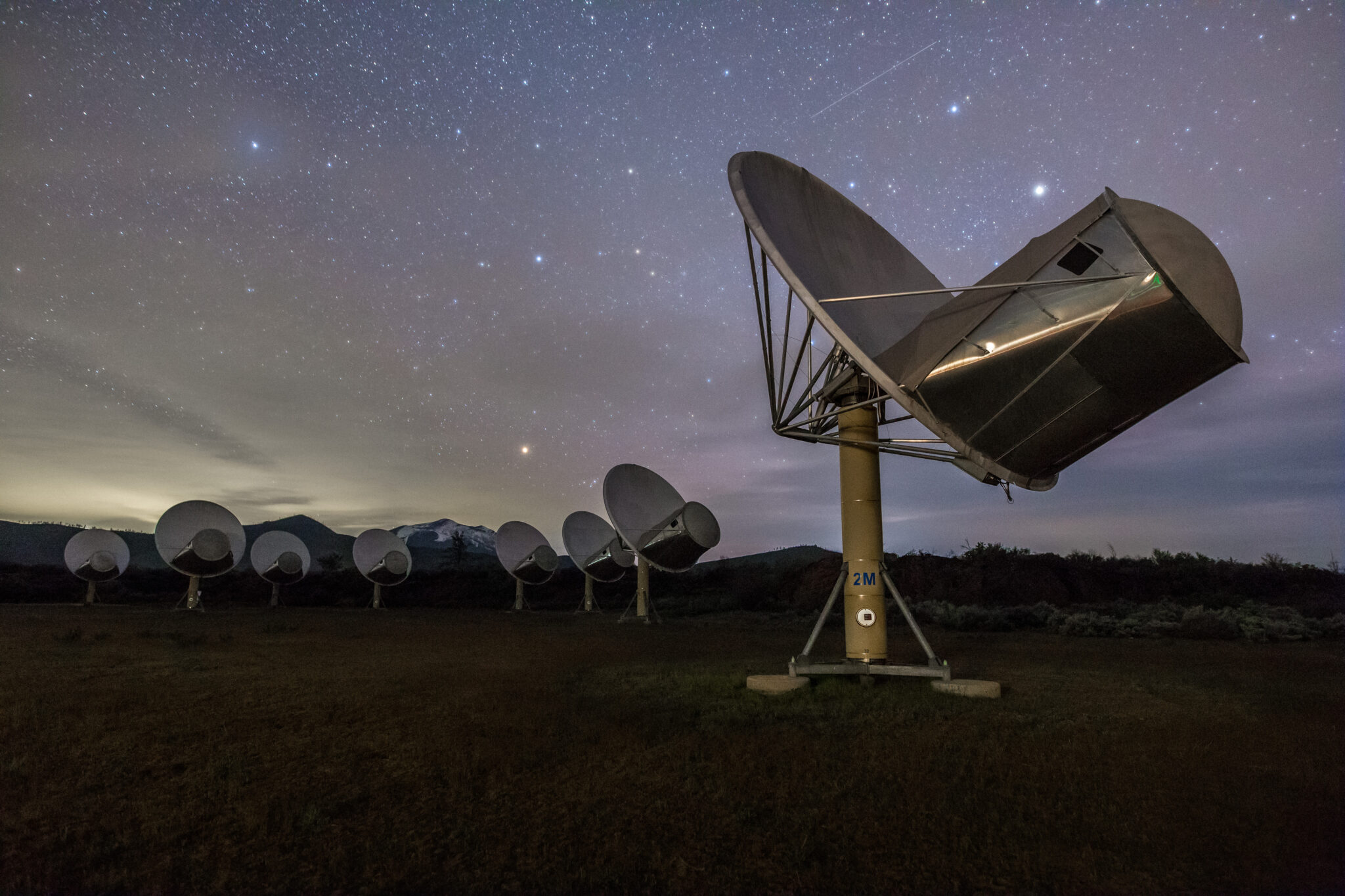
An Oct 30 NVIDIA blog post says Breakthrough Listen and the SETI Institute have brought agents into daily SETI work at the Allen Telescope Array (ATA, 42 dishes of 6 m each) in Northern California: from a single natural-language request, agents can steer the antennas, calibrate and focus, fix data errors, and run AI models on the live stream. Holoscan's DAQIRI library pulls sensor data straight into GPU memory, the SETI Institute's CyberEther handles signal processing, and the web-based orchestrator Nexus acts as the agent harness, handling up to 2.4 Tbps on premises on RTX PRO 6000 Blackwell GPUs. The pipeline has made the first real-time AI detection of a pulsar in the Crab Nebula, and the team is evaluating open models such as Nemotron. The @NVIDIAAI Halloween post on Oct 31 drew about 274 likes.
NVIDIA says AI agents now steer the SETI Allen Telescope Array, calibrating it and analyzing up to 2.4 Tbps of live radio data from plain-language requests

Key Takeaways

  • Throughput: up to 2.4 Tbps of radio data on NVIDIA RTX PRO 6000 Blackwell GPUs, with inference running on premises next to the instrument (NVIDIA blog, vendor-reported)
  • Three layers: DAQIRI moves sensor data straight into GPU memory, CyberEther does the signal math with cuFFT and cuBLAS, and Nexus serves as the agent harness for instrument state, compute, and pipelines
  • Capability: one plain-language request can steer the ATA's 42 six-meter dishes, calibrate and focus, fix data errors, and plot results; NVIDIA says this compresses weeks or years of human work into hours
  • Milestone: the first real-time AI detection of a pulsar in the Crab Nebula; no false-positive rates or other metrics were published, and no extraterrestrial signal has been found
  • Next: evaluating open models such as Nemotron for observatories where data locality matters, possibly one day running offline on the far side of the Moon
Read full story

Mistral AI and NVIDIA Forge Industrial Engineering AI Alliance, Previewing 1T Mistral Large 4

At GTC Berlin, Mistral AI and NVIDIA announced a strategic partnership dedicated to advancing AI for industrial engineering, computational physics, and electronic design automation (EDA). The alliance couples Mistral frontier architectures with NVIDIA CUDA-X libraries, Warp physics simulation frameworks, and Omniverse digital twins. Mistral simultaneously revealed architectural specifics for its forthcoming flagship, Mistral Large 4: spanning roughly 1 trillion total parameters with 49 billion active parameters (MoE), trained on 3,800 Grace Blackwell GPUs, with open weights slated for official release at the end of October 2026.

Mistral AI and NVIDIA Forge Industrial Engineering AI Alliance, Previewing 1T Mistral Large 4

Key Takeaways

  • Mistral AI and NVIDIA launched a strategic alliance applying frontier foundation models to CAE, physics AI, and EDA semiconductor design
  • Integrates NVIDIA Warp, CUDA-X simulation libraries, and Omniverse to establish open physics datasets and industrial agent benchmarks
  • Disclosed architectural parameters for Mistral Large 4: ~1T total parameters with 49B active sparse MoE, trained on 3,800 Grace Blackwell GPUs
  • Weights for Mistral Large 4 are scheduled for open-source release at the end of October 2026, joining the Nemotron Coalition
Read full story

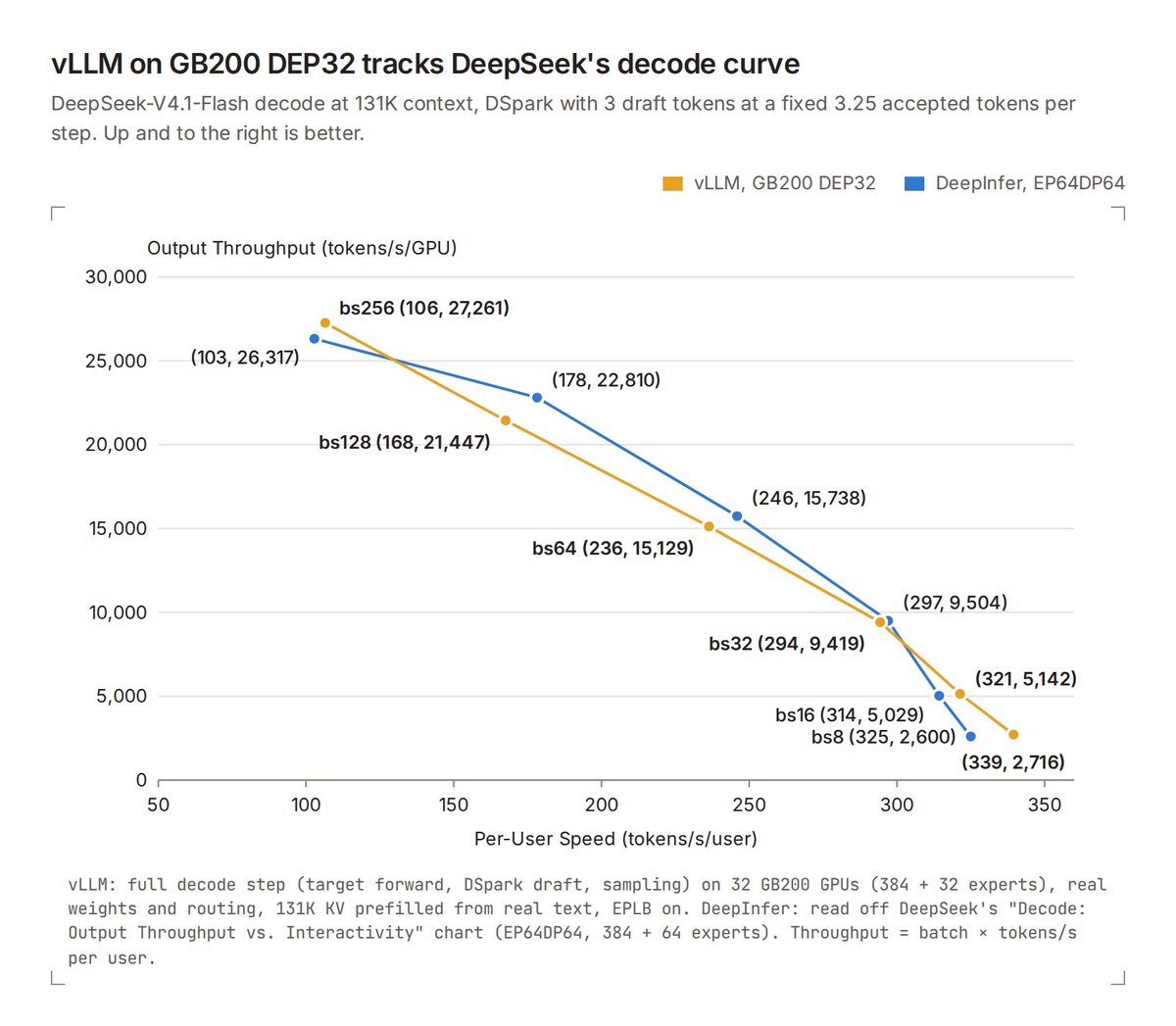
vLLM and Ant Group Open-Source Humming: Up to 5x Kernel Acceleration and +43.3% MoE Throughput

The vLLM project team and Ant Group officially open-sourced Humming (humming-kernels), a specialized high-performance kernel library designed for serving quantized MoE and dense LLMs at massive scale. Humming natively supports WnA16, W8A8, W4A8, and W4A4 across INT1–INT8 and FP4–FP8 formats, spanning NVIDIA architectures from Turing through Blackwell as well as T-Head Zhenwu 810E silicon. In production benchmarks, Humming kernels outpace cuBLAS by 3–4x at small batch sizes and surpass Marlin by 2x on H200 clusters. Serving DeepSeek-V4.1-Flash across 8x H20 GPUs, Humming drives a +43.3% throughput gain under 64 concurrent requests while reducing time-to-first-token (TTFT) by 32%, pre-integrated directly into vLLM v0.29.0+.

vLLM and Ant Group Open-Source Humming: Up to 5x Kernel Acceleration and +43.3% MoE Throughput

Key Takeaways

  • vLLM and Ant Group open-sourced Humming (humming-kernels), integrated out-of-the-box into vLLM v0.29.0+
  • Covers WnA16, W8A8, W4A8, and W4A4, compiling JIT kernels in just 1.82 seconds versus 23.35 seconds for CUTLASS
  • Serving DeepSeek-V4.1-Flash on 8x H20 GPUs yields a +43.3% throughput boost at 64 concurrency (442 to 634 tokens/sec)
  • Cuts time-to-first-token (TTFT) by 25% to 32% while delivering up to 5x kernel speedups on Blackwell B300 systems
Read full story

TRIAGE: Nanjing University Stabilizes Native NVFP4 Reinforcement Learning with Zero Performance Degradation and 2.3x Higher Throughput

Reinforcement learning post-training generates massive rollout bottlenecks, driving interest in low-precision execution like NVIDIA Blackwell's native NVFP4 (W4A4). However, numerical discrepancies between learner and sampler forward passes destabilize policy-gradient optimization, triggering policy collapse. Researchers from Nanjing University and Polixir present TRIAGE (arXiv:2610.07043), isolating how quantization mismatches interact with policy-gradient directions. The authors reveal that native NVFP4 introduces an early asymmetry that amplifies negative-advantage updates across concentrated tail tokens. TRIAGE implements segment-level diagnostics to rebalance policy updates while preserving native W4A4 forward execution across both learners and samplers. Validated on Qwen3-4B and Qwen3-30B-A3B, TRIAGE matches full-precision BF16 performance across five mathematical reasoning benchmarks while delivering up to 2.3x higher rollout throughput.

Key Takeaways

  • Nanjing University and Polixir introduce TRIAGE, stabilizing native NVFP4 (W4A4) RL training on NVIDIA Blackwell architecture
  • Pioneers direction-aware policy-gradient stabilization and segment diagnostics, mitigating learner-sampler numerical mismatch
  • Matches full BF16 precision on mathematical reasoning benchmarks while delivering 2.3x higher rollout throughput
Read full story
Linked Models & Agents:
ADSponsored

Mistral Large 4 "Le Chonk" public preview: 1.05T-total / 49B-active multimodal MoE, 1M context, open weights by month-end

On 2026-10-06 Mistral launched a public-preview API for Mistral Large 4: a granular MoE with 1.05T total / 49B active parameters plus a 1.6B vision encoder, 1M context, trained from scratch on 3,800 Grace Blackwell GPUs in Mistral's own European datacenters. It posts 61.7% DeepSWE v1.1 and 93% Cybench; weights are promised by the end of October.

Mistral Large 4 "Le Chonk" public preview: 1.05T-total / 49B-active multimodal MoE, 1M context, open weights by month-end

Key Takeaways

  • Scale: 1.05T total / 49B active MoE + 1.6B vision encoder, 1M context
  • Coding (Artificial Analysis private eval): DeepSWE v1.1 61.7%, SWE-Atlas-QnA 59.4%, Terminal-Bench 4 28.3%, Coding Agent Index 49.8%
  • Security: Cybench 93%; 82% on AA Cyber Index reproduce-and-patch test (highest of any model); Lakera B3 93.3% attack resistance
  • Agents: AutomationBench 59.9%, AA-Briefcase 1,393 Elo; Surge AI blind coding eval 3.74, behind only Claude Opus 5 (4.22)
  • Pricing per 1M tokens: $1.36 input / $0.14 cached / $4.18 output (docs also list a half-price tier); weights by end of month
Read full story
Linked Models & Agents:

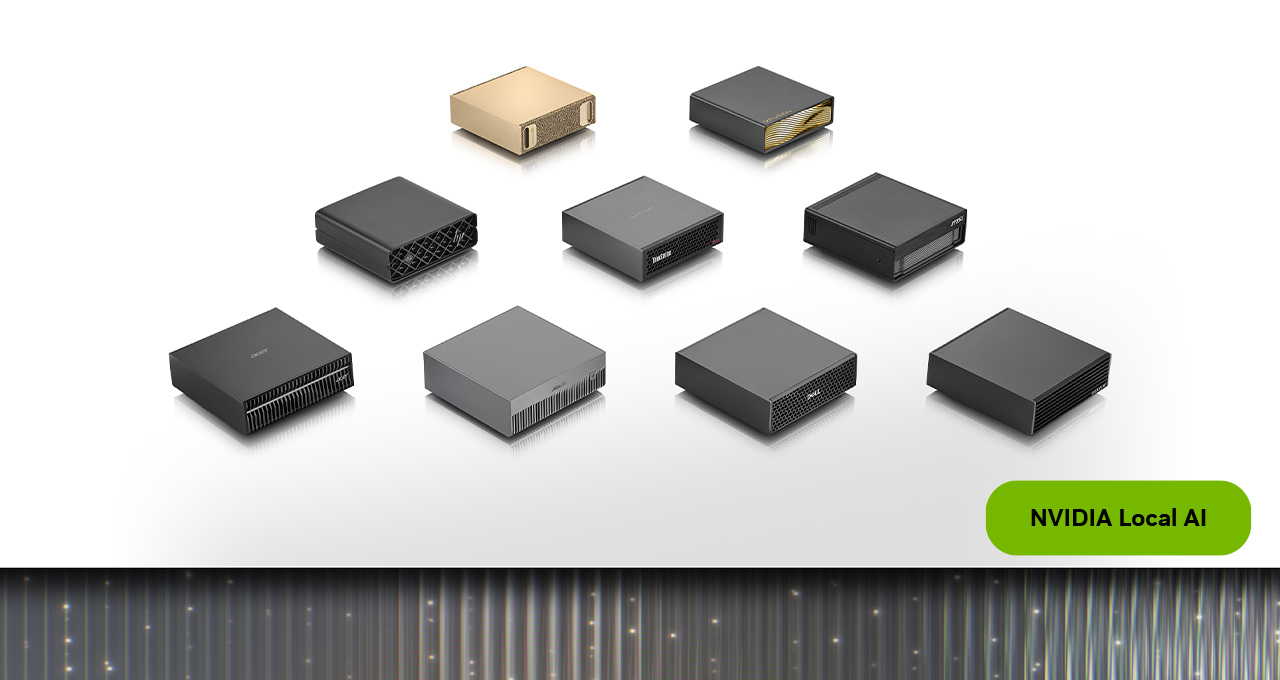
NVIDIA DGX Spark 64GB: OEM sale from Oct 23 at $4,999; dual-node up to ~1.7×, local models to ~100B

On 2 Oct 2026 NVIDIA blogged DGX Spark 64GB: on sale Friday 23 Oct via Acer/ASUS/Dell/Gigabyte/HP/MSI from $4,999. Same GB10 Grace Blackwell, DGX OS, and full NVIDIA AI stack; 64GB unified memory for local agents up to ~100B params. Two units cluster over ConnectX-7+QSFP to 128GB (~200B); Qwen 3.8 27B test showed up to ~1.7× vs one node.

NVIDIA DGX Spark 64GB: OEM sale from Oct 23 at $4,999; dual-node up to ~1.7×, local models to ~100B

Key Takeaways

  • Official blog by Allen Bourgoyne dated 2026-10-02
  • OEM availability Friday 2026-10-23 from Acer/ASUS/Dell/Gigabyte/HP/MSI; starting at $4,999; 64GB OEM-only
  • Same GB10 + DGX OS + CUDA AI stack; Agent Toolkit, Ollama, vLLM, PyTorch, Nemotron OOTB
  • Dual-node via ConnectX-7+QSFP pools 128GB / ~200B params; Qwen 3.8 27B up to ~1.7× vs single
  • Later this month: Sync Model Launcher for Qwen3.8 27B + OpenCode local wiring
Read full story

NVIDIA RTX Spark: local-agent speedups—up to 1.9× llama.cpp on RTX 5090, 1.2× vLLM on Blackwell

NVIDIA RTX Spark announced local-agent inference optimizations: up to 1.9× higher llama.cpp throughput on GeForce RTX 5090, 1.2× vLLM on RTX PRO 6000 Blackwell, and up to 1.4× on a two-system DGX Spark cluster—another step for faster on-device and local agent serving.

Key Takeaways

  • llama.cpp: up to ~1.9× throughput on GeForce RTX 5090 for local agent inference.
  • vLLM: ~1.2× on RTX PRO 6000 Blackwell; up to ~1.4× on a two-system DGX Spark cluster.
  • Focus: faster local/edge agent serving stacks, not only cloud inference.
Read full story
Linked Models & Agents:

DeepInfra Serves GLM-5.3 on NVIDIA Blackwell with Zero Data Retention and Explicit Cache Pricing

DeepInfra deployed GLM-5.3 on day zero utilizing NVIDIA Blackwell infrastructure in the US with Zero Data Retention (ZDR), publishing transparent pricing with an ultra-low $0.26/1M cached token tier.

Key Takeaways

  • Leverages US NVIDIA Blackwell hardware to maximize inference throughput and minimize time-to-first-token;
  • Explicit caching tier at $0.26/1M tokens drastically lowers operational costs for iterative agent loops;
  • Zero Data Retention (ZDR) guarantee provides stringent privacy compliance for enterprise codebases.
Read full story
Linked Models & Agents:

SGLang Ships Day-0 Serving for Open-Weight GLM-5.3: 537.6 tok/s on NVFP4 across NVIDIA and AMD

SGLang released day-0 production serving for open-weights GLM-5.3, demonstrating 537.6 tok/s/user under NVFP4 on 8x B300 and multi-platform optimization for NVIDIA Blackwell and AMD MI355X.

Key Takeaways

  • Day-0 production deployment support for 320B-A18B hybrid-attention architectures immediately upon weights release;
  • Optimized NVFP4/FP8 kernels sustain over 500 tokens/second per user under authentic agentic multi-turn traces;
  • Unified serving stack across NVIDIA Blackwell/Hopper and AMD Instinct accelerators eliminates vendor lock-in.
Read full story
Linked Models & Agents: