AI Coding Live News

Tencent Releases Hy4: First Hy Model With Vision and Computer Use, Live on Tencent Cloud and OpenRouter, Open Weights Planned

On November 4, Tencent Hy published Hy4 on its official site. Versus Augusts Hy4 preview, Tencent says it scaled up pre-training and post-training, added vision for the first time, added computer use across CLI and GUI, and trained specifically on Blender, CAD and engines like Unreal, Unity and Godot. Hy4 is live on Tencent Cloud and OpenRouter (tencent/hy4, 1M context) at the same API price as the preview. Weights and a system card are promised soon, and a cheaper Hy4 flash is coming.

Key Takeaways

  • Official blog: Introducing Hy4, dated 2026-11-04; the Tencent Hy transparency center also lists V1.0 Hy4
  • Two firsts: vision (fine-grained image detail, complex charts, math visual reasoning) and computer use (CLI plus GUI, with targeted training on Blender, CAD and long cross-app workflows)
  • Tencent's own evals: on 579 real finance tasks rated by 213 finance professionals Hy4 scores 3.04, first among open-weight models (DeepSeek-V4.1-Flash-1017 2.97, Kimi K3.1 Pro 2.68, GLM-5.3 2.68); GameDev +19.1%, GameLogic +9.8%; internal search hallucination rate 15.76% to 5.45%
  • Same API price as the preview: $0.042 cached input, $0.834 input, $2.501 output per million tokens; the OpenRouter page currently shows 50% off ($0.417/$1.251), 1,048,576 context and up to 65,536 output tokens
  • Weights are not out yet: Tencent says it will open-source them with a full system card, working with vLLM and SGLang; Hy4 flash is due soon
Read full story
Linked Models & Agents:
⚡ Hy4⚡ Hy4 preview⚡ Hy4 flash🤖 CodeBuddy🤖 WorkBuddy🌐 Tencent

OpenAI Shares Progress on ChatGPT and Codex for Hardware Engineering: GPT-6 Astra Designs a Codex Device in Under a Week, Mazda Joins for Aerodynamics Research

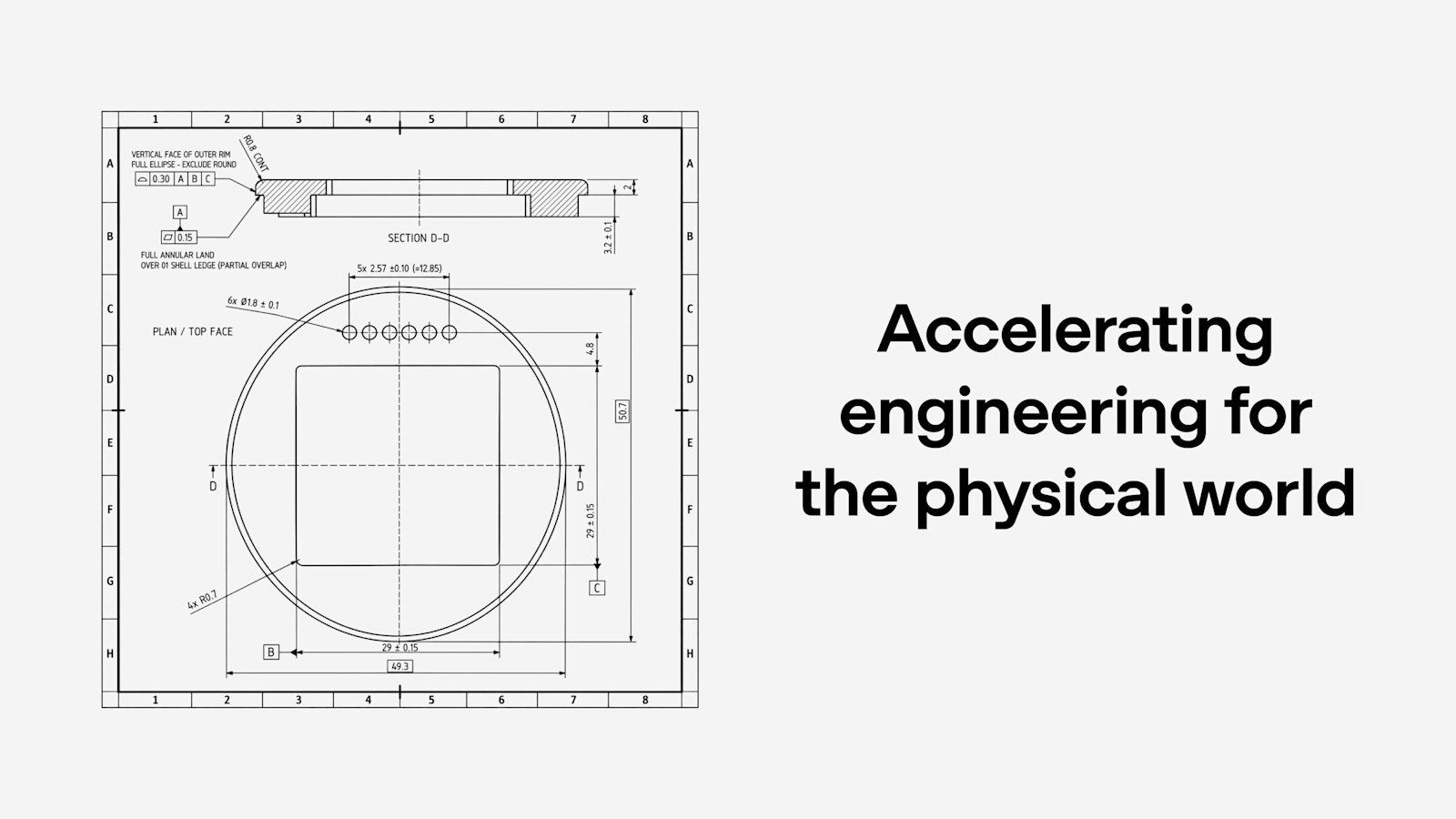
On November 3, OpenAI published "Accelerating engineering for the physical world," describing how its models help with mechanical design, electrical design and simulation. Two employees used GPT-6 Astra to design a device for talking to Codex (enclosure, PCB, firmware and software) in under a week, and a contract manufacturer built a small prototype batch in under a month, though manufacturing readiness still took several rounds of human review. Token usage across OpenAI hardware teams has grown 23-fold since February. On BenchCAD 2.0, a newer internal model averaged 0.875 versus 0.594 for GPT-6 Astra at its highest reasoning setting (OpenAI-reported). OpenAI is also expanding its work with Chip Ganassi Racing and announced a new research collaboration with Mazda.

OpenAI Shares Progress on ChatGPT and Codex for Hardware Engineering: GPT-6 Astra Designs a Codex Device in Under a Week, Mazda Joins for Aerodynamics Research

Key Takeaways

  • In a test with no direct human edits, GPT-6 Astra handled the look, enclosure structure, component selection, PCB layout, UI and firmware; two employees finished the design in under a week as a side project, and prototypes came back in under a month, per the OpenAI blog.
  • OpenAI names the gaps: Astra did not consistently account for the manufacturer's production limits, tolerances or assembly details, so manufacturing readiness took several rounds of review.
  • OpenAI hardware and infrastructure teams use Codex and ChatGPT for CAD models, 2D manufacturing drawings, simulation and FEA setup, and design reviews; token usage has grown 23-fold since February (OpenAI-reported).
  • BenchCAD 2.0 (reconstructing 3D parts and assemblies, identifying circuit-board connections): a newer internal model scored 0.875 versus 0.594 for GPT-6 Astra at its highest reasoning setting (OpenAI-reported; the internal model is unnamed and unreleased).
  • Collaborators: Chip Ganassi Racing is testing 3D-scan-to-editable-CAD and 2D drawing workflows; Mazda is working with OpenAI researchers on airflow and structural simulations for vehicle design, with results promised "in the coming months."
Read full story

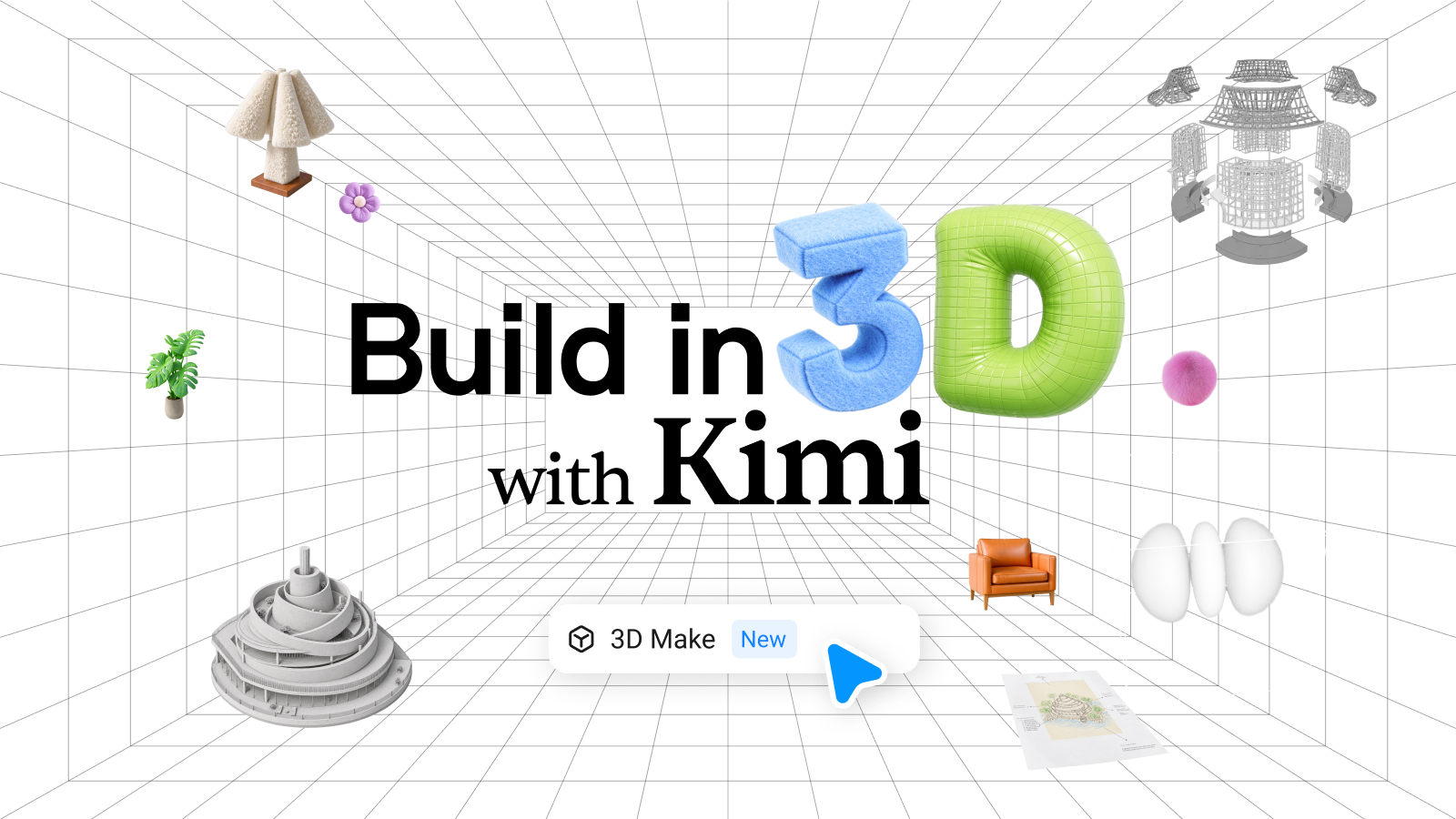
Kimi launches 3D Make: K3.1 Pro drives Blender, CAD tools and Unreal, Unity and Godot to build models, scenes and games

Moonshot AI's official Kimi account announced 3D Make at 03:14 UTC on Oct 30, saying Kimi connects to tools such as Blender and CAD software to create models, assemble scenes and develop games, available now on kimi.ai and Kimi Work. The companion 3D guide says K3.1 Pro was specifically trained to drive 3D software through Python scripts, so specialized tools without MCP support can join the workflow, while meshes such as people and animals are handed to diffusion services like Tripo. Plugins that need locally installed software work only in Kimi Work.

Kimi launches 3D Make: K3.1 Pro drives Blender, CAD tools and Unreal, Unity and Godot to build models, scenes and games

Key Takeaways

  • Availability: 3D Make is live on kimi.ai and Kimi Work; plugins that need locally installed software are Kimi Work only
  • Two modeling routes: parametric models (furniture, mechanical parts, buildings) via Python scripts written by K3.1 Pro, and meshes via services such as Tripo, Meshy and Hyper3D
  • Engines: Kimi says it is adapted to Unreal Engine, Unity and Godot to import models, assemble scenes and build gameplay step by step
  • Showcase: the celestial palace in the K3.1 Pro launch video was built in Unreal Engine 5.8 from source models totaling 36 million triangles, rendered with Nanite and Lumen
  • Benchmarks: no 3D benchmarks were published; the guide admits some tasks need several rounds, and rigging and complex materials remain weak spots
Read full story

GitHub Universe 2026: Copilot Fusion is generally available, routing and orchestrating models automatically, with Fusion Max scoring 60 on the Artificial Analysis Coding Agent Index at about half the cost of Claude Code with Opus 5.5 Max

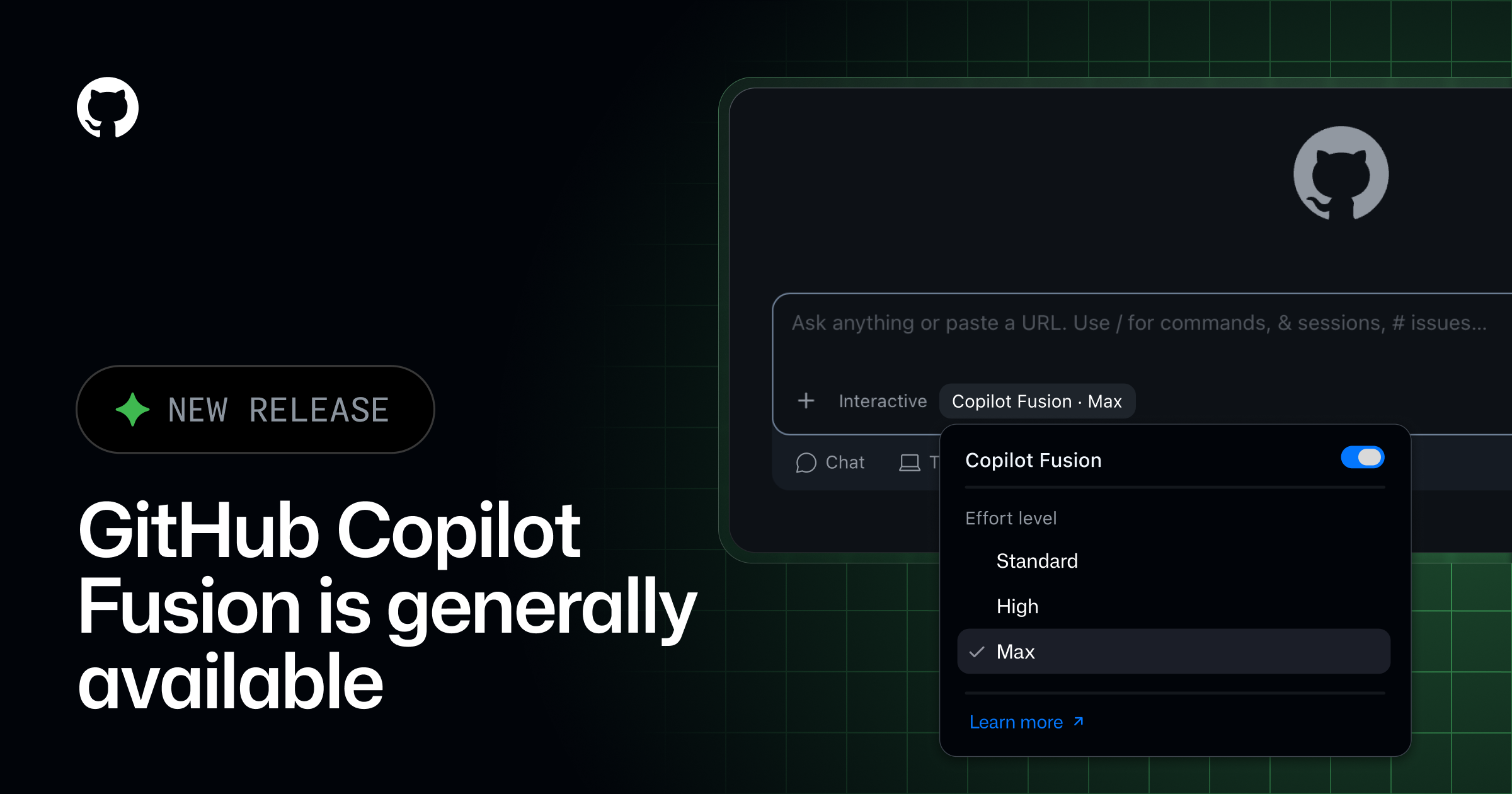
At GitHub Universe 2026 on Oct 28, GitHub made Copilot Fusion generally available. It merges the multi-model orchestration of the Project HydraFusion research preview with Copilot auto model selection: users pick Copilot Fusion and an effort level (Standard, High or Max) in the model picker, and the system decides which models to use and whether to run a Single, Cascade or Critique workflow. GitHub says Fusion Max scored 60 on the Artificial Analysis Coding Agent Index, two points below Claude Code with Opus 5.5 Max, at about half the API cost per task, about half the tokens and about 40% less time. Each underlying model is billed at its standard rate, and paid plans get 30% off through Nov 30.

GitHub Universe 2026: Copilot Fusion is generally available, routing and orchestrating models automatically, with Fusion Max scoring 60 on the Artificial Analysis Coding Agent Index at about half the cost of Claude Code with Opus 5.5 Max

Key Takeaways

  • Scores (Artificial Analysis Coding Agent Index v2.0): Fusion Max 60 versus 62 for Claude Code with Opus 5.5 Max; $5.59 per task versus $11.42, while the Devin Fusion pairing scores 62 at $8.00
  • Breakdown: a slight lead on Terminal-Bench 4.0 at 71, third on FrontierCode at 51 (Claude Code 56, Devin Fusion 54), and a weaker 57 on SWE-Atlas-QnA-AA
  • Efficiency: about 7.2M tokens per task, roughly half of Claude Code with Opus 5.5 and 30% fewer than Devin Fusion; GitHub reports about 40% less time per task
  • The pool includes Claude Opus 5.5, Claude Sonnet 5.5, GPT-6 Astra and GPT-6 Sol; admins can disable individual models for Fusion only and set Fusion as the default
  • Availability: all Copilot plans in VS Code, the Copilot app, Copilot CLI and JetBrains IDEs; existing auto, HydraFusion and HydraFusion Max selections migrate to matching effort levels
Read full story
ADSponsored

Cadence launches Maestro, a domain-specialized AI model portfolio for agentic chip and system design built in part on NVIDIA Nemotron, claiming up to 30% better results and 5x token efficiency

EDA leader Cadence announced the Maestro AI Model Portfolio on October 26: domain post-trained LLMs, trained decision models and self-improving agent skills that power its AuraStack, ChipStack, InnoStack and ViraStack AI Super Agents as they drive Cadence EDA and SDA tools. Cadence solvers score outputs against engineering constraints to close a reinforcement learning loop. Initial results per Cadence show up to 30% higher quality and up to 5x token efficiency versus a general-purpose foundation model. NVIDIA contributes Nemotron and OpenShell, and the stack runs on Cadence cloud, public cloud or on-premises. The first models reach select early access customers in Q4 2026.

Key Takeaways

  • Maestro is a portfolio, not one model: domain post-trained LLMs, decision models and self-improving agent skills, mixed with frontier and open-weight models per task
  • Deterministic solvers and EDA tools score outputs against engineering objectives and constraints, feeding a verified reinforcement learning loop
  • Per Cadence: up to 30% higher quality of results and up to 5x token efficiency versus a general-purpose foundation model; no third-party evaluation yet
  • NVIDIA supplies Nemotron models and the OpenShell sandbox reference architecture; customers can post-train on their own designs and run on-premises
  • First models go only to select early access customers in Q4 2026; Socionext expects up to 5x productivity from deploying InnoStack
Read full story

X discussion: a new paper from Harvard's Gary King says AI article reviews beat top human peer reviews "by every measure we could construct", and Ethan Mollick urges academia to adapt fast

At 00:27 UTC on 2026-10-23, Harvard social scientist Gary King (@kinggary) posted a new paper with Steven Worthington, "AI Article Reviews Dominate Human Peer Reviews at Their Best: Evidence and Policy Choices". Its abstract says AI-generated reviews are now better, by every measure the authors could construct, than reviews by well-compensated human experts that editors and authors judged to be unusually good. Wharton professor Ethan Mollick (@emollick) then wrote that the study covers 124 Harvard social science papers and used Claude Opus 4.8, and that academics need to figure out how to adapt science to AI fast; his post had about 1,675 likes and 97K views. The topic was still on X's trending news list over the past 12 hours. This is an X discussion of a single paper, not a conclusion from any journal or from Anthropic.

Key Takeaways

  • The paper is by Harvard's Gary King and Steven Worthington; its page says it was last updated on 2026-10-22 (paper page; King's post, about 472 likes, 121K views and 371 bookmarks when we pulled it)
  • In the abstract's words, AI reviews are better "by every measure we could construct" than reviews by "well-compensated" human experts judged to be of "unusually high quality"; the paper also discusses journal policy choices and their "concerning downsides"
  • Ethan Mollick's post (post) says the study used Claude Opus 4.8 on 124 papers; it had about 1,675 likes, 97K views and 249 replies when we pulled it
  • Many reposts on X also cite figures such as "former journal editors picked the AI review 87% of the time" and "5.5% vs 15.9% wrong claims"; we have not checked each of these against the paper itself, so treat the paper as the source of record
Read full story
Linked Models & Agents:

Moonshot launches Kimi K3.1 Pro: 2.8T-total / 104B-active open-weight MoE with 1M context, 65.7% on Terminal-Bench 4.0, API at $2/$10, weights by Nov 4

On 2026-10-23 (17:15 UTC) the official @Kimi_Moonshot account launched Kimi K3.1 Pro, alongside K3.1 Pro Highspeed (2-3x faster). Both are live on Kimi.ai, Kimi Work, Kimi Code and the Kimi API, and full weights are promised by 2026-11-04. The official tech blog describes it as a post-trained version of K3 with much larger multi-domain joint RL: a 2.8T-total / 104B-active MoE, 1M-token context, multimodal. Vendor-reported scores: 65.7% on Terminal-Bench 4.0 (GPT-6 Astra 58.2%, Claude Opus 5.5 66.4%) and 92.7% on BenchCAD with tools. The Kimi API pricing page lists kimi-k3.1-pro at $2 input, $10 output and $0.20 cached input per million tokens, down from K3 at $3/$15.

Moonshot launches Kimi K3.1 Pro: 2.8T-total / 104B-active open-weight MoE with 1M context, 65.7% on Terminal-Bench 4.0, API at $2/$10, weights by Nov 4

Key Takeaways

  • 2.8T-total / 104B-active MoE, 1M-token context, multimodal; full weights promised by 2026-11-04 (official blog)
  • Vendor-reported: 65.7% on Terminal-Bench 4.0, ahead of GPT-6 Astra (58.2%) and just behind Claude Opus 5.5 (66.4%); 61.2% on the internal Kimi Code Bench 3.0 Long-horizon (K3: 55.95%)
  • API pricing: kimi-k3.1-pro at $2 input / $10 output / $0.20 cached input per million tokens; Highspeed at $4 / $20 (pricing page)
  • On the internal Kimi Hallu Bench Hard stress test, claim-level hallucination fell from 23.4% (K3) to 8.3%; Moonshot notes this is not a daily-use error rate
  • Cyber-related data was removed from mid-training and RL for the open-weight release: xdev-bench-hard pass@3 drops from 90.5% (unmitigated checkpoint) to 81.0%
Read full story
Linked Models & Agents:

FocusGUI: Focused Omni-Modal GUI Agents Slashing Sequential Distraction and Doubling Type Match to 64.2%

Researchers from Alibaba and collaborating academic institutions introduced FocusGUI in arXiv:2610.26203, establishing a focused attention architecture for streaming omni-modal GUI agents. Across streaming observations of continuous UI screenshots, synchronous audio, and device state histories, agents routinely suffer from 'Sequential Distraction'—where transient visual clutter from previous steps compounds into catastrophic action hallucination. FocusGUI preserves the base model while introducing action-sufficient projection and channel decomposition. Tested across 29 smartphone apps on OmniGUI, FocusGUI elevates Type Match from 31.0% to 64.2% and Exact Match from 11.2% to 33.5% across four omni-modal foundation backbones.

FocusGUI: Focused Omni-Modal GUI Agents Slashing Sequential Distraction and Doubling Type Match to 64.2%

Key Takeaways

  • FocusGUI introduced in arXiv:2610.26203 by Alibaba researchers, solving Sequential Distraction in streaming multimodal GUI automation
  • Integrates action-sufficient projection and channel decomposition to dynamically prune transient visual and audio clutter
  • On the OmniGUI benchmark (29 apps, 2,572 steps), doubles average Type Match from 31.0% to 64.2% and triples Exact Match to 33.5%
  • Readily enhances Qwen2.5-Omni, MiniCPM-o 4.5, VITA-1.5, and Baichuan-Omni without requiring end-to-end backbone retraining
Read full story
Linked Models & Agents:
⚡ Qwen2.5-Omni⚡ MiniCPM-o 4.5⚡ VITA-1.5⚡ Baichuan-Omni-1.5🤖 FocusGUI🌐 Alibaba

Skyfall AI unveils SKY-001, an engineering world model that turns text or sketches into executable CAD build steps, claiming 51x faster and 150x cheaper than GPT-6 Astra on CAD

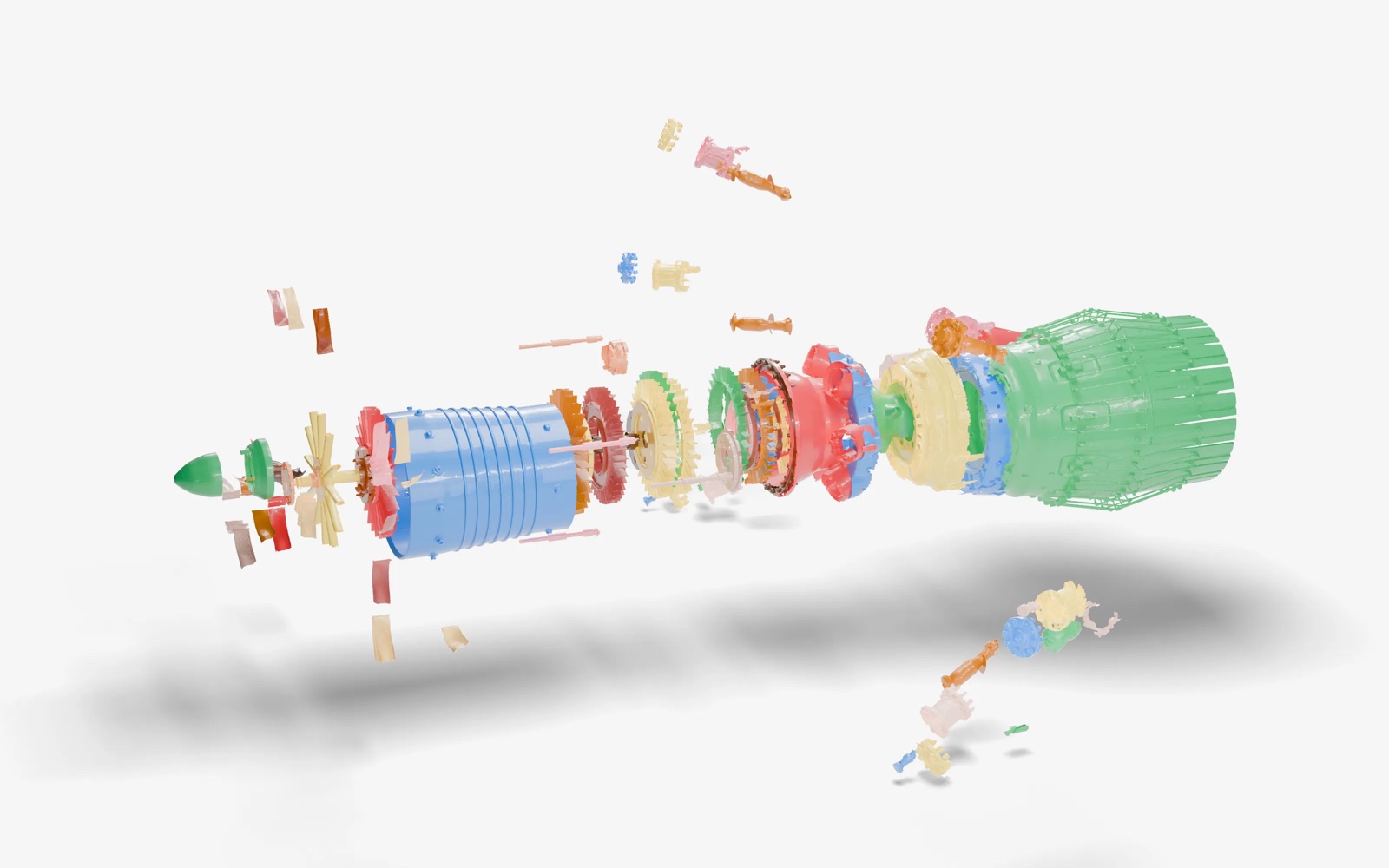
Skyfall AI, founded by the team behind Maluuba (acquired by Microsoft), released a research preview of SKY-001 on October 19, billing it as the first engineering world model. Instead of next-token prediction, it starts from text or a 2D image, generates several rough 3D options in parallel, recursively decomposes the chosen design into a parts tree, sketches and extrudes each part, then assembles them hierarchically for viewing in CAD tools such as Autodesk Fusion. On its own 3D CAD test it reports 79.7% IoU versus 79.1% for GPT-6 Astra, at 3.9 s and $0.005 per case versus 199 s and $0.75. Access is waitlist-only, with commercial deployment targeted for early 2027; all benchmarks are self-reported.

Skyfall AI unveils SKY-001, an engineering world model that turns text or sketches into executable CAD build steps, claiming 51x faster and 150x cheaper than GPT-6 Astra on CAD

Key Takeaways

  • 3D CAD (self-reported): SKY-001 79.7% IoU, 3.9 s, $0.005 per case; GPT-6 Astra 79.1%, 199 s, $0.75; Opus 5.5 69.4%; Grok 4.7 completed none.
  • BIM (self-reported): SKY-001 43.6% IoU, 1.22 s, about $0.0024 per case; best LLM Gemini 3.8 Flash at 42.3%; 118x faster and 188x cheaper than GPT-6 Astra.
  • Four stages: parallel design exploration, recursive diffusion-based 3D decomposition, 2D-to-3D latent modeling, hierarchical assembly; the Jaguar E-Type demo yields 103 leaf parts and 139 nodes.
  • Availability: research preview behind a waitlist; the press release targets commercial deployment in early 2027; parameter count, training data and API pricing are not disclosed.
  • Team: Maluuba founders Sam Pasupalak, Kaheer Suleman and Sumit Pasupalak; backers include Fidelity, Touring Capital, M13 and iNovia Capital.
Read full story

Cloudflare launches Clairic, a System One extraction model that returns typed values, dates and forecasts with confidence in one forward pass, in preview on Workers AI at $0.10 per million input tokens

On October 19 Cloudflare released a preview of Clairic, a "System One extraction model". Instead of generating tokens, it uses one parallel forward pass to extract, compute, estimate and forecast typed values from text or up to 4 images, with confidence, character spans and a null probability for each answer, returning null when a value is missing. It is live on Workers AI as @cf/cloudflare/clairic; the docs list a 64K context, vision support and $0.10 per million input tokens with no output charge. In Cloudflare's example, a Clairic+Clef+GLM-5.3 cascade ran about 3.2x faster and about 49% cheaper than GLM-5.3 alone (company figures). Open weights are planned later.

Cloudflare launches Clairic, a System One extraction model that returns typed values, dates and forecasts with confidence in one forward pass, in preview on Workers AI at $0.10 per million input tokens

Key Takeaways

  • Pricing and specs: $0.10 per million input tokens, no output charge, 65,536-token context, text plus up to 4 images (official docs).
  • Output types: text, number, date/time, duration, list, estimate, forecast; each answer carries confidence and p_null, and missing values return null.
  • Cascade test: Clairic to Clef to GLM-5.3 took 19.3 s vs 61.7 s, about 3.2x faster; $6,032 vs $11,740 per million claims, about 49% cheaper (company figures).
  • Forecast example: 21-day TSA checkpoint forecast averaged 3.3% error, with 17 of 21 days inside the 80% interval.
  • Limits: long arithmetic chains and multi-row aggregation are not reliable yet; it is a preview checkpoint with no date for open weights.
Read full story
Linked Models & Agents:
⚡ clairic⚡ clef⚡ GLM-5.3🌐 cloudflare
ADSponsored

GitHub Copilot updates HydraFusion and adds HydraFusion Max, with Claude Opus 5.5 and the GPT-6 family in its model pool

On 2026-10-14 GitHub updated HydraFusion, Copilot's multi-model orchestration feature, and added HydraFusion Max for harder tasks. The pool now includes Claude Opus 5.5, GPT-6 Astra, GPT-6.1 Sol and GPT-6 Luna; effort is tuned per stage (medium for drafts, high for review), Cascade gains a judging step, and Critique now inspects the workspace with tools using parallel critics. Both remain in research preview across VS Code, the Copilot app and Copilot CLI.

Key Takeaways

  • Pool: Claude Opus 5.5, GPT-6 Astra, GPT-6.1 Sol, GPT-6 Luna, chosen per workflow (GitHub Changelog)
  • Per-stage effort: medium for drafts, high for review (previously each model's default)
  • Cascade adds a judge that requests repair only when needed; Critique uses tools on the workspace plus parallel critics
  • Two tiers: HydraFusion (balanced) and HydraFusion Max (deepest reasoning, orchestration still minds tokens)
  • Available in VS Code, Copilot app and Copilot CLI on Pro, Pro+, Business and Enterprise with preview features enabled
Read full story

Tencent Hunyuan Releases LifeSearch: The First Real-World Life & Productivity Benchmark for Deep Research Agents, 4,500 Hours of Human Annotation Shows Frontier SOTA at Just 63.4%

While deep research (DR) agents excel on synthetic and academic queries, their reliability in realistic personal life and professional workflows remains uncharted. Tencent Hunyuan introduces LifeSearch, a rigorous benchmark featuring 203 real-user tasks across 7 domains backed by 4,500+ hours of expert annotation and 4,000+ fine-grained rubrics. Evaluating 12 leading DR agents reveals that the strongest frontier agent scores only 63.4%, unmasking persistent bottlenecks in multi-step information synthesis and constraint verification.

Tencent Hunyuan Releases LifeSearch: The First Real-World Life & Productivity Benchmark for Deep Research Agents, 4,500 Hours of Human Annotation Shows Frontier SOTA at Just 63.4%

Key Takeaways

  • Pioneering real-world life & productivity testbed: spans 203 bilingual tasks across 7 realistic domains including travel itinerary synthesis, procurement, and healthcare analysis
  • 4,500 hours and 4,000+ expert rubrics: evaluates both synthesized report depth and concrete attributes (exact values, units, dates, and live URLs) with Spearman rank correlation of 0.89
  • Revealing severe frontier agent limits: the highest-performing deep research agent scores a modest 63.4%, exposing widespread failures in temporal conflict resolution and deep search navigation
Read full story

Cadence Framework Published: Strategic Runtime Monitoring for Coding Agents Lifts SWE-bench Lite Resolve Rate by 25.33%

When autonomous LLM coding agents tackle complex software maintenance tasks, early minor missteps frequently compound into unrecoverable cascading failures. Existing runtime monitors struggle due to static guidance schemes: fixed-interval periodic checks introduce substantial token overhead during healthy executions while failing to intervene promptly during critical errors, and heuristic rule-based monitors fail to detect subtle reasoning errors in natural language. Researchers from Singapore Management University and University College London introduce Cadence (arXiv:2610.12269), a dynamic runtime monitoring framework delivering strategic guidance conditioned on real-time execution health. Cadence integrates a Two-Tier Intervention Module—supplying non-blocking advisory-level advice for minor lapses while enforcing replacement-level overrides (discarding erroneous actions and mandating step regeneration) during severe breakdowns—with an adaptive Inspection Scheduler that tightens supervision after replacement actions and relaxes monitoring intervals following advisory guidance. Evaluated on 300 SWE-bench Lite tasks across mini-swe-agent and Moatless, Cadence improves task resolve rates by 25.33% (+76 tasks) and 15.67% (+47 tasks) respectively over unmonitored baselines, while achieving up to 29.93% token savings compared with leading runtime monitors.

Key Takeaways

  • Cadence introduces dynamic runtime monitoring conditioned on real-time execution health for LLM coding agents
  • Combines two-tier interventions with adaptive scheduling, boosting SWE-bench Lite resolve rate by 25.33% (+76 tasks)
  • Achieves up to 29.93% token savings over state-of-the-art runtime monitors by dynamically relaxing supervision
Read full story

Beyond Pure Neural Prompt Loops: ABCAgent Treats Agent Behavior as Code, Achieving Over 92% Reusability and Robust Execution

Mainstream LLM agents predominantly rely on purely neural orchestration loops (such as ReAct), generating each step, tool call, and control decision through unconstrained language token generation. This paradigm suffers from high API latency, steep operational costs, rapid error cascading, and an inability to reuse verified execution logic across recurring task instances. Researchers from Uniphore introduce ABCAgent (arXiv:2610.04824), an innovative neuro-symbolic framework treating Agent Behavior as Code. ABCAgent decouples agent design from execution: a foundation model serves as a runtime designer to author and edit explicit programmatic specifications (Python programs with embedded neural functions), while a deterministic executor handles control flow, variable bindings, and state transitions. Evaluated across GAIA, Augmented GAIA, GSM-Symbolic, τ²-bench, and WorkArena, ABCAgent matches or exceeds neural agent accuracy while demonstrating superior stability. Crucially, it solves 92.6% of GSM-Symbolic and 20.1% of Augmented GAIA task instances without code synthesis simply by rebinding parameters into existing programs, slashing latency and inference overhead.

Key Takeaways

  • ABCAgent introduces a neuro-symbolic framework specifying agent behavior as executable Python programs
  • Solves 92.6% of GSM-Symbolic tasks via parameter rebinding without LLM re-authoring, drastically cutting cost and latency
  • Exhibits superior stability on τ²-bench and WorkArena over neural loops, eliminating error compounding in loops
Read full story

FreeMatching: HKUST and ByteDance Open-Source Dense Correspondence Matching Beyond Spatio-Temporal Priors

Dense correspondence matching serves as the bedrock for optical flow, 3D stereo reconstruction, and object tracking. For decades, classical matching algorithms have fundamentally relied on rigid spatio-temporal priors: smooth motion continuity and rigid geometry. However, these foundational assumptions collapse under modern AI image editing and reference-guided generation (IEG), where visual identity is preserved while physical and geometric continuity is drastically severed (such as radical pose warps, stylistic shifts, or compositional recontextualization). Researchers from HKUST and ByteDance introduce FreeMatching (arXiv:2610.12421, code: github.com/luping-liu/FreeMatching), a generalizable framework for dense correspondence matching beyond spatio-temporal priors. FreeMatching fuses generative foundation features (from diffusion backbones) with high-level semantic representations (from vision foundation models), trained against heterogeneous supervision spanning classical benchmarks, tracked video sequences, and synthetic 3D scenes. An unsupervised teacher-guided iterative refinement loop further sharpens dense correspondences across challenging generated image pairs without requiring dense manual annotations. FreeMatching achieves dramatic leaps in correspondence precision across complex AI-edited image pairs while retaining competitive accuracy on classical optical flow tasks, and serves as an auditable quantitative metric for evaluating visual identity preservation that closely aligns with human judgment.

Key Takeaways

  • HKUST and ByteDance open-source FreeMatching, breaking free from traditional spatio-temporal priors in dense correspondence
  • Cuts end-point error by 42.6% and raises PCK by 31.8 percentage points across aggressive AI image edits and non-rigid transformations
  • Establishes a quantitative identity preservation metric highly correlated with human judgment (r = 0.88), fully available on GitHub
Read full story
Linked Models & Agents: