AI Coding Live News

OpenCode team ships Hex 3.0 stable: local voice dictation for Mac, Windows and Linux, built for talking to coding agents

Anomaly, the company behind open-source coding agent OpenCode, shipped Hex 3.0 stable: hold a shortcut, speak, and the text is pasted at your cursor. Recognition runs on-device, local model memory drops from about 900 MB to about 160 MB, and it adds vocabulary hints, a hex CLI and optional OpenCode rewriting.
OpenCode team ships Hex 3.0 stable: local voice dictation for Mac, Windows and Linux, built for talking to coding agents

Key Takeaways

  • Hex v3.0.0 was released on GitHub at 00:38 UTC on Oct 31; it is MIT-licensed, written in Rust, and the repo has about 1,557 stars (release notes)
  • Vendor figures: local model memory drops from about 900 MB to about 160 MB; since 2.3.0 it streams, so a 2-minute dictation finishes about 0.1 s after release on an RTX 5070 Ti
  • Runs on macOS 15+ (Apple silicon), Windows x64/ARM64 and Linux x64/ARM64, with new .deb and .rpm packages on Linux
  • 3.0 does not auto-update from 2.3.1 and starts fresh, so settings, History and models must be set up again; Voice Action and spoken commands are removed
  • The @opencode launch post drew about 2,400 likes, 1,600 bookmarks and 100k+ views (post)
Read full story
Linked Models & Agents:
⚡ Parakeet⚡ Whisper🤖 OpenCode🤖 Hex🌐 Anomaly

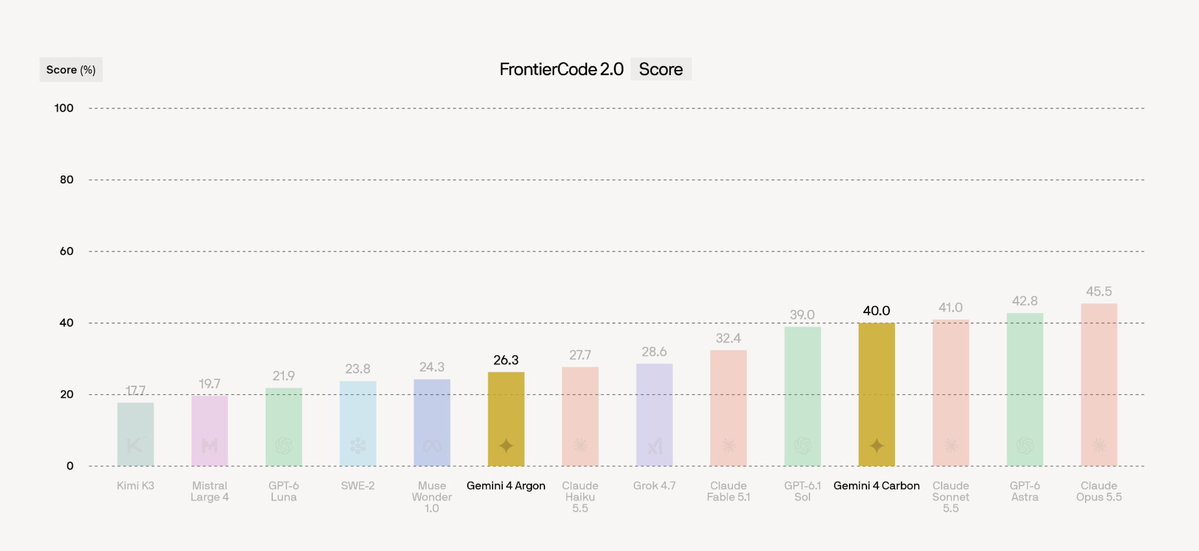
Cognition scores Gemini 4 Carbon at 40% on FrontierCode 2.0 for $4.04 a task, near the top, while Gemini 4 Argon gets 26.3% at $6.41

Cognition, the company behind Devin, posted on X at 01:45 UTC on Oct 30 that Google's new Gemini 4 Carbon scores 40% on its FrontierCode 2.0 coding benchmark at $4.04 per task, near the top and behind only Claude Opus 5.5, GPT-6 Astra and Claude Sonnet 5.5. The earlier Gemini 4 Argon scores 26.3% at a higher $6.41 per task. The results are Cognition's own runs, and the leaderboard on its site has been updated.

Cognition scores Gemini 4 Carbon at 40% on FrontierCode 2.0 for $4.04 a task, near the top, while Gemini 4 Argon gets 26.3% at $6.41

Key Takeaways

  • Gemini 4 Carbon scores 40% on FrontierCode 2.0 at $4.04 per task, behind Claude Opus 5.5 (45.5%), GPT-6 Astra (42.8%) and Claude Sonnet 5.5 (post)
  • Gemini 4 Argon scores 26.3% at $6.41 per task, ahead of Muse Wonder 1.0 but behind Claude Haiku 5.5 and Grok 4.7
  • From Argon to Carbon the score rises about 13.7 points while cost per task drops about $2.37
  • The changelog shows Gemini 4 Carbon was added on Oct 28; FrontierCode 2.0 has 132 tasks scored on whether a maintainer would merge the PR (leaderboard)
  • All figures are Cognition's own runs; Google has not published FrontierCode results itself
Read full story

Cognition acquires AI-native security company Corridor, folding its team into Devin Security

Cognition, the company behind Devin, announced on Oct 29 via its official @cognition account that it is acquiring Corridor. In a post on Cognition's official blog dated 2026.10.28, Corridor co-founders Jack Cable and Ashwin Ramaswami said the team is joining Cognition to take Devin Security to the next level. Corridor, founded almost two years ago, positions itself as the security layer for AI-native teams. Deal terms were not disclosed.

Cognition acquires AI-native security company Corridor, folding its team into Devin Security

Key Takeaways

  • Cognition is acquiring Corridor, and the team joins the Devin Security effort
  • Corridor co-founders Jack Cable and Ashwin Ramaswami will work with Cognition President Russell Kaplan, CSO Alex Stamos and CTO Steven Hao
  • Official view: AI agents can now run end-to-end attack chains, and the next 6 to 12 months are the most consequential period in cybersecurity
  • Deal terms were not disclosed
Read full story

Artificial Analysis launches Intelligence Index v5: 60% private test sets, Claude Opus 5.5 leads at 58 and the open-weights gap widens to 12 points

On Oct 28 independent evaluator Artificial Analysis released Intelligence Index v5, its biggest revision since v4 in January: it adds Cognition's FrontierCode 2.0 and Terminal-Bench-Science, swaps Humanity's Last Exam for HLE-Diamond, and now draws 60% of its weight from private or held-out test sets. Claude Opus 5.5 (max) leads at 58, ahead of GPT-6 Astra at 57 and GPT-6.1 Sol at 55; the top open-weights model, Kimi K3.1 Pro (weights not yet released), scores 46, widening the gap from 3 points in v4.3 to 12. It also launched Progress Index v1 for comparing models across years.

Artificial Analysis launches Intelligence Index v5: 60% private test sets, Claude Opus 5.5 leads at 58 and the open-weights gap widens to 12 points

Key Takeaways

  • Overall (vendor-reported by Artificial Analysis): Claude Opus 5.5 (max) 58, GPT-6 Astra (max) 57, GPT-6.1 Sol (max) 55; Anthropic and OpenAI hold the top five, with Gemini 4 Argon (high) next at 50
  • The open-weights gap grows from 3 to 12 points: Kimi K3.1 Pro scores 46, while released-weight leaders DeepSeek V4.1 Flash 1017 and GLM-5.3 (max) score 32, below Claude Haiku 5.5 (max) at 36
  • Cost per task varies more than 13x: among the top 10, GPT-6.1 Terra (max) is cheapest at $0.96 and Claude Fable 5.1 (max) priciest at $13.04; GPT-6.1 Sol trails Opus 5.5 by 4 points at about one eighth the cost ($1.27 vs $10.04)
  • Four categories at 25% each: Knowledge Work, Coding (FrontierCode 2.0 15%, Terminal-Bench 4.0 10%), Science and General; GDPval-AA v2.1, SciCode and AA-LCR were removed
  • Tasks are heavier: median output tokens per task rose from 35k to 59k, and effort matters more, with Opus 5.5 scoring 35 at low effort vs 58 at max for 10x the cost
Read full story
ADSponsored

Cognition launches FrontierCode 2.0 coding benchmark: it asks whether a PR should be merged, and top model Claude Opus 5.5 scores just 45.5%

Cognition, the maker of Devin, released FrontierCode 2.0 on Oct 27. It keeps the method of maintainer-written tasks graded on whether the code is actually mergeable, but draws tasks from more repositories, adds security patches and performance work, uses deliberately underspecified prompts and adds many thoroughness criteria. In Cognition's results Claude Opus 5.5 leads at 45.5%, GPT-6 Astra follows at 42.8%, and Grok 4.7 and Gemini 4 Argon drop into the 20s, leaving the benchmark far from saturated.

Cognition launches FrontierCode 2.0 coding benchmark: it asks whether a PR should be merged, and top model Claude Opus 5.5 scores just 45.5%

Key Takeaways

  • Claude Opus 5.5 leads at 45.5% (54.6% on v1.1) and GPT-6 Astra scores 42.8% (53.3% on v1.1), per Cognition (vendor-reported)
  • Grok 4.7 scores 28.6%, Gemini 4 Argon 26.3%, Muse Wonder 1.0 24.3%, SWE-2 23.9%, DeepSeek V4.1 Flash 19.3% and Kimi K3 17.7%, showing a wide gap for open models
  • Versus v1.1, reference solutions touch 67% more files and 89% more lines in codebases 25% larger; tasks come from 55% more repositories with 43% more blocking criteria
  • Thoroughness blockers grew from 168 to 501, about 3x; in 80% of tasks the reference solution improves on the upstream PR, and an audit agent found and reported an upstream security vulnerability
  • On the cost-score Pareto frontier, Opus 5.5 sits at the high end and Luna, Haiku and Sol at the low-cost end, with GPT-6.1 Sol called out for strong value (official blog)
Read full story

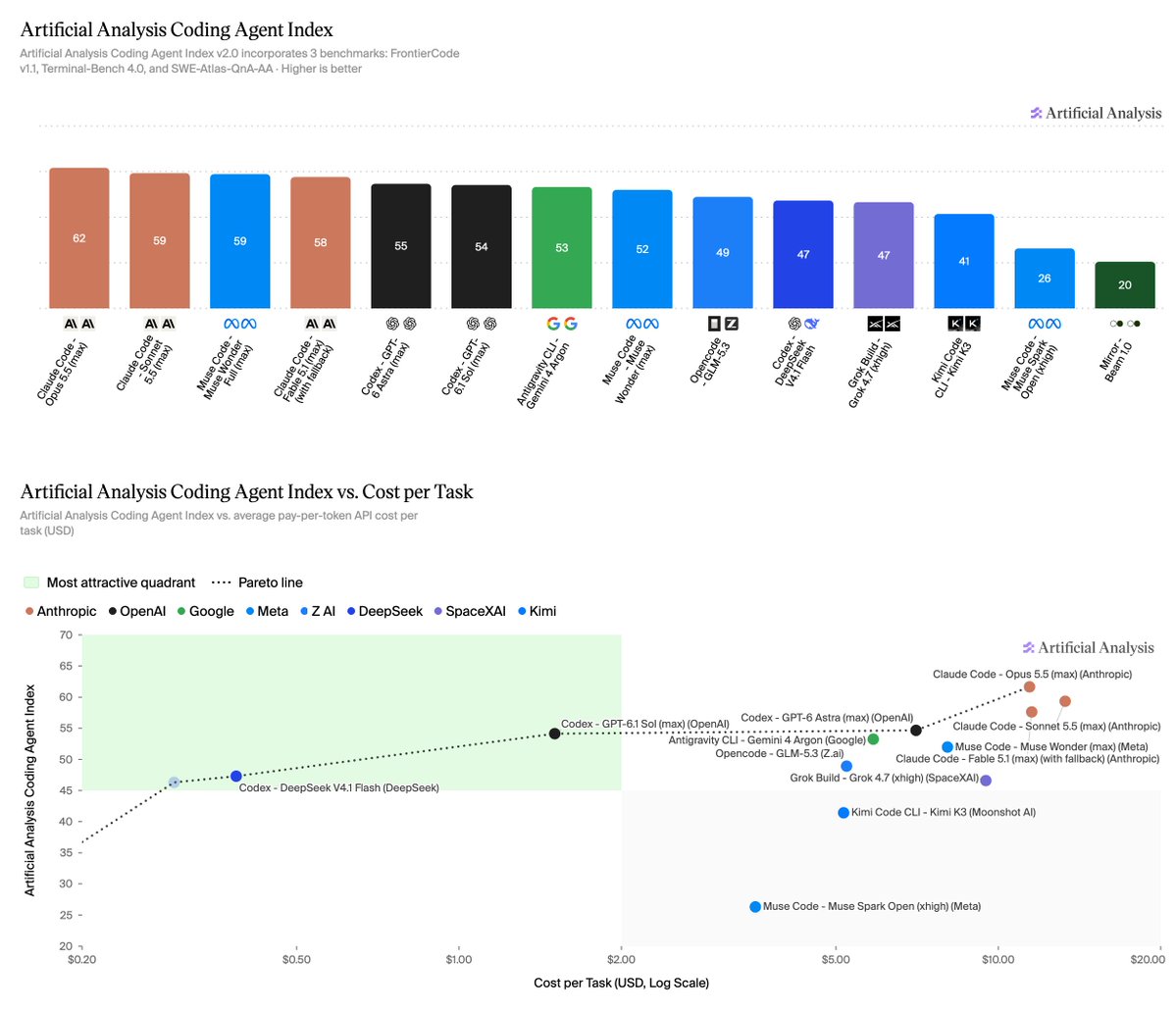
Artificial Analysis launches Coding Agent Index v2.0: FrontierCode from Cognition replaces DeepSWE, and Claude Code with Opus 5.5 leads at 61.7

On 2026-10-23 Artificial Analysis launched Coding Agent Index v2.0, which scores model-plus-harness combinations across 290 tasks with three equally weighted benchmarks: FrontierCode v1.1 from Cognition (100 tasks on real open-source repos, graded on whether a maintainer would merge the change) replaces DeepSWE v1.1, SWE-Atlas-QnA becomes the stricter SWE-Atlas-QnA-AA, and Terminal-Bench 4.0 is unchanged. Claude Code with Claude Opus 5.5 (max) leads at 61.7, ahead of Sonnet 5.5 at 59.3 and Muse Wonder Full at 58.9. Scores fall across the board: the 21 configurations measured on both versions drop from a mean of 54.8 to 47.4.

Artificial Analysis launches Coding Agent Index v2.0: FrontierCode from Cognition replaces DeepSWE, and Claude Code with Opus 5.5 leads at 61.7

Key Takeaways

  • Top of the index: Claude Code with Claude Opus 5.5 (max) 61.7, Claude Sonnet 5.5 (max) 59.3, Muse Code with Muse Wonder Full (max) 58.9, Claude Fable 5.1 (max with fallback) 57.6 (Artificial Analysis figures)
  • On FrontierCode v1.1, Opus 5.5 scores 56.0%, ahead of Codex with DeepSeek V4.1 Flash at 52.6%; 15 of 24 configurations sit between 43% and 49%
  • Version shift: 21 configurations average 54.8 on v1.5 and 47.4 on v2.0, with 20 of 21 moving down; the same set averages 45.1% on FrontierCode versus 65.6% on DeepSWE
  • Four points on the cost frontier: DeepSeek V4.1 Flash 47.3 at $0.39 per task, GPT-6.1 Sol 54.1 at $1.50, GPT-6 Astra 54.7 at $7.04, Opus 5.5 61.7 at $11.42 (pay-per-token API costs, not subscriptions)
  • SWE-Atlas-QnA-AA rewords 127 of 1,306 rubric criteria and uses GPT-6 Luna (xhigh) as judge with five votes per criterion; dataset and judge config are on Hugging Face
Read full story

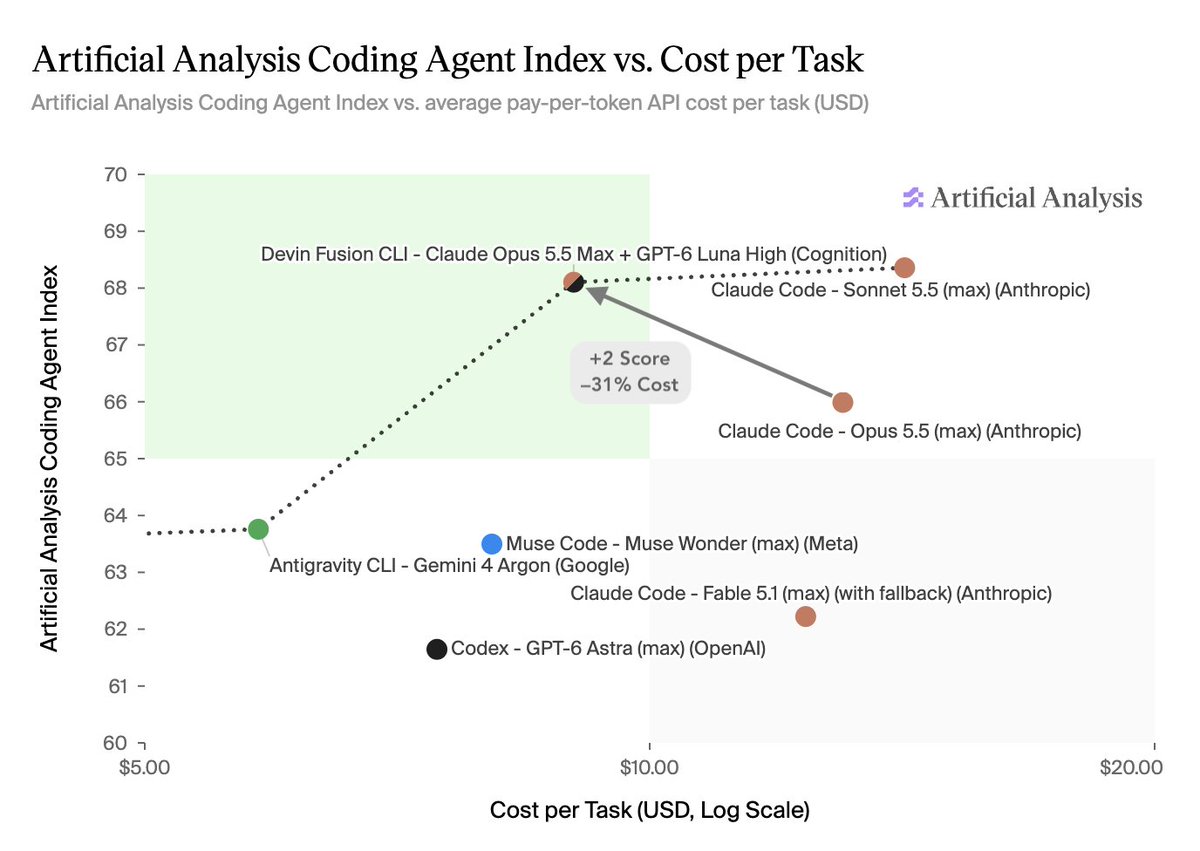
Artificial Analysis Benchmarks Devin Fusion: Scoring 68.1 on Coding Agent Index While Slashing Task Cost by 31%

Artificial Analysis released an independent evaluation of Cognition's new coding agent, Devin Fusion. Moving beyond single-model execution, Devin Fusion employs an asymmetric multi-agent architecture pairing Claude Opus 5.5 (max) as the lead reasoning orchestrator alongside GPT-6 Luna (high) as a high-speed parallel worker. In the standardized Coding Agent Index, Devin Fusion achieved an elite score of 68.1 (matching Muse Code at 68.0 and rivaling Claude Code Sonnet 5.5 at 68.4). Crucially, the hybrid architecture slashes average task expense from $13.04 down to $9.01 (a 31% cost reduction) while shortening execution runtime from 65 to 55 minutes.

Artificial Analysis Benchmarks Devin Fusion: Scoring 68.1 on Coding Agent Index While Slashing Task Cost by 31%

Key Takeaways

  • Artificial Analysis independently benchmarked Devin Fusion, scoring 68.1 on the standardized Coding Agent Index
  • Pioneers asymmetric model collaboration: Claude Opus 5.5 orchestrates architecture while GPT-6 Luna executes parallel sub-tasks
  • Cuts per-task execution costs from $13.04 to $9.01 (a 31% savings) and trims average completion time from 65 to 55 minutes
  • Outperforms Claude Code with Opus 5.5 on DeepSWE v1.1 (72.6% vs 68.4%) and SWE-Atlas-QnA (69.6% vs 66.4%)
Read full story

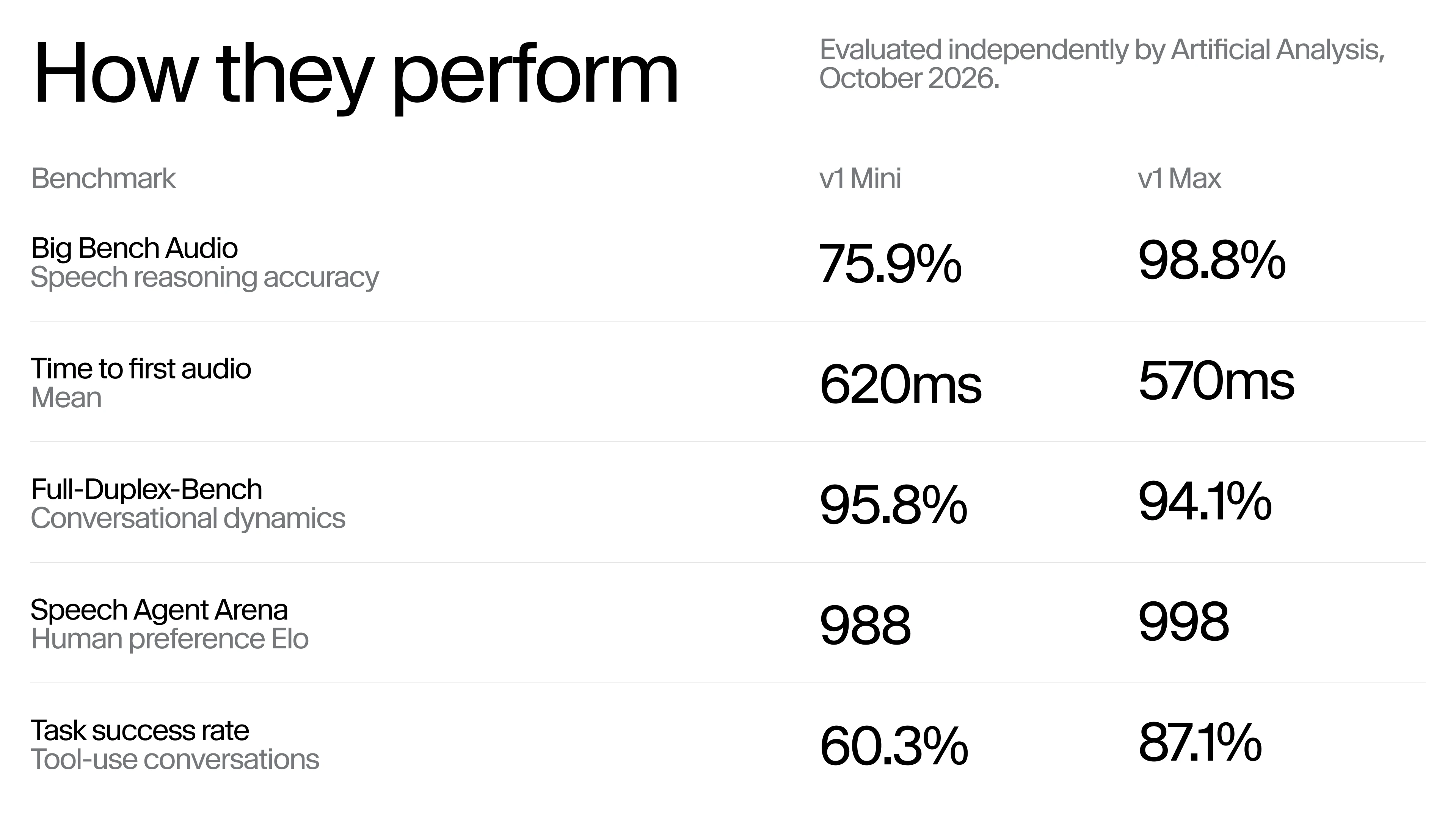
ElevenLabs launches Eleven Realtime v1 Mini and Max speech-to-speech models: Max scores 98.8% on Big Bench Audio, speaks in 0.57s on average, and is OpenAI Realtime API compatible

On Oct 20 ElevenLabs released Eleven Realtime, end-to-end speech-to-speech models where each model is a complete voice agent, removing the need to wire up speech recognition, an LLM and text-to-speech yourself. v1 Mini targets low-cost natural conversation and v1 Max targets support and multi-step tool use. Both cover 90+ languages and 17,000+ voices. Citing independent Artificial Analysis evals, Max answers 98.8% of Big Bench Audio correctly and starts speaking in 0.57s on average. The API is OpenAI Realtime compatible, so migrating means changing the endpoint and model name.

ElevenLabs launches Eleven Realtime v1 Mini and Max speech-to-speech models: Max scores 98.8% on Big Bench Audio, speaks in 0.57s on average, and is OpenAI Realtime API compatible

Key Takeaways

  • Speech reasoning (independent Artificial Analysis eval cited by ElevenLabs): on 1,000 Big Bench Audio questions, v1 Max scores 98.8% and v1 Mini 75.9%
  • Speed (vendor-stated): Max starts speaking in 0.57s on average and Mini in 0.62s; the launch post says "half a second", slightly faster than the blog figures
  • Conversation dynamics and preference: Full-Duplex-Bench Mini 95.8%, Max 94.1%; Speech Agent Arena blind tests Max 998, Mini 988
  • Tool-use task completion: Max 87.1% vs Mini 60.3%, which is why ElevenLabs recommends Max for heavy tool calling
  • 90+ languages and 17,000+ voices; the Realtime API is WebSocket-only at wss://api.elevenlabs.io/v1/convai/realtime and works with the OpenAI SDK; pricing was not in the launch post
Read full story
Linked Models & Agents:
⚡ Eleven Realtime v1 Mini⚡ Eleven Realtime v1 Max🤖 ElevenAgents🌐 ElevenLabs🌐 Artificial Analysis

Devin Fusion with an Opus 5.5 lead and GPT-6 Luna sidekick tops the Artificial Analysis Coding Agent Index at 68.1, at what Cognition says is 31% lower cost per task than Claude Code with Opus 5.5

Cognition said on October 19 that Devin Fusion, pairing Claude Opus 5.5 as the lead with GPT-6 Luna as the sidekick, scored 68.1 on the Artificial Analysis Coding Agent Index v1.5. Artificial Analysis's current data puts it first, but only 0.1 ahead of Muse Code with Muse Wonder Full at 68.0, effectively a tie; Antigravity CLI with Gemini 4 Argon is third at 63.8. Cognition says the pairing costs 31% less per task than Claude Code with Opus 5.5 (vendor-reported). Fusion ships in Devin CLI and Desktop.

Devin Fusion with an Opus 5.5 lead and GPT-6 Luna sidekick tops the Artificial Analysis Coding Agent Index at 68.1, at what Cognition says is 31% lower cost per task than Claude Code with Opus 5.5

Key Takeaways

  • 68.1 overall: DeepSWE v1.1 72.6, SWE-Atlas-QnA 69.6, Terminal-Bench v4 62.1, equally weighted (Artificial Analysis data).
  • Just 0.1 ahead of Muse Code with Muse Wonder Full (68.0); Antigravity CLI with Gemini 4 Argon 63.8, Codex with GPT-6.1 Sol (xhigh) 62.9.
  • Cost: Cognition says 31% lower per task than Claude Code with Opus 5.5 (vendor-reported).
  • Earlier, Fusion with Fable 5.1 + SWE-2 cut DeepSWE 1.1 cost per task from $14.63 to $7.88 (-46%) while scoring 63.1 vs 64.3.
  • Recommended pairing is Opus 5.5 + GPT-6 Luna, available by installing Devin CLI.
Read full story

Ant inclusionAI open-sources five Ming-3.0 speech models: a 0.5B TTS tops open-weight controlled voice, plus a 126B MoE audio-understanding model

On October 19 Ant Ling (inclusionAI) open-sourced five Ming-3.0 models under MIT, spanning speech synthesis (tts-0.5B; tts-tiny, 7.9B total/1.3B active), audio understanding (audio-flash, 126B/6.5B active; audio-tiny, 9.3B/2.7B active) and speech recognition (asr-tiny, 8.6B/2B active). Per the vendor, tts-0.5B ranks #1 among open-weight models on Artificial Analysis Controlled Voice at 1069 Elo and ties #1 overall on pronunciation robustness at 93.2%; asr-tiny averages 4.41% error across four ASR categories. Weights are on Hugging Face and ModelScope, with day-0 SGLang and vLLM support.

Ant inclusionAI open-sources five Ming-3.0 speech models: a 0.5B TTS tops open-weight controlled voice, plus a 126B MoE audio-understanding model

Key Takeaways

  • Lineup: five models in three families, two TTS, two audio-understanding and one ASR, all MIT-licensed.
  • TTS results: tts-0.5B scores 1069 Elo on AA Controlled Voice, #1 among open weights; 1188 Elo and #3 on Provider Voice; ties #1 overall on pronunciation robustness at 93.2% (vendor figures).
  • TTS features: 7 languages plus Sichuanese and Cantonese, 14 inline paralinguistic tags (laughter, sighs, coughs and more), 44.1 kHz output, built on Qwen2.5-0.5B.
  • Audio understanding: audio-flash has 126B total and 6.5B active parameters, and handles long-recording summaries, spoken Q&A, audio reasoning and tool-call generation.
  • ASR: asr-tiny accepts hotwords and dialogue context, is evaluated on 15 dialect test sets, and averages 4.41% error across four categories (vendor figures).
Read full story
Linked Models & Agents:
⚡ Ming-3.0-tts-0.5B⚡ Ming-3.0-tts-tiny⚡ Ming-3.0-audio-flash⚡ Ming-3.0-audio-tiny⚡ Ming-3.0-asr-tiny🌐 Ant Group🌐 inclusionAI🌐 SGLang🌐 vLLM
ADSponsored

Devin now works with any personal ChatGPT plan: Go, Plus or Pro subscriptions cover GPT model usage instead of Devin quota

On Oct 9 Cognition said Devin can now link any personal ChatGPT plan (Go, Plus or Pro). The GPT share of each session is billed to the ChatGPT subscription instead of Devin quota or on-demand credits, across Devin Cloud, Desktop and CLI. It requires a self-serve Devin Pro, Max or Teams plan (not Free or Enterprise), and falls back to Devin quota when the ChatGPT allowance runs out.

Devin now works with any personal ChatGPT plan: Go, Plus or Pro subscriptions cover GPT model usage instead of Devin quota

Key Takeaways

  • Eligible ChatGPT plans widened from Plus/Pro at the Sep 29 launch to Go, Plus and Pro; free ChatGPT accounts can't share usage
  • Only self-serve Devin Pro ($20/mo), Max ($200/mo) and Teams ($80/mo minimum); not Free or Enterprise
  • GPT usage bills only to ChatGPT, never double-counted against Devin quota; fast/priority variants excluded
  • Vendor-cited Artificial Analysis Coding Agent Index v1.5: Fusion (GPT-6 Astra + SWE-2) scores 58.9 at $4.54/task vs Codex Astra (max) 61.6 at $7.47, 39% cheaper
Read full story

LangChain 1.4.3: Bedrock Mantle in init_chat_model, GPT-6 structured-output recognition, create_agent repairs invalid tool calls

LangChain shipped langchain==1.4.3 on 2026-09-28 (on PyPI): init_chat_model supports AWS Bedrock Mantle chat models via langchain-aws Mantle interfaces; recognizes GPT-6 structured output without profiles; create_agent emits error ToolMessages for invalid tool calls missing results on replay; sanitizes cache settings for fallback models. Key PRs: #40837, #40844, #40530, #40886 vs 1.4.2.

LangChain 1.4.3: Bedrock Mantle in init_chat_model, GPT-6 structured-output recognition, create_agent repairs invalid tool calls

Key Takeaways

  • langchain==1.4.3 on PyPI (2026-09-28)
  • init_chat_model + Bedrock Mantle (#40837) via langchain-aws Mantle chat wrappers
  • GPT-6 structured output recognized without profiles (#40844)
  • create_agent repairs invalid tool calls with error ToolMessages (#40530); sanitize fallback cache settings (#40886)
Read full story
Linked Models & Agents:

AgentKernel Released: A Trust-Native Operating System for Autonomous AI Agents with Mandatory Security Boundaries

Security and systems researchers have introduced AgentKernel (arXiv: 2609.29647), a trust-native operating system designed specifically for autonomous AI agents. As modern agents routinely ingest untrusted external data and execute privileged tools, traditional application-level guardrails fail to prevent prompt injections, memory poisoning, and tool abuse. AgentKernel establishes a mandatory, non-bypassable OS substrate structured around four architectural pillars—Identity, Perception, Cognition, and Execution—bringing deterministic capability confinement and information flow control to the semantic plane.

AgentKernel Released: A Trust-Native Operating System for Autonomous AI Agents with Mandatory Security Boundaries

Key Takeaways

  • Translates classical operating system process isolation and privilege rings into the semantic LLM plane.
  • Structures security across four pillars: kernel-governed identity, graduated perception, information-flow-controlled memory, and semantic execution gates.
  • Eradicates persistent memory poisoning and unauthorized shell tool escalation caused by indirect prompt injection.
  • Achieves a 99.1% containment rate against red-team attack vectors while constraining runtime latency overhead to 3.2%.
  • Preprint, architecture specifications, and security proofs published openly on arXiv and Hugging Face.
Read full story

Cognition ships Devin Cloud in Terminal and devin ssh: CLI cloud sessions plus SSH into Devin VMs

@cognition introduced Devin Cloud in Terminal and devin ssh: create, steer, and resume Devin Cloud sessions from the CLI with /cloud, and for the first time SSH into Devin’s dedicated VM then /handoff the work back to your own device.

Cognition ships Devin Cloud in Terminal and devin ssh: CLI cloud sessions plus SSH into Devin VMs

Key Takeaways

  • New CLI: /cloud to create, steer, and resume Devin Cloud sessions in the terminal.
  • devin ssh: first-time SSH into Devin’s dedicated VM.
  • /handoff: return cloud work to your own device for local workflows.
Read full story
Linked Models & Agents:

Cognition: SWE-2 free on Devin Cloud for Pro/Max/Teams through Oct 8

Cognition co-founder Silas Alberti said demand for SWE-2 in Desktop and CLI is unprecedented, that they secured more compute, and that SWE-2 is free on Devin Cloud for Pro, Max, and Teams subscribers through October 8, 2026. The limited window lowers the cost of trying the coding model for existing Devin subscribers who want a short evaluation or production pilot.

Key Takeaways

  • SWE-2 is free on Devin Cloud for Pro/Max/Teams through 2026-10-08.
  • Officially cites unprecedented Desktop/CLI demand and extra secured compute.
  • A dated promo that lets existing Devin subscribers evaluate or pilot at lower cost.
Read full story
Linked Models & Agents: