AI Coding Live News

BOSS Zhipin's Nanbeige lab open-sources Nanbeige4.3-33B, a 33B dense agent model with 512K context under Apache 2.0, reporting 80.9 on Terminal-Bench 2.1 vs 73.0 for Qwen3.8-27B

At 12:11 UTC on 2026-10-25, the Nanbeige LLM Lab of BOSS Zhipin (Kanzhun Limited) announced Nanbeige4.3-33B from its account @nanbeige (post), with the model and its Base version released as open weights on Hugging Face under Apache 2.0 (model card). It is a 33B dense model on a Llama-style architecture with a 512K context window, positioned as the teacher model of the Nanbeige4.3 series that will be distilled into smaller models such as Nanbeige4.3-3B. The official model card compares it with Qwen3.8-27B, Muse-Glimmer-30B and Gemma4-31B using the same harness at highest thinking effort: 80.9 on Terminal-Bench 2.1 (Qwen3.8-27B 73.0) and 65.5 on DeepSWE (42.5), but 60.3 on SWE-Bench Pro, slightly below Qwen's 61.7, and 84.8 on GDPval vs 86.4. All figures are self-reported and not yet independently reproduced.

Key Takeaways

  • Official sources: @nanbeige post on X and the Hugging Face model card; the post had about 616 likes, 79 reposts and 38K views when we pulled it
  • Specs: 33B dense, Llama-style architecture, 512K context, Apache 2.0, with a Base checkpoint released too
  • Self-reported coding scores: Terminal-Bench 2.1 80.9, Terminal-Bench 4.0 23.8, DeepSWE 65.5, SWE-Bench Pro 60.3 (Qwen3.8-27B: 73.0, 6.3, 42.5, 61.7)
  • Self-reported cowork scores: Automation Bench 54.2, JobBench 44.8, GDPval 84.8 (Qwen3.8-27B: 38.3, 34.5, 86.4)
  • Deployment: Transformers, SGLang and vLLM, with official examples using 4-way tensor parallelism; Nanbeige4.3-3B distillation is next
Read full story
Linked Models & Agents:
⚡ Nanbeige4.3-33B⚡ Qwen3.8-27B⚡ Gemma4-31B⚡ Muse-Glimmer-30B🌐 Nanbeige🌐 BOSS Zhipin🌐 Kanzhun

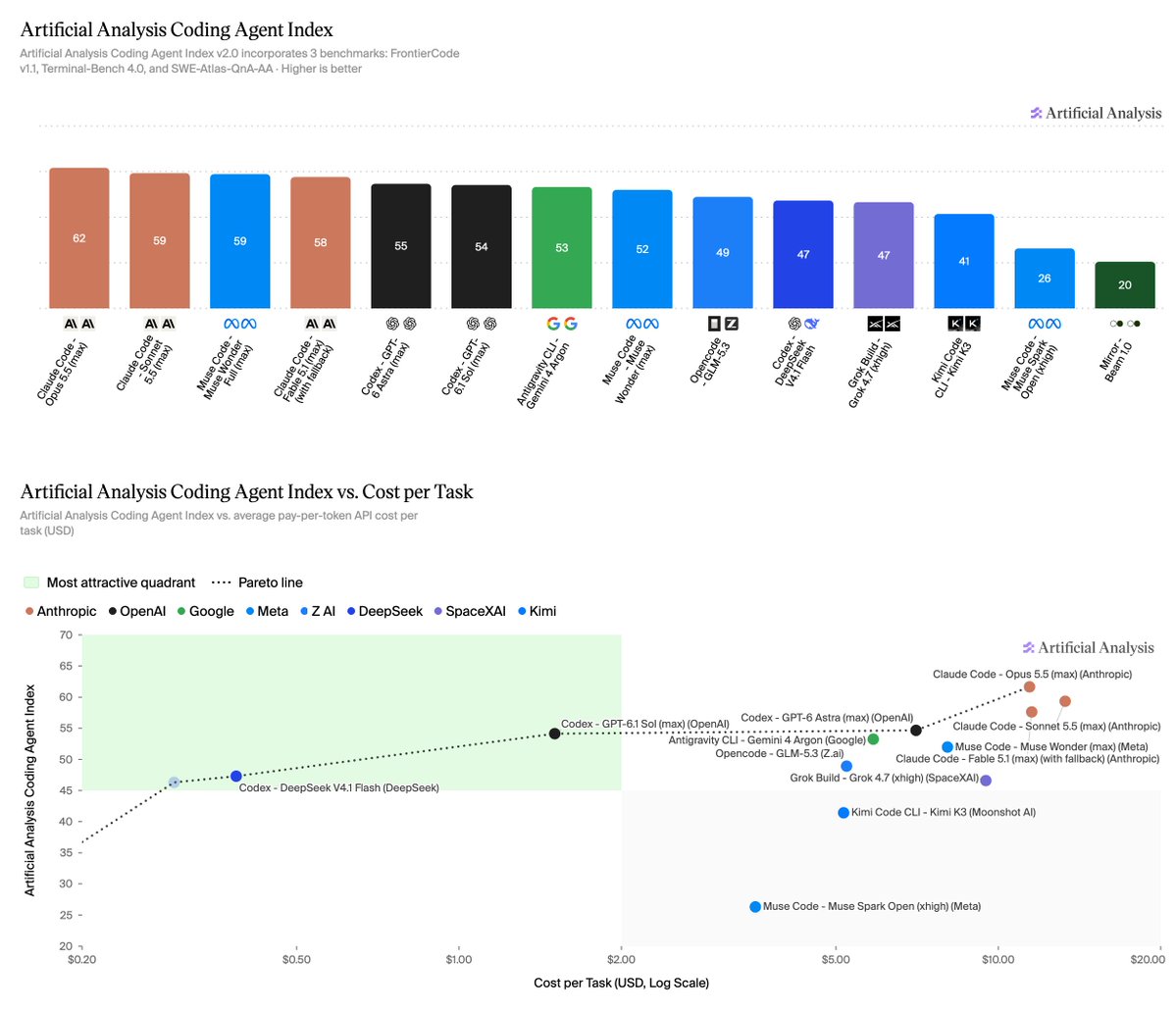
Artificial Analysis launches Coding Agent Index v2.0: FrontierCode from Cognition replaces DeepSWE, and Claude Code with Opus 5.5 leads at 61.7

On 2026-10-23 Artificial Analysis launched Coding Agent Index v2.0, which scores model-plus-harness combinations across 290 tasks with three equally weighted benchmarks: FrontierCode v1.1 from Cognition (100 tasks on real open-source repos, graded on whether a maintainer would merge the change) replaces DeepSWE v1.1, SWE-Atlas-QnA becomes the stricter SWE-Atlas-QnA-AA, and Terminal-Bench 4.0 is unchanged. Claude Code with Claude Opus 5.5 (max) leads at 61.7, ahead of Sonnet 5.5 at 59.3 and Muse Wonder Full at 58.9. Scores fall across the board: the 21 configurations measured on both versions drop from a mean of 54.8 to 47.4.

Artificial Analysis launches Coding Agent Index v2.0: FrontierCode from Cognition replaces DeepSWE, and Claude Code with Opus 5.5 leads at 61.7

Key Takeaways

  • Top of the index: Claude Code with Claude Opus 5.5 (max) 61.7, Claude Sonnet 5.5 (max) 59.3, Muse Code with Muse Wonder Full (max) 58.9, Claude Fable 5.1 (max with fallback) 57.6 (Artificial Analysis figures)
  • On FrontierCode v1.1, Opus 5.5 scores 56.0%, ahead of Codex with DeepSeek V4.1 Flash at 52.6%; 15 of 24 configurations sit between 43% and 49%
  • Version shift: 21 configurations average 54.8 on v1.5 and 47.4 on v2.0, with 20 of 21 moving down; the same set averages 45.1% on FrontierCode versus 65.6% on DeepSWE
  • Four points on the cost frontier: DeepSeek V4.1 Flash 47.3 at $0.39 per task, GPT-6.1 Sol 54.1 at $1.50, GPT-6 Astra 54.7 at $7.04, Opus 5.5 61.7 at $11.42 (pay-per-token API costs, not subscriptions)
  • SWE-Atlas-QnA-AA rewords 127 of 1,306 rubric criteria and uses GPT-6 Luna (xhigh) as judge with five votes per criterion; dataset and judge config are on Hugging Face
Read full story

Letta releases FrontierMemory 1.0, a benchmark that scores agent memory by downstream task success; Opus 5.5 and GLM-5.3 tie for first at 73.3%

On October 21 Letta released FrontierMemory 1.0. Instead of quizzing agents on facts such as birthdays or hobbies, it gives an agent a set of past trajectories, has it write memory or skills, and scores that memory by how many coding and knowledge-work tasks a task agent then solves. Version 1.0 has 15 tasks adapted from public benchmarks such as DeepSWE, SkillsBench and APEX-Agents. On the model board (memory written in Letta Dream, tasks run in Letta Code) Opus 5.5 and GLM-5.3 both score 73.3% and Grok 4.7 scores 33.3%; on the harness board Letta's own Letta Dream ranks first. All numbers are Letta's own.

Letta releases FrontierMemory 1.0, a benchmark that scores agent memory by downstream task success; Opus 5.5 and GLM-5.3 tie for first at 73.3%

Key Takeaways

  • Model board (vendor-run, top effort): Opus 5.5 73.3% (about $2.80 per task), GLM-5.3 73.3% ($3.58), Kimi K3 66.7%, GPT-6.1 Sol 60.0% ($0.77, cheapest), Gemini 4 Argon 60.0%, Muse Wonder 46.7%, Grok 4.7 33.3%
  • Harness board: Letta Dream 73.3%, Prime Agent 60.0%, OpenAI Agents SDK 40.0%, Claude Managed Agents 33.3%, Hermes Agent 26.7%
  • Version 1.0 has 15 tasks; only 219 of 665 source trajectories are relevant, so the agent has to find the useful experience itself
  • Letta says 53% of the source tasks it kept had broken verifiers, which it repaired; memory generation is capped at 6 hours with no web access
  • Memory comes in three kinds (task conventions, user preferences, environment facts); outside models and harnesses can be submitted
Read full story

MiniMax M3.1 Flash weights now open on Hugging Face: 428B-total / 23B-active MoE, $0.15 input and $0.60 output per million tokens, 73.7% on DeepSWE

MiniMax confirmed that Space Bunny, the anonymous model that led usage rankings on OpenRouter and elsewhere, was an early version of M3.1 Flash, and launched it on its API on October 19. Pay-as-you-go pricing is $0.15 input, $0.60 output and $0.015 cache read per million tokens, with a 1M context, text, image and video input, and an effort setting for thinking depth. Per MiniMax, it costs one third of M3 and runs 3x faster, scoring 73.7% on DeepSWE and 62.2% on Automation-Bench; the weights went live on Hugging Face on schedule on October 23 (MiniMax Community license, MXFP8), with day-0 support from Together, Inferact (vLLM) and LightSeek TokenSpeed.

MiniMax M3.1 Flash weights now open on Hugging Face: 428B-total / 23B-active MoE, $0.15 input and $0.60 output per million tokens, 73.7% on DeepSWE

Key Takeaways

  • Official pay-as-you-go pricing: $0.15 input / $0.60 output / $0.015 cache read per million tokens; per token that is half of M3 ($0.30/$1.20), and MiniMax does not explain how it gets one third of the cost.
  • Vendor benchmarks: DeepSWE v1.1 73.7% (Opus 5: 74.0%), Automation-Bench 62.2%, BabyVision with tools 91.0%, Terminal Bench 4.0 38.1% (Opus 5: 51.8%).
  • 1M context, text/image/video input, five effort levels from low to max, default max, thinking cannot be turned off.
  • Weights opened October 23 at Hugging Face MiniMaxAI/MiniMax-M3.1-Flash: ungated, MiniMax Community license (not MIT/Apache), MXFP8 quantized, native multimodal MoE with about 428B total and 23B active parameters per token, plus a DSpark speculative-decoding draft head.
  • Migration: M2.5 and M2.7 closed to new users on October 19 and retire on November 18; M Plan and Token Plan requests now route to M3.1 Flash automatically.
  • Day-0 serving: Together AI runs it fully managed, MiniMax is partnering with Inferact to contribute production-inference improvements back to vLLM, and LightSeek's TokenSpeed added day-0 support.
Read full story
ADSponsored

DeepSeek ships V4.1-Flash-1017: MIT open weights, live on web, app and API at unchanged prices, DeepSWE 77.0 (vendor-reported), plus public Search/Fetch APIs

On Oct 17 DeepSeek upgraded V4.1 Flash to V4.1-Flash-1017 across web, app and API (deepseek-flash, same call and price) and published MIT-licensed weights on Hugging Face and ModelScope. Vendor-reported DeepSWE v1.1 rises from 74.2 to 77.0 and Terminal-Bench 4.0 from 31.2 to 42.3, with shorter runtimes and outputs. It also opened Search/Fetch APIs backed by its in-house search engine at $0.75 per 1,000 calls.

DeepSeek ships V4.1-Flash-1017: MIT open weights, live on web, app and API at unchanged prices, DeepSWE 77.0 (vendor-reported), plus public Search/Fetch APIs

Key Takeaways

  • Vendor-reported DeepSWE v1.1 77.0 (prev. 74.2), above Claude Opus 5 (74.0) and GPT-5.6 Sol (73.0) in DeepSeek's table
  • Terminal-Bench 4.0 31.2 → 42.3 and ProgramBench 20.3 → 29.1, still behind Opus 5 (51.8 / 37.0); HLE w/o tools 42.6 vs Opus 5's 56.3
  • Pricing unchanged: deepseek-flash peak $0.30 input (cache miss) / $1.20 output per 1M tokens, off-peak half; 1M context, 384K max output
  • Search / Fetch APIs at $0.75 per 1,000 calls each; server-side calls via DeepSeek Harness, Claude Code and Codex are free until Oct 31, 2026 16:00 UTC
  • MIT weights on Hugging Face in FP8 (FP4 experts); no Jinja template — use the bundled encoding.py or deepseek-recipe
Read full story

Meta open-sources Muse Spark Open: 816B-total / 42B-active MoE with 1M context, billed as the most capable US open-weight model to date

On 2026-10-15 Meta released weights for Muse Spark Open, a natively multimodal MoE (~816B total / ~42B active per token, 1M context) aimed at long-horizon coding and agents. Weights are on Hugging Face and peers; hosted APIs include Together, Fireworks, Groq and OpenRouter. Reported figures include DeepSWE 60%, MCP-Atlas 89.2% and JobBench 61.8% (see Meta’s evaluation methodology).

Meta open-sources Muse Spark Open: 816B-total / 42B-active MoE with 1M context, billed as the most capable US open-weight model to date

Key Takeaways

  • Scale: ~816B total / ~42B active per token; 256 experts/layer with top-8 routing; 62 layers, hidden 8192; context up to 1,048,576 (HF blog)
  • Coding/agents (Meta scorecard / AA, xhigh): DeepSWE 60.0%; SWE-Atlas Codebase QnA 58.0%; MCP-Atlas 89.2%; JobBench 61.8%; Toolathlon-Verified 72.8% (eval methodology)
  • Throughput (NVIDIA tech blog, agentic on GB300 NVL72): up to ~50K tok/s/GPU and ~600 tok/s/user; NVFP4 checkpoints published (NVIDIA blog)
  • Deploy: Muse Model License with limited commercial terms; SGLang / vLLM / TensorRT-LLM / MLX / llama.cpp; Meta demos two Apple M5 Ultra Mac Studios for on-desk local run
  • Third-party index: Artificial Analysis Intelligence Index ~38.9–39 (xhigh, as of 2026-10-07)—behind closed frontier, but a key open-weight reference (AA)
Read full story
Linked Models & Agents:
⚡ Muse Spark Open⚡ Muse Spark Open 816B-A42B🤖 Muse Code🌐 Meta🌐 NVIDIA🌐 Hugging Face🌐 Apple

Opera: A Verbal Critic Framework for Long-Horizon Coding Agents Tracks Diagnosed Flaws Until Resolution to Boost SWE-Bench by 15%

Long-horizon coding agents tackling complex software repositories depend on timely guidance, yet conventional LLM critics often degrade agent outcomes by misinterpreting in-progress exploratory commands or offering ephemeral advice that is never tracked. Researchers from Rutgers and Lehigh University unveil Opera (arXiv:2609.33987), an open-source verbal critic framework that treats diagnostic corrections as persistent notes tracked until root problems are definitively resolved. Opera orchestrates reviews through hybrid periodic and event-driven triggers, verifies proposed critiques against visible terminal artifacts, and monitors downstream trajectories to distinguish mere superficial compliance from genuine resolution. As a test-time intervention, Opera elevates baseline agent resolve rates by 12.4 percentage points on Terminal-Bench 2.1, 15.0 on SWE-Bench Pro, and 8.9 on DeepSWE v1.1 across four foundation backbones. Furthermore, fine-tuning Qwen3.5-9B on Opera-guided rollouts yields a 10.2 percentage point gain on held-out repositories without any test-time critic, preserving stability across heterogeneous execution harnesses (such as OpenHands to Terminus-2).

Key Takeaways

  • Rutgers and Lehigh release Opera, introducing persistent diagnostic notes that track diagnosed faults until proven resolution in coding agents
  • Elevates resolve rates by 12.4 points on Terminal-Bench 2.1 and 15.0 points on SWE-Bench Pro across multiple policy models
  • Fine-tuning Qwen3.5-9B on Opera rollouts yields a 10.2 point gain on held-out repos without test-time critics, preserving cross-harness stability
Read full story
Linked Models & Agents:

IQuest-Q1 open-weights 320B MoE coding agent: 15B active / 524K context; DeepSWE 64.6, Terminal-Bench 2.1 83.2

IQuest Research’s IQuest-Q1 (~320B total / 15B active, 524K context) targets repo-level coding, terminal work, and long-horizon tool use. Weights and serving images are on Hugging Face / GitHub. Self-reported same-pipeline scores: DeepSWE v1.1 64.6, NL2Repo 63.0, CyberGym 84.5, Terminal-Bench 2.1 83.2. Ships with SGLang/vLLM images and Claude Code / Codex integration notes.

IQuest-Q1 open-weights 320B MoE coding agent: 15B active / 524K context; DeepSWE 64.6, Terminal-Bench 2.1 83.2

Key Takeaways

  • Spec: ~320B MoE / ~15B active, 88 layers, 256 experts / 8 active, 524,288 context; hybrid 3×SWA+1×FA (HF card)
  • Agentic coding (self-reported): DeepSWE v1.1 64.6 (DeepSeek-V4.1-Flash 74.2 / Opus 5 73.7); NL2Repo 63.0 (Opus 5 75.3)
  • Terminal / cyber: Terminal-Bench 2.1 83.2; CyberGym 84.5 (tied with GLM-5.3; Flash 88.1)
  • Post-train: SFT+RL plus Multi-Teacher On-Policy Distillation (MOPD); vendor flags early-stage, text-only limits
  • Ship: hf download IQuestLab/IQuest-Q1 + sglang-iquest-q1 / vllm-iquest-q1 images (tp=8); Claude Code 2.1.140 / Codex 0.142 notes
Read full story

Mistral Large 4 "Le Chonk" public preview: 1.05T-total / 49B-active multimodal MoE, 1M context, open weights by month-end

On 2026-10-06 Mistral launched a public-preview API for Mistral Large 4: a granular MoE with 1.05T total / 49B active parameters plus a 1.6B vision encoder, 1M context, trained from scratch on 3,800 Grace Blackwell GPUs in Mistral's own European datacenters. It posts 61.7% DeepSWE v1.1 and 93% Cybench; weights are promised by the end of October.

Mistral Large 4 "Le Chonk" public preview: 1.05T-total / 49B-active multimodal MoE, 1M context, open weights by month-end

Key Takeaways

  • Scale: 1.05T total / 49B active MoE + 1.6B vision encoder, 1M context
  • Coding (Artificial Analysis private eval): DeepSWE v1.1 61.7%, SWE-Atlas-QnA 59.4%, Terminal-Bench 4 28.3%, Coding Agent Index 49.8%
  • Security: Cybench 93%; 82% on AA Cyber Index reproduce-and-patch test (highest of any model); Lakera B3 93.3% attack resistance
  • Agents: AutomationBench 59.9%, AA-Briefcase 1,393 Elo; Surge AI blind coding eval 3.74, behind only Claude Opus 5 (4.22)
  • Pricing per 1M tokens: $1.36 input / $0.14 cached / $4.18 output (docs also list a half-price tier); weights by end of month
Read full story
Linked Models & Agents:
A
AgentField / Santosh Radha@Agent-Field·
👀78
🔥95

AgentField open-sources CodeAF v0.6: one Go binary software factory for open models; vendor DeepSWE 54.9% #1 same-model

CodeAF is an Apache-2.0 Go binary that runs open-weight models as a local software factory with task fan-out and Pareto crewing. v0.6.0 shipped 2026-10-01; ★259 now. Vendor DeepSWE doc: /senior-dev solved 62/113 (54.9%) on DeepSeek V4 Flash vs nine other harnesses—with stated one-seed and sampling caveats.

AgentField open-sources CodeAF v0.6: one Go binary software factory for open models; vendor DeepSWE 54.9% #1 same-model

Key Takeaways

  • Agent-Field/CodeAF Apache-2.0; ★259 / 34 forks; install via agentfield.ai/get/codeaf
  • v0.6.0 published 2026-10-01T18:59:00Z; README still says early preview
  • Vendor DeepSWE same-model table: senior-dev 62/113 (54.9%) at ~22¢/task vs nine harnesses—one seed; sampling-contract caveat documented
  • Later same 113 tasks: 88/113 (77.9%) on DeepSeek V4.1 Flash; 78/113 (69.0%) on Kimi K3 (senior-dev only)
  • Built-in providers include OpenRouter, DeepSeek, GLM, Kimi, MiniMax, Qwen, Codex, Ollama; default worker/planner/checker crew
Read full story
ADSponsored

Google DeepMind launches Gemini 4 Argon: DeepSWE 77.9%, 1M output; Fairwind trusted defenders first

DeepMind announced frontier Gemini 4 Argon for long-horizon coding, enterprise knowledge work, and cyber defense—first via Fairwind trusted defenders. Official: DeepSWE v1.1 77.9%, AutomationBench #1 at 51.3%, LVBench 91.7%, CWE-bench v1 tied 68%; intro $2/$10 per 1M tokens; 1M output limit.

Google DeepMind launches Gemini 4 Argon: DeepSWE 77.9%, 1M output; Fairwind trusted defenders first

Key Takeaways

  • Model: Gemini 4 Argon for long-horizon coding / enterprise knowledge work / cyber defense — official blog
  • Benchmarks (official): DeepSWE v1.1 77.9% SOTA; AutomationBench 51.3% #1; LVBench 91.7%; CWE-bench v1 tied 68%; Fairwind charts: vuln discovery 85.8% / Wiz pen-test 70.9%
  • Capacity & price: 1M output tokens (from ~64K); intro $2/$10 per 1M in/out (~95% off cached input), then $4/$20
  • Access: Fairwind trusted defenders today; next paid API + Google AI Ultra; not in public AI Studio yet — Fairwind
  • Internal: quantum subroutine spacetime −40% vs published baseline; libgav1 Rust port 2.7× faster; 300+ TiB memory freed in datacenters
Read full story

Together: GLM-5.3 Flash cascade hits 80.9% on DeepSWE at $1.70/task

Together ran about 900 DeepSWE rollouts of GLM-5.3 vs GLM-5.3 Flash: 69.0% pass@1 at ~$3.99 per task versus 63.4% at ~$0.24, a 17x cost gap. Distillation mostly removed first-try reliability, not coverage—the pass@4 gap shrinks to 2.6 points. A Flash-then-escalate cascade reached 80.9% at about $1.70 per task, beating the full model alone at less than half the price. Coding agents should default to Flash and promote on test failure, but Flash broke an already-passing baseline in 6.9% of rollouts versus 4.4%, so diffs still need a regression gate.

Key Takeaways

  • On DeepSWE, GLM-5.3 is 69.0% pass@1 at ~$3.99; Flash is 63.4% at ~$0.24, about 17x cheaper.
  • A Flash-first cascade that escalates on test failure hits 80.9% at ~$1.70 per task.
  • Flash breaks passing baselines more often (6.9% vs 4.4%), so accept diffs only behind regression tests.
Read full story
Linked Models & Agents:

Alibaba Qwen open-weights Qwen3.8-Flash: 125B/6B multimodal MoE scoring 62.5 on SWE-bench Pro

Alibaba Qwen released open-weight Qwen3.8-Flash, a multimodal Mixture-of-Experts model billed as an early preview of the Qwen4 architecture. The production-scale checkpoint is 125B parameters plus 51B N-gram embeddings, with only 6B activated per token. The new stack combines Gated DeltaNet plus Qwen Sparse Attention, Gated Residual branches, N-gram embeddings that can live in host memory, and a refined Muon optimizer. Qwen said it trained at about one-ninth the cost of Qwen3.7-Plus while beating it across the board, especially on coding and office work: 58.7 on DeepSWE 1.1, 62.5 on SWE-bench Pro, 73.9 on CoWorkBench, 84.5 on AndroidWorld, and 95.7 on MathVision with CI. Native context is 262K tokens, extendable to 1M with YaRN; at 1M context the QSA kernel is up to 7.6x faster in prefill and 4.9x faster in decode. QwenCloud lists roughly $0.15 input / $0.47 output per million tokens, and day-0 runtimes arrived from NVIDIA NeMo, SGLang, Unsloth, OpenRouter, and OpenCode Go.

Key Takeaways

  • 125B/6B MoE hits 62.5 SWE-bench Pro and 58.7 DeepSWE 1.1 at ~1/9 the training cost of Qwen3.7-Plus.
  • QSA hybrid attention is up to 7.6x faster in prefill and 4.9x in decode at 1M context.
  • Open weights plus day-0 support on QwenCloud, OpenRouter, OpenCode, NeMo, SGLang, and Unsloth.
Read full story

Together AI Launches GLM-5.3 Flash: Natively Multimodal 320B-A18B MoE with 1M Context Window

Together AI added GLM-5.3 Flash to its cloud inference catalog, offering native multimodal understanding, 1M context with hybrid attention, and double the DeepSWE throughput per dollar compared to proprietary peers.

Key Takeaways

  • 320B-A18B sparse MoE architecture minimizes cost per token while sustaining frontier-grade reasoning quality;
  • Native multimodality with 1M hybrid-attention context designed for comprehensive codebase inspection;
  • High-throughput enterprise hosting tailored for autonomous continuous coding loops.
Read full story
Linked Models & Agents:

Together AI Serves GLM-5.3 Flash: 320B-A18B MoE with 1M Context Delivering 2x Work per Dollar on DeepSWE

Together AI launched hosted Day-1 inference for GLM-5.3 Flash (320B-A18B MoE, 1M context), nearly matching Luna on DeepSWE benchmarks while completing more than twice the work per dollar.

Key Takeaways

  • Day-1 managed serving of 320B-A18B MoE lowers deployment hurdles for custom hybrid-attention architectures;
  • DeepSWE evaluations demonstrate over 2x work completed per dollar compared to closed frontier models;
  • Available immediately via Together AI Model Market and unified developer API for dedicated endpoints.
Read full story
Linked Models & Agents: