AI Coding Live News

Deep Principle Open-Sources Hydrogen-1.0, a 753B Science Model Post-Trained From GLM-5.3 on Lab Records, MIT Licensed

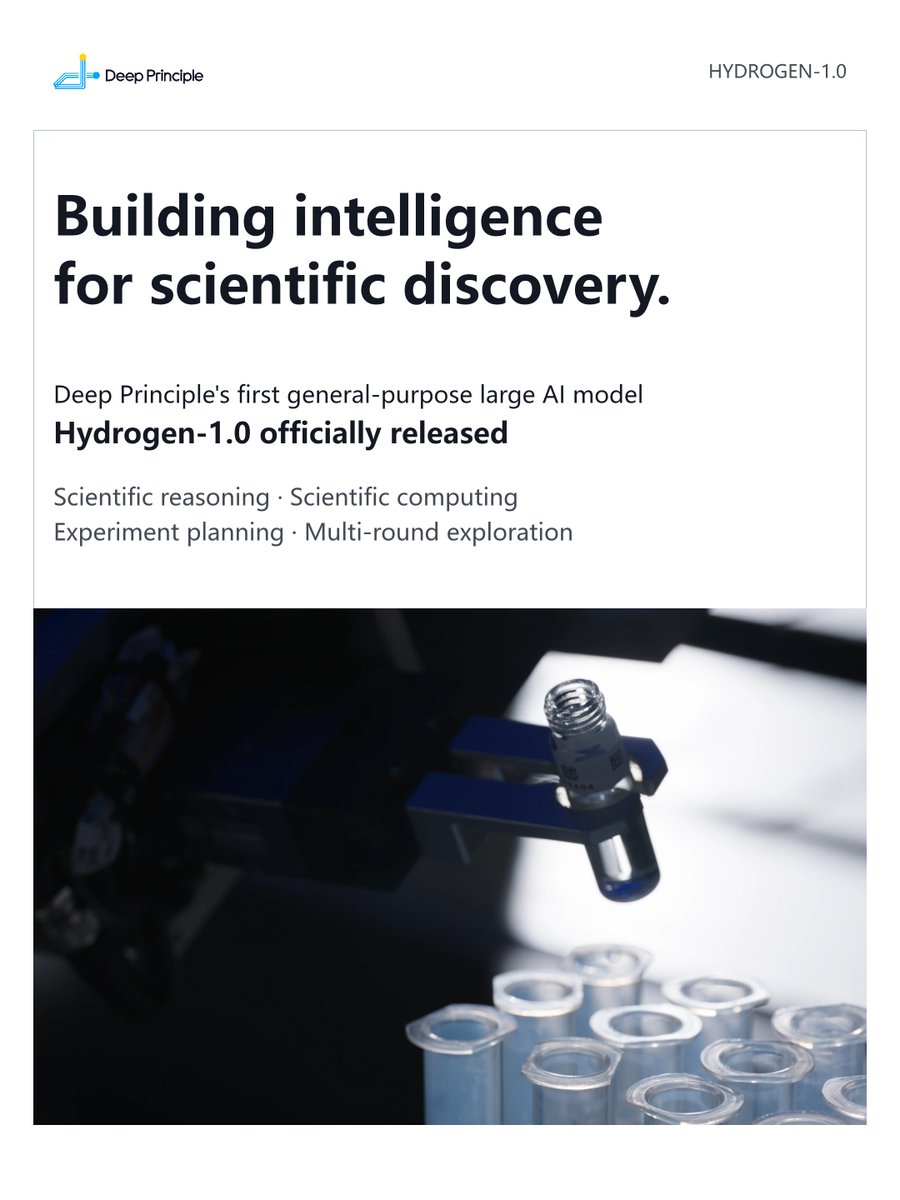
Hangzhou-based AI-for-science company Deep Principle released Hydrogen-1.0 on November 2, its first general-purpose scientific model. It post-trains Zhipu's GLM-5.3 with SFT and RL on chemistry, materials and life-science data plus its own lab records and discovery trajectories, and ships about 753B parameters of BF16 weights on Hugging Face under the MIT license. By the vendor's own evaluation it scores 38.3% on FrontierScience-Research versus 33.3% for GPT-6 Astra; none of the results have been independently reproduced yet.
Deep Principle Open-Sources Hydrogen-1.0, a 753B Science Model Post-Trained From GLM-5.3 on Lab Records, MIT Licensed

Key Takeaways

  • Scale: Hugging Face lists about 753B total parameters (BF16, roughly 1.5 TB of weights), glm_moe_dsa architecture, 1M-token context and 128K max output, MIT licensed (download requires accepting HF terms).
  • Benchmarks (vendor-reported): 38.3% on FrontierScience-Research vs 33.3% for GPT-6 Astra; 93.0% on GPQA Diamond, which the company says roughly matches Kimi K3.
  • Internal scenarios (vendor-reported): leads max-thinking GPT-6 Astra by 5.13 points on scientific computing and 4.76 points on forward reaction prediction, but trails it by 3.33 points on NMR structure elucidation.
  • Materials discovery: after five rounds of transition-metal-complex search, the mean best HOMO-LUMO gap reached 4.318 eV vs 3.689 eV for GPT-6 Astra and 3.353 eV for Kimi K3 (official blog).
  • Access: weights on HF and ModelScope, plus NVFP4 (B200/B300) and MXFP4 (MI350X/MI355X) quantized repos; API via NeuroSpark and in-app use in the Mira AI Scientist; tested with SGLang on 8 GPUs.
Read full story

Epoch AI: open-weight GLM 5.3 autonomously exploited the patch gap in six Firefox releases for about $1,000 each

Epoch AI reported on Oct 29 that, in a deliberately basic setup emulating an unsophisticated attacker, Z.ai's open-weight GLM 5.3 read security fixes that were public but not yet shipped and autonomously built exploit chains for all six Firefox releases from Sep 17 to Oct 26, letting a single webpage visit read local files. Marginal cost was about $1,000 per version and the fastest run took 12 hours. Mozilla patched a previously undisclosed bug the model also used in Firefox 159.0 on Oct 27.

Epoch AI: open-weight GLM 5.3 autonomously exploited the patch gap in six Firefox releases for about $1,000 each

Key Takeaways

  • 6 of 6: every Firefox release from Sep 17 to Oct 26 was compromised using only information public at each release (Epoch report)
  • About $1,000 marginal cost per version, with a 48-hour budget and the fastest run at 12 hours; total Firefox research spend exceeded $100,000 including setup
  • The model also rediscovered an unpublished bug on each attempt, which Mozilla fixed in Firefox 159.0 on Oct 27
  • No refusals or safeguards triggered through first-party or third-party APIs
  • Roughly $100,000 of attempts against Chrome failed so far, which Epoch says is not strong evidence Chrome is safe
Read full story

Mistral launches its Responses API in public preview: OpenAI Responses-compatible, returning the answer, reasoning and tool calls as separate items for building agents

Mistral AI announced on X on Oct 28 that its Responses API is in public preview, positioned as the interface for building agents on Mistral. The official docs say it uses the OpenAI Responses format, and each response's output array carries the models messages, its reasoning and its function calls as separate items, which is easier to handle step by step than Chat Completions. The preview is stateless, so the app keeps the conversation history and sends it back; it supports text, image and file input, JSON Schema structured output, streaming events, client-executed function calls, reasoning.effort, and token counting via POST /v1/responses/input_tokens. It is served in the EU and US on Mistral AI Cloud Inference. The same thread says Mistral now also serves DeepSeek V4.1 Flash (public preview) and GLM 5.3 Flash (generally available).

Key Takeaways

  • The Responses API is in public preview and uses the OpenAI Responses format, so existing Responses integrations can move to Mistral more easily
  • Each response splits the answer, reasoning and function calls into separate output items, which suits step-by-step agent loops
  • The preview is stateless: the app keeps the history and sends earlier output items back along with function_call_output results
  • It supports image and file input, JSON Schema structured output, streaming, function calling (including namespaces), reasoning.effort and token counting via /v1/responses/input_tokens
  • It is served in the EU and US on Mistral AI Cloud Inference; Mistral also added DeepSeek V4.1 Flash (preview) and GLM 5.3 Flash (GA)
Read full story

Shanghai AI Lab ships Atria Dawn full release: 744B MoE GLM-5.2 agentic model, context doubled to 512K, MIT weights

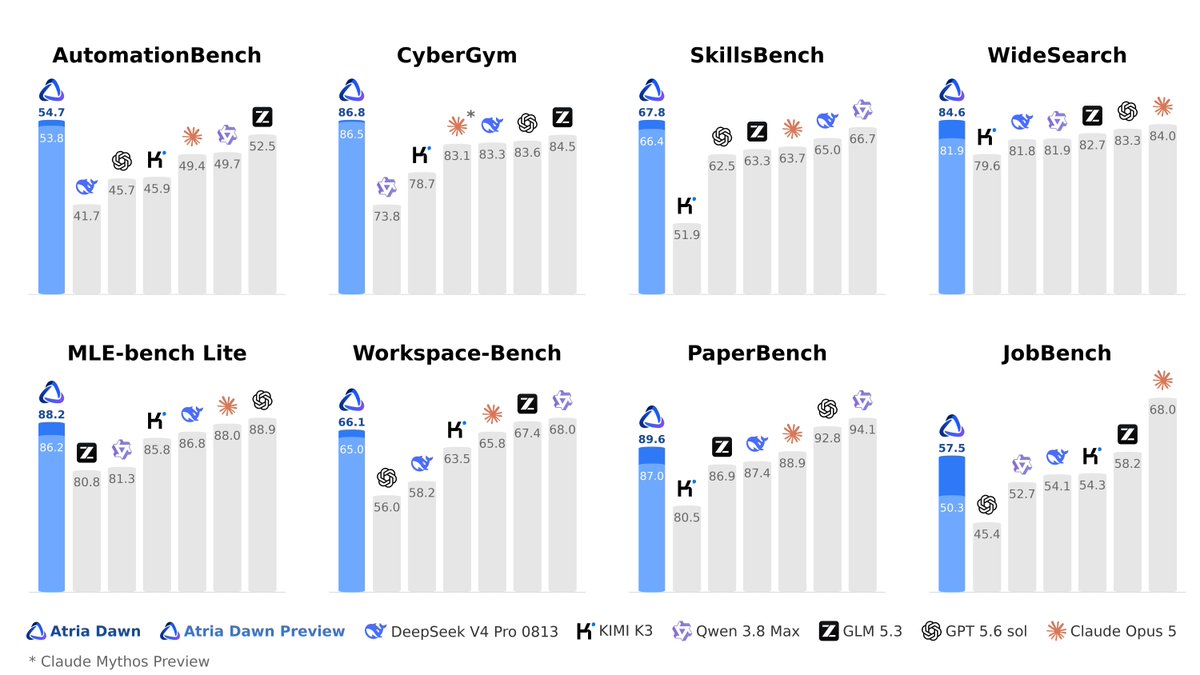
Shanghai AI Laboratory has moved Atria Dawn from Preview to a full release, with open weights (plus an FP8 build) on Hugging Face under internlm/Atria-Dawn and on ModelScope, MIT licensed. Built on the 744B-parameter MoE GLM-5.2, it targets long-horizon research and engineering agent work; context doubles from the Preview's 256K to 512K and input is text only. The vendor table shows it leading the listed models on AutomationBench, CyberGym and SkillsBench, while still trailing Claude Opus 5 on coding tests such as SWE-bench Pro and Terminal-Bench 2.1 (all vendor-reported).

Shanghai AI Lab ships Atria Dawn full release: 744B MoE GLM-5.2 agentic model, context doubled to 512K, MIT weights

Key Takeaways

  • 512K context, double the Preview's 256K; built on the 744B-parameter MoE GLM-5.2, text input only
  • BF16 and FP8 weights on Hugging Face and ModelScope, MIT license
  • Vendor-reported: AutomationBench 54.7, CyberGym 86.8, SkillsBench 67.8, BFCL V4 78.4, each the top score in its table
  • Weak spots from the same table: SWE-bench Pro 61.7 vs 76.5 for Claude Opus 5, Terminal-Bench 2.1 81.0 vs 90.2
  • Local serving needs SGLang v0.5.13.post1+ or vLLM v0.23.0+; an OpenAI-compatible API also plugs into Codex
Read full story
Linked Models & Agents:
ADSponsored

Cloudflare discloses a cross-request KV cache leak in GLM-5.3 on Workers AI: a config mismatch plus an SGLang bug let 155 responses carry other users' data over 13 days

In an Oct 26 incident report on its blog, Cloudflare said that between Aug 27 and Sep 9, 155 responses from GLM-5.3 on Workers AI (@cf/zai-org/glm-5.3) to prompts longer than 681,280 tokens contained data from other customers' recent requests, all returned with HTTP 200. The cause was a prefill KV cache pool smaller than the 1,048,576-token context window, combined with an SGLang bug in disaggregated prefill/decode mode. Cloudflare found no evidence of deliberate exploitation, has fixed it, and recommends operators upgrade to SGLang v0.5.22 or later.

Cloudflare discloses a cross-request KV cache leak in GLM-5.3 on Workers AI: a config mismatch plus an SGLang bug let 155 responses carry other users' data over 13 days

Key Takeaways

  • Scope: 155 responses between 2026-08-27 and 09-09, all to prompts over 681,280 tokens; Cloudflare confirmed no other Workers AI model was affected
  • Cause 1: GLM-5.3 advertised a 1,048,576-token context but the prefill KV pool held only 681,280 tokens; after the fix the pool holds about 2.04 million tokens, roughly twice the context
  • Cause 2: SGLang marked over-length requests as rejected and swapped in a one-token placeholder without aborting, so the decode node read stale cache pages from earlier requests
  • Response: report from Gadi Evron of Knostic via HackerOne on Sep 8; model taken offline within 40 minutes of declaring the incident on Sep 9 and restored at 19:40 UTC that day
  • Action: teams running SGLang should upgrade to v0.5.22 or later and check KV pool size against context length directly
Read full story
Linked Models & Agents:
⚡ Z.ai GLM 5.3🌐 cloudflare🌐 zai

Letta releases FrontierMemory 1.0, a benchmark that scores agent memory by downstream task success; Opus 5.5 and GLM-5.3 tie for first at 73.3%

On October 21 Letta released FrontierMemory 1.0. Instead of quizzing agents on facts such as birthdays or hobbies, it gives an agent a set of past trajectories, has it write memory or skills, and scores that memory by how many coding and knowledge-work tasks a task agent then solves. Version 1.0 has 15 tasks adapted from public benchmarks such as DeepSWE, SkillsBench and APEX-Agents. On the model board (memory written in Letta Dream, tasks run in Letta Code) Opus 5.5 and GLM-5.3 both score 73.3% and Grok 4.7 scores 33.3%; on the harness board Letta's own Letta Dream ranks first. All numbers are Letta's own.

Letta releases FrontierMemory 1.0, a benchmark that scores agent memory by downstream task success; Opus 5.5 and GLM-5.3 tie for first at 73.3%

Key Takeaways

  • Model board (vendor-run, top effort): Opus 5.5 73.3% (about $2.80 per task), GLM-5.3 73.3% ($3.58), Kimi K3 66.7%, GPT-6.1 Sol 60.0% ($0.77, cheapest), Gemini 4 Argon 60.0%, Muse Wonder 46.7%, Grok 4.7 33.3%
  • Harness board: Letta Dream 73.3%, Prime Agent 60.0%, OpenAI Agents SDK 40.0%, Claude Managed Agents 33.3%, Hermes Agent 26.7%
  • Version 1.0 has 15 tasks; only 219 of 665 source trajectories are relevant, so the agent has to find the useful experience itself
  • Letta says 53% of the source tasks it kept had broken verifiers, which it repaired; memory generation is capped at 6 hours with no web access
  • Memory comes in three kinds (task conventions, user preferences, environment facts); outside models and harnesses can be submitted
Read full story

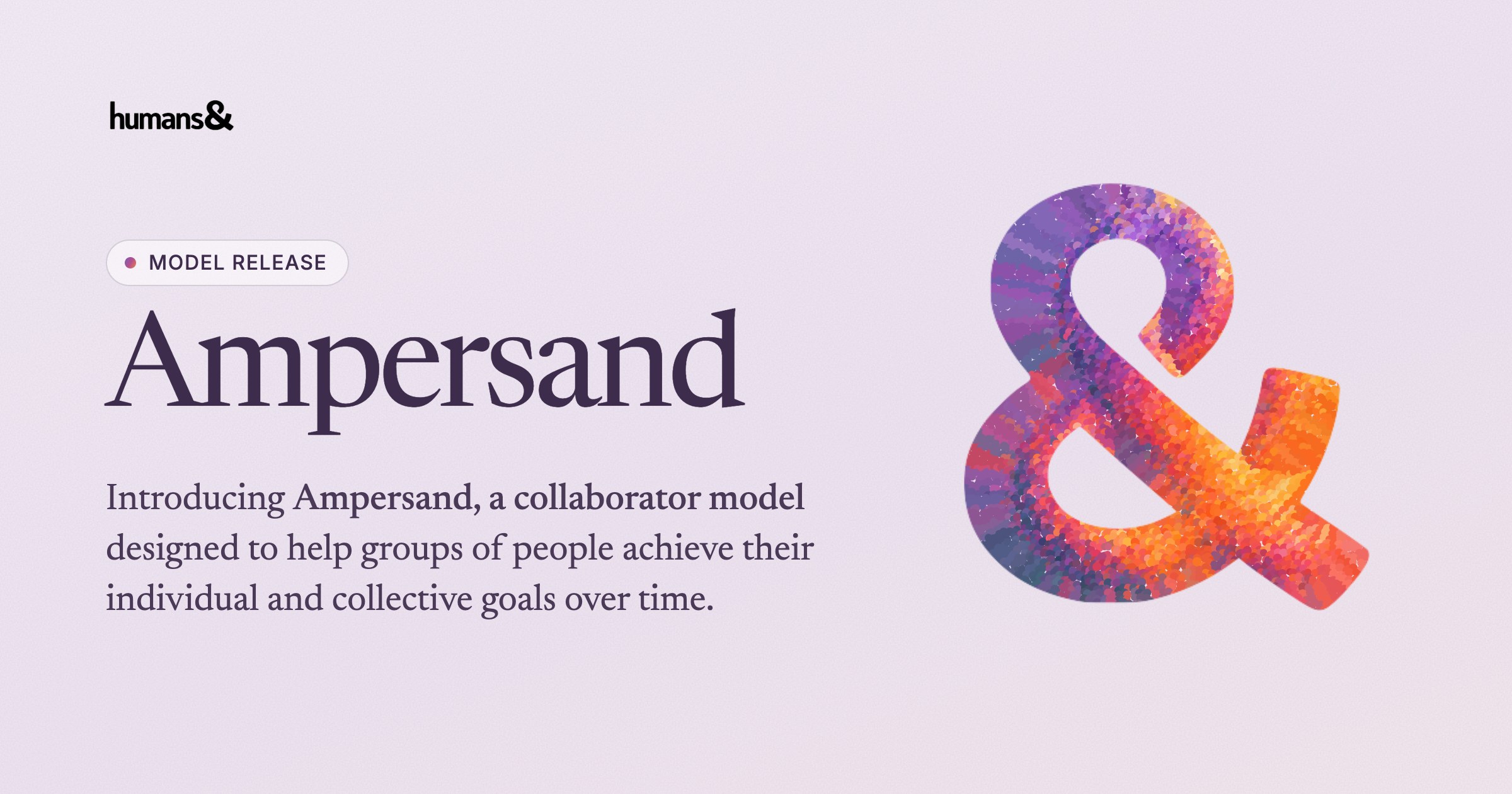
humans& releases its first model, Ampersand v0.1: a group-collaboration model trained from GLM 5.3, now open via its Agents API

On Oct 20, AI startup humans& released its first model, Ampersand v0.1, pitched as a collaborator that helps groups reach individual and shared goals rather than an assistant that completes tasks alone. It is trained from Z.ai's GLM 5.3 (about 744B total, about 40B active parameters) with long-horizon multi-party RL against simulated users played by humans&'s own user model, Persimmon. It is available now, with no waitlist, through an API compatible with OpenAI's Agents API.

humans& releases its first model, Ampersand v0.1: a group-collaboration model trained from GLM 5.3, now open via its Agents API

Key Takeaways

  • Base: GLM 5.3 MoE with about 744B total and about 40B active parameters and a 1,048,576-token context (official model card)
  • Long-term collaboration simulation (vendor figures): 12.94 for Ampersand versus 9.89 for base GLM 5.3
  • Collaborative Intelligence teamwork 59.1% (GLM 5.3: 54.3%); CooperBench cooperative success 39.0% versus 17.3% for GLM 5.3
  • Trade-off: SWE-bench Pro v2 (Hard-51) 82.4%, slightly below the base model's 84.3%; humans& also admits it sometimes over-coaches
  • Access: model ID ampersand-v0.1, usable with the official OpenAI SDK pointed at the humans& base URL
Read full story
Linked Models & Agents:

Cloudflare launches Clairic, a System One extraction model that returns typed values, dates and forecasts with confidence in one forward pass, in preview on Workers AI at $0.10 per million input tokens

On October 19 Cloudflare released a preview of Clairic, a "System One extraction model". Instead of generating tokens, it uses one parallel forward pass to extract, compute, estimate and forecast typed values from text or up to 4 images, with confidence, character spans and a null probability for each answer, returning null when a value is missing. It is live on Workers AI as @cf/cloudflare/clairic; the docs list a 64K context, vision support and $0.10 per million input tokens with no output charge. In Cloudflare's example, a Clairic+Clef+GLM-5.3 cascade ran about 3.2x faster and about 49% cheaper than GLM-5.3 alone (company figures). Open weights are planned later.

Cloudflare launches Clairic, a System One extraction model that returns typed values, dates and forecasts with confidence in one forward pass, in preview on Workers AI at $0.10 per million input tokens

Key Takeaways

  • Pricing and specs: $0.10 per million input tokens, no output charge, 65,536-token context, text plus up to 4 images (official docs).
  • Output types: text, number, date/time, duration, list, estimate, forecast; each answer carries confidence and p_null, and missing values return null.
  • Cascade test: Clairic to Clef to GLM-5.3 took 19.3 s vs 61.7 s, about 3.2x faster; $6,032 vs $11,740 per million claims, about 49% cheaper (company figures).
  • Forecast example: 21-day TSA checkpoint forecast averaged 3.3% error, with 17 of 21 days inside the 80% interval.
  • Limits: long arithmetic chains and multi-row aggregation are not reliable yet; it is a preview checkpoint with no date for open weights.
Read full story
Linked Models & Agents:
⚡ clairic⚡ clef⚡ GLM-5.3🌐 cloudflare

SGLang v0.5.22 Released: DeepSeek-V4.1 Throughput Jumps 2.3x on H200 and 1.9x on MI355X, InstantTensor Loads Models 10x Faster

The SGLang team released v0.5.22 featuring 950 PRs from 245 contributors: DeepSeek-V4.1 delivers up to 2.3x more throughput per GPU on NVIDIA H200 and 1.9x on AMD MI350X/MI355X via DSpark. The new InstantTensor loader cuts model loading time by 10x. B200 decodes Qwen3.8-Flash-Next 12% faster, while B300 speeds up GLM-5.3-Flash by 10% and yields 1.85x decode throughput for MiMo-V2.6-Pro. SGLang also adds native Apple Silicon PyTorch support and ComfyUI integration.

SGLang v0.5.22 Released: DeepSeek-V4.1 Throughput Jumps 2.3x on H200 and 1.9x on MI355X, InstantTensor Loads Models 10x Faster

Key Takeaways

  • SGLang v0.5.22 released with 950 PRs from 245 contributors across heterogeneous platforms
  • DeepSeek-V4.1 achieves up to 2.3x throughput per GPU on NVIDIA H200 and 1.9x on AMD MI350X/MI355X via DSpark
  • New InstantTensor loader speeds up large model checkpoint ingestion by 10x
  • Qwen3.8-Flash-Next decodes 12% faster on B200; MiMo-V2.6-Pro reaches 1.85x decode throughput on B300
  • PD disaggregation cuts p95 TTFT in half (-50%) on long prompts, alongside native Apple Silicon and ComfyUI diffusion support
Read full story
Linked Models & Agents:

USC, UCLA, and CMU Release Grid-Bench for Multi-Step Spatial Reasoning: 8,928 Executable Instances Reveal Severe State Drift Across 64-Step Trajectories

Can LLMs reliably maintain spatial state representations across sequential operations? USC, UCLA, and CMU introduced Grid-Bench (arXiv:2610.22312, GitHub: grid-bench/Grid-Bench), an executable benchmark with 8,928 instances testing 2D/3D/4D grid state transitions across history lengths up to T=64. Evaluations across 6 frontier models show steep degradation: while GPT-5.6 Sol and Claude 5 Sonnet retain strong cell accuracy, open-weight and mid-tier models collapse to near-zero exact world reconstruction over long trajectories.

USC, UCLA, and CMU Release Grid-Bench for Multi-Step Spatial Reasoning: 8,928 Executable Instances Reveal Severe State Drift Across 64-Step Trajectories

Key Takeaways

  • USC, UCLA, and CMU introduced Grid-Bench (arXiv:2610.22312), an executable spatial tracking benchmark across 2D, 3D, and 4D discrete manifolds
  • Evaluates 8,928 instances across 8 spatial transformation rule families and trajectory lengths up to T=64 steps
  • At intermediate length T=16, GPT-5.6 Sol (98.0% cell accuracy) and Claude 5 Sonnet (96.8%) lead while mid-tier models drop sharply
  • At extreme length T=64, exact world recovery drops to 0 for GLM-5 and Kimi K2.5, demonstrating that long-horizon agents must rely on external state engines
Read full story
Linked Models & Agents:
ADSponsored

vLLM v0.32.0: 814 commits, built-in /v1/systemone structured-decision endpoint, NVFP4 KV cache on more GPUs, and 43–85% more req/s with multiple API workers

vLLM shipped v0.32.0 on Oct 18 with 814 commits from 363 contributors (121 new). Highlights: a default-served POST /v1/systemone structured-decision endpoint and a generic hf tool/reasoning parser; NVFP4 KV cache on SM8x/SM90/SM12x and FP8 KV by default for GLM-5.x on SM100; Model Runner V2 gains a GPU n-gram speculator and Elastic EP and becomes the ROCm default; three security advisories are fixed, default CORS is restricted, and Python 3.10 is dropped.

vLLM v0.32.0: 814 commits, built-in /v1/systemone structured-decision endpoint, NVFP4 KV cache on more GPUs, and 43–85% more req/s with multiple API workers

Key Takeaways

  • Scale: 814 commits from 363 contributors (121 new); see the release notes.
  • Structured decisions: POST /v1/systemone is new and served by default for choice/score questions, including Cloudflare/clef-omni and LiquidAI/d1-3B; --tool-call-parser hf reads a checkpoint's response_template so no model-specific parser is needed.
  • Low-precision KV: GLM-5.x defaults to FP8 KV on SM100, halving KV memory per rank with 2.3–5.5% more throughput at a 7–11% TTFT cost (PR benchmark, vendor figures); ROCm adds a 4-bit KV cache at about 2x FP8 density.
  • Serving: with --api-server-count above 1, connections go to the least-loaded worker for 43–85% more req/s on short requests (Qwen3-0.6B, 32 in / 1 out tokens, PR benchmark).
  • Breaking: Python 3.10 dropped, default CORS origins restricted, cascade attention removed, and max_tokens is no longer reserved from the context window.
Read full story

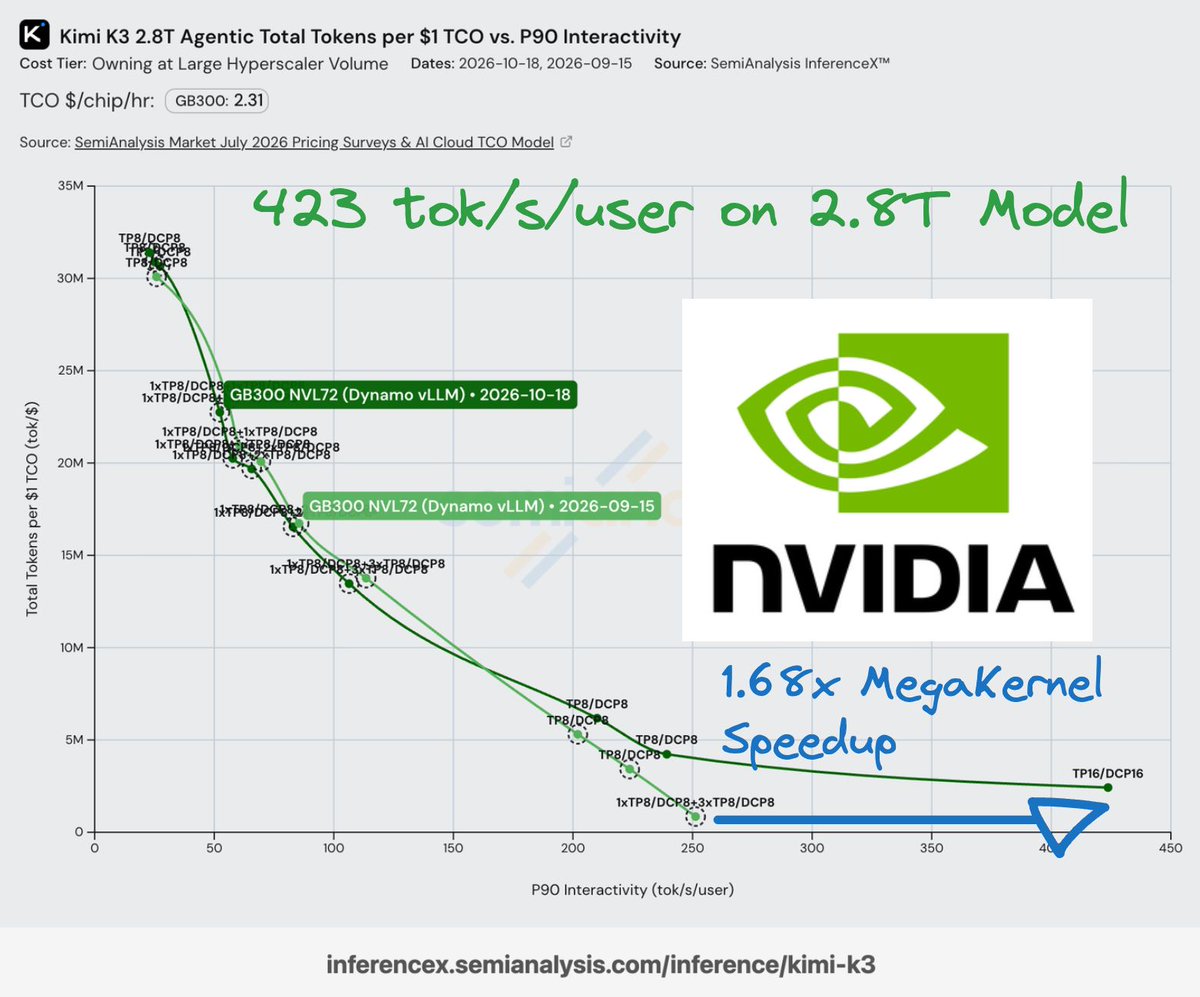
Kimi K3 Hits 842 tok/s on NVIDIA GB300 NVL72: NVIDIA and vLLM Unveil 12,000-Line CuTe DSL Decode Megakernel with 1.8x Higher AgentX Interactivity

vLLM and NVIDIA unveiled a unified CuTe DSL decode megakernel (~12,000 LoC authored by NVIDIA CentML's Benjamin Chislett) for Moonshot AI's frontier Kimi K3 model on NVIDIA GB300 NVL72. By fusing attention, MoE, and cross-GPU communication, the optimization cuts per-layer latency from 130 µs (23 kernels) to 69 µs (13 kernels), delivering 842 tokens/s at batch=1 with DSpark speculative decoding (1.73x faster than stock vLLM) and up to 1.8x higher P90 per-user interactivity (403.2–423 tok/s/user) on SemiAnalysis AgentX, with DeepSeek-V4.1-Flash (PR #61868) and GLM-5.3 support coming next.

Kimi K3 Hits 842 tok/s on NVIDIA GB300 NVL72: NVIDIA and vLLM Unveil 12,000-Line CuTe DSL Decode Megakernel with 1.8x Higher AgentX Interactivity

Key Takeaways

  • NVIDIA and vLLM introduce a 12,000-line CuTe DSL decode megakernel for the 2.8T-parameter Kimi K3, reducing per-layer execution from 23 kernels (130 µs) to 13 kernels (69 µs)
  • On 16x NVIDIA GB300 NVL72 GPUs, batch-1 decode hits 842 tok/s with DSpark speculative decoding (1.73x faster) and 256.4 tok/s without speculation (1.88x faster)
  • Delivers up to 1.8x higher P90 interactivity (403.2-423 tok/s/user) on SemiAnalysis AgentX, with DeepSeek-V4.1-Flash (vLLM PR #61868) and GLM-5.3 megakernels following next
Read full story
Linked Models & Agents:

Ollama Cloud Launches US/EU Zero-Data-Retention Hosting for DeepSeek-V4.1-Flash-1017 with Claude Code CLI, While SemiAnalysis Reveals GLM-5.3 Was Built 100% via Post-Training

Ollama launched US- and EU-hosted Ollama Cloud with strict zero data retention and zero training, adding immediate support for DeepSeek-V4.1-Flash-1017 via one-line launch commands for Claude Code and OpenCode alongside Ollama v0.40.6. Meanwhile, SemiAnalysis revealed that GLM-5.3 was built entirely by post-training the previous GLM-5.2 base model without pretraining from scratch, achieving a 'night and day difference' in cybersecurity and agentic capabilities.

Ollama Cloud Launches US/EU Zero-Data-Retention Hosting for DeepSeek-V4.1-Flash-1017 with Claude Code CLI, While SemiAnalysis Reveals GLM-5.3 Was Built 100% via Post-Training

Key Takeaways

  • Ollama Cloud launches US- and EU-hosted zero-data-retention serving for DeepSeek-V4.1-Flash-1017 with one-line ollama launch integrations for Claude Code and OpenCode
  • Ollama v0.40.6 adds GGUF q2_0 tensor support, clef cloud integration, and fixes orphaned runner processes on Windows
  • SemiAnalysis reveals GLM-5.3 was built entirely by post-training the previous model without pretraining from scratch, delivering a 'night and day difference' in cyber capabilities over GLM-5.2
Read full story
Linked Models & Agents:

When Remote KV Cache Is Slower Than GPU Recompute: Sharded LMCache Cuts p99 from 83.32s to 0.67s on 8xB300, While Baidu VHA Halves KV Cache and Beats MLA

Addressing KV cache bottlenecks in long-context LLM serving, a new production study on 8xB300 nodes serving GLM-5.3 (arXiv:2610.21500) reveals that unsharded remote KV caches inflate hit-heavy p99 TTFT to 83.32s, and resolves it via rank-sharded asynchronous LMCache loading—boosting GET bandwidth 6.3x to 10.76 GB/s and slashing p99 to 0.67s (+34% throughput). Meanwhile, Baidu PaddlePaddle open-sources Virtual Head Attention (VHA, arXiv:2610.17959), folding linear Q-Premix and Postmix into standard GQA-2 weights at inference to halve KV cache while beating MLA (+0.70%) and GQA-4 (+2.60%) on a 30B-A3B MoE and lifting 8K-128K RULER from 73.0 to 84.4.

When Remote KV Cache Is Slower Than GPU Recompute: Sharded LMCache Cuts p99 from 83.32s to 0.67s on 8xB300, While Baidu VHA Halves KV Cache and Beats MLA

Key Takeaways

  • On 8xB300 nodes serving GLM-5.3 with PCP8, sharding LMCache across ranks and adding async loading boosts GET bandwidth 6.3x to 10.76 GB/s, cutting hit-heavy p99 TTFT from 83.32s to 0.67s (+34% throughput)
  • Baidu's Virtual Head Attention (VHA) folds linear Q-Premix and low-rank Postmix directly into W_Q and W_O at inference, reducing to a zero-overhead GQA-2 architecture with half to a quarter of the KV cache
  • On a 500B-token 30B-A3B MoE, VHA outperforms both MLA (+0.70%) and GQA-4 (+2.60%), and boosts 8K-128K RULER on a 10B-A1B MoE from 73.0 (GQA-4) to 84.4 using only 2 KV heads
Read full story
Linked Models & Agents:

MLExpert: Open 35B MoE Agentic Model Lifts MLE-Bench Lite Medal Rate from 37.9% to 72.7%, Matching Kimi-K3 and GLM-5.3

Advancing autonomous AI-for-AI (AI4AI) engineering, researchers from Shanghai AI Lab (InternScience) release MLExpert (arXiv:2610.22344), a 35B Mixture-of-Experts agentic model for autonomous machine learning engineering. Powered by the Kaggle-MLE Factory, hierarchical agentic SFT, and Windowed Interaction RL (WIRL), MLExpert boosts average medal rates on MLE-Bench Lite from 37.9% to 72.7%—matching frontier giants like Kimi-K3 and GLM-5.3 while generalizing to agent scaffold optimization.

MLExpert: Open 35B MoE Agentic Model Lifts MLE-Bench Lite Medal Rate from 37.9% to 72.7%, Matching Kimi-K3 and GLM-5.3

Key Takeaways

  • 72.7% medal rate on MLE-Bench Lite: boosts base model performance from 37.9% to 72.7%, matching frontier models Kimi-K3 and GLM-5.3 with a 35B MoE backbone
  • Windowed Interaction RL (WIRL): assigns shared outcome rewards to multi-turn windows between successive experiment results with asynchronous policy updates
  • Cross-domain AI4AI generalization: transfers optimization skills directly to NatureBench Lite, agent scaffold optimization, and algorithm engineering
Read full story