AI Coding Live News

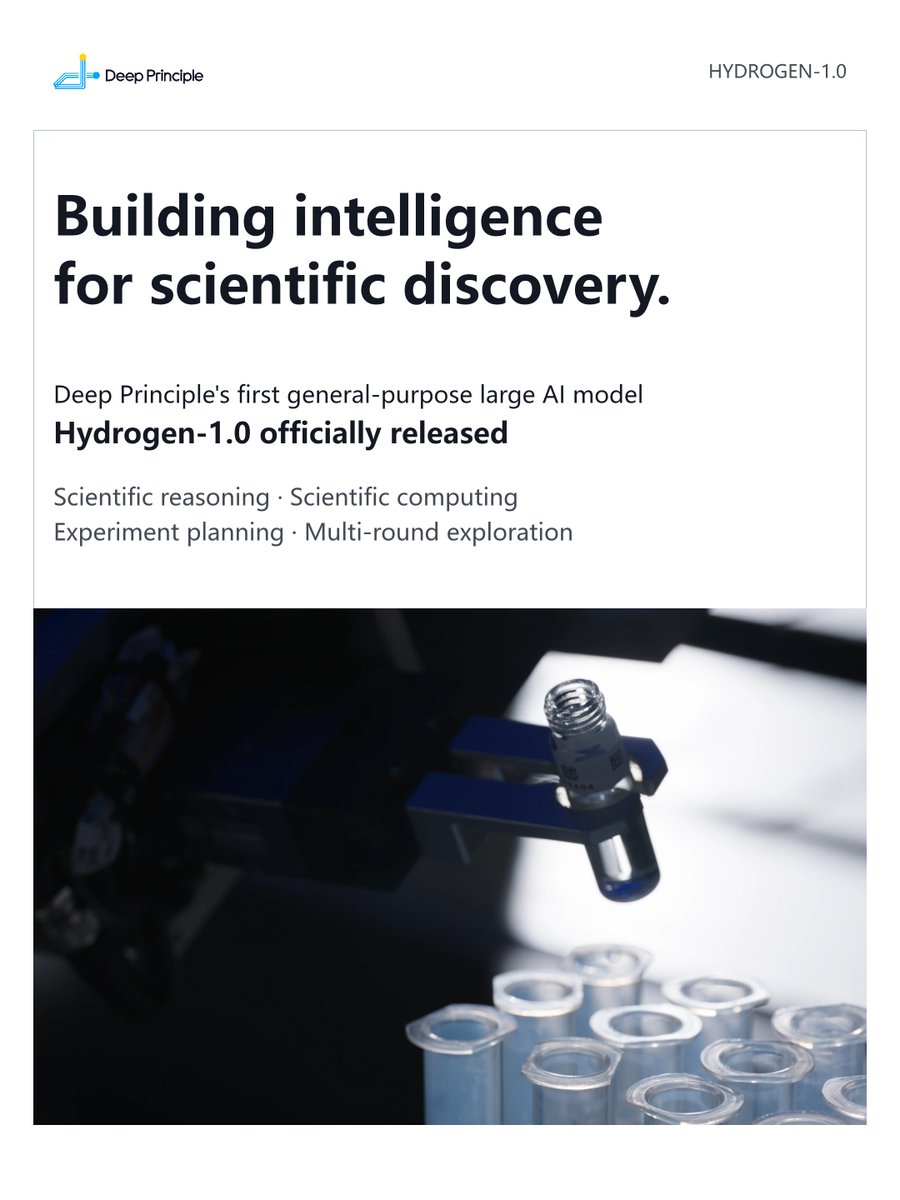
Deep Principle Open-Sources Hydrogen-1.0, a 753B Science Model Post-Trained From GLM-5.3 on Lab Records, MIT Licensed

Hangzhou-based AI-for-science company Deep Principle released Hydrogen-1.0 on November 2, its first general-purpose scientific model. It post-trains Zhipu's GLM-5.3 with SFT and RL on chemistry, materials and life-science data plus its own lab records and discovery trajectories, and ships about 753B parameters of BF16 weights on Hugging Face under the MIT license. By the vendor's own evaluation it scores 38.3% on FrontierScience-Research versus 33.3% for GPT-6 Astra; none of the results have been independently reproduced yet.
Deep Principle Open-Sources Hydrogen-1.0, a 753B Science Model Post-Trained From GLM-5.3 on Lab Records, MIT Licensed

Key Takeaways

  • Scale: Hugging Face lists about 753B total parameters (BF16, roughly 1.5 TB of weights), glm_moe_dsa architecture, 1M-token context and 128K max output, MIT licensed (download requires accepting HF terms).
  • Benchmarks (vendor-reported): 38.3% on FrontierScience-Research vs 33.3% for GPT-6 Astra; 93.0% on GPQA Diamond, which the company says roughly matches Kimi K3.
  • Internal scenarios (vendor-reported): leads max-thinking GPT-6 Astra by 5.13 points on scientific computing and 4.76 points on forward reaction prediction, but trails it by 3.33 points on NMR structure elucidation.
  • Materials discovery: after five rounds of transition-metal-complex search, the mean best HOMO-LUMO gap reached 4.318 eV vs 3.689 eV for GPT-6 Astra and 3.353 eV for Kimi K3 (official blog).
  • Access: weights on HF and ModelScope, plus NVFP4 (B200/B300) and MXFP4 (MI350X/MI355X) quantized repos; API via NeuroSpark and in-app use in the Mira AI Scientist; tested with SGLang on 8 GPUs.
Read full story

Cloudflare discloses a cross-request KV cache leak in GLM-5.3 on Workers AI: a config mismatch plus an SGLang bug let 155 responses carry other users' data over 13 days

In an Oct 26 incident report on its blog, Cloudflare said that between Aug 27 and Sep 9, 155 responses from GLM-5.3 on Workers AI (@cf/zai-org/glm-5.3) to prompts longer than 681,280 tokens contained data from other customers' recent requests, all returned with HTTP 200. The cause was a prefill KV cache pool smaller than the 1,048,576-token context window, combined with an SGLang bug in disaggregated prefill/decode mode. Cloudflare found no evidence of deliberate exploitation, has fixed it, and recommends operators upgrade to SGLang v0.5.22 or later.

Cloudflare discloses a cross-request KV cache leak in GLM-5.3 on Workers AI: a config mismatch plus an SGLang bug let 155 responses carry other users' data over 13 days

Key Takeaways

  • Scope: 155 responses between 2026-08-27 and 09-09, all to prompts over 681,280 tokens; Cloudflare confirmed no other Workers AI model was affected
  • Cause 1: GLM-5.3 advertised a 1,048,576-token context but the prefill KV pool held only 681,280 tokens; after the fix the pool holds about 2.04 million tokens, roughly twice the context
  • Cause 2: SGLang marked over-length requests as rejected and swapped in a one-token placeholder without aborting, so the decode node read stale cache pages from earlier requests
  • Response: report from Gadi Evron of Knostic via HackerOne on Sep 8; model taken offline within 40 minutes of declaring the incident on Sep 9 and restored at 19:40 UTC that day
  • Action: teams running SGLang should upgrade to v0.5.22 or later and check KV pool size against context length directly
Read full story
Linked Models & Agents:
⚡ Z.ai GLM 5.3🌐 cloudflare🌐 zai

Letta releases FrontierMemory 1.0, a benchmark that scores agent memory by downstream task success; Opus 5.5 and GLM-5.3 tie for first at 73.3%

On October 21 Letta released FrontierMemory 1.0. Instead of quizzing agents on facts such as birthdays or hobbies, it gives an agent a set of past trajectories, has it write memory or skills, and scores that memory by how many coding and knowledge-work tasks a task agent then solves. Version 1.0 has 15 tasks adapted from public benchmarks such as DeepSWE, SkillsBench and APEX-Agents. On the model board (memory written in Letta Dream, tasks run in Letta Code) Opus 5.5 and GLM-5.3 both score 73.3% and Grok 4.7 scores 33.3%; on the harness board Letta's own Letta Dream ranks first. All numbers are Letta's own.

Letta releases FrontierMemory 1.0, a benchmark that scores agent memory by downstream task success; Opus 5.5 and GLM-5.3 tie for first at 73.3%

Key Takeaways

  • Model board (vendor-run, top effort): Opus 5.5 73.3% (about $2.80 per task), GLM-5.3 73.3% ($3.58), Kimi K3 66.7%, GPT-6.1 Sol 60.0% ($0.77, cheapest), Gemini 4 Argon 60.0%, Muse Wonder 46.7%, Grok 4.7 33.3%
  • Harness board: Letta Dream 73.3%, Prime Agent 60.0%, OpenAI Agents SDK 40.0%, Claude Managed Agents 33.3%, Hermes Agent 26.7%
  • Version 1.0 has 15 tasks; only 219 of 665 source trajectories are relevant, so the agent has to find the useful experience itself
  • Letta says 53% of the source tasks it kept had broken verifiers, which it repaired; memory generation is capped at 6 hours with no web access
  • Memory comes in three kinds (task conventions, user preferences, environment facts); outside models and harnesses can be submitted
Read full story

Cloudflare launches Clairic, a System One extraction model that returns typed values, dates and forecasts with confidence in one forward pass, in preview on Workers AI at $0.10 per million input tokens

On October 19 Cloudflare released a preview of Clairic, a "System One extraction model". Instead of generating tokens, it uses one parallel forward pass to extract, compute, estimate and forecast typed values from text or up to 4 images, with confidence, character spans and a null probability for each answer, returning null when a value is missing. It is live on Workers AI as @cf/cloudflare/clairic; the docs list a 64K context, vision support and $0.10 per million input tokens with no output charge. In Cloudflare's example, a Clairic+Clef+GLM-5.3 cascade ran about 3.2x faster and about 49% cheaper than GLM-5.3 alone (company figures). Open weights are planned later.

Cloudflare launches Clairic, a System One extraction model that returns typed values, dates and forecasts with confidence in one forward pass, in preview on Workers AI at $0.10 per million input tokens

Key Takeaways

  • Pricing and specs: $0.10 per million input tokens, no output charge, 65,536-token context, text plus up to 4 images (official docs).
  • Output types: text, number, date/time, duration, list, estimate, forecast; each answer carries confidence and p_null, and missing values return null.
  • Cascade test: Clairic to Clef to GLM-5.3 took 19.3 s vs 61.7 s, about 3.2x faster; $6,032 vs $11,740 per million claims, about 49% cheaper (company figures).
  • Forecast example: 21-day TSA checkpoint forecast averaged 3.3% error, with 17 of 21 days inside the 80% interval.
  • Limits: long arithmetic chains and multi-row aggregation are not reliable yet; it is a preview checkpoint with no date for open weights.
Read full story
Linked Models & Agents:
⚡ clairic⚡ clef⚡ GLM-5.3🌐 cloudflare
ADSponsored

SGLang v0.5.22 Released: DeepSeek-V4.1 Throughput Jumps 2.3x on H200 and 1.9x on MI355X, InstantTensor Loads Models 10x Faster

The SGLang team released v0.5.22 featuring 950 PRs from 245 contributors: DeepSeek-V4.1 delivers up to 2.3x more throughput per GPU on NVIDIA H200 and 1.9x on AMD MI350X/MI355X via DSpark. The new InstantTensor loader cuts model loading time by 10x. B200 decodes Qwen3.8-Flash-Next 12% faster, while B300 speeds up GLM-5.3-Flash by 10% and yields 1.85x decode throughput for MiMo-V2.6-Pro. SGLang also adds native Apple Silicon PyTorch support and ComfyUI integration.

SGLang v0.5.22 Released: DeepSeek-V4.1 Throughput Jumps 2.3x on H200 and 1.9x on MI355X, InstantTensor Loads Models 10x Faster

Key Takeaways

  • SGLang v0.5.22 released with 950 PRs from 245 contributors across heterogeneous platforms
  • DeepSeek-V4.1 achieves up to 2.3x throughput per GPU on NVIDIA H200 and 1.9x on AMD MI350X/MI355X via DSpark
  • New InstantTensor loader speeds up large model checkpoint ingestion by 10x
  • Qwen3.8-Flash-Next decodes 12% faster on B200; MiMo-V2.6-Pro reaches 1.85x decode throughput on B300
  • PD disaggregation cuts p95 TTFT in half (-50%) on long prompts, alongside native Apple Silicon and ComfyUI diffusion support
Read full story
Linked Models & Agents:

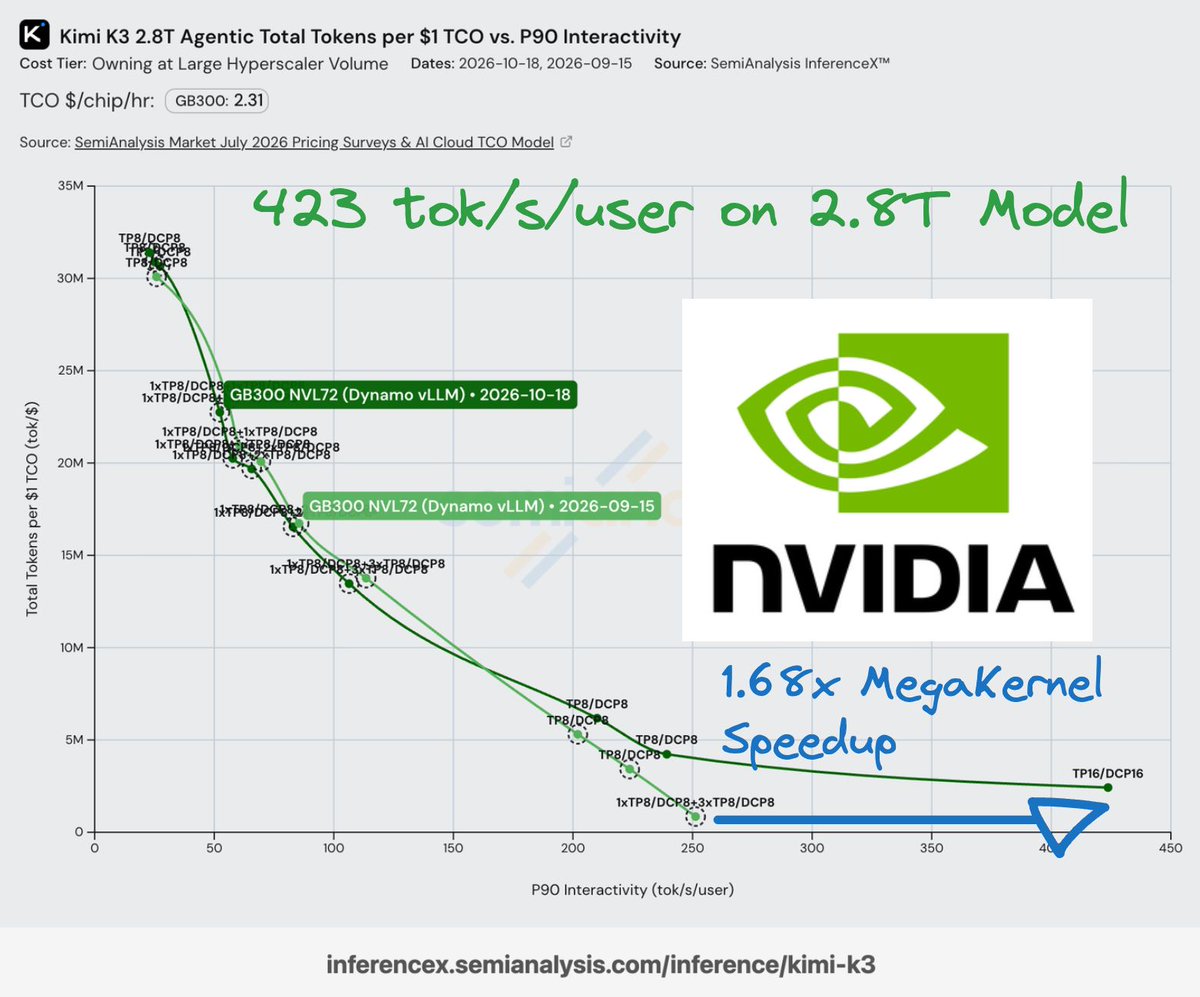
Kimi K3 Hits 842 tok/s on NVIDIA GB300 NVL72: NVIDIA and vLLM Unveil 12,000-Line CuTe DSL Decode Megakernel with 1.8x Higher AgentX Interactivity

vLLM and NVIDIA unveiled a unified CuTe DSL decode megakernel (~12,000 LoC authored by NVIDIA CentML's Benjamin Chislett) for Moonshot AI's frontier Kimi K3 model on NVIDIA GB300 NVL72. By fusing attention, MoE, and cross-GPU communication, the optimization cuts per-layer latency from 130 µs (23 kernels) to 69 µs (13 kernels), delivering 842 tokens/s at batch=1 with DSpark speculative decoding (1.73x faster than stock vLLM) and up to 1.8x higher P90 per-user interactivity (403.2–423 tok/s/user) on SemiAnalysis AgentX, with DeepSeek-V4.1-Flash (PR #61868) and GLM-5.3 support coming next.

Kimi K3 Hits 842 tok/s on NVIDIA GB300 NVL72: NVIDIA and vLLM Unveil 12,000-Line CuTe DSL Decode Megakernel with 1.8x Higher AgentX Interactivity

Key Takeaways

  • NVIDIA and vLLM introduce a 12,000-line CuTe DSL decode megakernel for the 2.8T-parameter Kimi K3, reducing per-layer execution from 23 kernels (130 µs) to 13 kernels (69 µs)
  • On 16x NVIDIA GB300 NVL72 GPUs, batch-1 decode hits 842 tok/s with DSpark speculative decoding (1.73x faster) and 256.4 tok/s without speculation (1.88x faster)
  • Delivers up to 1.8x higher P90 interactivity (403.2-423 tok/s/user) on SemiAnalysis AgentX, with DeepSeek-V4.1-Flash (vLLM PR #61868) and GLM-5.3 megakernels following next
Read full story
Linked Models & Agents:

Ollama Cloud Launches US/EU Zero-Data-Retention Hosting for DeepSeek-V4.1-Flash-1017 with Claude Code CLI, While SemiAnalysis Reveals GLM-5.3 Was Built 100% via Post-Training

Ollama launched US- and EU-hosted Ollama Cloud with strict zero data retention and zero training, adding immediate support for DeepSeek-V4.1-Flash-1017 via one-line launch commands for Claude Code and OpenCode alongside Ollama v0.40.6. Meanwhile, SemiAnalysis revealed that GLM-5.3 was built entirely by post-training the previous GLM-5.2 base model without pretraining from scratch, achieving a 'night and day difference' in cybersecurity and agentic capabilities.

Ollama Cloud Launches US/EU Zero-Data-Retention Hosting for DeepSeek-V4.1-Flash-1017 with Claude Code CLI, While SemiAnalysis Reveals GLM-5.3 Was Built 100% via Post-Training

Key Takeaways

  • Ollama Cloud launches US- and EU-hosted zero-data-retention serving for DeepSeek-V4.1-Flash-1017 with one-line ollama launch integrations for Claude Code and OpenCode
  • Ollama v0.40.6 adds GGUF q2_0 tensor support, clef cloud integration, and fixes orphaned runner processes on Windows
  • SemiAnalysis reveals GLM-5.3 was built entirely by post-training the previous model without pretraining from scratch, delivering a 'night and day difference' in cyber capabilities over GLM-5.2
Read full story
Linked Models & Agents:

When Remote KV Cache Is Slower Than GPU Recompute: Sharded LMCache Cuts p99 from 83.32s to 0.67s on 8xB300, While Baidu VHA Halves KV Cache and Beats MLA

Addressing KV cache bottlenecks in long-context LLM serving, a new production study on 8xB300 nodes serving GLM-5.3 (arXiv:2610.21500) reveals that unsharded remote KV caches inflate hit-heavy p99 TTFT to 83.32s, and resolves it via rank-sharded asynchronous LMCache loading—boosting GET bandwidth 6.3x to 10.76 GB/s and slashing p99 to 0.67s (+34% throughput). Meanwhile, Baidu PaddlePaddle open-sources Virtual Head Attention (VHA, arXiv:2610.17959), folding linear Q-Premix and Postmix into standard GQA-2 weights at inference to halve KV cache while beating MLA (+0.70%) and GQA-4 (+2.60%) on a 30B-A3B MoE and lifting 8K-128K RULER from 73.0 to 84.4.

When Remote KV Cache Is Slower Than GPU Recompute: Sharded LMCache Cuts p99 from 83.32s to 0.67s on 8xB300, While Baidu VHA Halves KV Cache and Beats MLA

Key Takeaways

  • On 8xB300 nodes serving GLM-5.3 with PCP8, sharding LMCache across ranks and adding async loading boosts GET bandwidth 6.3x to 10.76 GB/s, cutting hit-heavy p99 TTFT from 83.32s to 0.67s (+34% throughput)
  • Baidu's Virtual Head Attention (VHA) folds linear Q-Premix and low-rank Postmix directly into W_Q and W_O at inference, reducing to a zero-overhead GQA-2 architecture with half to a quarter of the KV cache
  • On a 500B-token 30B-A3B MoE, VHA outperforms both MLA (+0.70%) and GQA-4 (+2.60%), and boosts 8K-128K RULER on a 10B-A1B MoE from 73.0 (GQA-4) to 84.4 using only 2 KV heads
Read full story
Linked Models & Agents:

MLExpert: Open 35B MoE Agentic Model Lifts MLE-Bench Lite Medal Rate from 37.9% to 72.7%, Matching Kimi-K3 and GLM-5.3

Advancing autonomous AI-for-AI (AI4AI) engineering, researchers from Shanghai AI Lab (InternScience) release MLExpert (arXiv:2610.22344), a 35B Mixture-of-Experts agentic model for autonomous machine learning engineering. Powered by the Kaggle-MLE Factory, hierarchical agentic SFT, and Windowed Interaction RL (WIRL), MLExpert boosts average medal rates on MLE-Bench Lite from 37.9% to 72.7%—matching frontier giants like Kimi-K3 and GLM-5.3 while generalizing to agent scaffold optimization.

MLExpert: Open 35B MoE Agentic Model Lifts MLE-Bench Lite Medal Rate from 37.9% to 72.7%, Matching Kimi-K3 and GLM-5.3

Key Takeaways

  • 72.7% medal rate on MLE-Bench Lite: boosts base model performance from 37.9% to 72.7%, matching frontier models Kimi-K3 and GLM-5.3 with a 35B MoE backbone
  • Windowed Interaction RL (WIRL): assigns shared outcome rewards to multi-turn windows between successive experiment results with asynchronous policy updates
  • Cross-domain AI4AI generalization: transfers optimization skills directly to NatureBench Lite, agent scaffold optimization, and algorithm engineering
Read full story

Paper Instruments releases Ultramarine 1 Flash: non-verifiable-RL knowledge-work model on GLM-5.3 Flash, $0.13/task on its own suite, API live, weights promised

San Francisco lab Paper Instruments launched Ultramarine 1 Flash on 2026-10-14 16:02 UTC: GLM-5.3 Flash post-trained with large-scale non-verifiable RL (per-task rubric rewards) for finance, legal, consulting and operations work. Its report claims +4.1 points on average over the base across six knowledge-work benchmarks with 6.5% fewer output tokens, and 59.3 at $0.13/task on its internal PI Knowledge Work suite vs Claude Fable 5 at 57.8 / $8.19. An OpenAI-compatible API (ultramarine-1-flash) is live; the CEO says weights follow in about two weeks and post-training cost ~$300k. The headline cost comparison rests on an internal benchmark and has not been independently reproduced.

Paper Instruments releases Ultramarine 1 Flash: non-verifiable-RL knowledge-work model on GLM-5.3 Flash, $0.13/task on its own suite, API live, weights promised

Key Takeaways

  • GLM-5.3 Flash base + modified CISPO RL (LoRA rank 64, 131K context, up to 250 turns); +4.1 avg over base on 6 knowledge-work benchmarks with 6.5% fewer tokens
  • JobBench 62.9 (#1, Gemini 3.8 Flash 60.6); FrontierFinance 53.3 (#1); APEX-Agents 1.1 57.0 vs Gemini 3.8 Flash 64.3
  • Internal PI Knowledge Work: 59.3 at $0.13/task vs Claude Fable 5 57.8 / $8.19 and GPT-6 Sol 61.3 / $1.26
  • Trade-off: slight coding regression — Terminal-Bench 2.1 83.2 (base 84.3), DeepSWE 1.1 61.5 (base 63.4)
  • Curriculum: 4 domains, 19 practice areas, 88 synthetic environment types, fully synthetic tasks graded by rubrics
Read full story
ADSponsored

Anthropic details Claude anti-distillation stack: two-stage classifiers and preserved thinking cut harvested reasoning tokens ~10–100×

On 2026-10-12 Anthropic published a research post claiming substantially stronger defenses against illicit distillation of Claude: early evidence of ~90–99% less data harvested by distillers, and ~10–100× fewer reasoning tokens extractable on-platform after new safeguards. Methods include preserved thinking (harder context rewriting for newer API accounts), org-scoped reasoning transcripts, a two-stage classifier against chain-of-thought extraction (<0.1% claimed false-positive rate), bans/limits, and resumed charging for blocked low-FPR requests. The post cites cyber-capability distillation into models such as GLM-5.3 and urges other frontier labs and platforms to share the load.

Key Takeaways

  • Official: Anthropic Research — distillation defenses (2026-10-12)
  • Vendor effect: ~90–99% less data harvested; ~10–100× fewer reasoning tokens extractable on-platform; tens of thousands of accounts banned, often within ~2 hours
  • Stack: preserved thinking (newer API accounts), org-scoped reasoning transcripts, two-stage CoT-extraction classifiers (<0.1% claimed FPR)
  • Coverage: Sonnet 5.5, Opus 5/5.5, Fable 5/5.1 among generally available targets; legitimate apps may need integration updates and can hit rare charged blocks
  • Industry: cites open-weight cyber-capability distillation cases; argues platforms must disrupt fraudulent proxies too
Read full story

Z.ai introduces GLM-Legal on GLM-5.3-Flash: 19.2% Harvey LAB all-pass (vendor-reported), API by application

On 2026-10-12 Z.ai introduced GLM-Legal, built on GLM-5.3-Flash with legal mid-training and RL across tens of thousands of legal environments, co-trained with its agent harness. Vendor-reported: 19.2% Harvey LAB all-pass (base 6.7%); LegalBench and PLawBench claimed at parity without scores. No open weights; API by application; AutoClaw support coming.

Z.ai introduces GLM-Legal on GLM-5.3-Flash: 19.2% Harvey LAB all-pass (vendor-reported), API by application

Key Takeaways

  • Official: Z.ai tech blog, 2026-10-12; base model GLM-5.3-Flash
  • Harvey LAB all-pass (vendor-reported): GLM-Legal 19.2%, Kimi K3 12.9%, Claude Fable 5 11.3%, GLM-5.3-Flash 6.7%, GPT-6 Astra 5.4%
  • LegalBench / PLawBench: 'parity with frontier closed models', no scores published
  • Training: legal mid-training plus RL across tens of thousands of legal environments, co-evolved with the agent harness
  • Availability: no open weights; API by application, pricing undisclosed; AutoClaw support coming, no date
Read full story
Linked Models & Agents:
⚡ Z.ai GLM Legal⚡ Z.ai GLM 5.3 Flash🤖 autoclaw🌐 zhipu🌐 zai

CrowdStrike: attacker used open-source AI pentest agent ARTEX plus Claude Code to breach South Korean financial firms

CrowdStrike Intelligence found Claude Code session histories, ARTEX configs and a CLAUDE.md in attacker open directories, showing a likely Chinese-speaking, financially motivated actor used the China-built open-source agentic pentest framework ARTEX (DeepSeek v4.1-flash primary, plus GLM-5.3 and Grok 4.6) to breach loan-inquiry and employee mobile systems at South Korean financial institutions from late September to early October 2026.

Key Takeaways

  • Window: late Sep to early Oct 2026; CrowdStrike attribution is moderate confidence, no named adversary
  • Model stack: DeepSeek v4.1-flash as ARTEX primary backend via likely reseller xcai[.]pro; GLM-5.3 and Grok 4.6 in Claude Code sessions
  • IOCs: 1 actor-controlled IP (38.244.50[.]120) plus 9 proxy IPs, with MITRE ATT&CK mapping
  • Reported impact: Shinhan 25,729 customers, Hana 89, Yegaram ~40,000 (press reports)
  • The upstream Autumn-27/ARTEX GitHub repo now returns 404
Read full story

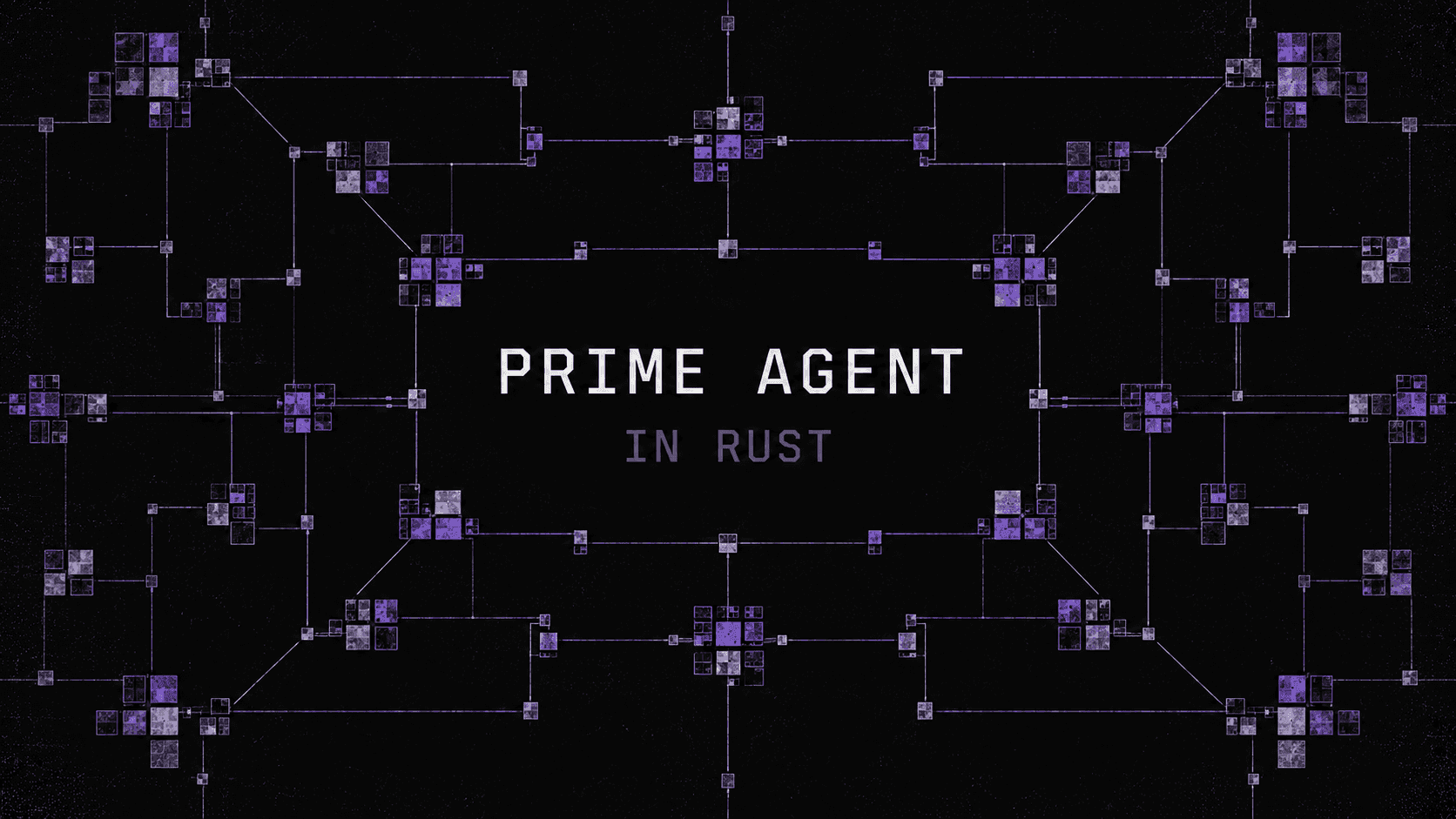
Prime Intellect's Prime Agent used a 2,209-agent swarm to rewrite itself in Rust: time-to-type 738ms→56ms, 80%+ less memory

On Oct 9 Prime Intellect shipped a Rust rewrite of Prime Agent, its open-source coding agent harness. A root orchestrator ran 2,209 sub-agents across 10,000+ Prime Sandboxes and ~228.7B GLM-5.3 tokens over two weeks, with differential TUI, harness and protocol parity tests gating every merge. Vendor-measured cold time-to-type dropped from 737.8ms to 55.8ms and post-startup memory from 607MB to 106MB; Windows (beta) and Homebrew installs were added.

Prime Intellect's Prime Agent used a 2,209-agent swarm to rewrite itself in Rust: time-to-type 738ms→56ms, 80%+ less memory

Key Takeaways

  • Scale: 2,209 agents, 16,758 agent-to-agent messages, 228.70B tokens (192.99B/1,981 agents for the port, 35.70B/228 for perf hillclimbing) across 10,000+ Prime Sandboxes
  • Vendor-measured: cold time-to-type 737.8ms→55.8ms (13.22x), first paint 722.8ms→23.6ms, post-startup RSS 607.4MB→106.0MB, install 172.1MB→59.6MB
  • Each task ran a Planner→Implementer→adversarial Reviewer (different model)→Verifier state machine; failures loop back to the implementer
  • A 3-day target-free hillclimb loop logged 144+ experiment/audit records and merged 69+ performance changes
  • Codebase now 9 crates, largest file ~2,500 lines (was ~15,000); native Windows (beta) and Homebrew installs, still open source
Read full story
g
ggml-org@AICoder·
👀189
🔥84

llama.cpp v0.6.0 ships GLM-5.3-Flash (320B) and Qwen4Exp MTP speculative decoding, a new llama_batch_ext API, and up to ~3x faster few-row mat-mul on Apple GPUs

ggml-org released llama.cpp v0.6.0 on Oct 5 (v0.5.0 was Sep 23). It brings GLM-5.3-Flash (GLM5-Next, a 320B text+vision hybrid MoE) into a stable tag, adds MTP speculative decoding for Qwen4Exp (~1.5x decode on DGX Spark), introduces the llama_batch_ext / llama_process() API for mixed token and embedding batches, adds few-row MMA mat-mul kernels on Metal (up to ~3x for speculative and batched decoding), and bumps ggml to v0.26.0. Session file formats are bumped too.

Key Takeaways

  • New models: GLM-5.3-Flash (GLM5-Next, 320B KDA/DSA hybrid text+vision MoE), Clef decision model, Ling 3.0 VL, LFM2.5-Encoder
  • Speed: Qwen4Exp MTP speculative decoding ~1.5x decode on DGX Spark; Metal few-row MMA mat-mul up to ~3x
  • API: llama_batch_ext + llama_process() for mixed token/embedding batches; server and examples migrated
  • Compat: LLAMA_SESSION_VERSION 11 and LLAMA_STATE_SEQ_VERSION 4, so old session/state files must be regenerated
  • Server: /v1/models reports modalities, /v1/embeddings takes typed vision/audio/video input, new /v1/systemone endpoint
Read full story
Linked Models & Agents: