AI Coding Live News

Google Project Suncatcher Gets First AI Response From a TPU in Orbit: Gemma 4 Downlinks a Haiku, Twin Satellites Planned for 2027

Google CEO Sundar Pichai and Google Research announced that the Project Suncatcher prototype satellite, launched on October 1, finished commissioning and ran a prompt on its onboard TPU with the open Gemma 4 model, downlinking a haiku as it passed over Svalbard, Norway. Google calls it the first AI response from a data-center-class TPU in orbit. Next come thermal-stress and radiation tests, then two interconnected satellites in 2027 to test AI computation distributed across satellites.

Google Project Suncatcher Gets First AI Response From a TPU in Orbit: Gemma 4 Downlinks a Haiku, Twin Satellites Planned for 2027

Key Takeaways

  • The satellite launched on October 1 on SpaceX's Transporter-18 rideshare, built with Planet, and ran its first in-orbit inference after about three weeks of commissioning (official account).
  • Per TechCrunch, it carries four TPUs and generates up to about 1 kW, so power limits it to one TPU at a time for roughly 20 minutes.
  • Sundar Pichai's announcement drew about 26K likes and 3.97M views; Google's official account said "Our TPUs just phoned home... from space."
  • Ground proton-beam tests in Google's paper found high-bandwidth memory irregularities only after a cumulative 2 krad(Si), about 3x the 750 rad(Si) minimum requirement (as cited by The Register).
  • Two interconnected satellites are planned for 2027 to test optical inter-satellite links and AI computation distributed across satellites.
Read full story

Google Project Suncatcher runs its first in-orbit TPU inference, with Gemma 4 writing a haiku

On Oct 30 Google CEO Sundar Pichai announced a "hello world" milestone for Project Suncatcher on X: the team sent a command to the prototype satellite in orbit, booted the TPU, ran a prompt and received the first complete response back on Earth, a haiku. TechCrunch reports the reply came from Gemma 4 preloaded on the satellite.

Google Project Suncatcher runs its first in-orbit TPU inference, with Gemma 4 writing a haiku

Key Takeaways

  • The prototype launched Oct 1 on SpaceX Transporter-18 and ran its first in-orbit inference after about three weeks of commissioning (commissioning time per TechCrunch)
  • Per TechCrunch the onboard model is Google DeepMind's Gemma 4, and the first prompt asked for a haiku about being in space
  • TechCrunch says the satellite generates up to about 1 kW and the TPU can run only about 20 minutes at a time; TPU count differs by source (Google's earlier X post said four, TechCrunch says one)
  • Next step is two more satellites in 2027 to test higher power and inter-satellite optical links; Google has published no throughput or benchmark numbers
Read full story

Google's Gemma team says Gemini 4 Argon wrote vLLM optimizations that speed up gemma-4-E2B-it 2.85x on an A100

On Oct 26, Google's official @googlegemma account said a set of vLLM optimizations built with Gemini 4 Argon lifted gemma-4-E2B-it throughput on a single A100 from about 37,900 to 108,000+ tokens/sec, roughly 2.85x, with 100% token parity. The PRs were filed by Luciano Martins of Google DeepMind, and most are still under review.

Google's Gemma team says Gemini 4 Argon wrote vLLM optimizations that speed up gemma-4-E2B-it 2.85x on an A100

Key Takeaways

  • Google says gemma-4-E2B-it throughput on an A100 rose about 2.85x (about 37.9K to 108K+ tokens/sec) with 100% token parity
  • The PRs come from Luciano Martins of Google DeepMind and cover fused Triton kernels, MTP speculative decoding and KV-sharing fast prefill
  • The 2.85x figure is Google's claim for the full set; PR #60674 alone self-reports up to 1.90x prefill and about 1.06x decode
  • As of Oct 27, only 3 of the 10 PRs in the linked list are merged; the rest are still in review
  • It is a public example of using a frontier coding model for inference-kernel performance work, still awaiting reproduction by the vLLM community
Read full story
Linked Models & Agents:

NVIDIA open-sources Nemotron 3.5 Bolt E4B 4GB, a Gemma 4 E4B-based small model for local assistants, characters and robots with tool use

On 2026-10-23 (15:41 UTC) the official @NVIDIAAI account announced Nemotron 3.5 Bolt E4B 4GB, a small open model for local assistants, interactive characters and robots that can hold a conversation and use tools. The official Hugging Face model card says it is post-trained from Gemma-4-E4B-it, has 8B total parameters (4B effective), ships in Q4_K_M quantization, supports up to 64K input and 64K output tokens, and has a switchable thinking mode, plus a DFlash speculative-decoding drafter and a BF16 version. Weights, data and recipes are open under the OpenMDW-1.1 license, with commercial use allowed. On the model card the 4GB build scores 55.60 on MultiChallenge (Gemma4 E4B-it at the same quantization 39.36, Qwen3.5 4B 52.23), but trails Qwen3.5 4B on Tau2-Bench (52.32) and BFCL-v3 (67.31).

NVIDIA open-sources Nemotron 3.5 Bolt E4B 4GB, a Gemma 4 E4B-based small model for local assistants, characters and robots with tool use

Key Takeaways

  • NVIDIA officially released Nemotron 3.5 Bolt E4B 4GB for local assistants, interactive characters and robots
  • Post-trained from Gemma-4-E4B-it: 8B total parameters (4B effective), Q4_K_M quantization, 64K context, switchable thinking mode
  • Open weights, data and recipes under the OpenMDW-1.1 license with commercial use allowed, plus a DFlash speculative-decoding drafter
  • Model card results: 55.60 on MultiChallenge leads its size class, but it trails Qwen3.5 4B on Tau2-Bench and BFCL-v3
Read full story
Linked Models & Agents:
⚡ Nemotron 3.5 Bolt E4B⚡ Gemma 4 E4B🌐 NVIDIA🌐 Google
ADSponsored

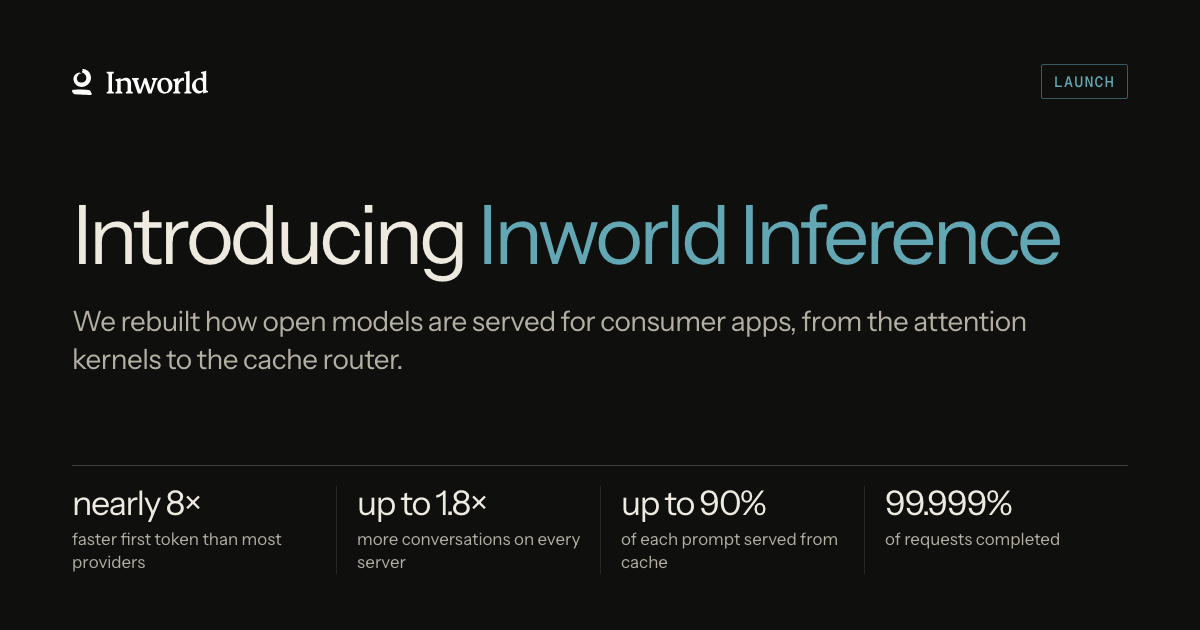
Inworld Inference opens to all developers: an open-model inference API built for consumer AI, with Gemma 4 26B p95 first token 7.8x faster than the median OpenRouter provider

On 2026-10-14 Inworld AI opened Inworld Inference to every developer, positioning it as an inference service for consumer apps (companions, tutors, voice, interactive fiction). Instead of listing thousands of models it builds a per-model serving stack for open models such as Gemma 4, GLM 5.3 Flash, DeepSeek and MiMo: draft-and-verify (speculative) decoding, a rewritten split-KV verify attention kernel, KV-aware routing and eval-gated low precision. Vendor-reported: Gemma 4 26B p95 first token of 0.31 s, 7.8x faster than the median OpenRouter provider; up to 90% of prompts from cache; 99.999% success over 20M+ GLM 5.3 Flash requests in 30 days. The API is OpenAI-compatible with Flex/Default/Priority/Fast tiers per request.

Inworld Inference opens to all developers: an open-model inference API built for consumer AI, with Gemma 4 26B p95 first token 7.8x faster than the median OpenRouter provider

Key Takeaways

  • Gemma 4 26B first token: p50 0.17 s / p95 0.31 s, 3.6x / 7.8x faster than the median OpenRouter provider (blog, vendor-reported snapshot, not a matched workload)
  • Pricing: Gemma 4 26B at $0.07 input, $0.035 cached, $0.34 output per 1M tokens, nearly 40% below the median no-training provider
  • Rewritten verify attention: 3.4–7.5x faster per layer, attention share of a decode step 27.5%→16.5%, p50 TTFT 154→117 ms at equal eval scores
  • KV-aware routing: GLM 5.3 Flash cache hits 25%→47%, DeepSeek V4.1 Flash 11%→33%; cached MiMo 2.6 Pro input costs 99% less
  • Reliability: 98 failures across 20M+ GLM 5.3 Flash requests in 30 days (~4.8 per million); per-request service_tier of Flex/Default/Priority/Fast
Read full story

GUI-Decisions open-sourced: slot-reading replaces coordinate JSON decoding for ~3× faster computer-use grounding (31B/2B)

On 2026-10-10 Logesh Kumar Umapathi published GUI-Decisions on Hugging Face: computer-use actions/coordinates are read from fixed next-token slots instead of autoregressive JSON. On an RTX PRO 6000 with vLLM, Gemma-4-31B slot reads median ~146–158 ms/step vs ~472–546 ms native JSON (~3.5×) and ~20–25× vs thinking decode. ScreenSpot click-in-element ~0.87. Open weights for 31B/2B, GitHub, and a Spaces demo.

GUI-Decisions open-sourced: slot-reading replaces coordinate JSON decoding for ~3× faster computer-use grounding (31B/2B)

Key Takeaways

  • Official: HF Blog (2026-10-10); code gui-decisions; Spaces demo
  • Latency (vendor, RTX PRO 6000, cold shots): slot read ~146 ms vs native JSON 472–546 ms (~3.5×); with thinking 2.6–3.1 s (~20–25×)
  • Quality: ScreenSpot click-in ~0.869; held-out AGUVIS steps ~0.65; RefCOCO val box IoU 0.770
  • Mechanism: 256-bin byte labels for coords; read only slots the action needs; type/answer still need base decode—slots speed grounding only
  • Serve: vllm serve infinitylogesh/GUI-Decisions-31B --max-logprobs 300 --api-server-count 8 then SlotModel.decide(...)
Read full story
Linked Models & Agents:
⚡ GUI-Decisions-31B⚡ GUI-Decisions-2B⚡ Gemma-4-31B🤖 computer-use🤖 GUI agent🌐 Hugging Face🌐 Google

openTPU, an open-source AI accelerator developed by AI agents, goes viral: full RTL/ISA/compiler stack runs Qwen3.5, Gemma 4 and a 35B MoE on a Kintex-7 FPGA card at up to 85.8 tok/s

FeSens/openTPU (Apache-2.0) hit the Hacker News front page (250+ points, 300+ comments). Reusing the AI-driven method from auto-arch-tournament (AI-designed RISC-V cores), the author had AI agents iterate on an inference accelerator; one repo holds SystemVerilog RTL, the ISA, a bit-exact simulator, a kernel language/compiler and a profiler. On a Kintex-7 xc7k480t PCIe card it runs Qwen3, Qwen3.5, Gemma 4, Phi-4-mini and others with real weights, token-for-token identical to the simulator; LFM2.5-230M decodes at 85.8 tok/s in 4-bit and Qwen3.5-35B-A3B reaches 3.95 tok/s with host-streamed experts.

openTPU, an open-source AI accelerator developed by AI agents, goes viral: full RTL/ISA/compiler stack runs Qwen3.5, Gemma 4 and a 35B MoE on a Kintex-7 FPGA card at up to 85.8 tok/s

Key Takeaways

  • Full stack in one repo: SystemVerilog RTL, 8x32-bit-word ISA, bit-exact Python simulator, @ol.jit kernel compiler and Lens profiler, Apache-2.0 (GitHub)
  • Measured device decode (4-bit, int8 head): LFM2.5-230M 85.8 tok/s, Qwen3-0.6B 31.3, Qwen3.5-2B 12.09, Gemma 4 E2B 12.14 tok/s
  • Uses 82-94% of the 17.1 GB/s DDR3-1066 peak while decoding; 133.33 MHz clock, four-column systolic array
  • MoE offload: Qwen3.5-35B-A3B at 3.95 tok/s (153 MB of experts streamed per token, 62% slot hit), LFM2.5-8B-A1B at 10.6 tok/s (offload docs)
  • 4-bit weights (FP4 with two-level block scales, 4.25 bits/weight) decode 40-45% faster than int8, with per-model perplexity cost documented
Read full story
Linked Models & Agents:
⚡ Qwen3.5⚡ Gemma 4⚡ LFM2.5⚡ Phi-4 Mini

Google DeepMind releases EmbeddingGemma 2: a 740M Apache-2.0 multimodal embedding model that maps text, code, images, audio and video into one space, +9.92 on MTEB Code

On 2026-10-06 Google DeepMind released EmbeddingGemma 2, a 740M-parameter Apache-2.0 embedding model built on Gemma 4 that maps text, code, images, audio and video into one 768-dim space with an 8K context. MTEB Code rises from 68.76 to 78.68, and quantized text-only inference needs ~191MB RAM on a Pixel 11 Pro. Hugging Face Transformers v5.19.0 supports it natively.

Google DeepMind releases EmbeddingGemma 2: a 740M Apache-2.0 multimodal embedding model that maps text, code, images, audio and video into one space, +9.92 on MTEB Code

Key Takeaways

  • Size: 740M params, modular 270M text backbone + 170M vision + 300M audio encoders, loadable on demand
  • Code retrieval: MTEB Code 68.76 → 78.68 (+9.92); Google claims leading sub-1B multimodal scores on MTEB Code and MAEB
  • Storage: Matryoshka embeddings truncate 768 → 512/256/128 dims, up to 6x smaller local vector stores
  • On-device: ~191MB RAM text-only / ~567MB full multimodal (quantized, Pixel 11 Pro); 8K context (4x v1) covers 5.5 min audio, 29 images or 58 video frames
  • Ecosystem: Apache 2.0 weights on Hugging Face and Kaggle; supported in Transformers v5.19.0, plus sentence-transformers, vLLM, llama.cpp, SGLang, Ollama and MLX per Google
Read full story
Linked Models & Agents:
⚡ EmbeddingGemma 2⚡ Gemma 4🌐 Google DeepMind🌐 Google

GitHub Next opens LocalJev: local Jev-compatible decision API on oMLX

GitHub Next open-sourced LocalJev (github.com/githubnext/localjev): a morning build of a “poor man’s Jev” for teammates without TypeSafe Jev access. It exposes a Jev-compatible POST /v1/systemone API in Bun/TypeScript, defaults to oMLX-backed local models such as DiffusionGemma, and reports evals across DiffusionGemma, Qwen MoE, Gemma 4 MoE, and Gemma 4 e4b/e2b (benchmark report in-repo). The LocalJev server works with normal Jev client wrappers, but probabilities are model-reported rather than logit reads—calibrate before consequential use.

Key Takeaways

  • Open-sources LocalJev: a local Jev-compatible POST /v1/systemone decision API (Bun/TypeScript).
  • Defaults to oMLX-backed local models such as DiffusionGemma, with multi-model evals in-repo.
  • Works with normal Jev client wrappers; probabilities are model-reported, not logit reads—calibrate first.
Read full story
Linked Models & Agents:
⚡ diffusiongemma⚡ qwen⚡ Gemma 4🌐 github

Together cuts Dedicated Inference on H100s to $3.99/hr for September

Together AI is cutting Dedicated Inference on H100s from $5.49/hr to $3.99/hr for September, with the lower rate applied automatically to new and existing deployments. Supported options include Gemma 4, Qwen3/3.5, gpt-oss, Llama, Nemotron 3.5 Lightning, or a bring-your-own LoRA. For teams that pin coding agents or fine-tunes to dedicated GPUs, the change is a straight cut in 24/7 serving cost without a migration.

Key Takeaways

  • H100 Dedicated Inference drops from $5.49/hr to $3.99/hr in September, auto-applied to all deployments.
  • Catalog includes Gemma 4, Qwen3/3.5, gpt-oss, Llama, Nemotron 3.5 Lightning, and BYO LoRA.
  • Existing dedicated endpoints get the cut with no migration.
Read full story
ADSponsored

Cohere Open-Sources North Micro Vision 2.4B VLM Under Apache 2.0 for Native Document & Visual Understanding

Cohere added North Micro Vision to its open-source family under Apache 2.0. At 2.4B parameters, it supports native-resolution vision, multi-turn multimodal chat, spatial grounding, and multilingual image understanding, outperforming Gemma 4 E2B and Ministral 3 3B on document VQA.

Key Takeaways

  • Cohere released 2.4B North Micro Vision under Apache 2.0 license on Hugging Face.
  • Designed for enterprise document parsing, visual QA, and spatial grounding.
  • Lightweight footprint enables edge deployment and private multimodal agent integration.
Read full story
Linked Models & Agents: