AI Coding Live News

OpenAI Details Pando, Its In-House Git Backend: Median Push Latency Down Nearly 5x, Nearly 1 PB Served Daily, Built With Codex in 10 Weeks

On November 2 OpenAI published "Scaling Git at OpenAI", describing Pando, a Git-compatible backend it built for its monorepo. Per OpenAI, Pando cut median push latency by nearly 5x (about 80%), now delivers nearly a petabyte of Git data per day, and has served more than 57 TB in a single hour. It is written in Rust, its core was designed by one engineer and implemented by teams of Codex agents, and it went from kick-off to production in 10 weeks, serving production traffic since April. The trigger: Codex multiplied parallel branches and pushes, and the old system's reliability at times fell below 90%.
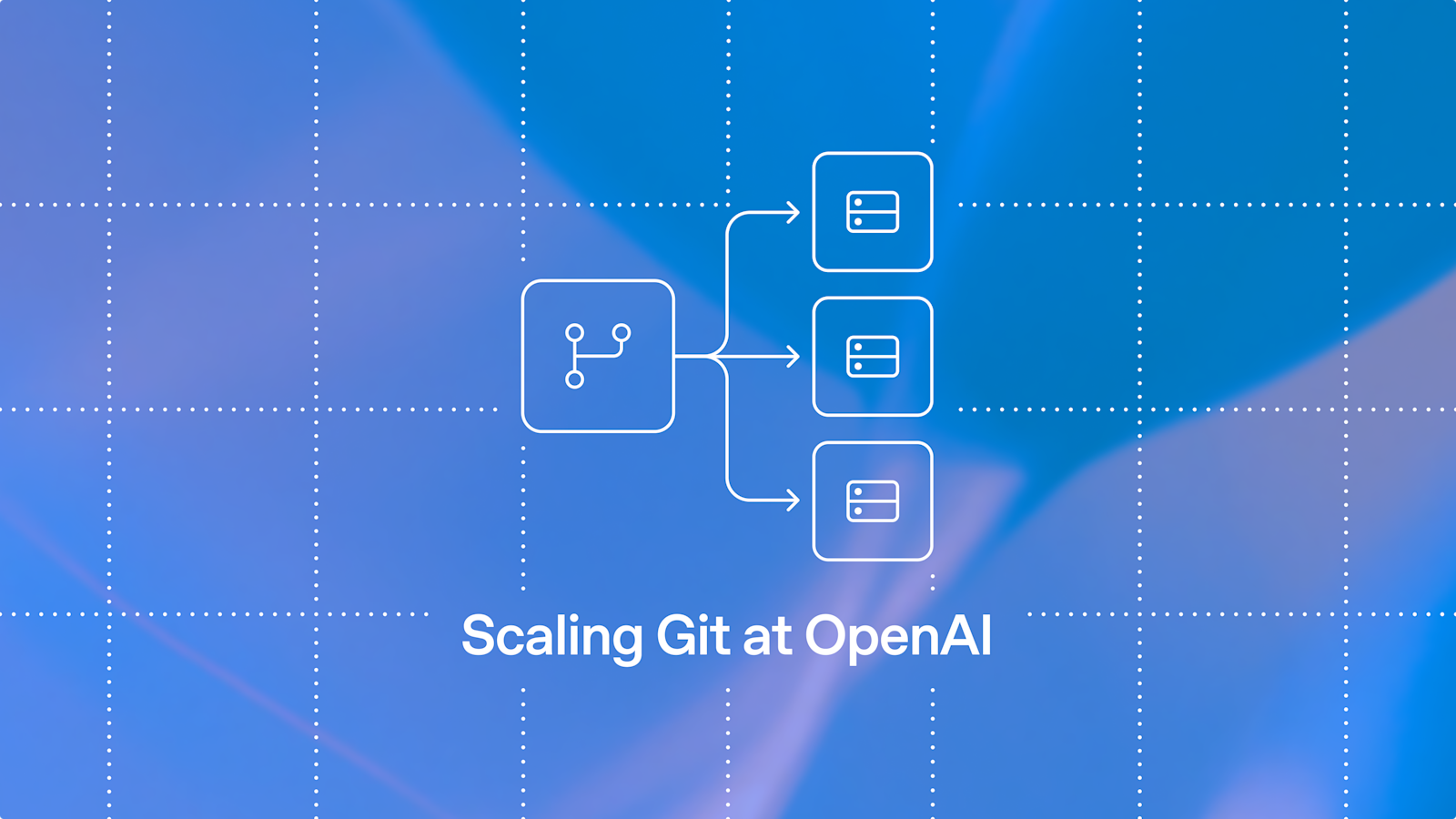
OpenAI Details Pando, Its In-House Git Backend: Median Push Latency Down Nearly 5x, Nearly 1 PB Served Daily, Built With Codex in 10 Weeks

Key Takeaways

  • Per OpenAI: median push latency down nearly 5x (about 80%), nearly 1 PB of Git data delivered per day, and a peak of more than 57 TB in one hour, with over 99% of bytes from local disk cache.
  • The trigger: Codex let engineers run far more branches and CI jobs in parallel; the old system struggled from late last year, with reliability at times below 90%.
  • The key trade-off: Pando drops repository-wide consistency for per-branch causal consistency and reuses pushed packfiles, stored as immutable blobs, to serve later fetches.
  • Written in Rust, core designed by one engineer and implemented by teams of Codex agents in 10 weeks; agents using GPT-6 Astra also wrote Lean and TLA+ specs to find bugs and prove properties.
  • Several improvements, such as packfile-uri fixes, are already in upstream Git, and OpenAI says it is exploring ways to share the technology with users.
Read full story

Aramco closes deal for 49% of HUMAIN: PIF keeps 51%, about $2.6B cash in 2026, 3 GW of AI data centers targeted by 2030

Saudi Arabia's Public Investment Fund (PIF) and Aramco announced on November 1 that their deal has closed: Aramco, through a wholly owned subsidiary, takes a 49% stake in Saudi AI company HUMAIN, while PIF keeps 51% control. Besides transferring its own AI, compute and digital assets, Aramco will contribute about SAR 9.9 billion (roughly $2.6 billion) in cash to HUMAIN in 2026. HUMAIN plans to deploy 3 GW of AI data center capacity by 2030 and keeps developing ALLaM, its multimodal Arabic large language model.

Key Takeaways

  • Ownership: Aramco 49% (through a wholly owned subsidiary) and PIF 51%; the deal closed on 2026-11-01 (Aramco press release)
  • Money: about SAR 9.9 billion (roughly $2.6 billion) in cash during 2026, plus AI, compute and digital assets (official figures)
  • Compute goal: 3 GW of AI data center capacity by 2030 (official figure)
  • Aramco says it has realized $11.3 billion in "Technology Realized Value" since 2023, much of it from AI solutions (CEO Amin Nasser, company figure)
  • HUMAIN launched in May 2025 and works in four areas: data centers, cloud platforms, the ALLaM models and industry solutions
Read full story
Linked Models & Agents:
g
guregodevo (Memdoor author)github.com·
👀14
🔥81

Memdoor reproduces GVS5H: a team of five Qwen3.8-27B agents averages 9.8/10 on the first 10 LiveCodeBench Hard problems, against 8.0 for a single Fable 5 call

On Oct 31 the open-source coding agent Memdoor (GitHub guregodevo/memdoor, Apache 2.0) published its team-solve workflow: using the GVS5H paper authors' exact prompts and loop, five Qwen3.8-27B instances act as planner, two ideators, solver and manager, talk only through files on disk, and a script that runs the tests decides success. Over five passes on the first 10 LiveCodeBench Hard problems from the GVS5H list it averaged 9.8/10, against 9.6 for the authors' own harness and 8.0 for a single Fable 5 call; 49 of 50 runs solved the problem for $35.79 in total, and every request and reply is public. The Hacker News post has about 200 points. This is a community reproduction on only 10 problems, and the author notes that training-data contamination cannot be ruled out.

Key Takeaways

  • Score: a mean of 9.8/10 over five passes (10, 10, 10, 10, 9), against 9.6 for the GVS5H authors' own harness and 8.0 for a single Fable 5 call (team-solve README, project-reported)
  • Cost: 49 of 50 runs solved, $35.79 and 15.3M output tokens in total; a median run took about 40 minutes of model time and $0.39, the longest 4 hours
  • Method: five roles (planner, two ideators, solver, manager) plus a repair worker each start from a fresh context, talk only through files on disk, and a shell script that runs the tests decides success instead of a model
  • Limits: only 10 problems rather than the paper's 100; the contests date from March and April 2025 and may be in training data; Fable 5's column comes from the GVS5H authors' result files and was not rerun in this harness
  • Reach: the HN post has about 200 points as of Nov 1, 16:10 SGT; the original GVS5H paper is arXiv 2608.26480, which reached #1 on HN on Oct 25
Read full story

DeepSeek Harness team open-sources dsh-superagent, a proactive coding agent prototype for a single GitHub repo, alongside its Super-agent architecture article

On Oct 31, deepseek-ai open-sourced dsh-superagent-prototype on GitHub under the MIT license: a proactive coding agent that runs as a DeepSeek Harness bundle, lives on one GitHub repository and can optionally listen to Feishu. When an allowed person asks for work, it opens a work item, works in its own session and directory, and answers in the original conversation, for example with a pull request. The README states it is a research prototype, not an official DeepSeek product. The companion article, Exploring Super-agent Design, proposes a two-layer Router-Worker architecture; the team test, as reproduced by media, reports a p95 completion time of 15.7 minutes versus 29.5 minutes for a single-session setup.

Key Takeaways

  • Open source: deepseek-ai/dsh-superagent-prototype went public on Oct 31 under MIT, written in TypeScript, with about 1,800 stars at the time of writing
  • Scope: each deployment serves 1 GitHub repository, with optional Feishu; it acts only when an allowed person addresses it or a team-written rule allows it
  • Delivery: by default it only allows auto-merge for an approved pull request opened for a ticket with fewer than 200 changed lines, and never enables auto-merge as the agent account
  • Team test (as reproduced by media, vendor-reported): in a simulation with about 300 messages and 20 requests, p50 / p95 completion was 12.4 / 15.7 minutes versus 20.4 / 29.5 for a single session with a subagent tool
  • Risk: worker sessions run commands without approval as the operator's OS user, and the README asks users to review and adapt the code first
Read full story
ADSponsored

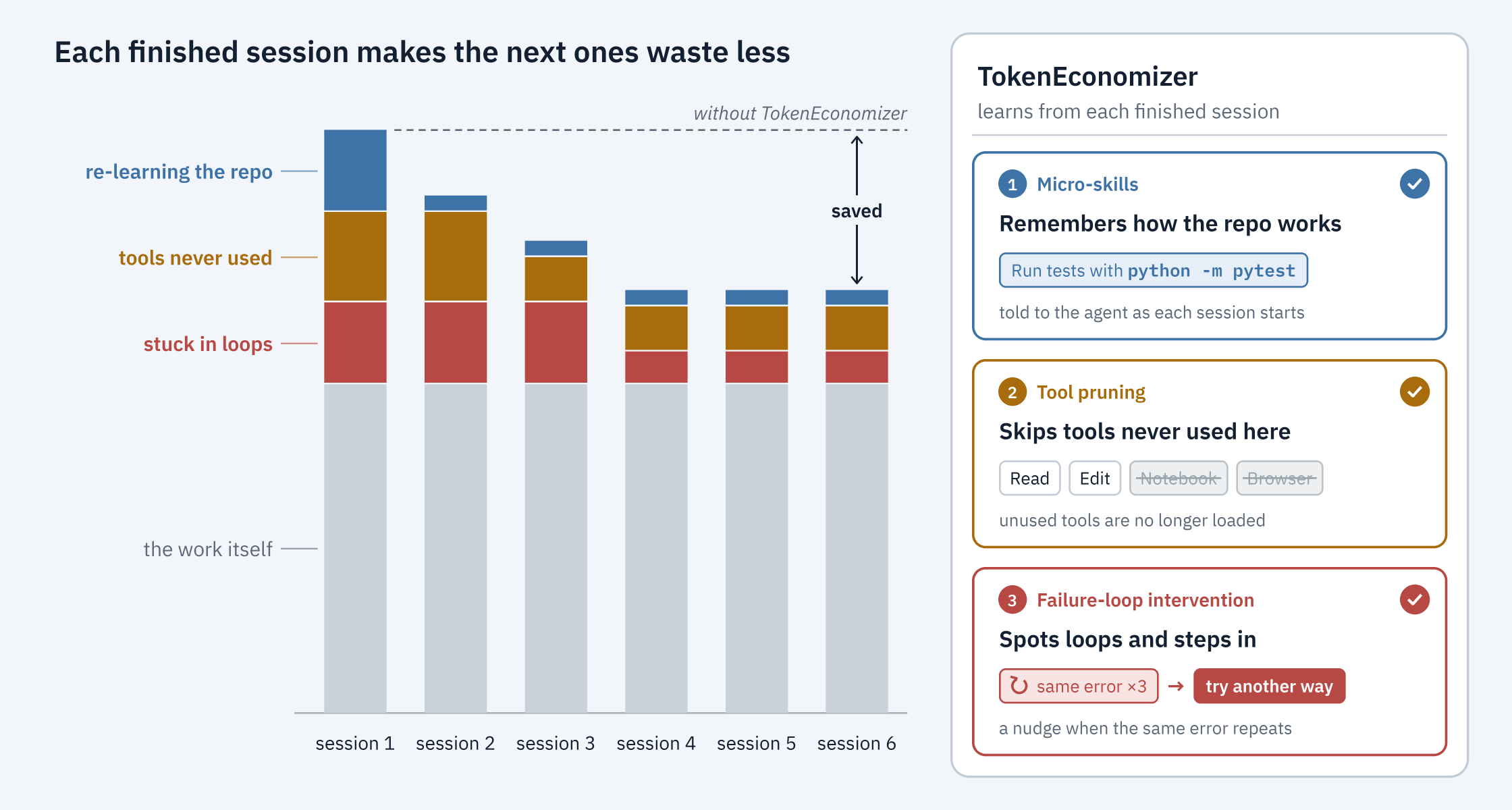
Microsoft Research and UC Berkeley open-source TokenEconomizer, a plugin that cuts Claude Code and Codex costs by 18.4–30.9% on SWE-Bench without changing the agent

Microsoft Research, Microsoft Security and UC Berkeley open-sourced TokenEconomizer on GitHub (Apache 2.0, v0.1.0 released October 26), a plugin for Claude Code, Codex, GitHub Copilot CLI and Pi, with experimental opencode support. It learns from earlier sessions in the same repository: micro-skills remember repo facts, tool pruning drops tool definitions that go unused, and a loop guard nudges an agent that is stuck. The paper reports 18.4–30.9% lower mean cost across five agent and model combinations on 277 SWE-Bench tasks (paper figures).

Microsoft Research and UC Berkeley open-source TokenEconomizer, a plugin that cuts Claude Code and Codex costs by 18.4–30.9% on SWE-Bench without changing the agent

Key Takeaways

  • Cost: on 277 SWE-Bench tasks across 6 repositories and 5 agent and model combinations, mean cost fell 18.4–30.9%, and all 30 repository-by-combination cells got cheaper (paper figures, including the plugin's own model calls)
  • Success rate: Pass@1 rose in 4 of 5 combinations, e.g. Copilot CLI with Sonnet 5 cost 18.4% less with Pass@1 +2.6, while Claude Code with Opus 4.8 cost 30.9% less with Pass@1 -1.0
  • Three mechanisms: micro-skills (repo facts stated only after three sessions confirm them), tool pruning (by default a tool unused over 10 prompts across 2 sessions is left out), and a failure-loop guard (one redirect when a judge is at least 0.7 confident, never stopping a turn itself)
  • Generalization: 16–21% lower cost on Web-Bench and 6–20% lower on two security-auditing benchmarks where every task is a new repository
  • Deployment: Apache 2.0, Python 3.10+, no API key of its own, and learned experience stays local in ~/.tokeneconomizer
Read full story

Pika releases open-weight video model Pika H3 Flex: post-trained on MiniMax H3, six-step sampling, five audio stems, API from $0.01 per second

On October 29 Pika released Pika H3 Flex, a joint audio-video generator post-trained on MiniMax H3, with weights on Hugging Face, code on GitHub, and ComfyUI and Diffusers support. Pika says it distilled sampling from 50 denoising steps to six, averages about 1.8x faster DiT denoising than Fal H3 Max at 768p, and can produce a 15-second clip with soundtrack in as little as about 7 seconds; the hosted API adds 1080p to 4K upscaling and five exportable audio stems (dialogue, score, SFX, foley, ambience). All speed and quality figures are vendor-reported.

Pika releases open-weight video model Pika H3 Flex: post-trained on MiniMax H3, six-step sampling, five audio stems, API from $0.01 per second

Key Takeaways

  • Pricing (vendor figures): text/image-to-video from $0.01 per output second, reference-to-video from $0.03/s; Pika's comparison table lists MiniMax H3 at $0.08/s and Seedance 2.5 at $0.103/s
  • Speed (vendor figures): six-step sampling, about 1.8x faster DiT denoising than Fal H3 Max at 768p on average and about 2x for 10–15 s text/image-to-video; 1.60x faster end-to-end 5 s 768p generation on eight B300 GPUs
  • Ranking: Pika's product page says it scores 1293 and ranks #7 on DesignArena's text-to-video board, the highest open-weight model there
  • Release form: the Hugging Face repo is tagged as an adapter on MiniMax-H3 under an 'other' license; local inference natively supports 480p/768p with mixed stereo audio, while 4K upscaling and audio stems are hosted-API only
  • Accepts up to 12 reference inputs (image, audio, video, sketch and more) and supports style transfer, motion transfer, character swap and targeted edits
Read full story
Linked Models & Agents:
⚡ Pika H3 Flex⚡ MiniMax H3⚡ Fal H3 Max⚡ HeyGen Video⚡ Gemini Omni 1.1 Flash🌐 Pika🌐 MiniMax

LM Studio Bionic 1.1.10 adds the oMLX engine, bringing RAM-plus-SSD KV caching and MLX speculative decoding to local models on Macs

LM Studio posted on X at 15:32 UTC on Oct 29 that users can now download a new oMLX engine inside LM Studio and run it with MLX models they already have. The official changelog lists it in Bionic 1.1.10, alongside speculative decoding for MLX models and an in-app terminal. oMLX is an open-source Apple Silicon inference server maintained by developer jundot (Apache 2.0, about 23,000 GitHub stars) built around continuous batching and a two-tier RAM and SSD KV cache. LM Studio has not published speed comparisons for the engine.

LM Studio Bionic 1.1.10 adds the oMLX engine, bringing RAM-plus-SSD KV caching and MLX speculative decoding to local models on Macs

Key Takeaways

  • LM Studio says the oMLX engine can now be downloaded inside the app and used with existing MLX models; the post has about 540 likes (post)
  • The Bionic 1.1.10 changelog (Oct 29) also lists speculative decoding for MLX models, a public in-app terminal and llama.cpp 2.66.0 extension packs (changelog)
  • oMLX is Apache 2.0 open source with about 23,000 GitHub stars and needs macOS 15+ on Apple Silicon M1 to M5 (GitHub)
  • Its core is a two-tier KV cache: hot blocks stay in RAM, overflow is written to SSD as safetensors, and matching prefixes are restored from disk even after a restart
  • LM Studio has published no speed comparison with its existing MLX engine; one user reported that restart-to-update failed after launch and LM Studio is investigating
Read full story
O
OpenAI@AICoder·
👀35
🔥80

OpenAI Codex CLI 0.166.0: keyboard transcript selection, GPT-6.1 Terra in Vertex AI and Bedrock catalogs, codex doctor network checks

OpenAI published the stable Codex CLI release rust-v0.166.0 on GitHub at 19:47 UTC on Oct 29. It adds keyboard-driven transcript selection by word, line and page with built-in search, adds GPT-6.1 Terra to the bundled, Vertex AI and Amazon Bedrock model catalogs, introduces codex queue --resume and codex doctor --network-only, and shows clearer safety-block explanations with selectable safer follow-up prompts in the TUI.

Key Takeaways

  • Model catalogs: GPT-6.1 Terra added to the bundled, Vertex AI and Amazon Bedrock catalogs (#57293)
  • Transcript: keyboard selection by word, line and page, integrated search and configurable shortcuts (#57221 to #57224)
  • New commands: codex queue --resume resumes unloaded threads after queueing a message; codex doctor --network-only checks config, connectivity and WebSocket
  • Safety UX: clearer explanations when a request is blocked, plus selectable safer follow-up prompts (#57363, #57365)
  • Fixes: approval and permission settings survive resume and fork, and reasoning-token accounting is preserved to avoid premature compaction
Read full story
A
Anthropic@AICoder·
👀90
🔥80

Claude Code 2.1.314 adds a block on writes outside working directories, IdP group routing for the apps gateway, and idle compaction in VS Code and Desktop

Anthropic published Claude Code v2.1.314 on GitHub at 01:06 UTC on Oct 30. The official CHANGELOG lists 119 entries, more than half of them fixes. The new features lean enterprise: permissions.blockWritesOutsideWorkingDirectories makes Write, Edit and NotebookEdit refuse paths outside the working directories in every permission mode; Claude apps gateway upstreams can be limited to IdP groups, and Bedrock upstreams can log which guardrail fired; idle compaction now also runs in VS Code and the Code tab of Claude Desktop. It also fixes sessions failing repeatedly when an admin caps effort, and claude -p exiting 0 with no output when startup failed.

Key Takeaways

  • Size: the official v2.1.314 CHANGELOG has 119 entries, more than half of them fixes; released at 01:06 UTC on Oct 30
  • Safety: the new permissions.blockWritesOutsideWorkingDirectories setting stops Write, Edit and NotebookEdit from writing outside the working directories in every permission mode
  • Enterprise gateway: upstreams take an optional groups list so only developers in those IdP groups are routed there, failover included; Bedrock upstreams gain guardrail_trace
  • Experience: idle compaction now runs in VS Code and the Claude Desktop Code tab, summarizing idle conversations above 200K tokens
  • Fixes: when an admin caps effort, Claude Code lowers it and retries; a failed claude -p startup now prints the error and exits 1
Read full story
Linked Models & Agents:

GitHub Copilot Automations go team-wide: repo-owned shared automations, 24 new triggers, 20 new tools and AI credit limits

At GitHub Universe on Oct 28, GitHub shipped a batch of Copilot Automations updates. Shared automations now belong to the repository, act as Copilot, bill AI credits to the repo owner and keep running after their creator leaves. Automations gain 24 new GitHub event triggers, REST API triggers from external systems and chaining, plus 20 new tools and custom MCP servers. Teams can cap AI credits per run, day, week or month, automations can propose improvements to their own prompts from real outcomes, and VS Code 1.144 can run them in the cloud.

GitHub Copilot Automations go team-wide: repo-owned shared automations, 24 new triggers, 20 new tools and AI credit limits

Key Takeaways

  • Shared automations belong to the repository: anyone with read access can view them, anyone with write access can edit, actions are attributed to Copilot and AI credits bill to the repo owner
  • 24 new triggers across issues, pull requests, discussions and security alerts, plus REST API triggers from systems like Jira, Sentry and PagerDuty
  • 20 new GitHub tools (merge PRs, retry workflow runs, upload screenshots and more) and support for custom MCP servers
  • AI credit limits can be set per run, day, week or month; org repos need an admin to enable the "Allow use of Copilot cloud agent billed to the organization" policy
  • Rolling out to Copilot Pro, Pro+, Max, Business and Enterprise; VS Code 1.144 runs them in the cloud with chat.automations.cloud.enabled
Read full story
ADSponsored

GitHub Octoverse 2026: agents start over 40% of pull requests, pushes hit 17.9 billion, and Copilot users tapped 47 models

On Oct 28 GitHub published its Octoverse 2026 report: developers pushed code 17.9 billion times in the past 12 months, more than 2024 and 2025 combined, with 34.3 billion commits and 1.3 billion merged pull requests (3.5 million a day). By September more than 40% of pull requests started with an agent draft, up from 17% in March; 55% of Copilot monthly active users use agentic features, and paid Copilot users used 47 distinct models in September.

GitHub Octoverse 2026: agents start over 40% of pull requests, pushes hit 17.9 billion, and Copilot users tapped 47 models

Key Takeaways

  • 17.9 billion pushes, 34.3 billion commits and 1.3 billion merged pull requests in the past 12 months, about 3.5 million merges a day (GitHub figures)
  • More than 40% of pull requests started with an agent draft by September 2026, up from 17% in March; that was 110 million in September alone, about 6x March
  • 55% of Copilot monthly active users now use agentic features, up from 35% a year ago, and Copilot cloud agent grew 230% year over year
  • Paid Copilot users used 29 distinct models in May and 47 in September, with no model above 25% of requests; 61% of users who pick models mix more than one
  • GitHub now serves more than 225 million developers; the US has 38.3 million and India 32 million, each adding over 10 million this year
Read full story

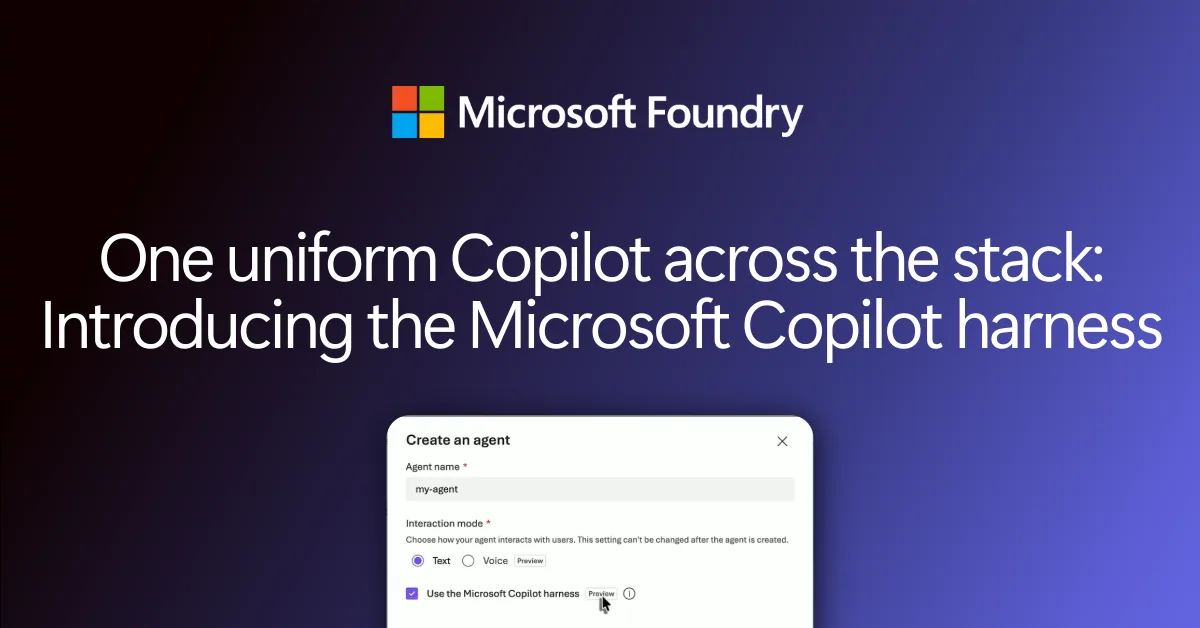
Microsoft opens the GitHub-built Copilot harness in Foundry Agent Service: public preview, 20+ frontier models plus BYOK, billing from Dec 1

During GitHub Universe on Oct 28, Microsoft put the Microsoft Copilot harness, the shared agent execution layer behind Copilot Code, Copilot Studio, the GitHub Copilot app, the CLI and VS Code, into Foundry Agent Service as a public preview. Microsoft runs the agent loop and sandbox while developers supply instructions, skills, tools and model choice; Microsoft says it works across 20+ frontier models plus bring-your-own-key. Long-running resilience for hosted agents also reached GA. Harness runtime usage is free until Dec 1.

Microsoft opens the GitHub-built Copilot harness in Foundry Agent Service: public preview, 20+ frontier models plus BYOK, billing from Dec 1

Key Takeaways

  • Microsoft says the harness spans 20+ frontier models plus bring-your-own-key, so you can swap models without rewriting orchestration (official blog)
  • Preview building blocks: reusable skills, Foundry and MCP tools with explicit auth and approvals, file and code execution with built-in subagent delegation, and source-controlled agent definitions
  • Pricing: harness runtime is free until Dec 1; after that sandbox compute is USD 0.0994 per vCPU-hour and 0.0118 per GiB-hour, with model inference billed separately (Foundry blog)
  • Long-running resilience for hosted agents went GA the same week: interrupted work restarts with its original input, and your app saves checkpoints
  • Limits: you pick the harness only when creating a new agent; existing agents are unchanged and switching later is not supported yet
Read full story

GitHub Enterprise now includes Copilot: $0 seat charge for Enterprise Cloud users, $10 a month Copilot Standalone for others, with AI usage metered from the first request

At Universe 2026 on Oct 28, GitHub announced a new Copilot access billing model: users with a GitHub Enterprise Cloud license pay no Copilot seat charge, and users without one can get Copilot Standalone at $10 per user per month. Both get the same features and models as Copilot Enterprise but no monthly per-seat AI credits; all usage is metered against the enterprise budget from the first request. It is available now only to Enterprise Cloud customers working with a GitHub or Microsoft account team, opens to self-serve customers in stages, and Copilot Business and Enterprise stay on sale.

Key Takeaways

  • Seat charge: $0 for users with a GitHub Enterprise Cloud license; users without one get Copilot Standalone at $10 per user per month
  • Versus the old plans: Copilot Business is $19 per user per month with 1,900 pooled AI credits and Copilot Enterprise is $39 with 3,900; the new model includes no credits and meters usage from the first request
  • When the budget runs out: code completion and next edit suggestions keep working, while Copilot Chat, Copilot code review and Copilot in the cloud need available budget
  • Availability: from Oct 28 only for Enterprise Cloud customers working with a GitHub or Microsoft account team; self-serve opens in stages, and GitHub Free and Team are not eligible
  • Switching is voluntary, but the billing model applies to the whole enterprise, cannot be mixed with Copilot Business or Enterprise seats, and admins still have to assign seats
Read full story

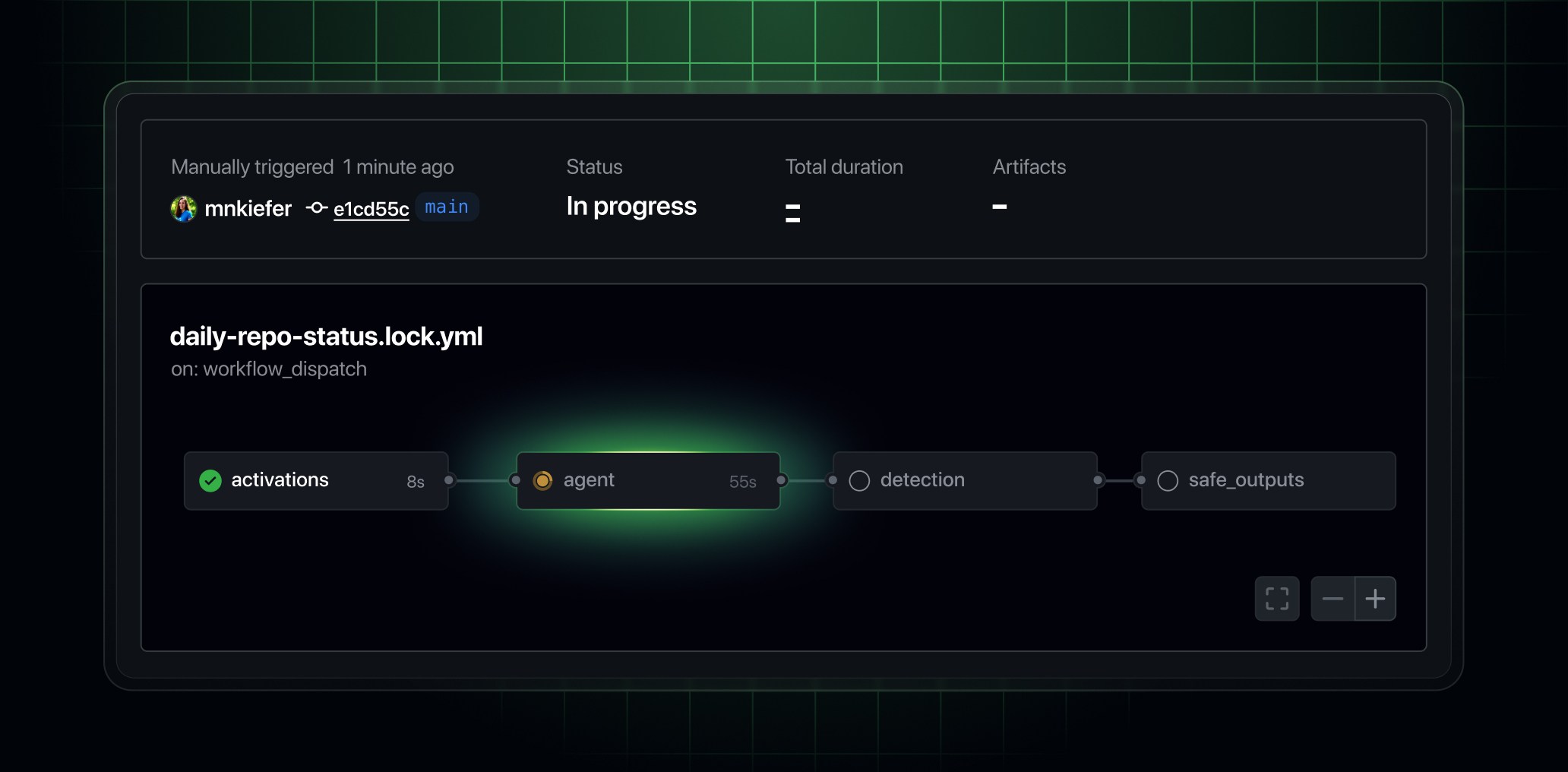
GitHub Agentic Workflows is generally available: write automation in Markdown, compile it to Actions YAML, run Copilot or your own coding agent, now with ARC self-hosting and micro-VM isolation

At Universe 2026 on Oct 28, GitHub made GitHub Agentic Workflows, an open source GitHub Next project, generally available on GitHub Free, Team and Enterprise. Developers describe tasks such as issue triage, CI failure analysis, documentation updates and test writing in natural-language Markdown, and gh aw compiles them into standard Actions YAML run by Copilot or a coding agent of their choice. GA adds self-hosted ARC runners with Docker-in-Docker, a non-experimental gh aw forecast cost estimate, per-workflow model providers and model routing, and Cloud Hypervisor or NVX micro-VM isolation.

GitHub Agentic Workflows is generally available: write automation in Markdown, compile it to Actions YAML, run Copilot or your own coding agent, now with ARC self-hosting and micro-VM isolation

Key Takeaways

  • Availability: GitHub Free, Team and Enterprise on github.com; using the default Copilot CLI engine requires a Copilot license
  • How it works: requirements in Markdown, compiled to standard Actions YAML that reuses existing runner groups and policies; run with Copilot or your own coding agent
  • Safe defaults: read-only permissions, a sandboxed container behind the Agent Workflow Firewall, safe-outputs validation, and a threat detection job before changes are applied
  • New at GA: self-hosted ARC runners with Docker-in-Docker, gh aw forecast out of experimental (with threat detection credits and monthly ranges), per-workflow model providers, model routing, micro-VM isolation and cross-repo enclaves
  • Customer story (Accenture's figures): one lead saved about 29 hours a week, AI authors 91% of the team's commits, and production errors fell from about 11,000 a day to under 1,000
Read full story

GitLab brings Claude Mythos 5.1 into its Business Logic Security Analyzer and offers free-credit security sprints

On Oct 28, GitLab CEO Bill Staples announced in a blog post and on X that new and existing customers can request free credits to run a security sprint with Claude Mythos alongside GitLab Orbit, Secrets Manager and Duo Agent Platform. The core capability is the Business Logic Security Analyzer, the first GitLab feature to support Anthropic's Claude Mythos 5.1. It reads the whole repository, infers what each endpoint should enforce, and flags authorization and mass-assignment flaws that pattern-based SAST misses. The analyzer has been in early access for a small group of GitLab.com Ultimate customers since Oct 20.

GitLab brings Claude Mythos 5.1 into its Business Logic Security Analyzer and offers free-credit security sprints

Key Takeaways

  • The Business Logic Security Analyzer is the first GitLab feature to support Claude Mythos 5.1; it also supports Claude Opus 5.5, Sonnet 5.5, Sonnet 5 and Sonnet 4.6, all as GitLab-managed models via GitLab's AI gateway
  • It starts with three flaw classes: broken object-level authorization (BOLA), missing or improper authorization, and mass assignment
  • Scans can run on the whole repository from Duo Chat or the API, or automatically on each merge request after its pipeline passes; findings land in the Vulnerability Report and MR security widget as SAST results
  • Early access is limited to a small group of GitLab.com Ultimate customers; each scan consumes GitLab Credits, with cost scaling with the application's attack surface
  • New on Oct 28: a security sprint offer where qualifying teams can request free credits for Ultimate, Duo Agent Platform, Orbit and Secrets Manager
Read full story