AI Coding Live News

Microsoft Research and UC Berkeley open-source TokenEconomizer, a plugin that cuts Claude Code and Codex costs by 18.4–30.9% on SWE-Bench without changing the agent

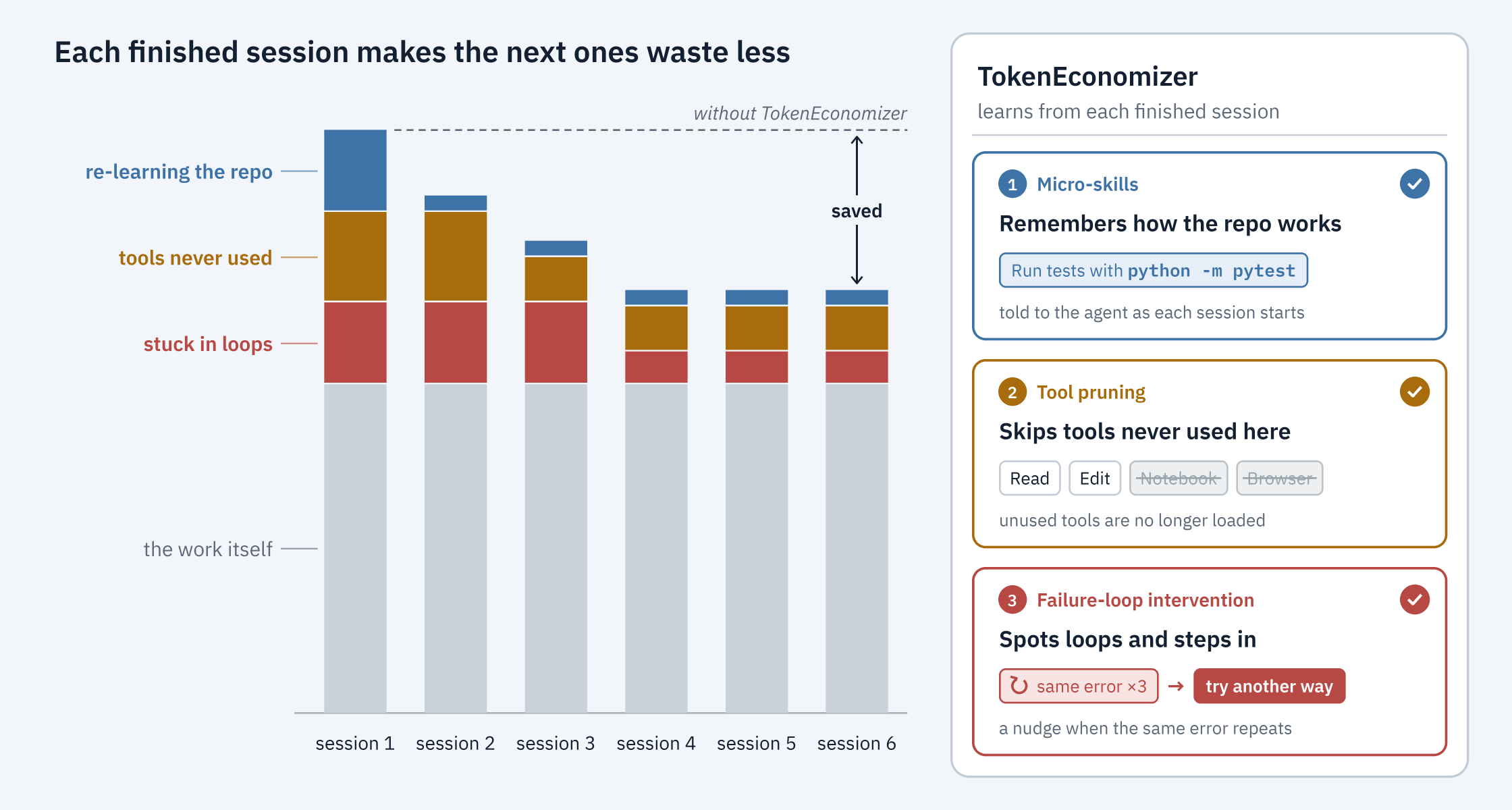
Microsoft Research, Microsoft Security and UC Berkeley open-sourced TokenEconomizer on GitHub (Apache 2.0, v0.1.0 released October 26), a plugin for Claude Code, Codex, GitHub Copilot CLI and Pi, with experimental opencode support. It learns from earlier sessions in the same repository: micro-skills remember repo facts, tool pruning drops tool definitions that go unused, and a loop guard nudges an agent that is stuck. The paper reports 18.4–30.9% lower mean cost across five agent and model combinations on 277 SWE-Bench tasks (paper figures).
Microsoft Research and UC Berkeley open-source TokenEconomizer, a plugin that cuts Claude Code and Codex costs by 18.4–30.9% on SWE-Bench without changing the agent

Key Takeaways

  • Cost: on 277 SWE-Bench tasks across 6 repositories and 5 agent and model combinations, mean cost fell 18.4–30.9%, and all 30 repository-by-combination cells got cheaper (paper figures, including the plugin's own model calls)
  • Success rate: Pass@1 rose in 4 of 5 combinations, e.g. Copilot CLI with Sonnet 5 cost 18.4% less with Pass@1 +2.6, while Claude Code with Opus 4.8 cost 30.9% less with Pass@1 -1.0
  • Three mechanisms: micro-skills (repo facts stated only after three sessions confirm them), tool pruning (by default a tool unused over 10 prompts across 2 sessions is left out), and a failure-loop guard (one redirect when a judge is at least 0.7 confident, never stopping a turn itself)
  • Generalization: 16–21% lower cost on Web-Bench and 6–20% lower on two security-auditing benchmarks where every task is a new repository
  • Deployment: Apache 2.0, Python 3.10+, no API key of its own, and learned experience stays local in ~/.tokeneconomizer
Read full story

GitHub Copilot Automations go team-wide: repo-owned shared automations, 24 new triggers, 20 new tools and AI credit limits

At GitHub Universe on Oct 28, GitHub shipped a batch of Copilot Automations updates. Shared automations now belong to the repository, act as Copilot, bill AI credits to the repo owner and keep running after their creator leaves. Automations gain 24 new GitHub event triggers, REST API triggers from external systems and chaining, plus 20 new tools and custom MCP servers. Teams can cap AI credits per run, day, week or month, automations can propose improvements to their own prompts from real outcomes, and VS Code 1.144 can run them in the cloud.

GitHub Copilot Automations go team-wide: repo-owned shared automations, 24 new triggers, 20 new tools and AI credit limits

Key Takeaways

  • Shared automations belong to the repository: anyone with read access can view them, anyone with write access can edit, actions are attributed to Copilot and AI credits bill to the repo owner
  • 24 new triggers across issues, pull requests, discussions and security alerts, plus REST API triggers from systems like Jira, Sentry and PagerDuty
  • 20 new GitHub tools (merge PRs, retry workflow runs, upload screenshots and more) and support for custom MCP servers
  • AI credit limits can be set per run, day, week or month; org repos need an admin to enable the "Allow use of Copilot cloud agent billed to the organization" policy
  • Rolling out to Copilot Pro, Pro+, Max, Business and Enterprise; VS Code 1.144 runs them in the cloud with chat.automations.cloud.enabled
Read full story

Microsoft opens the GitHub-built Copilot harness in Foundry Agent Service: public preview, 20+ frontier models plus BYOK, billing from Dec 1

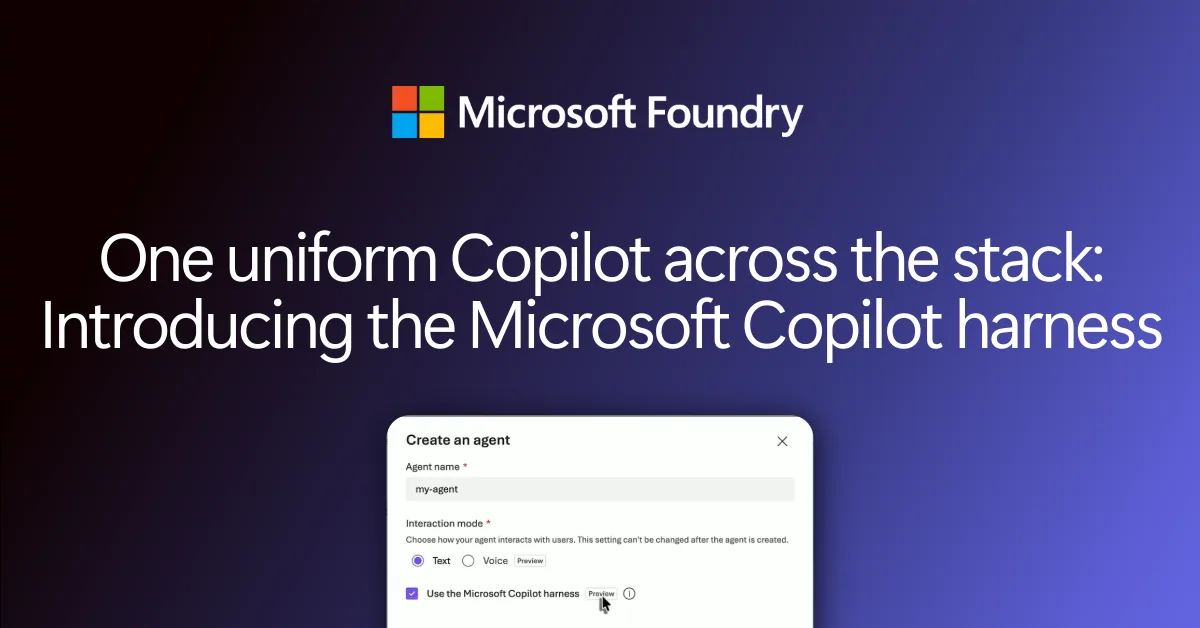
During GitHub Universe on Oct 28, Microsoft put the Microsoft Copilot harness, the shared agent execution layer behind Copilot Code, Copilot Studio, the GitHub Copilot app, the CLI and VS Code, into Foundry Agent Service as a public preview. Microsoft runs the agent loop and sandbox while developers supply instructions, skills, tools and model choice; Microsoft says it works across 20+ frontier models plus bring-your-own-key. Long-running resilience for hosted agents also reached GA. Harness runtime usage is free until Dec 1.

Microsoft opens the GitHub-built Copilot harness in Foundry Agent Service: public preview, 20+ frontier models plus BYOK, billing from Dec 1

Key Takeaways

  • Microsoft says the harness spans 20+ frontier models plus bring-your-own-key, so you can swap models without rewriting orchestration (official blog)
  • Preview building blocks: reusable skills, Foundry and MCP tools with explicit auth and approvals, file and code execution with built-in subagent delegation, and source-controlled agent definitions
  • Pricing: harness runtime is free until Dec 1; after that sandbox compute is USD 0.0994 per vCPU-hour and 0.0118 per GiB-hour, with model inference billed separately (Foundry blog)
  • Long-running resilience for hosted agents went GA the same week: interrupted work restarts with its original input, and your app saves checkpoints
  • Limits: you pick the harness only when creating a new agent; existing agents are unchanged and switching later is not supported yet
Read full story

Anthropic donates the Agent Skills open standard to the Linux Foundation’s Agentic AI Foundation, after 70+ agent platforms adopted it with 1M skills published and nearly 280M installs

On 2026-10-22 Anthropic said it is donating Agent Skills, the open standard that teaches agents a task through a folder with a SKILL.md file, to the Agentic AI Foundation (AAIF) under the Linux Foundation, the same neutral home it gave MCP. The donation covers the Agent Skills name and logo, the GitHub organization and the agentskills.io domain. Anthropic says more than 70 agent platforms, including ChatGPT, Cursor, GitHub Copilot and VS Code, have integrated the standard since December 2025, with 1 million skills published and nearly 280 million installs. Engineers from Anthropic, Google, OpenAI and others will maintain it as individuals.

Anthropic donates the Agent Skills open standard to the Linux Foundation’s Agentic AI Foundation, after 70+ agent platforms adopted it with 1M skills published and nearly 280M installs

Key Takeaways

  • Official figure: 70+ agent platforms have integrated Agent Skills, including ChatGPT, Cursor, GitHub Copilot and VS Code
  • 1 million skills published and nearly 280 million installs so far (Anthropic figures)
  • Donated: the Agent Skills name and logo, the GitHub organization and the agentskills.io domain; you can keep using or contributing without joining AAIF
  • Lead Maintainers are David Soria Parra and Mahesh Murag, with engineers from Anthropic, Google, OpenAI and others maintaining it as individuals
  • Proposed first roadmap: versioned releases, a formal proposal process and security guidance for people who write and install skills
Read full story
ADSponsored

VS Code Preview Introduces Canvases: Shared Workspaces for Developers and Coding Agents

The Microsoft VS Code team announced Canvases in VS Code Preview (v1.142), introducing dedicated shared visual workspaces connecting developers with autonomous coding agents. Addressing the severe UX limitations of cramped sidebar chat windows—where complex multi-file architectural modifications and agent diffs become hard to track—Canvases provides an expansive, interactive infinite-canvas whiteboard. Developers and agents (such as GitHub Copilot, Claude Code, and Cline) can collaboratively organize system flowcharts, live interactive code diffs, execution traces, and unit test rollouts side by side.

VS Code Preview Introduces Canvases: Shared Workspaces for Developers and Coding Agents

Key Takeaways

  • Microsoft VS Code Preview v1.142 introduced Canvases, pioneering a spatial human-agent collaborative interface
  • Transceives beyond claustrophobic sidebar chats to an expansive, pan-and-zoom whiteboard mapping concurrent multi-file agent diffs
  • Embeds code files, architecture diagrams, interactive git diffs, terminal outputs, and test runners as unified interactive cards
  • Natively bridges GitHub Copilot, Claude Code, and third-party coding agent harnesses, accelerating IDE spatial development
Read full story

GitHub Copilot updates HydraFusion and adds HydraFusion Max, with Claude Opus 5.5 and the GPT-6 family in its model pool

On 2026-10-14 GitHub updated HydraFusion, Copilot's multi-model orchestration feature, and added HydraFusion Max for harder tasks. The pool now includes Claude Opus 5.5, GPT-6 Astra, GPT-6.1 Sol and GPT-6 Luna; effort is tuned per stage (medium for drafts, high for review), Cascade gains a judging step, and Critique now inspects the workspace with tools using parallel critics. Both remain in research preview across VS Code, the Copilot app and Copilot CLI.

Key Takeaways

  • Pool: Claude Opus 5.5, GPT-6 Astra, GPT-6.1 Sol, GPT-6 Luna, chosen per workflow (GitHub Changelog)
  • Per-stage effort: medium for drafts, high for review (previously each model's default)
  • Cascade adds a judge that requests repair only when needed; Critique uses tools on the workspace plus parallel critics
  • Two tiers: HydraFusion (balanced) and HydraFusion Max (deepest reasoning, orchestration still minds tokens)
  • Available in VS Code, Copilot app and Copilot CLI on Pro, Pro+, Business and Enterprise with preview features enabled
Read full story

Microsoft takes MAI-Code-1.1-Flash local: 137B MoE scores 70.8% SWE-Bench Verified on-device, GitHub Copilot to route between local and cloud

At its Oct 7 Windows event Microsoft shipped an on-device MAI-Code-1.1-Flash (137B total / 6.8B active MoE, 256K context, ~3.3 bits per weight) on RTX Spark PCs, scoring 70.80% SWE-Bench Verified and 66.29% Terminal-Bench 2.1 locally. GitHub HydraFusion will route Copilot tasks between local and cloud models in experimental preview later in October, with no inference charge for local calls; MXC agent containment went GA the same day.

Microsoft takes MAI-Code-1.1-Flash local: 137B MoE scores 70.8% SWE-Bench Verified on-device, GitHub Copilot to route between local and cloud

Key Takeaways

  • On-device: 70.80% SWE-Bench Verified (cloud 72.6%) and 66.29% Terminal-Bench 2.1 (cloud 62.9%); GPT-OSS-120B scored 32.0% / 23.6% in the same test (Microsoft Command Line)
  • Footprint: ~3.3 bits/weight mixed precision plus DFlash2 speculative decoding; 75.5GB peak memory at 256K; 923.5 / 769.8 tok/s prompt processing at 64K / 128K
  • Routing: HydraFusion local+cloud routing reaches the Copilot app, Copilot CLI and VS Code in experimental preview later in October, with no inference charge for local calls (Windows Blog)
  • Available now: Copilot CLI 1.0.94-0+ discovers local Ollama models via /model (tool calling + streaming required) (GitHub Changelog)
  • Security: MXC agent containment is GA on Windows 11, already supported by Codex, Copilot, OpenClaw and LM Studio, with Claude Code and Hermes Agent among those to follow
Read full story

GitHub Copilot Dynamic Workflows public preview: code-defined multi-agent orchestration across CLI, app, and SDK

GitHub’s 2026-10-01 Changelog launched Dynamic Workflows in public preview for Copilot CLI, the Copilot app, and the SDK: code-defined reusable orchestration (sequential/parallel steps, pause checkpoints, subagent cross-checks)—unlike Autopilot or /fleet, where Copilot invents the plan each run. CLI needs --experimental or /experimental on; available on all Copilot plans.

Key Takeaways

  • Anchors: Oct 1 Changelog + docs concepts + how-to pages linked above
  • Code defines steps/conditions/handoffs; agents handle judgment. Distinct from Autopilot and /fleet
  • Surfaces: CLI workflow run + /workflows; App Workflows button; SDK/extension canvases; share via personal or repo extensions
  • Limits: max concurrent/total subagents, timeoutSeconds, approx maxAiCredits; prompt > workflow code > personal defaults
  • Public preview; CLI experimental flag; no published agent-bench deltas—don’t conflate with HydraFusion or Computer Use
Read full story
A
AICoder Editorial@aicoder·
👀78
🔥90

Developer 'A vs B' comparison intent surges: Sonnet 5.5, Sol, Argon, Air, and Copilot Computer Use collide in one week

Over ~7 days, Claude Sonnet 5.5, GPT-6.1 Sol, Gemini 4 Argon, JetBrains Air in IDEs EAP, and GitHub Copilot Computer Use landed in the same window. Search and HN discourse shifted from single-release chase to pairwise selection on price bands, terminal agents, IDE harnesses, and computer-use. Meta industry brief for readers without X.

Key Takeaways

  • Same-week cascade: Sonnet 5.5 in Copilot (09-28) → Sol in Copilot (09-29) → Argon Fairwind preview (09-30) → Air EAP + Copilot Computer Use (10-01)
  • Hot pairs: Sonnet↔Opus, Sonnet↔Sol, Argon↔Opus/Astra, Air↔Cursor, Copilot CU↔Claude CU, Codex↔Claude Code, Sol↔Astra same-family economics
  • Selection axes: price band × terminal harness × IDE orchestration (Air ACP BYO) × computer-use for GUI-only legacy
  • Compliance caveat: Anthropic subscription auth ToS constrains third-party harnesses; Air docs allow Claude subscription via terminal full-screen tab only
  • Argon still Fairwind-gated (not GA); no public developer GA date—label comparison pages as preview-gated
Read full story

GitHub Copilot Computer Use enters public preview in CLI and Copilot app (macOS/Windows)

On 2026-10-01 GitHub announced Computer Use in public preview for Copilot CLI and the Copilot app on macOS and Windows: agents can drive local desktop apps via accessibility tree/screenshots, clicks, typing, scroll/drag, and cross-app workflows—targeting GUI-only legacy software. Off by default; enable with /computer on or Settings; enterprise policy can block it.

GitHub Copilot Computer Use enters public preview in CLI and Copilot app (macOS/Windows)

Key Takeaways

Read full story
ADSponsored

Cline 4.1.22: GPT-6.1 Sol becomes default across gateways; Anthropic server-side refusal fallback; Bee & Pareto providers

Cline shipped v4.1.22 on 2026-09-30 (59 commits ahead of v4.1.21): refreshed catalog makes GPT-6.1 Sol the default for OpenAI, OpenRouter, GitHub Copilot, Requesty and more when unpinned; direct Anthropic uses server-side refusal fallback with OpenRouter/Cline failover; adds Bee (HEOSSI) and Pareto Inference (PARETO_API_KEY); fixes cancel races, double-counted reasoning tokens, and Bedrock inference-profile routing. SDK @cline/[email protected] ships the same day.

Cline 4.1.22: GPT-6.1 Sol becomes default across gateways; Anthropic server-side refusal fallback; Bee & Pareto providers

Key Takeaways

  • Release v4.1.22; 59 commits ahead of v4.1.21
  • Unpinned defaults: GPT-6.1 Sol on OpenAI/OpenRouter/Copilot/Requesty and more; Vercel AI Gateway→Ling 3.1 Flash; CrossModel/Ofox→Sonnet 5.5
  • Anthropic server-side refusal fallback + OpenRouter/Cline allow_fallovers; content-filter finish reason instead of empty response
  • New providers: Bee (HEOSSI), Pareto Inference (PARETO_API_KEY)
  • SDK @cline/[email protected]; docs https://docs.cline.bot/
Read full story

Who Finishes the Job? First Empirical Study Reveals AI Coding Agent Merges Require 1.62x More Follow-Up Fixes

Researchers from Monash University and the University of Melbourne published the first large-scale empirical study tracking the post-merge lifecycle of AI coding agents across GitHub open-source repositories (arXiv:2609.26847). Analyzing 6,774 merged agent PRs (spanning Devin, Cursor, Claude Code, GitHub Copilot, and OpenAI Codex) against 5,044 contemporaneous human PRs across repos with 500+ stars, the study reveals that merged agent code requires verified follow-up bug fixes at 1.62 times the odds of human merges. However, 69.6% of verified fixes are authored by the same agent, and 76.4% of fix PR commits remain entirely agent-driven, debunking assumptions that human maintainers bear the full manual burden of cleanup.

Who Finishes the Job? First Empirical Study Reveals AI Coding Agent Merges Require 1.62x More Follow-Up Fixes

Key Takeaways

  • Empirical scale: analyzes 6,774 merged agent PRs and 5,044 contemporaneous human PRs across popular repos (500+ stars)
  • Higher bug odds: merged agent PRs attract verified follow-up fixes at 1.62x the odds of human PRs (OR = 1.62)
  • Self-fixing loop: 69.6% of verified fixes come from the original agent, with 76.4% of fix commits authored entirely by AI
  • High-agreement benchmark: evaluated via human annotators and LLM Judge (Kappa = 0.78 vs human-human Kappa = 0.77) with 90% direct-fix precision
  • Engineering takeaway: maintainers should introduce post-merge staging soak periods and harness agent self-repair workflows
Read full story

Cline v4.1.21 Released: Refreshes Catalog to 6,386 Models Across 209 Providers, Defaults to Claude Opus 5.5

Open-source autonomous coding agent Cline (@cline_dev) shipped v4.1.21. The update refreshes Cline's model directory to 6,386 models across 209 providers, switching the resolved default to Anthropic's new Claude Opus 5.5 for 11 major providers (including GitHub Copilot and Google Cloud Vertex AI). It also introduces the Japanese open-weight provider ai& and patches a critical parser vulnerability in js-yaml.

Cline v4.1.21 Released: Refreshes Catalog to 6,386 Models Across 209 Providers, Defaults to Claude Opus 5.5

Key Takeaways

  • Expands provider coverage to 209 endpoints and 6,386 distinct models, the widest catalog among open-source coding agents.
  • Automatically updates the resolved default model to Claude Opus 5.5 across 11 major providers without user re-configuration.
  • Integrates OpenAI-compatible provider ai& to expand low-latency open-weight model serving in the Asia-Pacific region.
  • Upgrades core parser dependencies to js-yaml 4.3.2 to eradicate security vulnerabilities in untrusted config parsing.
Read full story

Cline v4.1.21: ai& Japan OpenAI-compatible provider, 6,386 models / 209 providers, local long-reply compact retry

Cline VS Code extension shipped v4.1.21 on 2026-09-24 with a new Japan OpenAI-compatible provider (ai&), a refreshed catalog of 6,386 models across 209 providers (19 unpinned defaults change—11 to Claude Opus 5.5 including GitHub Copilot and Vertex), and compact-and-retry once when local servers (llama.cpp/Ollama/LM Studio) hit output-token limits. Minimum js-yaml raised to 4.3.2 for frontmatter parsing security.

Cline v4.1.21: ai& Japan OpenAI-compatible provider, 6,386 models / 209 providers, local long-reply compact retry

Key Takeaways

  • New provider ai& (Japan OpenAI-compatible open-weight endpoint)
  • Catalog: 6,386 models / 209 providers; 19 unpinned defaults shift (11 → Opus 5.5 incl. Copilot & Vertex)
  • Local models compact-and-retry once on output-token caps
  • js-yaml floor 4.3.2 for rule/skill frontmatter
  • Install via Marketplace or cline-4.1.21.vsix
Read full story

Pydantic AI 2.49.0: GitHub Copilot OAuth device flow, BoolCriteria, GPT-6 on Bedrock

Pydantic AI shipped v2.49.0 on 2026-09-24 (PyPI aligned). Highlights: GitHubCopilotOAuthFlow device auth, BoolCriteria for typed yes/no fields, RealtimeSession.wait_for_reply(), plus Bedrock Converse fixes for gpt-6-sol/gpt-6-luna/gpt-6-astra and dropping unsupported temperature/top_p on GPT-5.6/GPT-6.

Pydantic AI 2.49.0: GitHub Copilot OAuth device flow, BoolCriteria, GPT-6 on Bedrock

Key Takeaways

  • Upgrade: pip install -U 'pydantic-ai==2.49.0' (PyPI)
  • GitHubCopilotOAuthFlow device authorization (#8618)
  • BoolCriteria clarifies bool/Enum yes-no semantics (#8586)
  • RealtimeSession.wait_for_reply() (#8514)
  • Bedrock: allow gpt-6-sol/luna/astra; strip temperature/top_p for GPT-5.6/GPT-6 (#8656/#8668)
Read full story