AI Coding Live News

Google Project Suncatcher Gets First AI Response From a TPU in Orbit: Gemma 4 Downlinks a Haiku, Twin Satellites Planned for 2027

Google CEO Sundar Pichai and Google Research announced that the Project Suncatcher prototype satellite, launched on October 1, finished commissioning and ran a prompt on its onboard TPU with the open Gemma 4 model, downlinking a haiku as it passed over Svalbard, Norway. Google calls it the first AI response from a data-center-class TPU in orbit. Next come thermal-stress and radiation tests, then two interconnected satellites in 2027 to test AI computation distributed across satellites.

Google Project Suncatcher Gets First AI Response From a TPU in Orbit: Gemma 4 Downlinks a Haiku, Twin Satellites Planned for 2027

Key Takeaways

  • The satellite launched on October 1 on SpaceX's Transporter-18 rideshare, built with Planet, and ran its first in-orbit inference after about three weeks of commissioning (official account).
  • Per TechCrunch, it carries four TPUs and generates up to about 1 kW, so power limits it to one TPU at a time for roughly 20 minutes.
  • Sundar Pichai's announcement drew about 26K likes and 3.97M views; Google's official account said "Our TPUs just phoned home... from space."
  • Ground proton-beam tests in Google's paper found high-bandwidth memory irregularities only after a cumulative 2 krad(Si), about 3x the 750 rad(Si) minimum requirement (as cited by The Register).
  • Two interconnected satellites are planned for 2027 to test optical inter-satellite links and AI computation distributed across satellites.
Read full story

Google DeepMind expands Gemini-built PlanAssist to 15 English councils after pilots cut planning assessment time by up to 58%

On October 31, Google DeepMind said PlanAssist, a Gemini-built planning tool developed with the UK government, Google Cloud and Faculty, will be made available to 12 more local planning authorities in England, bringing the total to 15 for a 12-month Beta on live applications. In early pilots at Barnet, Camden and Dorset, DeepMind says the average officer time on householder assessment tasks fell by 58%, and more than 70% of the drafted reports were approved with no edits. Planning officers keep the final decision.

Google DeepMind expands Gemini-built PlanAssist to 15 English councils after pilots cut planning assessment time by up to 58%

Key Takeaways

  • Scale: from 3 pilot councils to 15; the 12 new ones join in three cohorts for a 12-month Beta (DeepMind blog)
  • Efficiency: average officer time on householder assessment tasks fell 58% in pilots (vendor-reported; DeepMind's X post says "up to 58%")
  • Quality: more than 70% of AI-drafted reports were approved by officers with no edits (vendor-reported)
  • The UK government says, together with new rules, routine householder processing can halve from eight weeks to four, and it aims to offer the tool to every council in England in 2027 (GOV.UK)
Read full story
A
Anthropic (Claude Help Center)support.claude.com·
👀7
🔥82

Anthropic extends Claude text watermarking to older models including Mythos 5, Opus 4.7/4.6 and Sonnet 4.6, reportedly from November 3

Anthropics help center article "How Claude marks AI-generated content" (updated Oct 28) now lists older models released before Aug 2, 2026, including Claude Mythos 5, Opus 4.7, Opus 4.6, Opus 4.5, Sonnet 4.6 and Sonnet 4.5, as carrying text watermarks on first-party surfaces, and says Anthropic is adding watermarks to these models to meet EU AI Act Article 50 transparency duties. According to a customer email screenshot reported by outlets such as MACCUS, the legacy rollout starts Nov 3, with Amazon Bedrock possibly a few days later; Anthropics public pages do not state that date. The watermark follows Google DeepMinds SynthID-Text approach, adds no hidden characters or extra tokens, and detection is in private preview only for regulators, media, researchers and similarly obligated organizations, which has drawn complaints on X that users cannot check their own text.

Anthropic extends Claude text watermarking to older models including Mythos 5, Opus 4.7/4.6 and Sonnet 4.6, reportedly from November 3

Key Takeaways

  • Scope: in the official support table, older models such as Mythos 5, Opus 4.7/4.6/4.5 and Sonnet 4.6/4.5 are ticked only for first-party text watermarks; cloud-partner watermarks and C2PA file credentials remain limited to models launched after Aug 2 (see the help center)
  • Timing: a customer email reported by media puts the start at Nov 3, with Bedrock possibly a few days later (MACCUS); Anthropics public pages give no date
  • Cost and quality: Anthropic says the watermark adds no characters, no extra tokens and no extra cost, using a variant of SynthID-Text (see Anthropics explainer)
  • Detection: the detection API is in private preview for regulators, law enforcement, media, fact-checkers, researchers and obligated enterprises; ordinary users cannot check text yet
  • Reach: watermarks apply worldwide across Claude, the Claude Platform API, Claude Code, Cowork and Tag, because Anthropic says it has no durable way to scope them by region yet
Read full story
O
OpenAI / Google / Microsoft / Anthropic@AICoder·
👀10
🔥83

OpenAI, Google, Microsoft and Anthropic back one robots.txt AI-training opt-out token, __usage_ai-training; Anthropic has started, Microsoft honors it from Feb 1, 2027

On October 30, OpenAI, Google, Microsoft and Anthropic each published posts committing to one shared robots.txt training-preference signal: a site writes a single Disallow group for the policy token __usage_ai-training to tell every participating provider not to use its content for generative AI training. The mechanism comes from an IETF individual Internet-Draft filed that day by Anthropic standards lead Kevin Kelley and is not yet a formal standard. Timelines differ: The Verge and CNA report Anthropic has already started implementing it, OpenAI says "in the coming months", Microsoft honors it from February 1, 2027, and Google plans support during 2027.

Key Takeaways

  • Syntax: in robots.txt, User-Agent: __usage_ai-training plus Disallow: / states a site-wide preference against AI training, and Allow rules can carve out paths such as /press-kit/; omitting the group means no preference is expressed
  • Draft: draft-kelley-aipref-training-preference-signal-00 by Kevin Kelley (Anthropic), filed 2026-10-30 and expiring 2027-05-03, an individual IETF draft with no formal standing yet
  • Timeline: Anthropic has reportedly started; OpenAI says "in the coming months"; Microsoft honors it from 2027-02-01 and sites relying on NoArchive/NoCache should migrate by 2027-03-01; Google plans support in 2027
  • Training only, not crawling: the draft says the token is not a crawl directive, wildcard User-Agent: * groups do not match it, and existing GPTBot, ClaudeBot and Google-Extended rules keep working
  • Microsoft also adds a page-level AI Grounding preference whose new DisallowExtended value limits grounding to Microsoft's own products (Copilot, AI Overview and others) and excludes third-party grounding services such as Foundry API access
Read full story
Linked Models & Agents:
ADSponsored

Google Project Suncatcher runs its first in-orbit TPU inference, with Gemma 4 writing a haiku

On Oct 30 Google CEO Sundar Pichai announced a "hello world" milestone for Project Suncatcher on X: the team sent a command to the prototype satellite in orbit, booted the TPU, ran a prompt and received the first complete response back on Earth, a haiku. TechCrunch reports the reply came from Gemma 4 preloaded on the satellite.

Google Project Suncatcher runs its first in-orbit TPU inference, with Gemma 4 writing a haiku

Key Takeaways

  • The prototype launched Oct 1 on SpaceX Transporter-18 and ran its first in-orbit inference after about three weeks of commissioning (commissioning time per TechCrunch)
  • Per TechCrunch the onboard model is Google DeepMind's Gemma 4, and the first prompt asked for a haiku about being in space
  • TechCrunch says the satellite generates up to about 1 kW and the TPU can run only about 20 minutes at a time; TPU count differs by source (Google's earlier X post said four, TechCrunch says one)
  • Next step is two more satellites in 2027 to test higher power and inter-satellite optical links; Google has published no throughput or benchmark numbers
Read full story

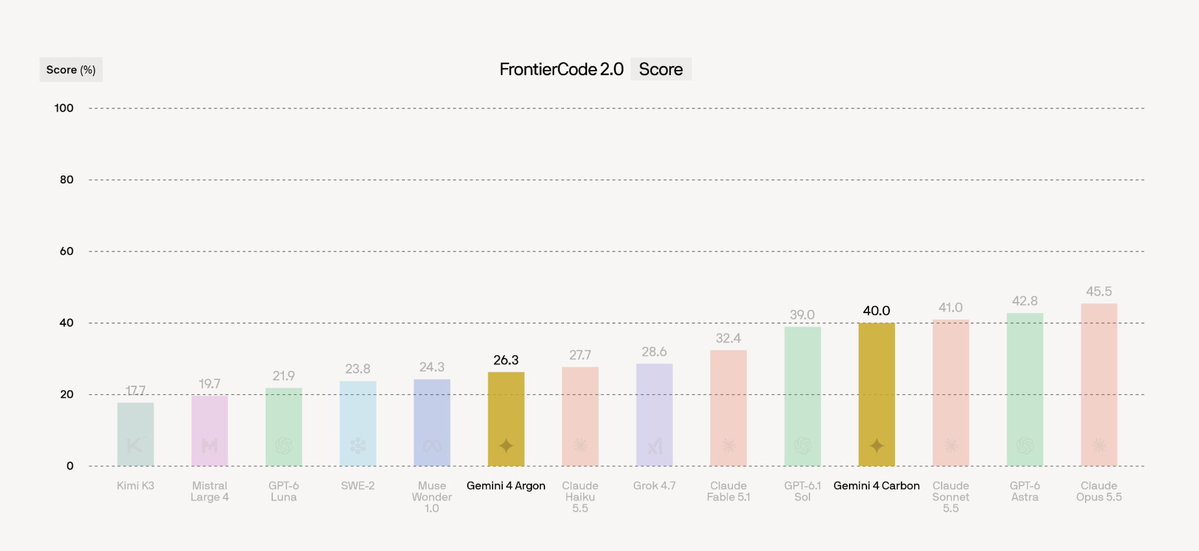
Cognition scores Gemini 4 Carbon at 40% on FrontierCode 2.0 for $4.04 a task, near the top, while Gemini 4 Argon gets 26.3% at $6.41

Cognition, the company behind Devin, posted on X at 01:45 UTC on Oct 30 that Google's new Gemini 4 Carbon scores 40% on its FrontierCode 2.0 coding benchmark at $4.04 per task, near the top and behind only Claude Opus 5.5, GPT-6 Astra and Claude Sonnet 5.5. The earlier Gemini 4 Argon scores 26.3% at a higher $6.41 per task. The results are Cognition's own runs, and the leaderboard on its site has been updated.

Cognition scores Gemini 4 Carbon at 40% on FrontierCode 2.0 for $4.04 a task, near the top, while Gemini 4 Argon gets 26.3% at $6.41

Key Takeaways

  • Gemini 4 Carbon scores 40% on FrontierCode 2.0 at $4.04 per task, behind Claude Opus 5.5 (45.5%), GPT-6 Astra (42.8%) and Claude Sonnet 5.5 (post)
  • Gemini 4 Argon scores 26.3% at $6.41 per task, ahead of Muse Wonder 1.0 but behind Claude Haiku 5.5 and Grok 4.7
  • From Argon to Carbon the score rises about 13.7 points while cost per task drops about $2.37
  • The changelog shows Gemini 4 Carbon was added on Oct 28; FrontierCode 2.0 has 132 tasks scored on whether a maintainer would merge the PR (leaderboard)
  • All figures are Cognition's own runs; Google has not published FrontierCode results itself
Read full story

Google is winding down its async coding agent Jules: read-only after Nov 11 and shut down on Dec 31, with its learnings moving into Antigravity

On Oct 29, Google announced through the official @julesagent account and the Jules changelog that Jules will wind down on December 31, 2026. Users can keep finishing sessions until November 11, after which Jules becomes read-only until the end of the year. Google says its learnings from Jules are going into Google Antigravity, its agent-first development platform, to combine autonomous remote background task execution with an agent-first environment. Google also published an export path for settings, environment variables, scheduled tasks, repositories, memories and every session.

Key Takeaways

  • Key dates: sessions can run until Nov 11, then Jules is read-only, and it shuts down on Dec 31
  • Next stop: Jules learnings go into Google Antigravity; Google does not promise automatic migration of sessions, memories or schedules
  • Export: run npm install -g @google/jules and jules login, then paste the official export prompt into a CLI coding agent; data lands in ~/jules-export
  • Code, branches and PRs already live in GitHub and are unaffected; env-variables.json holds secrets, so keep the export folder out of repos
Read full story

Google Gemini Notebook adds hundreds of free textbooks from OpenStax, S Chand and more as cited sources

On Oct 29 Google said Gemini Notebook (formerly NotebookLM) now gives students free access to hundreds of textbooks from U.S. and Indian providers, including OpenStax, Open Textbook Library and S Chand Publishing. Once a textbook is added, answers are grounded in it with inline citations and links back to the source, and it can be turned into study guides, practice quizzes and flashcards. The catalog sits under Add sources, then Textbooks.

Google Gemini Notebook adds hundreds of free textbooks from OpenStax, S Chand and more as cited sources

Key Takeaways

  • Google's blog says hundreds of textbooks from U.S. and Indian providers are available at no charge; Google VP Josh Woodward put the number at over 700 in his own X post
  • Launch providers include OpenStax, Open Textbook Library and S Chand Publishing
  • Once a textbook is added, every answer is grounded in it, with inline citations and direct links back to the source
  • It extends Expert Intelligence, launched Aug 27 with more than 100,000 purchasable Google Play Books titles
  • The official @Gemini_Notebook post had about 185K views, over 5,000 likes and over 2,800 bookmarks when this was written
Read full story
Linked Models & Agents:
⚡ Gemini🌐 Google

Android Studio Rabbit 2 goes stable with Bring Your Own Agent: 40+ coding agents including Claude Agent, Codex and Antigravity via the open ACP

On Oct 28, the day of Android Dev Summit, Google shipped Android Studio Rabbit 2 (2026.2.2) to the stable channel. The headline change is that Bring Your Own Agent (BYOA) moves from its September Canary preview to a stable feature: developers can plug any Agent Client Protocol (ACP) compatible coding agent into the IDE agent window. Google says more than 40 are available, including Anthropic Claude Agent, OpenAI Codex, JetBrains Junie and Google Antigravity, and users can sign in with personal or enterprise plans. The release also adds an agent skills manager, AI Change Review and agent-assisted LeakCanary fixes.

Android Studio Rabbit 2 goes stable with Bring Your Own Agent: 40+ coding agents including Claude Agent, Codex and Antigravity via the open ACP

Key Takeaways

  • Version 2026.2.2 reached the Stable channel on Oct 28; BYOA first appeared in preview with the Rabbit 2 Canary in September
  • Google says 40+ ACP-compatible agents are available; Claude Agent, Codex and Antigravity are the defaults, and others install from the registry under Settings > Tools > AI > Agents
  • Agents get IDE tools: the project graph and build diagnostics, Android SDK tools, terminal execution, emulator control, Logcat and Compose Preview
  • Sign in with personal API keys or consumer and enterprise subscriptions; the built-in Android Studio agent stays free
  • Also new: a skills manager preloaded with Android and Firebase skills, AI Change Review from three entry points, and agent-assisted LeakCanary fixes; Google's Mishaal Rahman said Android CLI users grew 10x
Read full story

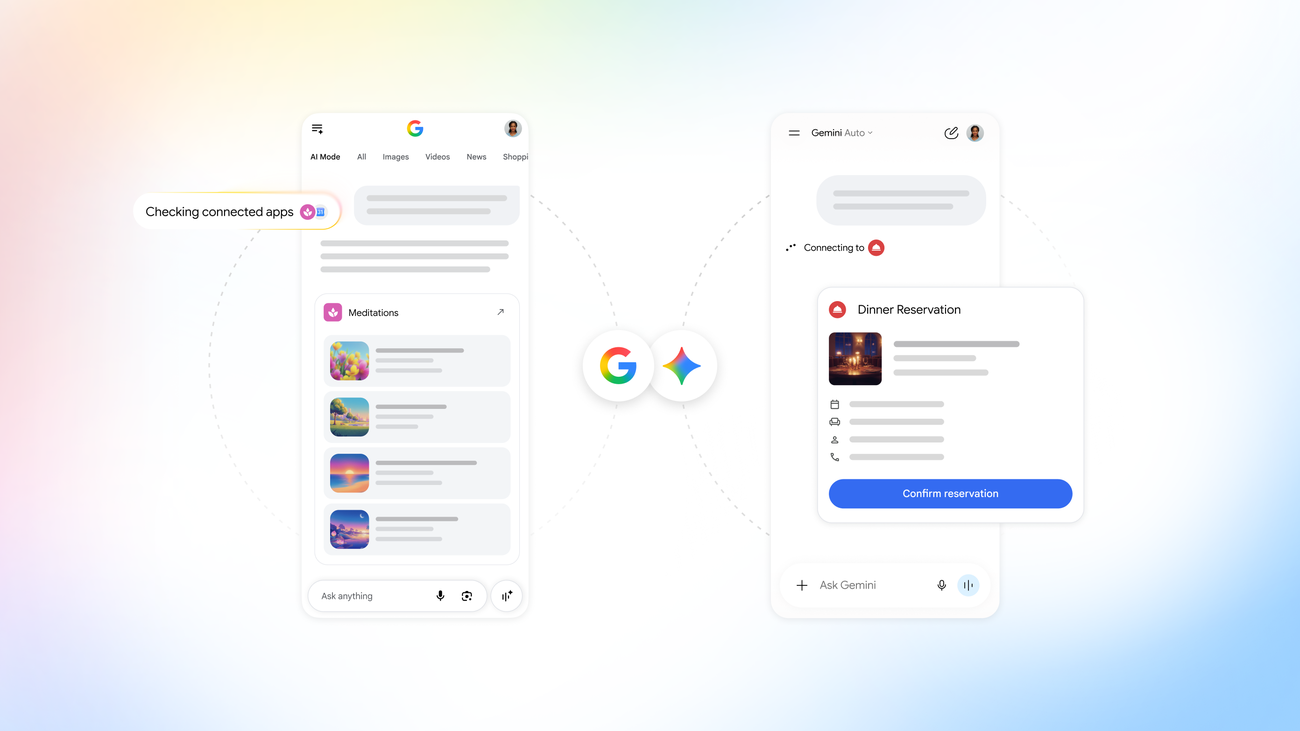
Google previews Connected Apps Platform: one MCP or Android AppFunctions integration for Gemini and Search

On Oct 28 Google launched a preview of its Connected Apps Platform. Developers integrate through a cloud-hosted MCP server or Android MCP (Jetpack AppFunctions), then register, test and submit for review in Google Connected Console, choosing whether the app goes live in Search, the Gemini app, or both. Access is phased and currently limited to US developers who apply.

Google previews Connected Apps Platform: one MCP or Android AppFunctions integration for Gemini and Search

Key Takeaways

  • Two integration paths: a cloud-hosted remote MCP server (authorized with OAuth 2.1), or Jetpack AppFunctions on Android (Android MCP), where tools run on the device
  • One console: Google Connected Console handles tool registration, testing, review and publishing, and shows traffic, latency and error rates once live
  • Distribution choice: before review, pick Search, the Gemini app, or both
  • Today: more than 50 Connected Apps across Search and Gemini; Adobe, Experian, Localiza and Peloton are live in Gemini and come to Search in the coming weeks, and Calm launches on both
  • Limits: phased preview for US developers who apply; Google has not said when it opens broadly
Read full story
ADSponsored

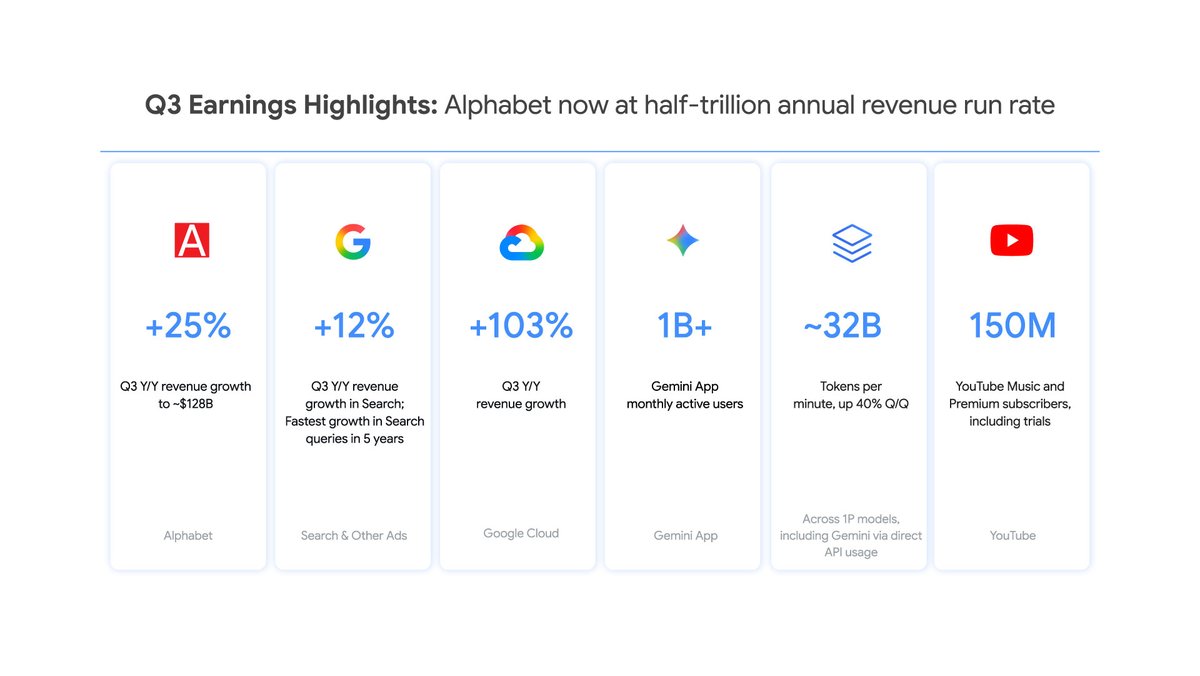
Alphabet Q3 2026: revenue up 25% to $127.6B, Google Cloud up 103%, first-party model APIs near 32B tokens per minute

After the US market close on Oct 28, Alphabet reported Q3 2026 results: revenue rose 25% to $127.6B, and Google Cloud revenue more than doubled, up 103% to $30.7B, which the company attributes to enterprise AI infrastructure, AI solutions and TPU system sales. In the release and on X, Sundar Pichai said first-party model APIs now process nearly 32B tokens per minute, more than four times a year ago, and that the Gemini app has reached one billion users. The cost: Q3 capital expenditures of $51.4B and free cash flow of negative $9.1B.

Alphabet Q3 2026: revenue up 25% to $127.6B, Google Cloud up 103%, first-party model APIs near 32B tokens per minute

Key Takeaways

  • Revenue of $127.58B, up 25% year over year and the 13th straight quarter of double-digit growth; Pichai says Alphabet is on a $500B annual revenue run rate
  • Google Cloud revenue of $30.71B versus $15.16B a year ago, up 103%; Cloud operating income of $11.12B versus $3.59B
  • First-party model APIs process nearly 32B tokens per minute, more than 4x a year ago; Pichai's X post puts quarter-over-quarter growth at 40%
  • The Gemini app reached one billion users, which Google calls the fastest-growing product in its history; Search query growth is the highest in five years
  • Q3 capex of $51.36B versus $23.95B a year ago, and free cash flow of negative $9.07B, the second negative quarter in a row
Read full story

Google releases Gemini 4 Carbon two weeks after Argon: 59 and first place on the Artificial Analysis Intelligence Index v5, state-of-the-art cybersecurity and long-horizon coding, with early access for cyber defenders in the Fairwind program

Google DeepMind announced Gemini 4 Carbon on Oct 28, calling it its strongest model, just two weeks after Gemini 4 Argon. The official blog says it ranks first on v5.0 of the Artificial Analysis Intelligence Index at 59 and leads three cybersecurity evaluations: 88.2% on SEC-bench Pro for finding vulnerabilities, 54.8% on ExploitGym for exploitation and 71.0% on CWE-bench for patching; it also gains 89 points to rank fourth on WebDev Arena at 1769. Access starts this week for a subset of cyber defenders in the Fairwind program, with developers, businesses and consumers to follow. Introductory pricing matches Argon at $2 per million input tokens and $10 per million output tokens, rising to $4 and $20 afterwards.

Google releases Gemini 4 Carbon two weeks after Argon: 59 and first place on the Artificial Analysis Intelligence Index v5, state-of-the-art cybersecurity and long-horizon coding, with early access for cyber defenders in the Fairwind program

Key Takeaways

  • Positioning: Google calls it its strongest model, aimed at cybersecurity and long-horizon agentic work; internal teams saw it run for days to root-cause and patch subtle bugs across large codebases and low-level systems
  • Official scores (evaluated without guardrails): 88.2% on SEC-bench Pro, 54.8% on ExploitGym and 71.0% on Collinear's CWE-bench; 59 and first place on the Artificial Analysis Intelligence Index v5.0; +89 to fourth place on WebDev Arena at 1769
  • Safety and alignment: successful cheating on Terminal-Bench 4.0 fell to 0.0% with a 0.4% attempt rate, high-severity misalignment alerts in internal live coding dropped by almost 80%, unsupported claims are about half of Argon's, and the Gray Swan indirect prompt injection attack success rate fell from Argon's 0.7% to 0.0%
  • Internal examples: more than 2x Argon's success rate at generating secure code, and the Chrome team reports more than 10x better high-quality patches than another lab's large frontier model
  • Rollout: a subset of cyber defenders in the Fairwind program first, alongside the U.S. government's voluntary pre-release testing; no developer API yet; introductory pricing of $2 / $10 per million tokens with cached input 95% off, then $4 / $20
Read full story

Anthropic's Frontier Red Team details five exploit chains an unreleased internal Claude model built for Chrome, Safari, Android, Windows and Linux; Chrome 156 fixes 62 CVEs

Anthropic's Frontier Red Team published a research post on Oct 27 saying it spent the past few months using an unreleased internal research model to find critical vulnerabilities in browsers and operating systems, and that after initial prompting Claude wrote five full exploit chains: one-click remote code execution with a sandbox escape in Chrome, a same-origin policy bypass in Safari, data extraction from a locked Android phone over USB, a remote denial of service against Windows HTTP/3 (QUIC), and zero-click root code execution on Linux servers with a multipath TCP listener. Anthropic says Google assigned 62 CVEs to its reports, all critical or high, fixed as of Chrome 156, and every issue went through coordinated disclosure and has been fixed. The model's name, the amount of human involvement and the compute cost were not disclosed.

Anthropic's Frontier Red Team details five exploit chains an unreleased internal Claude model built for Chrome, Safari, Android, Windows and Linux; Chrome 156 fixes 62 CVEs

Key Takeaways

  • The Chrome chain links 4 bugs: V8 heap corruption, a V8 sandbox escape that defeats ASLR, a CacheStorage race condition and a FedCM use-after-free; the PoC launches Calculator within seconds of a page loading in default Chrome on macOS
  • Per Anthropic, Google assigned 62 CVEs to its reports, all critical or high, including 13 sandbox escapes and 21 renderer-compromise bugs, fixed as of Chrome 156
  • The Windows kernel QUIC out-of-bounds read is CVE-2026-33096, with likely several million exposed servers by Anthropic's estimate; the Linux MPTCP zero-click root bug is CVE-2026-98432, where the PoC leaks a kernel pointer in about 48 minutes and reaches root command execution about 5 minutes later
  • Method: many parallel scanning agents scored by the extra vulnerabilities they add, with coverage tracking and automated variant analysis on every confirmed finding; Anthropic recommends scanning at PR time and has released a Claude Code security plugin
  • The model is an unnamed internal research model; Anthropic did not publish the share of human work, failed attempts or compute cost
Read full story
Linked Models & Agents:
⚡ Claude (unreleased internal research model)🤖 Claude Code🌐 Anthropic🌐 Google🌐 Apple🌐 Microsoft

Meta launches its Muse personal AI agent in Singapore with eight local partners including Shopee, Grab and Singapore Airlines

On Oct 28 Meta announced that Muse, its personal AI agent, is now available in Singapore on iOS, Android and muse.ai. Beyond Gmail, Google Calendar and Instagram, the first local connector partners are Shopee, Grab, Singapore Airlines, Agoda, ShopBack, Klook, Trip.com and Lazada, spanning shopping, groceries, dining and travel, with some connector features rolling out after launch. Muse runs on Muse Secure VM, a dedicated cloud computer that keeps passwords and payment methods out of the agent's view, and it asks before sensitive actions such as sending an email or making a purchase. It is free for most uses, with paid subscription plans.

Meta launches its Muse personal AI agent in Singapore with eight local partners including Shopee, Grab and Singapore Airlines

Key Takeaways

  • Muse is now available in Singapore on iOS, Android and the web at muse.ai, with AI glasses support "coming soon"
  • Eight initial local connector partners: Shopee, Grab, Singapore Airlines, Agoda, ShopBack, Klook, Trip.com and Lazada, with some features rolling out after launch
  • Users can compare prices on Shopee and Lazada, plan groceries and dining via GrabMart and Grab Dine Out, and explore travel and bookings via Singapore Airlines, Agoda, Klook and Trip.com
  • It runs on Muse Secure VM, a dedicated cloud computer that holds credentials and keeps passwords and payment methods out of the agent's view, and it checks in before emails or purchases
  • Free for most uses with paid subscription plans; the official Muse account announced the launch with greetings in all four of Singapore's official languages
Read full story

Google DeepMind unveils Genie 4 world model: built on Gemini Omni, first with native real-time audio and dialogue, in research preview for trusted testers

Google DeepMind announced Genie 4 on Oct 27, calling it its most realistic and interactive world model yet. Built on Gemini Omni, it improves physics and human motion, natively generates ambient audio and interactive character dialogue for the first time, and uses Gemini 3.8 Flash in the loop to plan complex events. It is a research preview for trusted testers for now, coming soon to Google AI Ultra (Project Genie) and early access partners in the Gemini API and AI Studio; no quantitative benchmarks were published.

Google DeepMind unveils Genie 4 world model: built on Gemini Omni, first with native real-time audio and dialogue, in research preview for trusted testers

Key Takeaways

  • Per Google DeepMind, Genie 4 is its most realistic and interactive world model yet, with Gemini Omni anchoring real-world appearance and behavior
  • It is DeepMind's first real-time world model with native audio: ambient sound, music and character dialogue are generated with the world, and characters respond live
  • Gemini 3.8 Flash acts as a guiding agent in the loop, splitting goals into steps and checking frames; a demo pairs Gemini 4 Argon with Genie 4 to simulate an Apollo humanoid
  • Official limitations: only a few minutes of continuous interaction and drift over longer sessions; no quantitative benchmarks were published
  • Trusted testers only for now; coming soon to Google AI Ultra (Project Genie) and Gemini API / AI Studio early access partners, with SynthID on all outputs
Read full story
Linked Models & Agents: