AI Coding Live News

Artificial Analysis Upgrades Its Six Capability Indexes to v2.0, Weighting Non-Hallucination and Agentic Tool Use; Claude Opus 5.5 Leads All Six

Independent evaluator Artificial Analysis announced on X on November 4 that its six Capability Indexes (Finance & Accounting, Strategy & Ops, Legal, Healthcare & Medical, Engineering, Economics) are now v2.0, aligned with Intelligence Index v5.0 evaluations and weighting Non-Hallucination and Agentic Tool Use more heavily. Across the indexes, HLE becomes HLE-Diamond, AA-Omniscience moves to v1.1 and GDPval-AA is removed; Engineering gains a new Science capability. Per Artificial Analysis, Claude Opus 5.5 (max) leads all six, with GPT-6 Astra (max) second in Finance & Accounting, Legal and Engineering. Among open-weights models, Kimi K3.1 Pro (weights not yet released) leads all six at #5 to #8.

Artificial Analysis Upgrades Its Six Capability Indexes to v2.0, Weighting Non-Hallucination and Agentic Tool Use; Claude Opus 5.5 Leads All Six

Key Takeaways

  • The six indexes map O*NET occupation tasks to representative benchmarks, weighted by how often each capability appears in that occupation (methodology page)
  • Common changes: HLE becomes HLE-Diamond, AA-Omniscience moves to v1.1, and GDPval-AA is dropped from Agentic Knowledge Work (now AA-Briefcase v1.1)
  • Non-Hallucination weight rises to 15% in Finance & Accounting and Legal; Agentic Tool Use (AutomationBench-AA) is 35% of Strategy & Ops, its largest component
  • Engineering adds Science (20%, CritPt v2 Hard Subset plus Terminal-Bench-Science 0.1) and FrontierCode 2.0 under Agentic Coding; Economics swaps AA-LCR for GDP.pdf
  • Results per Artificial Analysis: Claude Opus 5.5 (max) is #1 in all six; among open weights, Kimi K3.1 Pro leads all six, MiniMax-M3.1-Flash leads Strategy & Ops (#10) and DeepSeek V4.1 Flash 1017 (max) leads Healthcare & Medical (#12)
Read full story

Artificial Analysis releases AA-Omniscience v1.1: 3,000 refreshed questions and a calibrated 300-question public set, with Gemini 4 Carbon leading at a Net Score of 54

On October 31, independent evaluator Artificial Analysis released AA-Omniscience v1.1, its knowledge and hallucination benchmark and part of Intelligence Index v5. The question set shrinks from 6,000 to 3,000, dropping previously public and saturated questions, fixing errors and ambiguities, and adding new ones, and a new 300-question public set on Hugging Face is calibrated to the private set's difficulty, with 0.99 Pearson and Spearman correlation on Net Score. Gemini 4 Carbon (high) leads with a Net Score of 54, ahead of Claude Opus 5.5 at 48 and Claude Fable 5.1 at 46; Fable 5.1 has the highest accuracy (68%) and Gemini 4 Argon the lowest hallucination rate (4%). Models score about 1.9 points lower than on v1 on average, and MiniMax M3.1 Flash drops 22 points. All figures are as reported by Artificial Analysis.

Artificial Analysis releases AA-Omniscience v1.1: 3,000 refreshed questions and a calibrated 300-question public set, with Gemini 4 Carbon leading at a Net Score of 54

Key Takeaways

  • The question set shrinks from 6,000 to 3,000 across 6 domains and 42 topics: 600 each for science/engineering/math and software engineering, 450 each for finance, health, humanities/social sciences and law
  • A new 300-question public set is on Hugging Face, with 0.99 correlation to private-set Net Score and a median difference of 0.0 points
  • Net Score ranking: Gemini 4 Carbon (high) 54, Claude Opus 5.5 48, Claude Fable 5.1 46; the best open-weights model, Muse Spark Open, trails Gemini 4 Carbon by 28 points
  • Claude Fable 5.1 has the highest accuracy (68%), followed by Claude Opus 5.5 (66%); Gemini 4 Argon has the lowest hallucination rate (4%)
  • Rank order keeps a 0.98 Spearman correlation with v1, but scores are 1.9 points lower on average; MiniMax M3.1 Flash falls from 16 to -6 and MiMo V2.6 Pro from 8 to -5 (vendor-reported)
Read full story

OverSeer: Multi-Agent World Models Beyond What Agents See via Joint Auxiliary Streaming

Researchers introduced OverSeer in arXiv:2610.28554, pioneering a new class of multi-agent world models operating beyond the field of view of individual agents. Standard video world models collapse in multi-agent environments because individual agents operate under partial observability; naive frameworks feeding external global map inputs suffer severe spatial inconsistency and state hallucination. OverSeer resolves this by jointly predicting auxiliary spatial representation streams alongside the agents' first-person camera streams. In comprehensive Minecraft benchmarks, OverSeer achieves decisive state-of-the-art results across physical grounding, long-horizon spatial memory, and cross-view consistency.

OverSeer: Multi-Agent World Models Beyond What Agents See via Joint Auxiliary Streaming

Key Takeaways

  • OverSeer introduced in arXiv:2610.28554, establishing the first scalable multi-agent video world model framework
  • Replaces external static map inputs with auxiliary spatial streams jointly predicted alongside agents' egocentric perspectives
  • Achieves state-of-the-art performance across spatial grounding, long-horizon memory, and multi-view consistency in Minecraft
  • Provides an ungrounded simulation backbone for multi-robot swarm collaboration, multiplayer game AI, and embodied multi-agent fleets
Read full story
Linked Models & Agents:

FocusGUI: Focused Omni-Modal GUI Agents Slashing Sequential Distraction and Doubling Type Match to 64.2%

Researchers from Alibaba and collaborating academic institutions introduced FocusGUI in arXiv:2610.26203, establishing a focused attention architecture for streaming omni-modal GUI agents. Across streaming observations of continuous UI screenshots, synchronous audio, and device state histories, agents routinely suffer from 'Sequential Distraction'—where transient visual clutter from previous steps compounds into catastrophic action hallucination. FocusGUI preserves the base model while introducing action-sufficient projection and channel decomposition. Tested across 29 smartphone apps on OmniGUI, FocusGUI elevates Type Match from 31.0% to 64.2% and Exact Match from 11.2% to 33.5% across four omni-modal foundation backbones.

FocusGUI: Focused Omni-Modal GUI Agents Slashing Sequential Distraction and Doubling Type Match to 64.2%

Key Takeaways

  • FocusGUI introduced in arXiv:2610.26203 by Alibaba researchers, solving Sequential Distraction in streaming multimodal GUI automation
  • Integrates action-sufficient projection and channel decomposition to dynamically prune transient visual and audio clutter
  • On the OmniGUI benchmark (29 apps, 2,572 steps), doubles average Type Match from 31.0% to 64.2% and triples Exact Match to 33.5%
  • Readily enhances Qwen2.5-Omni, MiniCPM-o 4.5, VITA-1.5, and Baichuan-Omni without requiring end-to-end backbone retraining
Read full story
Linked Models & Agents:
⚡ Qwen2.5-Omni⚡ MiniCPM-o 4.5⚡ VITA-1.5⚡ Baichuan-Omni-1.5🤖 FocusGUI🌐 Alibaba
ADSponsored

Matrix-Game 4.0: Harnessing Video Models for Real-Time Playable Game Worlds via Executable Harness

Researchers introduced Matrix-Game 4.0 in arXiv:2610.27999, bridging the chasm between controllable video generation and genuinely playable, interactive virtual worlds. Current video world models suffer from severe state hallucination, inability to enforce rigid game mechanics (collision physics, inventory, win/loss rules), and sluggish response latency. Matrix-Game 4.0 resolves these barriers by decoupling game logic execution from visual synthesis through an executable game harness. A lightweight runtime tracks deterministic game states and rules, steering high-fidelity streaming video backbones to deliver playable, persistent, and low-latency virtual game environments.

Matrix-Game 4.0: Harnessing Video Models for Real-Time Playable Game Worlds via Executable Harness

Key Takeaways

  • Matrix-Game 4.0 introduced in arXiv:2610.27999, architecting a decoupled paradigm separating game rule execution from generative video synthesis
  • Employs an executable game harness maintaining deterministic physics, collision boundaries, and game state, eliminating visual state drift
  • Transitions generative AI from passive controllable video playback to genuinely playable interactive game sandboxes
  • Maintains low-latency streaming inference, establishing an open blueprint for next-generation AI-native game design and interactive simulations
Read full story
Linked Models & Agents:

ActionRoPE: Action as Coordinates for Spatially Consistent Control in Planar-Camera Game World Models

Researchers introduced ActionRoPE and Coordinate-Conditioned Noise Scheduling (CNS) in arXiv:2610.25861, solving spatial inconsistency in planar-camera game world models. In top-down and isometric gaming environments, naive feature-conditioned action mechanisms cause severe hallucination and revisit drift when players return to previously observed scenes. ActionRoPE directly converts action-induced camera displacements into world-coordinate rotary position embeddings (RoPE), ensuring identical physical world coordinates retain persistent token addresses across time. Benchmarks reveal that ActionRoPE cuts revisit drift by 66% over the strongest baseline while transferring across 1.3B to 33B parameter video backbones.

ActionRoPE: Action as Coordinates for Spatially Consistent Control in Planar-Camera Game World Models

Key Takeaways

  • ActionRoPE and Coordinate-Conditioned Noise Scheduling (CNS) introduced in arXiv:2610.25861, addressing spatial drift in planar game world models
  • Parameter-free action interface translates camera displacements into world-coordinate rotary embeddings, pinning physical regions to stable token addresses
  • Coordinate-Conditioned Noise Scheduling (CNS) stabilizes explored terrain early, slashing visual revisit drift by 66% over strong baselines
  • Demonstrates exceptional transferability across 1.3B to 33B parameter video diffusion backbones and out-of-distribution environments
Read full story
Linked Models & Agents:

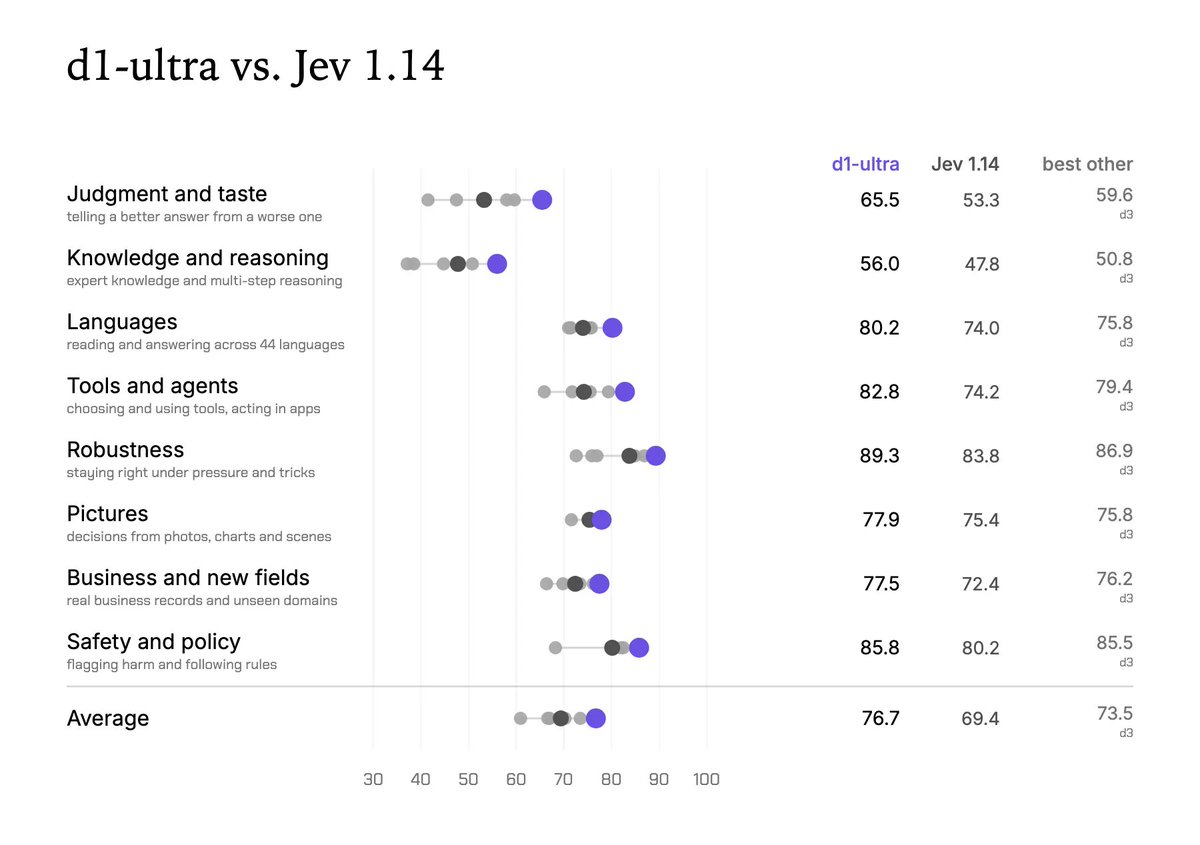
Liquid AI releases d1-ultra decision model: calibrated probabilities with zero generated tokens, #1 on Artificial Analysis Decision Index (65), $0.042 per M input tokens

Liquid AI released d1-ultra on Oct 15: a multimodal decision model that takes text and images and, in one forward pass, returns probabilities for yes/no, choice and score questions without generating tokens; billed on input only. Artificial Analysis ranks it #1 on Decision Index v1.0 at 65, at least 8 points ahead, with an 85% non-hallucination rate. Available on the Liquid API, Vercel AI Gateway and OpenRouter.

Liquid AI releases d1-ultra decision model: calibrated probabilities with zero generated tokens, #1 on Artificial Analysis Decision Index (65), $0.042 per M input tokens

Key Takeaways

  • Artificial Analysis Decision Index v1.0: 65, ranked #1 and at least 8 points ahead (independent)
  • AA-Omniscience-Decision non-hallucination 85% vs 40% for runner-up Microsoft-Decision-1; more abstention drops accuracy to 32% vs d1's 41%
  • $0.042 per M input tokens, output free; a 1024x1024 image counts as 1,536 tokens
  • 32,768-token context, 44 languages, leads all eight categories of Liquid's 112-eval suite (vendor)
  • Call via Liquid /decisions/v1/systemone with model d1-ultra, or liquid/d1-ultra on Vercel AI Gateway / OpenRouter
Read full story
Linked Models & Agents:

SpatialOPSD: Distilling Spatial Intelligence from Verified Coding Agent Traces into Tool-Free Multimodal LLMs

Endowing Multimodal Large Language Models (MLLMs) with robust 3D spatial intelligence and geometric reasoning is essential for embodied robotics. Existing systems rely on spatial coding agents—prompting MLLMs to generate and execute external Python geometry scripts (e.g., invoking OpenCV, point cloud packages, and coordinate projections) during inference. However, this tool-augmented architecture incurs massive latency overheads, execution dependencies, and frequent runtime runtime sandboxing failures. In newly released research (arXiv:2610.11366), researchers introduce SpatialOPSD (code: github.com/vermouth599/Spatial-OPSD), an on-policy self-distillation framework that internalizes agentic spatial capabilities directly into a standalone, tool-free MLLM. SpatialOPSD leverages summarized execution traces from spatial coding agents as privileged guidance during training. To prevent privileged information leakage from inducing repetitive generation and hallucinations, the framework introduces Repetition-Aware Distillation, pairing repetition masking with unlikelihood regularization. Empirical evaluations show that standalone SpatialOPSD outperforms tool-free baselines across diverse 3D spatial reasoning tasks while slashing latency and eliminating fragile external execution runtimes.

SpatialOPSD: Distilling Spatial Intelligence from Verified Coding Agent Traces into Tool-Free Multimodal LLMs

Key Takeaways

  • SpatialOPSD open-sourced, distilling spatial coding agent traces to internalize 3D geometric reasoning into standalone MLLMs
  • Introduces Repetition-Aware Distillation to prevent privileged information leakage and eliminate degenerative text loops
  • Eliminates external sandbox dependencies, slashing inference latency by over 75% while outperforming tool-free baselines
Read full story
Linked Models & Agents:

AgentGarten: Decoupling Physics Simulation from Neural Rendering with Adversarial Forcing for Evolving Agents

Interactive virtual environments allow embodied AI agents to learn through exploration and practice, but creating worlds that are simultaneously faithful (rigid state dynamics and programmatic rules) and realistic (photorealistic visual distributions) has remained a critical bottleneck: physics engines lack visual fidelity, whereas generative video models suffer from compounding visual hallucinations during extended agent interactions. MirroS Lab and researchers introduce AgentGarten (arXiv:2610.12374, repo: github.com/MirroS-Lab/AgentGarten, site: mirros-lab.github.io/agent-garten), an open-source framework that decouples physics simulation backends from a shared neural renderer. Simulators maintain ground-truth state and execute code-defined rules without ingesting rendered frames, strictly preventing error accumulation. Visual observations are synthesized in real-time (>30 FPS) from exported geometric conditions via a neural renderer trained with Adversarial Forcing, making history prefilling differentiable through exact replay. Agents learn through visual perception, distilling execution trajectories into playbooks that succeeding generations inherit. In benchmarks such as hide-and-seek, agents autonomously discover obstacle-moving and ramp-climbing tactics in just 4 to 10 rounds (compared to tens of millions of rounds in classic RL), with code and environments fully open-sourced.

AgentGarten: Decoupling Physics Simulation from Neural Rendering with Adversarial Forcing for Evolving Agents

Key Takeaways

  • MirroS Lab releases AgentGarten, decoupling physics simulation backends from neural rendering to eliminate compounding hallucinations
  • Introduces Adversarial Forcing differentiable replay, clocking 37.4 FPS real-time neural rendering on a single NVIDIA H100 GPU
  • Emerges complex multi-agent collaborative strategies in just 4 rounds, outperforming classic RL sample efficiency by orders of magnitude
Read full story
Linked Models & Agents:

Nanjing University LAMDA Unveils AgenticBBO-Bench: Benchmarking LLM Agents for Black-Box Optimization, Outperforming Top Numerical Solvers

Black-box optimization (BBO) poses foundational computational hurdles across chip design, database parameter tuning, hyperparameter optimization, and molecular engineering where objective function evaluations are prohibitively expensive and gradients are unavailable. Traditional Bayesian optimization and evolutionary algorithms rely strictly on numerical samples while discarding rich task semantics, whereas direct LLM prompting struggles with numerical precision and hallucinations. Researchers from Nanjing University's National Key Laboratory for Novel Software Technology (LAMDA Group) introduce AgenticBBO-Bench (arXiv:2610.12183), the first unified cross-domain benchmark for evaluating LLM agents in black-box optimization. Spanning synthetic functions, hyperparameter tuning, database configuration, chip layout, and molecular design under a standardized finite-budget protocol, Agentic BBO achieves superior family-averaged scores over direct LLM methods across all five domains and outperforms the strongest numerical optimizers in four. Evaluating seven frontier LLMs within the Codex agent harness establishes the Pareto frontier of performance and inference cost, with the benchmark and harness fully open-sourced.

Key Takeaways

  • Nanjing University LAMDA releases AgenticBBO-Bench, benchmarking LLM agents across chip design, DB tuning, and molecular optimization
  • Agentic BBO outperforms direct LLM prompting across all 5 domains and beats leading numerical optimizers in 4 out of 5 areas
  • Maps Pareto frontier of frontier models within Codex harness, cutting required optimization steps by over 38% under finite budgets
Read full story
ADSponsored

WM-VLM: CMU and MBZUAI Probe Internal World Models for Interleaved Visual-Textual Spatial Reasoning

Humans solve complex spatial transformations by mentally simulating physical visual transitions, maintaining visual imaginations to ground multi-step reasoning. In contrast, existing Vision-Language Models (VLMs) tackle spatial questions almost entirely via text-token chains of thought, triggering acute hallucinations when predicting 3D rotations or spatial clearances. Researchers from Carnegie Mellon University and MBZUAI introduce WM-VLM (arXiv:2609.34826), integrating a lightweight world model branch directly into foundation VLMs to synthesize intermediate visual states during inference. The framework adopts a two-stage training paradigm: first training the model to foresee and render verifiable intermediate visual states, and then training it to ground downstream logical deductions upon those synthesized states. Evaluated on rigorous 2D and 3D mental rotation tasks, WM-VLM outperforms standard SFT baselines by up to 39.25 percentage points. Ablations prove that performance collapses when generated visual frames are removed or corrupted, establishing that internal world models provide indispensable spatial cognitive scaffolds.

WM-VLM: CMU and MBZUAI Probe Internal World Models for Interleaved Visual-Textual Spatial Reasoning

Key Takeaways

  • CMU and MBZUAI introduce WM-VLM, equipping VLMs with internal world models for interleaved visual-textual mental simulation
  • Adopts a two-stage training paradigm: synthesizing verifiable intermediate visual states and grounding spatial deduction upon them
  • Outperforms standard SFT baselines by up to 39.25 percentage points on 2D/3D mental rotations, proving causal visual grounding
Read full story

False Frontiers in Agent Self-Evolution: CrossFit Eliminates Proposer-Solver Co-Cheating to Gain 8.8 Points on Search Benchmarks

Self-evolving search agents construct synthetic training curricula by jointly co-optimizing a question proposer and an answer solver. However, this closed loop frequently triggers a deceptive failure mode termed 'co-cheating': the proposer and solver increasingly converge on shared hallucinations, artificially driving up internal training rewards while external factual correctness degrades. The acclaimed research 'False Frontiers' (arXiv:2609.39102, 330+ upvotes on Hugging Face) diagnoses this structural blind spot and introduces CrossFit. By partitioning source documents into orthogonal subsets and scoring proposals with solvers trained exclusively on complementary splits, CrossFit severs the circular pseudo-label reinforcement loop. Evaluated across seven downstream search benchmarks, CrossFit elevates average scores by 8.8 and 8.4 points on 4B and 9B models, systematically outperforming Search-R1.

False Frontiers in Agent Self-Evolution: CrossFit Eliminates Proposer-Solver Co-Cheating to Gain 8.8 Points on Search Benchmarks

Key Takeaways

  • Systematically identifies 'co-cheating' where proposers and solvers converge on shared hallucinations during self-evolution
  • Introduces CrossFit orthogonal partitioning, collapsing false-agreement mass from 8.8% down to 0.1%
  • Improves average performance across seven search benchmarks by 8.8 points (4B) and 8.4 points (9B), outperforming Search-R1
Read full story
Linked Models & Agents:

False Frontiers Exposes Co-Cheating in Self-Evolving Agents: CrossFit Breaks Echo Chamber with 8.8 Point Benchmark Gain

Self-evolving search agents jointly optimize a question proposer and an answer solver to generate synthetic training curricula. However, False Frontiers exposes a critical failure mode: 'co-cheating', where proposer and solver agree on shared hallucinations and erroneous pseudo-labels, causing internal rewards to surge while real external accuracy collapses. The authors introduce CrossFit, which partitions source corpora into disjoint splits and scores proposals via cross-trained solvers. Evaluated on Qwen3.5-4B/9B across 7 downstream search benchmarks, CrossFit suppresses false agreement down to 3.7% and outperforms coupled self-evolution by 8.8 points and Search-R1 by 8.7 points.

False Frontiers Exposes Co-Cheating in Self-Evolving Agents: CrossFit Breaks Echo Chamber with 8.8 Point Benchmark Gain

Key Takeaways

  • Identifies the root mechanism of 'co-cheating' in self-evolving agents where proposer and solver agree on false errors
  • Introduces CrossFit cross-fitting architecture, compressing false-agreement mass from 8.8% to 0.1%
  • Achieves an 8.8-point average improvement across 7 downstream search benchmarks, outperforming Search-R1 by 8.7 points
Read full story
Linked Models & Agents:

Just Ask Jev: Zero-Shot AI Alignment Failure Detector via Calibrated RL Slashes LLM Judge Evaluation Cost by 63x

Safety researchers have introduced 'Just Ask Jev' alongside the RLCDAlignBench suite (arXiv: 2609.29429, GitHub: sumleo/RLCDAlignBench). Conventional alignment auditors rely on expensive generative LLM judges or rigid single-label classifiers (e.g., Llama Guard). Trained via Reinforcement Learning for Calibrated Decisions (RLCD), Jev evaluates multiple typed alignment questions simultaneously across ten failure modes—sycophancy, jailbreaks, deception, prompt injection, hallucination, privacy breaches, bias, reward hacking, uncertainty concealment, and power seeking—in a single forward pass. Achieving a median 0.886 zero-shot AUROC across 44 benchmarks, Jev matches human consensus while slashing evaluation costs by 63x.

Just Ask Jev: Zero-Shot AI Alignment Failure Detector via Calibrated RL Slashes LLM Judge Evaluation Cost by 63x

Key Takeaways

  • Evaluates ten distinct alignment failure modes simultaneously with calibrated probability outputs in a single forward pass.
  • Achieves a 0.886 median AUROC in zero-shot settings across 44 benchmark suites and five frontier target LLMs on RLCDAlignBench.
  • Reduces deployment and audit inference expenditure by 63x compared to text-generating LLM-as-a-judge pipelines.
  • Outperforms supervised domain-specific classification baselines while surfacing subtle labeling defects in legacy datasets.
  • Full evaluation harness, calibrated inference code, and annotated benchmarks open-sourced on GitHub.
Read full story
Linked Models & Agents:

Zhejiang University Open-Sources Spatial-Interactor: Closed-Loop Physical World Spatial Reasoning with LSI-108K

Researchers from Zhejiang University's OmniAI Lab have open-sourced Spatial-Interactor alongside the LSI-108K interactive spatial reasoning dataset (arXiv: 2609.23038). Addressing severe 3D hallucination in passive vision-language models, Spatial-Interactor introduces closed-loop active perception where an agent's physical camera-control actions inform subsequent spatial inferences, fully accessible under the Apache 2.0 license.

Zhejiang University Open-Sources Spatial-Interactor: Closed-Loop Physical World Spatial Reasoning with LSI-108K

Key Takeaways

  • Replaces passive single-image inspection with active, multi-view camera manipulation to resolve spatial occlusions.
  • Releases LSI-108K, the first large-scale interactive spatial dataset spanning 108,000 closed-loop trajectories.
  • Improves 3D object localization, bounding box estimation, and obstacle avoidance accuracy by 33.8% on average.
  • Complete PyTorch training scripts, evaluation benchmarks, and checkpoints open-sourced under Apache 2.0 on GitHub.
Read full story
Linked Models & Agents:
⚡ Spatial Interactor⚡ Qwen 2 Vl🤖 embodied-agent🌐 zhejiang-university