AI Coding Live News

MiniMax M3.1 Flash weights now open on Hugging Face: 428B-total / 23B-active MoE, $0.15 input and $0.60 output per million tokens, 73.7% on DeepSWE

MiniMax confirmed that Space Bunny, the anonymous model that led usage rankings on OpenRouter and elsewhere, was an early version of M3.1 Flash, and launched it on its API on October 19. Pay-as-you-go pricing is $0.15 input, $0.60 output and $0.015 cache read per million tokens, with a 1M context, text, image and video input, and an effort setting for thinking depth. Per MiniMax, it costs one third of M3 and runs 3x faster, scoring 73.7% on DeepSWE and 62.2% on Automation-Bench; the weights went live on Hugging Face on schedule on October 23 (MiniMax Community license, MXFP8), with day-0 support from Together, Inferact (vLLM) and LightSeek TokenSpeed.

MiniMax M3.1 Flash weights now open on Hugging Face: 428B-total / 23B-active MoE, $0.15 input and $0.60 output per million tokens, 73.7% on DeepSWE

Key Takeaways

  • Official pay-as-you-go pricing: $0.15 input / $0.60 output / $0.015 cache read per million tokens; per token that is half of M3 ($0.30/$1.20), and MiniMax does not explain how it gets one third of the cost.
  • Vendor benchmarks: DeepSWE v1.1 73.7% (Opus 5: 74.0%), Automation-Bench 62.2%, BabyVision with tools 91.0%, Terminal Bench 4.0 38.1% (Opus 5: 51.8%).
  • 1M context, text/image/video input, five effort levels from low to max, default max, thinking cannot be turned off.
  • Weights opened October 23 at Hugging Face MiniMaxAI/MiniMax-M3.1-Flash: ungated, MiniMax Community license (not MIT/Apache), MXFP8 quantized, native multimodal MoE with about 428B total and 23B active parameters per token, plus a DSpark speculative-decoding draft head.
  • Migration: M2.5 and M2.7 closed to new users on October 19 and retire on November 18; M Plan and Token Plan requests now route to M3.1 Flash automatically.
  • Day-0 serving: Together AI runs it fully managed, MiniMax is partnering with Inferact to contribute production-inference improvements back to vLLM, and LightSeek's TokenSpeed added day-0 support.
Read full story

SemiAnalysis Discloses Google & Inferact TPUv7 Submission: TorchTPU vLLM Megakernels Drive 2.8T Kimi K3, Surpassing GB200 NVL72 and B300 in High-Interactivity TCO

SemiAnalysis revealed the first Google TPUv7 benchmark submission for the 2.8T Kimi K3 MoE model, led end-to-end by Inferact (the creators of vLLM) and Google using the TorchTPU vLLM stack. At a hardware rental cost of just $1.21/chip-hour (vs $2.31 for GB300 and $1.86 for GB200), TPUv7 delivers ~2.2M tokens per $1 TCO in the ultra-high interactivity regime (~390 tok/s/user), outpacing NVIDIA GB200 NVL72, B300, and AMD MI355X on cost-performance.

SemiAnalysis Discloses Google & Inferact TPUv7 Submission: TorchTPU vLLM Megakernels Drive 2.8T Kimi K3, Surpassing GB200 NVL72 and B300 in High-Interactivity TCO

Key Takeaways

  • Inferact (creators of vLLM) and Google submitted their first preliminary TPUv7 benchmark for the 2.8T Kimi K3 MoE model
  • TPUv7 chip rental sits at $1.21/hour, significantly below GB300 ($2.31), B300 ($2.26), and GB200 ($1.86)
  • Delivers ~2.2M tokens per $1 TCO at ~390 tok/s/user, beating NVIDIA GB200 NVL72, B300, and AMD MI355X in the ultra-high interactivity regime
  • Built with fused TorchTPU vLLM megakernels and the TPU-Sync KVCache offload library for production PD disaggregation
Read full story
Linked Models & Agents:

SemiAnalysis Breaks Down 1.3B Tokens/$ AgentX Record: vLLM + Inferact Disaggregated Serving Beats Aggregated B300 by 4x, While Cline Highlights Multi-Harness RL

SemiAnalysis published the architectural breakdown behind the 1.3B tokens per dollar TCO record on AgentX: vLLM and Inferact utilized Prefill/Decode disaggregated serving at hyperscaler volume pricing to achieve 4x better cost-efficiency than an aggregated NVIDIA B300 configuration. Concurrently, open-source coding agent Cline reported that DeepSeek-V4.1-Flash-1017 beats GPT-5.6-Sol on Terminal-Bench at ~17x lower cost (+35% over prior V4.1-Flash) purely by scaling RL training across multiple coding agent harnesses.

SemiAnalysis Breaks Down 1.3B Tokens/$ AgentX Record: vLLM + Inferact Disaggregated Serving Beats Aggregated B300 by 4x, While Cline Highlights Multi-Harness RL

Key Takeaways

  • SemiAnalysis confirms vLLM and Inferact achieve 1.3B tokens per dollar TCO on AgentX via disaggregated serving—4x better than an aggregated NVIDIA B300 configuration
  • Cline reports that DeepSeek-V4.1-Flash-1017 improves prior V4.1-Flash Terminal-Bench performance by 35%, beating GPT-5.6-Sol at ~17x lower cost
  • The 35% agentic coding leap was achieved without base algorithmic changes by scaling reinforcement learning directly across multiple coding agent harnesses
Read full story
Linked Models & Agents:

vLLM adds NVIDIA Vera Rubin NVL72 support: up to 7.84x per-GPU throughput over GB200 on AgentX with MiniMax M3

On Oct 9 the vLLM team, with Inferact, Red Hat and NVIDIA, shipped early Vera Rubin NVL72 support: CUDA 13.4 nightly images already serve DeepSeek, Kimi, GLM and MiniMax. Vendor-reported results: up to 7.84x per-GPU throughput vs GB200 on SemiAnalysis AgentX (MiniMax M3, matched interactivity) and up to 3.7x vs GB300 NVL72 on the MLPerf Inference v6.1 VLM benchmark (Qwen3-VL-235B-A22B).

vLLM adds NVIDIA Vera Rubin NVL72 support: up to 7.84x per-GPU throughput over GB200 on AgentX with MiniMax M3

Key Takeaways

  • Versus GB200 NVL72: 5x NVFP4 FLOPS, ~2.4x HBM4 bandwidth, 1.7x bidirectional NVLink, 2–4x faster softmax exponentials (vLLM blog)
  • AgentX with MiniMax M3: up to 7.84x per-GPU throughput at matched interactivity, 5.18x under a 150 TPS cap (vendor-reported, early)
  • MLPerf Inference v6.1: Qwen3-VL-235B-A22B on vLLM + Dynamo, up to 3.7x vs GB300 NVL72
  • CUDA 13.4 locality domains split MoE weights for ~1.2x average MoE-layer speedup in small-token decode
  • Image: vllm/vllm-openai:cu134-nightly (CUDA 13.4 + PyTorch 2.15)
Read full story
ADSponsored

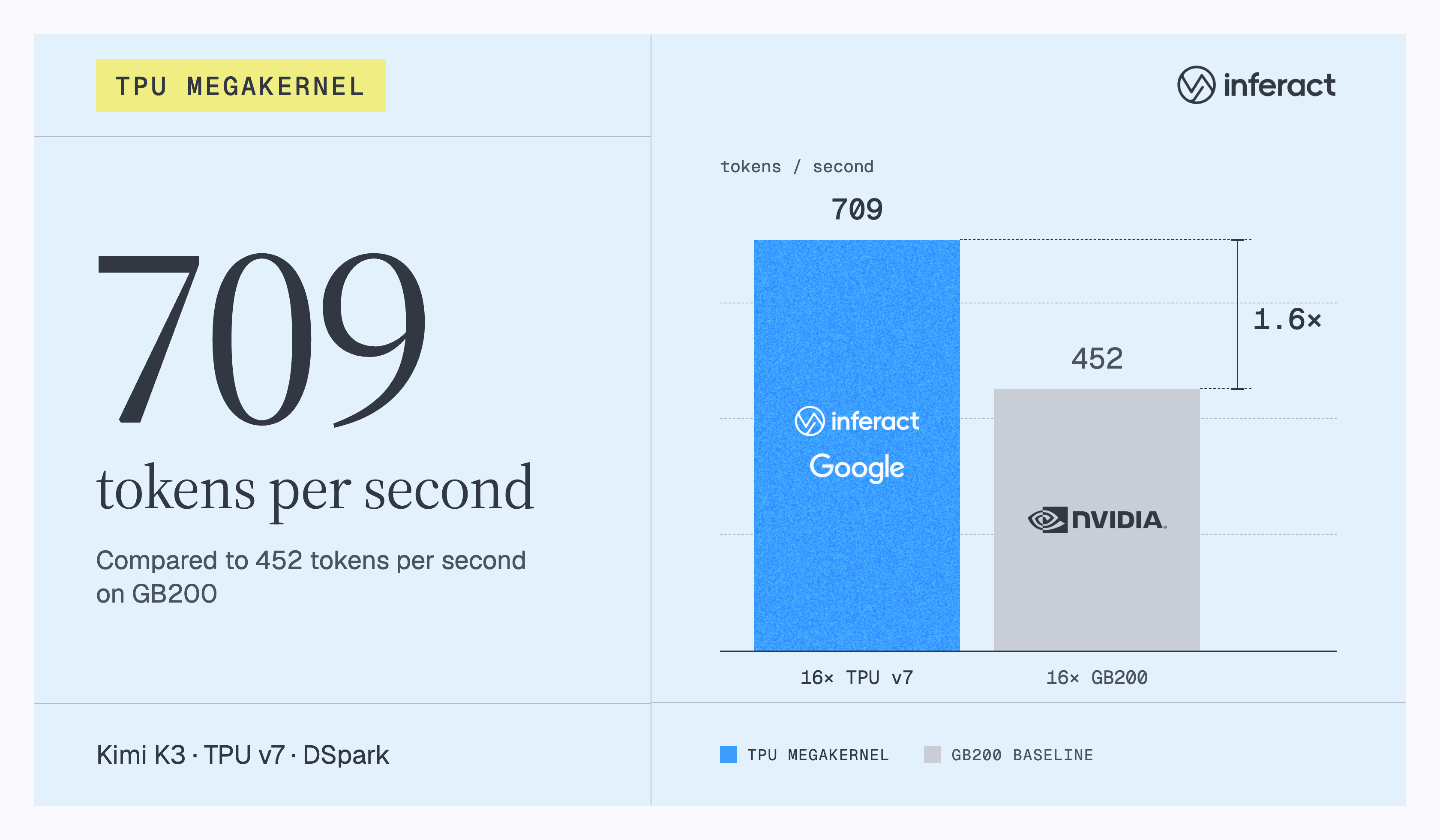
Inferact open-sources TPU megakernels: Kimi K3 hits 709 tok/s on 16× TPU v7 vs 452 on GB200

Inferact open-sourced inferact/tpu-megakernels on 2026-09-23: a Pallas megakernel collection for TPU v7. Their blog reports Kimi K3 at 709 tok/s on 16× TPU v7 Ironwood vs 452 tok/s on 16× GB200 under DSpark speculative decoding (acceptance length 6), and roughly 1.4–2× the GB200 baseline at batch sizes 1–8 without speculation. All 92 MoE layers of Kimi K3 run in a single kernel with cross-layer weight prefetch.

Inferact open-sources TPU megakernels: Kimi K3 hits 709 tok/s on 16× TPU v7 vs 452 on GB200

Key Takeaways

  • Inferact-reported (not independently reproduced): Kimi K3 + DSpark reaches 709 tok/s on 16× TPU v7 vs 452 tok/s on 16× GB200 (blog)
  • Without speculation: ~1.4–2× GB200 baseline at batch 1–8; Qwen 3.8 27B: 1,515 vs 695 tok/s on 4× chips with speculation
  • All 92 MoE layers of Kimi K3 run in one Pallas megakernel with cross-layer weight prefetch into VMEM
  • Repo: Inferact/tpu-megakernels (Apache-2.0)
Read full story
Linked Models & Agents:

Google Cloud and Inferact partner to make TPU first-class in vLLM with open-source serving work

Inferact (@inferact) announced a Google Cloud partnership to make TPU first-class in vLLM: one engineering roadmap for production serving/kernels, a native PyTorch path via TorchTPU, and day-0 frontier-model support, plus a community program with shared TPU capacity and maintainer review — all open source.

Key Takeaways

  • Google Cloud and Inferact are making TPU first-class in vLLM.
  • Roadmap covers production serving/kernels, TorchTPU, and day-0 frontier models.
  • Community shared TPU capacity; all collaboration work is open source.
Read full story
Linked Models & Agents: