On November 9 at NVIDIA AI Day Seoul, LG AI Research made the K-EXAONE 2.5 API free through its EXAONE API Platform (docs.exaone.ai). Developers, startups, enterprises and research institutions can get an API key and use it for service development and research. K-EXAONE 2.5 is a technical validation model built by further training K-EXAONE 2.0, released in August: 750B total parameters with 31B active, text-only, Korean and English, a 512K context and an OpenAI-compatible endpoint. On four agentic benchmarks run internally, LG reports 59.2 on SWE-Bench Pro, 78.0 on BrowseComp, 74.6 on AutomationBench and 77.3 on Claw-Eval, roughly on par with DeepSeek-V4.1-Flash and GLM-5.3 but not leading across the board. NVIDIA says the model was trained with Nemotron datasets. LG has not published how long the free access lasts or any quota, and has not released 2.5 weights.
Zoom
Key Takeaways
Free access: the EXAONE API Platform launched on November 9 and is currently free of charge; get an API key to call it. EXAONE Tabular, a 21M-parameter tabular prediction model, launched alongside it
Specs: 750B total / 31B active parameters, text-only, Korean and English, 512K context and 512K max output, January 2026 knowledge cutoff; supports tool calling, structured outputs, code generation and streaming
API: OpenAI-compatible POST /v1/chat/completions with model name k-exaone_v2.5; reasoning cannot be turned off, reasoning_effort takes low / high / max (default max), and reasoning tokens count toward max_tokens
LG internal results (vs DeepSeek-V4.1-Flash / GLM-5.3): SWE-Bench Pro 59.21 vs 58.41 / 64.03; BrowseComp 78 vs 75.8 / 79; AutomationBench 74.6 vs 74.9 / 71.6; Claw-Eval 77.29 vs 75.78 / 77.64
Versus K-EXAONE 2.0: AutomationBench rose from 16.9 to 74.6 and SWE-Bench Pro from 47.1 to 59.21. All figures are vendor-run and not independently reproduced; LG has not stated the free period, quotas or whether 2.5 weights will be released
At NVIDIA AI Day Seoul, NVIDIA released Dynamo-optimized deployment recipes for four leading Korean open models: SK Telecom's A.X K2, LG AI Research's K-EXAONE 2.0 (750B-A37B), Upstage's Solar Open 2 (250B) and Motif Technologies' Motif-3. The recipes target B200 GPUs with NVFP4 weights, FP8 KV cache and a vLLM backend, and ship aggregated and disaggregated (prefill/decode split) Kubernetes manifests plus benchmark jobs. NVIDIA claims up to 2x inference performance out of the box, without naming the baseline. Per the Dynamo docs, Motif-3 on two B200s reaches about 294 output tok/s per GPU, and K-EXAONE 2.0 on four B200s hits a 291 ms median time to first token. The recipes are part of NVIDIA's AI for All collaboration with Korea's Ministry of Science and ICT.
Zoom
Key Takeaways
Covers four Korean open models: SK Telecom A.X K2, LG K-EXAONE 2.0 (750B-A37B), Upstage Solar Open 2 (250B) and Motif-3; recipes live under recipes/ in the ai-dynamo/dynamo GitHub repo
Per NVIDIA: up to 2x inference performance out of the box on B200, though NVIDIA does not name the baseline
Dynamo docs results (chat trace, SLA of at least 50 tok/s per user and TTFT p50 under 5 s): Motif-3 on 2x B200 at 293.96 tok/s per GPU with 388 ms TTFT; Solar Open 2 with two replicas at 216.88 tok/s per GPU with 308 ms TTFT
K-EXAONE 2.0 aggregated on 4x B200: 87 tok/s per GPU, 51.4 tok/s per user, 291 ms TTFT; A.X K2 on 8x B200 with EAGLE3: 76.49 tok/s per GPU, 0.525 s TTFT, plus a 32x H200 option
Caveats: Motif-3 and A.X K2 numbers use synthetic speculative-decoding acceptance lengths (about 2.1) and do not reflect real acceptance or output quality; Solar Open 2 defaults to high reasoning effort with a median GPQA output near 6,400 tokens, so set max_tokens generously
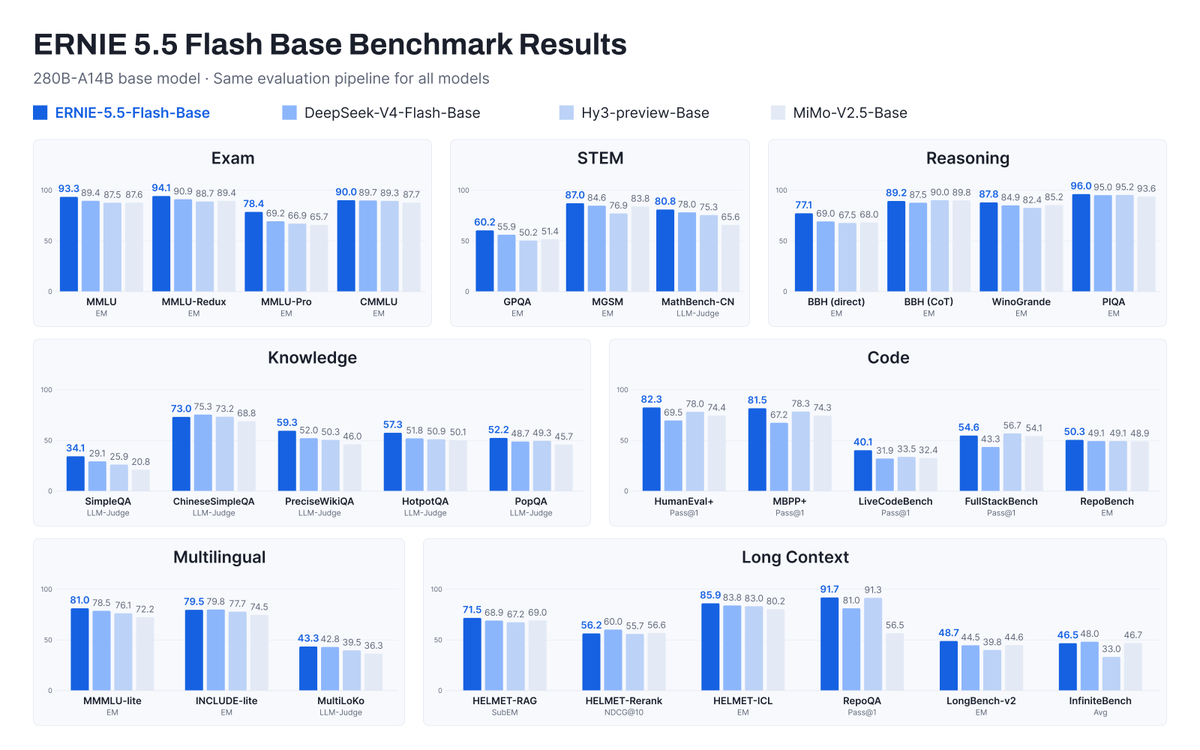
On November 5 Baidu (official blog + @BaiduResearch) open-sourced ERNIE-5.5-Flash-Base: a text-only MoE base checkpoint at end of pre-training (no mid/post-training), 280B total / 14B active per token, 33.5T pretrain tokens, up to 128K train context and 1M for fine-tune/inference. FP8 and BF16 weights are on Hugging Face and ModelScope. Under Baidu's unified eval pipeline vs similar bases: MMLU 93.3, HumanEval+ 82.3, LiveCodeBench 40.1 (vendor-reported). Post-trained ERNIE 5.5 Flash "will follow". License is custom (excludes EU/UK/South Korea; commercial use above $50M related revenue needs prior written authorization).
Zoom
Key Takeaways
Nov 5 open base at end of pre-training: 280B total / 14B active — not a chat/instruct model
33.5T pretrain tokens; up to 128K train context, 1M for fine-tune and inference
Vendor unified eval: MMLU 93.3, HumanEval+ 82.3, LiveCodeBench 40.1 vs similar bases
On November 3, model-compression company Pruna AI open-sourced P-H3-Image, which turns MiniMax-H3, the open-weights video model MiniMax released this summer, into a text-to-image and image-editing model. Per Pruna: sampling drops from 50 to 8 steps, a 4 MP image on one B200 goes from 12.4 s to 2.6 s, the 4-bit set is a 20 GB download (vs 143 GB for H3), and peak VRAM at 8 MP is about 21 GB. It renders 2 to 16 MP and edits with multiple reference images. Weights are on Hugging Face with native ComfyUI support. It keeps the MiniMax H3 Community License, which by default excludes the EU, UK, South Korea and the US.
Zoom
Key Takeaways
Speed (Pruna figures): 8 steps instead of 50; on one B200 a 4 MP image goes from 12.4 s to 2.6 s and 8 MP from 30.6 s to 5.8 s; the 4-bit set does 4 MP in about 6.3 s on an L40S
Size: the transformer shrinks from 33B to 20B parameters and the text encoder is distilled from 32B to 4B (67 GB to 9 GB); downloads are 55 GB in bf16 and 20 GB in 4-bit vs 143 GB for H3
Memory: peak VRAM at 8 MP is about 56 GB in bf16 and 21 GB in 4-bit; the bf16 diffusers pipeline with the prompt upsampler needs about 100 GB
Capabilities: renders 2 to 16 MP, strongest at photorealistic and documentary photography, film stills, anime and graphics with short text; supports multi-reference editing (8 images per the X post, 9 per the blog)
License: MiniMax H3 Community License; the EU, UK, South Korea and US need a separate license from MiniMax, and products must show "Powered by MiniMax H3"
In his 2027 budget address to the National Assembly on November 2, South Korean President Lee Jae Myung proposed a record 820.9 trillion won budget (+12.8%), with 21.3 trillion won (about $16B) for semiconductors, physical AI, AI data centers and AI, nearly double the 10.8 trillion won in 2026. The Ministry of Planning and Budget document allocates 4.7 trillion won to a sovereign AI model aiming for world-leading performance, including the purchase of 10,000 Vera Rubin GPUs. Parliament still has to pass the budget.
Zoom
Key Takeaways
The three mega-projects plus AI rise from 10.8 to 21.3 trillion won, up 97.2%; the total budget is 820.9 trillion won, up 12.8% (official budget document).
The 4.7 trillion won frontier AI program buys 10,000 Vera Rubin GPUs (3.9T won), training data (0.8T won), and recruits 20 top overseas researchers (25B won).
Until then, about 7,000 government-owned GPUs go first, plus about 8,000 leased from industry and academia; companies are picked by open competition and the state invests as an equity holder.
A new 0.25 trillion won AI for All program builds public AI agents on the domestic model that can handle ID documents, KTX train bookings and passport renewals; AI education gets 2.1T won for 3.9 million people.
Another 70B won funds a dedicated AI security model and 50B won subsidizes AI security subscriptions for 10,000 SMEs; physical AI rises from 0.9T to 3.1T won.
On Oct 26 Apple released iOS, iPadOS, macOS, watchOS and visionOS 27.2, and Siri AI (beta), the assistant rebuilt on Apple Intelligence, now supports French, Japanese, Korean, Portuguese and Spanish in addition to English. Apple says Traditional Chinese, Norwegian, Turkish and Vietnamese will follow by the end of the year. Per the iOS 27.2 release notes, Siri AI can now recall past conversations and draw on more sources such as photos in Messages, Calendar attendees and voicemails. Siri AI is still unavailable in the EU on iOS, iPadOS and watchOS and in mainland China, and server-side features have daily usage limits; Apple says expanded access will be offered for a fee in the future.
Zoom
Key Takeaways
Languages: Siri AI grows from English-only to 6 languages, adding French, Japanese, Korean, Portuguese and Spanish; Apple says Traditional Chinese, Norwegian, Turkish and Vietnamese arrive by year end
5 platforms: iOS, iPadOS, macOS, watchOS and visionOS 27.2 shipped the same day, with Siri AI still labeled beta
New abilities (per iOS 27.2 release notes): recall of past conversations, more sources including photos in Messages, Calendar attendees and voicemails, plus one Excluded Apps setting
Limits: unavailable on iOS/iPadOS/watchOS in the EU, for mainland China accounts and for users under 13; server-side features have daily caps, and Apple says paid expanded access is coming
Devices: Apple Intelligence hardware such as iPhone 15 Pro and later and M1-or-later iPad and Mac, with device and Siri language set to the same supported language
On Oct 16 OpenAI made prompt-to-voice generally available to all API customers. Developers describe accent, pitch, timbre and pace in plain text and create a saved custom voice through /v1/audio/voices or the voice Playground, then reuse it in GPT-Live sessions. Creating a voice is free; speech uses regular GPT-Live session billing, with up to 100 prompt-generated voices per organization. OpenAI also added nine natural GPT-Live voices in German, French, Hindi, Japanese and Korean.
Zoom
Key Takeaways
Generally available to all API customers from Oct 16; no reference or consent recording needed
Creating a voice is free; speaking in GPT-Live and previewing in the Playground use regular session billing (per OpenAI)
Up to 100 prompt-generated voices per organization; optional script_hint of up to 2,000 characters
Nine new natural voices: 3 German, 2 French, 2 Japanese, 1 Hindi and 1 Korean
Limits: prompt voices work only with GPT-Live, not TTS, Realtime or Chat Completions; voice creation is not Zero Data Retention compatible
On Oct 15 OpenAI rolled out GPT-Live-1.1 (successor to GPT-Live-1) and GPT-Live-1.1 Quip (successor to GPT-Live-1 mini), full-duplex voice models that become the default voice for Plus-and-up users in ChatGPT Voice, Codex and dots. New voices cover French, German, Hindi, Japanese, Korean and Mexican Spanish, accents are more natural and the constant 'checking...' filler is reduced. Rolling out to all users; API coming soon. The system card reports statistically significant regressions in four synthetic safety categories.
Zoom
Key Takeaways
Two tiers: GPT-Live-1.1 replaces GPT-Live-1 and GPT-Live-1.1 Quip replaces GPT-Live-1 mini; 1.1 is default for Plus+ including Codex and dots, Quip for everyone else
New Live voices in 6 languages (French, German, Hindi, Japanese, Korean, Mexican Spanish) plus Bubbie in English; fewer repetitive 'checking...' fillers while searching
Full-duplex: listens and speaks continuously, handling pauses, interruptions and pace changes; the system card describes GPT-Live as a two-model system that delegates hard work to thinking models
System card: parity on production voice evals; statistically significant regressions on sexual, mental health, emotional reliance and gore synthetic evals vs GPT-Live-1
Rolling out to all users today; API 'coming soon' with no published price, model ID, latency or WER figures yet
CrowdStrike Intelligence found Claude Code session histories, ARTEX configs and a CLAUDE.md in attacker open directories, showing a likely Chinese-speaking, financially motivated actor used the China-built open-source agentic pentest framework ARTEX (DeepSeek v4.1-flash primary, plus GLM-5.3 and Grok 4.6) to breach loan-inquiry and employee mobile systems at South Korean financial institutions from late September to early October 2026.
Key Takeaways
Window: late Sep to early Oct 2026; CrowdStrike attribution is moderate confidence, no named adversary
Model stack: DeepSeek v4.1-flash as ARTEX primary backend via likely reseller xcai[.]pro; GLM-5.3 and Grok 4.6 in Claude Code sessions
IOCs: 1 actor-controlled IP (38.244.50[.]120) plus 9 proxy IPs, with MITRE ATT&CK mapping