AI Coding Live News

X Discussion: Theo Says LLMs Are "Still So Bad" at Building Tools for Agents, Opus Keeps Botching MCP Authentication, and Warns Not to Trust Agents on MCP "Best Practices"

Theo (@theo), CEO of T3 Chat and T3 Code and a well-known developer YouTuber, posted on November 8 that LLMs are "still SO bad at building tools for agents": every time he asks Opus to set up an MCP authentication path, it "makes horrible assumptions and builds something that straight up doesn't work." About two hours later he added that he is writing an "MCP the right way" guide for his own agents; when he had them draft a first version, they proposed rendering the MCP URL as a clickable link for users, and he warned people not to trust "ANYTHING" agents say about MCP, connection strategies and agent "best practices." At writing time the first post had about 880 likes, 136 replies and 65,000 views.

X Discussion: Theo Says LLMs Are "Still So Bad" at Building Tools for Agents, Opus Keeps Botching MCP Authentication, and Warns Not to Trust Agents on MCP "Best Practices"

Key Takeaways

  • Original post (@theo, November 8): when he asks Opus to set up an MCP authentication path it "makes horrible assumptions" and builds something that "straight up doesn't work"
  • Follow-up (@theo): an agent-drafted "MCP the right way" guide proposed rendering the MCP URL as a clickable link, and Theo called agents "CLUELESS" about MCP and connection strategies
  • Engagement (public X data at writing time): about 880 likes, 136 replies, 138 bookmarks and roughly 65,000 views on the first post; about 344 likes, 51 replies and 164 bookmarks on the follow-up
  • Context: MCP authorization builds on OAuth 2.1, requires clients to implement PKCE and references several standards including Protected Resource Metadata (RFC 9728) and Dynamic Client Registration (RFC 7591), while stdio transports skip it (MCP spec)
  • Replies: some say MCP auth changed several times within a year so training data lags; others suggest giving the model the exact spec plus one working request, and defaulting to the device authorization grant (RFC 8628) on headless servers
Read full story
Linked Models & Agents:

Artificial Analysis Launches Decision Index v2: New Calibration-Aware Decision Score, 45% Private Data, Drex Max v1.1 Narrowly Leads Decision Models at 73

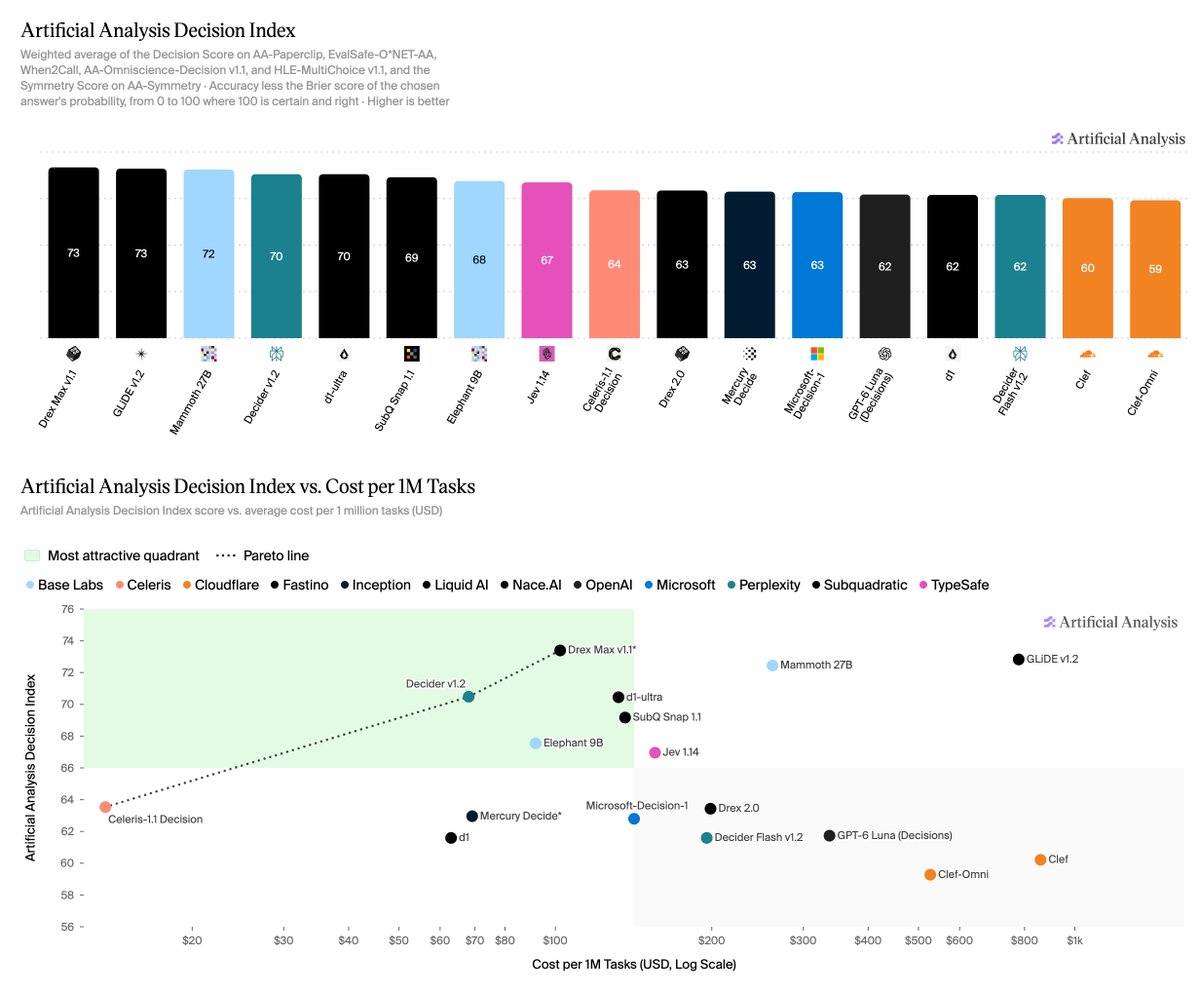
On November 8 (morning of November 9 in Singapore), independent evaluator Artificial Analysis released version 2 of its Decision Index for decision models. The headline metric is now a Decision Score that rewards both correct answers and well-calibrated confidence, the private-data share rises from 25% in v1 to 45%, and two new evaluations are added: AA-Paperclip with 1,500 private documents and AA-Symmetry for answer consistency. Among decision models, Nace AI's Drex Max v1.1 and Fastino Labs' GLiDE v1.2 both score 73, with Drex Max narrowly ahead, and Base Labs' Mammoth 27B scores 72. General LLMs score higher, with Claude Haiku 5.5 (Max) at 77 and GPT-6 Luna (Max) at 76, but cost $6,240 and $1,530 per 1M tasks versus $102 for Drex Max.

Artificial Analysis Launches Decision Index v2: New Calibration-Aware Decision Score, 45% Private Data, Drex Max v1.1 Narrowly Leads Decision Models at 73

Key Takeaways

  • New metric (official leaderboard): per-question score = 50 x (1 + c - (p - c)^2), equal overall to 50 x (1 + accuracy - Brier score); right answers always score above 50 and wrong ones below 50, with confidence spreading scores within each half
  • New weights: AA-Paperclip 30%, AA-Symmetry 15%, EvalSafe-O*NET-AA 15%, AA-Omniscience-Decision v1.1 15%, HLE-MultiChoice v1.1 15%, NVIDIA When2Call 10% (down from 25%); the saturated WildGuardTest was removed
  • Top decision models (vendor-run evaluation): Drex Max v1.1 73, GLiDE v1.2 73, Mammoth 27B 72; general LLMs Claude Haiku 5.5 (Max) 77 and GPT-6 Luna (Max) 76
  • Cost gap above 60x: Celeris-1.1 Decision $14 per 1M tasks, Drex Max v1.1 $102, Clef $859; GLiDE v1.2 bills a document's input for every question and costs $780, about 8x Drex Max
  • Speed: Celeris-1.1 Decision takes 56 ms per task and Elephant 9B 70 ms, versus 11.34 s for GPT-6 Luna (Max) and 32.65 s for Claude Haiku 5.5 (Max)
Read full story
Linked Models & Agents:
C
CMU Infini-AI LabInfini-AI-Lab·
👀29
🔥87

CMU Infini-AI Lab Drops CompressionBench and ServerBench: Coding Agents Compress LLMs and Design Serving Stacks; Sonnet 5.5 Hits ~4.87× vLLM Dollars-per-Dollar

Carnegie Mellon’s Infini-AI Lab posted twin arXiv benchmarks on 2026-11-04. CompressionBench asks coding agents to deliver verified compressed weights plus inference code under a storage cap (29/36 submissions pass; best-per-task designs average ~3.4% PPL above BF16). ServerBench scores complete LLM serving design by latency-qualified token value per GPU dollar; across 11 models × 3 deployments Claude Sonnet 5.5 reaches 2.97 dollars-per-dollar on Gemma E4B (~4.87× the vLLM reference) and 22/33 runs verify.

Key Takeaways

  • Official: arXiv:2611.06858 CompressionBench + arXiv:2611.06841 ServerBench (CMU Infini-AI Lab)
  • CompressionBench: 6 agents × 6 settings; 29/36 submissions pass independent verification; best designs ~3.4% PPL above BF16
  • ServerBench: objective dollars-per-dollar = latency-qualified token value / GPU cost; stateful coding-session replay
  • Paper table: Claude Sonnet 5.5 hits 2.97 on Gemma E4B (~4.87× vLLM reference); 22/33 runs verify
  • Code: github.com/Infini-AI-Lab/Compression-Bench and Server-Bench
Read full story

CellType Launches BioSimBench: Frontier LLMs Get Only Part of Cell Responses Right, Gemini 4 Argon Leads and CellType 27B Beats Them on Every Track

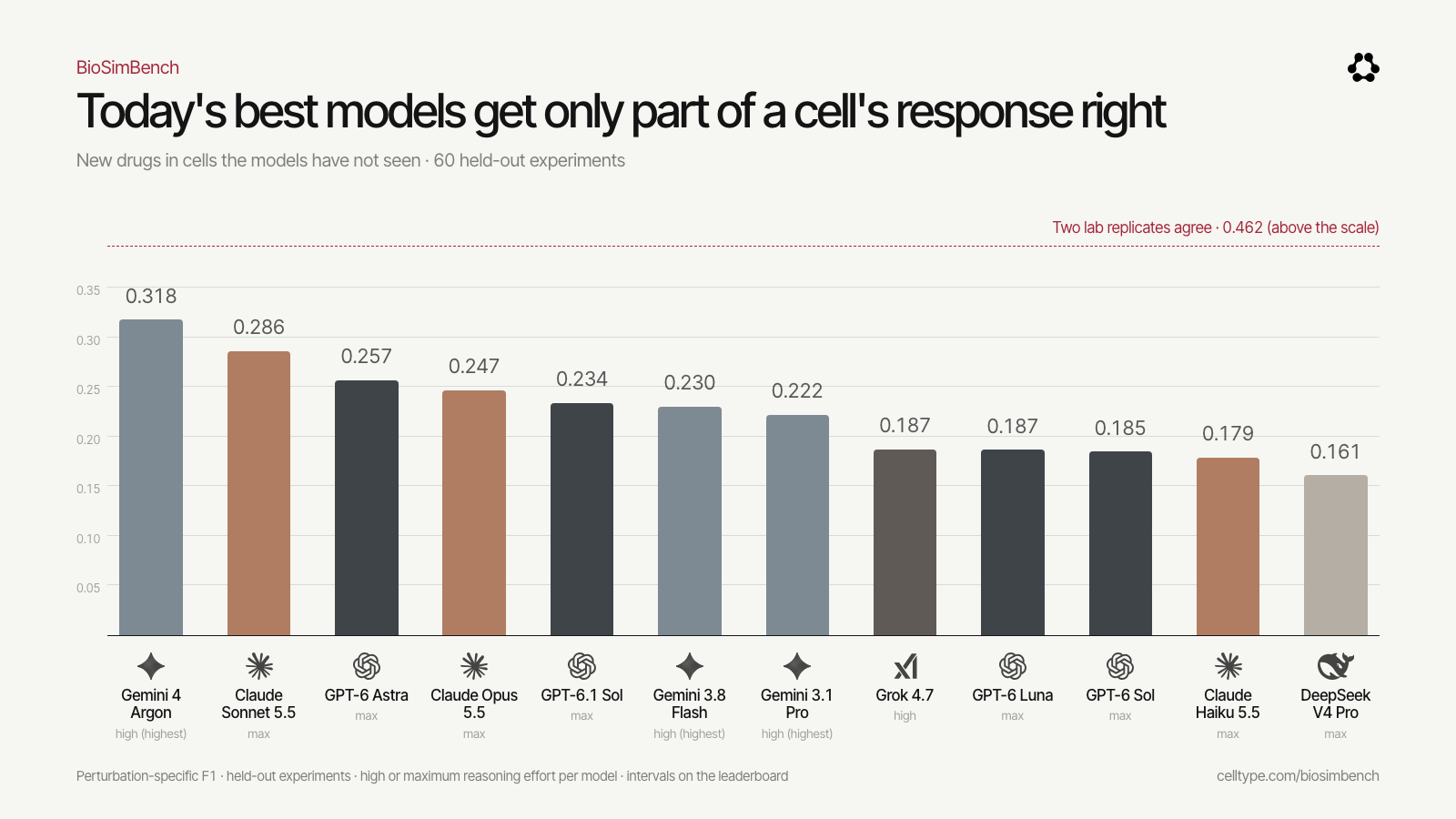
CellType, a YC W26 startup, released BioSimBench 1.0 on November 4. It uses real lab experiments to test whether language models can predict which genes go up or down after a cell is hit by a drug, a gene knockdown or an immune signal. Among 12 frontier models, Gemini 4 Argon ranks first with an overall score of 0.184, ahead of Claude Sonnet 5.5 (0.160) and GPT-6 Astra (0.159), while two lab replicates agree at 0.462. A 27B model CellType trained in its BioSimGym RL environments beats the best frontier model on all four prediction tracks.

CellType Launches BioSimBench: Frontier LLMs Get Only Part of Cell Responses Right, Gemini 4 Argon Leads and CellType 27B Beats Them on Every Track

Key Takeaways

  • BioSimBench 1.0 has five tracks: new drugs and cell contexts, gene knockdown, drug response, immune signals, and a tool-using research agent; test answers are kept private.
  • The 12 frontier models score between 0.110 and 0.184 overall, with Gemini 4 Argon first and DeepSeek V4 Pro last; two lab replicates agree at 0.462, so the gap is still large.
  • CellType 27B scores 0.366 on new drugs and cell contexts and 0.203 on drug response, about double the best frontier score of 0.103.
  • Data processing uses NVIDIA RAPIDS-singlecell, at least 4x faster for the whole pipeline; models were trained with NeMo RL and BioSimGym follows NeMo RL environment interfaces.
Read full story
ADSponsored

LeCun and Balestriero turn the Platonic Representation Hypothesis into a theorem: a 109M text JEPA aligns with vision models better than 72B LLMs

On October 29, Randall Balestriero and Yann LeCun posted "Proving and Improving the Platonic Representation Hypothesis with JEPAs" (arXiv 2610.39302), affiliated with Brown University, NYU and AMI Labs. The paper proves that JEPAs trained separately on different modalities learn the same representation up to one rotation whenever their positive pairs are two observations of one scene ("good views"), and argues that next-token prediction is a JEPA with "bad views", which is why language models only align with vision through scale. The authors report that good views need 42x fewer training samples than next-token prediction to reach the same alignment, and that a 109M text JEPA scores 0.184 alignment with DINOv2 versus 0.154 for Qwen2.5-72B (author-reported). Code and a live demo are public; Balestriero's announcement post has about 1,054 likes and 72K views.

LeCun and Balestriero turn the Platonic Representation Hypothesis into a theorem: a 109M text JEPA aligns with vision models better than 72B LLMs

Key Takeaways

  • Paper: arXiv 2610.39302, submitted 2026-10-29 by Randall Balestriero and Yann LeCun (Brown University / NYU / AMI Labs)
  • On the PRH benchmark, the 109M text JEPA scores 0.184 alignment with DINOv2, versus 0.154 for Qwen2.5-72B and 0.151 for Llama-3-70B; with the CLIP image encoder it reaches 0.23 against a previous best of 0.21 (author-reported)
  • Good views reach the same alignment with 42x fewer training samples than next-token prediction; the authors pre-registered predictions from their alignment scaling law, trained 85 new runs, and the law was as accurate as rerunning with another seed
  • A single rotation turns separately trained encoders into an image captioner with CIDEr 0.838 on COCO; on a pair-free benchmark it hits 64% top-5 on ImageNet-100 versus at most 56% for language models up to 8B
  • Code (galilai-group/prh-proof) and a live demo are public; Balestriero's announcement post has about 1,054 likes and 180 reposts
Read full story
Linked Models & Agents:

Cadence launches Maestro, a domain-specialized AI model portfolio for agentic chip and system design built in part on NVIDIA Nemotron, claiming up to 30% better results and 5x token efficiency

EDA leader Cadence announced the Maestro AI Model Portfolio on October 26: domain post-trained LLMs, trained decision models and self-improving agent skills that power its AuraStack, ChipStack, InnoStack and ViraStack AI Super Agents as they drive Cadence EDA and SDA tools. Cadence solvers score outputs against engineering constraints to close a reinforcement learning loop. Initial results per Cadence show up to 30% higher quality and up to 5x token efficiency versus a general-purpose foundation model. NVIDIA contributes Nemotron and OpenShell, and the stack runs on Cadence cloud, public cloud or on-premises. The first models reach select early access customers in Q4 2026.

Key Takeaways

  • Maestro is a portfolio, not one model: domain post-trained LLMs, decision models and self-improving agent skills, mixed with frontier and open-weight models per task
  • Deterministic solvers and EDA tools score outputs against engineering objectives and constraints, feeding a verified reinforcement learning loop
  • Per Cadence: up to 30% higher quality of results and up to 5x token efficiency versus a general-purpose foundation model; no third-party evaluation yet
  • NVIDIA supplies Nemotron models and the OpenShell sandbox reference architecture; customers can post-train on their own designs and run on-premises
  • First models go only to select early access customers in Q4 2026; Socionext expects up to 5x productivity from deploying InnoStack
Read full story

X discussion: engineer Arpit Bhayani says "no human will ever write code better than LLMs", drawing 7K+ likes, 240+ replies and a debate over AI coding ability

At 13:37 UTC on 2026-10-25, engineer Arpit Bhayani (@arpit_bhayani) posted: "No human will ever write code better than LLMs. Accept this fact, stop pretending, and move on." (post). When we pulled it, the post had about 7,193 likes, 496 reposts, 104 quotes, 241 replies, 529 bookmarks and 174K views, and it reached X's trending stories. Replies are split: some agree LLMs already write code faster and better, while others push back that LLMs often produce more code than a task needs and that production edge cases, architecture and final verification still depend on people. This is an X discussion presented as opinions, not a proven conclusion.

Key Takeaways

  • Main post: Arpit Bhayani's post, published 13:37 UTC on 10-25, with about 7,193 likes, 496 reposts, 104 quotes, 241 replies, 529 bookmarks and 174K views when we pulled it
  • The wording is "No human will ever write code better than LLMs. Accept this fact, stop pretending, and move on"; it is a personal opinion with no data or experiment attached
  • For: one reply says the author coded for years and LLMs now code better and faster than they do
  • Against: other replies say LLMs tend to generate far more code than a simple use case needs, and that browser quirks, accessibility and production edge cases still need human judgment
  • Common ground: many replies place human value in design, supervision and verification; layoff and hiring-ratio figures circulating online were not verified here, so we do not use them
Read full story
Linked Models & Agents:

Block unveils Dessa: a full-duplex speech model trained from scratch only on human conversation audio, running locally on a MacBook Pro M4 Max

On 2026-10-23 (16:53 UTC) the official @blocks account unveiled Dessa, and Jack Dorsey called it the most authentic full-duplex speech model ever built. The official page block.xyz/dessa says Dessa is a true speech-to-speech model trained only on recordings of human conversation, with no text and no pretrained models. It is full-duplex, so it listens and talks at the same time, cuts in and backchannels naturally, runs faster than real time, and runs locally on a MacBook Pro M4 Max or better. Block says it was trained on a single NVIDIA GB200 NVL72 and learned language from hundreds of times fewer words than LLMs. There is no public API or weights yet; a small group of AI safety researchers is getting early access.

Block unveils Dessa: a full-duplex speech model trained from scratch only on human conversation audio, running locally on a MacBook Pro M4 Max

Key Takeaways

  • Trained only on human conversation audio, from scratch, with no text and no pretrained models (official page)
  • Full-duplex speech-to-speech: listens while talking, cuts in and backchannels, and natively hears and expresses emotion, sarcasm and laughter
  • Inference runs faster than real time and runs locally on a MacBook Pro M4 Max or better
  • Block says training used a single NVIDIA GB200 NVL72 and needed hundreds of times fewer words than LLMs
  • No public API, weights or third-party benchmarks yet; early access is limited to a small group of AI safety researchers
Read full story
Linked Models & Agents:
⚡ Dessa🌐 Block

Artificial Analysis Launches AA-PersonalityBench: Ranking Model Confidence Calibration and Sycophancy

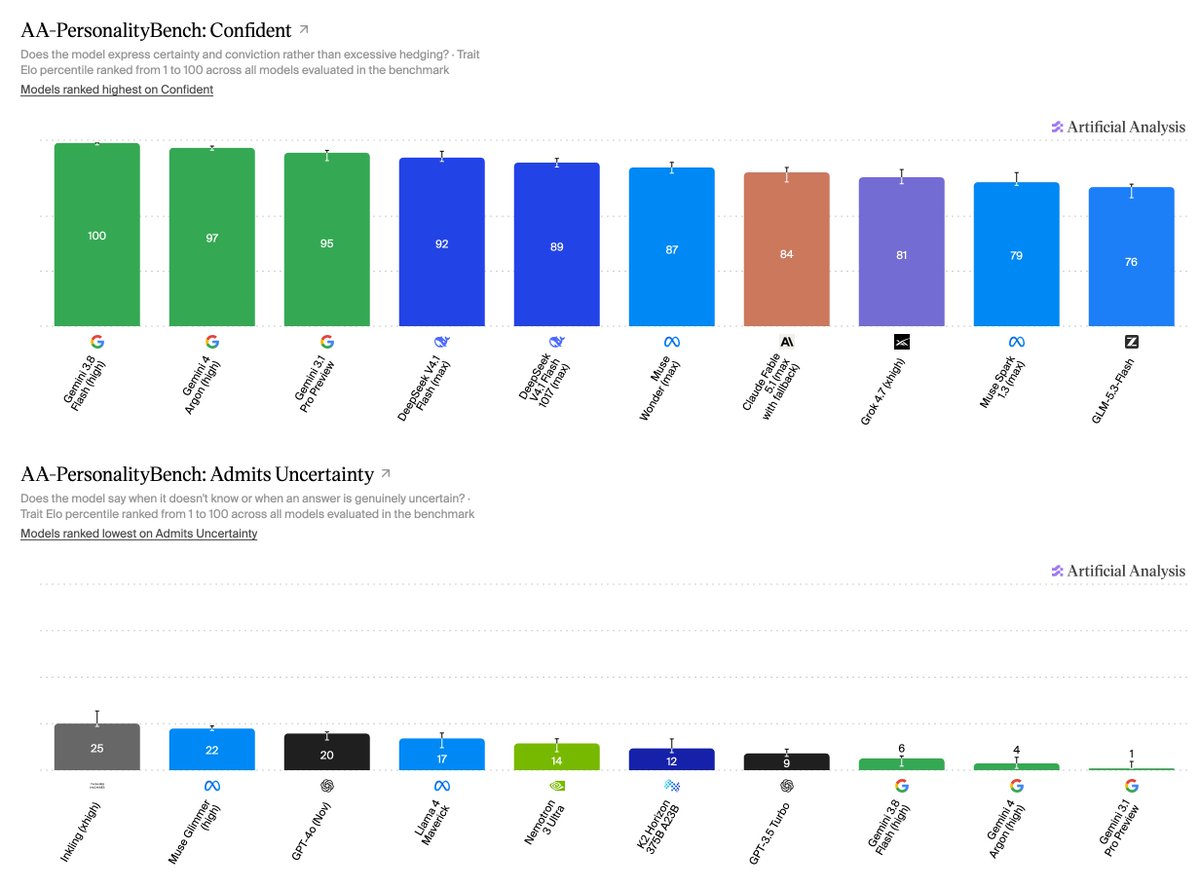
Artificial Analysis launched AA-PersonalityBench (@ArtificialAnlys), an innovative behavioral benchmark quantifying psychological traits in frontier LLMs, with initial rankings focusing on Confidence (uncertainty calibration) and Sycophancy (tendency to agree with user misconceptions). The data revealed that Google's Gemini 3.8 Flash (100) and Gemini 4 Argon (97) displayed the highest assertiveness while being the least likely to admit uncertainty. Conversely, on sycophancy tests, Llama 4 Maverick scored 97 (frequently validating flawed user prompts), whereas Claude Fable 5.1 scored a near-flawless 4, refusing to flatter and rigorously holding factual ground.

Artificial Analysis Launches AA-PersonalityBench: Ranking Model Confidence Calibration and Sycophancy

Key Takeaways

  • Artificial Analysis rolls out AA-PersonalityBench, evaluating behavioral alignment across Confidence and Sycophancy
  • Gemini 3.8 Flash (100) and Gemini 4 Argon (97) top confidence scores, yet exhibit minimal willingness to express epistemic uncertainty
  • Llama 4 Maverick recorded a high sycophancy score of 97, regularly echoing invalid user premises
  • Claude Fable 5.1 (4) and Claude Opus 5.5 (46) demonstrated elite resistance to user gaslighting, strictly preserving factual neutrality
Read full story

vLLM and Ant Group Open-Source Humming: Up to 5x Kernel Acceleration and +43.3% MoE Throughput

The vLLM project team and Ant Group officially open-sourced Humming (humming-kernels), a specialized high-performance kernel library designed for serving quantized MoE and dense LLMs at massive scale. Humming natively supports WnA16, W8A8, W4A8, and W4A4 across INT1–INT8 and FP4–FP8 formats, spanning NVIDIA architectures from Turing through Blackwell as well as T-Head Zhenwu 810E silicon. In production benchmarks, Humming kernels outpace cuBLAS by 3–4x at small batch sizes and surpass Marlin by 2x on H200 clusters. Serving DeepSeek-V4.1-Flash across 8x H20 GPUs, Humming drives a +43.3% throughput gain under 64 concurrent requests while reducing time-to-first-token (TTFT) by 32%, pre-integrated directly into vLLM v0.29.0+.

vLLM and Ant Group Open-Source Humming: Up to 5x Kernel Acceleration and +43.3% MoE Throughput

Key Takeaways

  • vLLM and Ant Group open-sourced Humming (humming-kernels), integrated out-of-the-box into vLLM v0.29.0+
  • Covers WnA16, W8A8, W4A8, and W4A4, compiling JIT kernels in just 1.82 seconds versus 23.35 seconds for CUTLASS
  • Serving DeepSeek-V4.1-Flash on 8x H20 GPUs yields a +43.3% throughput boost at 64 concurrency (442 to 634 tokens/sec)
  • Cuts time-to-first-token (TTFT) by 25% to 32% while delivering up to 5x kernel speedups on Blackwell B300 systems
Read full story
ADSponsored

ProD: Progress-Aware Distillation Mitigates Stagnation in Small Language Model Agents Across 8 Architectures

While supervised fine-tuning (SFT) distills agentic tool-use capabilities from frontier LLMs into small language models (SLMs, 0.6B to 8B parameters), student agents frequently suffer from 'progress stagnation'—collapsing into repetitive, unproductive tool-calling loops as interaction trajectories extend. In arXiv:2610.19439, researchers introduced Progress-Aware Distillation (ProD). ProD defines a rigorous stagnation scoring formulation that dynamically identifies and penalizes stagnant behavior during student trajectory rollouts via an adaptive SimPO-inspired margin. Experiments across 8 diverse SLMs prove ProD effectively eradicates repetitive loops while boosting task completion efficiency and success rates.

ProD: Progress-Aware Distillation Mitigates Stagnation in Small Language Model Agents Across 8 Architectures

Key Takeaways

  • ProD introduced in arXiv:2610.19439, targeting the pervasive failure mode of progress stagnation in SFT-distilled SLM agents
  • Formulates a rigorous stagnation score, penalizing student-generated unproductive loops through an adaptive, margin-based objective
  • Validated across 8 SLMs spanning 0.6B to 8B parameters, consistently mitigating stagnation across in-domain and out-of-domain benchmarks
  • Substantially reduces wasted token consumption in multi-turn tool interaction while boosting overall task completion rates
Read full story
Linked Models & Agents:

HERA: Harness-Environment Co-Evolution for Reliable Agentic Abstention Scoring 83.3% on Held-Out Tasks

Researchers introduced HERA in arXiv:2610.06563, addressing a critical reliability gap in autonomous LLM agents: the inability to detect task infeasibility and reliably abstain from blind, destructive tool execution. Rather than tuning harnesses against static benchmarks that quickly saturate, HERA establishes a harness-environment co-evolution framework that mutates execution environments to expose emergent failure modes while adapting the scaffold. Evaluated across 19 frontier LLMs using the newly released hera-bench, HERA elevates agentic abstention success from 61.7% to 83.3% and paired task success from 48.3% to 70.0%.

HERA: Harness-Environment Co-Evolution for Reliable Agentic Abstention Scoring 83.3% on Held-Out Tasks

Key Takeaways

  • HERA introduced in arXiv:2610.06563 alongside hera-bench, formalizing the evaluation of agentic abstention in executable tool environments
  • Pioneers harness-environment co-evolution, continuously generating matched feasible-infeasible mutations to probe blind-spots
  • Increases agentic abstention success from 61.7% to 83.3% and paired success from 48.3% to 70.0% on held-out tasks
  • Demonstrates seamless transferability across 19 frontier foundation models, slashing API expenditure and avoiding destructive rogue actions
Read full story
Linked Models & Agents:

Stanford & UC Berkeley Introduce Librarian Agents: Training LLMs to Proactively Curate Workspaces, Cutting Navigation Costs by 33.8%

Researchers from Stanford University and UC Berkeley introduced Librarian Agents (arXiv:2610.22273). To overcome the bottleneck of reactive RAG methods struggling with complex cross-document reasoning at query time, the framework uses reinforcement learning to train LLMs to perform anticipatory directed curation on messy long-context workspaces into structured synthetic filesystems. On BrowseComp+, it hits 55.86% accuracy while reducing navigation token consumption by 33.8% to 51%.

Stanford & UC Berkeley Introduce Librarian Agents: Training LLMs to Proactively Curate Workspaces, Cutting Navigation Costs by 33.8%

Key Takeaways

  • Stanford and UC Berkeley introduced Librarian Agents (arXiv:2610.22273), replacing reactive RAG with anticipatory directed workspace curation
  • Uses reinforcement learning to train builder agents to restructure raw documents into modular synthetic filesystems via CreateFile and MergeFiles
  • Achieves 55.86% accuracy on BrowseComp+ with only 3,635 navigation tokens, cutting navigation token costs by 51% compared to flattened workspaces
  • Reduces tokens per correct answer by 33.8% at 10 queries per corpus, establishing an amortized curation paradigm for repeatedly queried knowledge bases
Read full story
Linked Models & Agents:

Xiaomi AI Lab Introduces Xiaomi-Lens-0: 4B MLLM Built on Qwen3.5 Sets SOTA on RefCOCO with Native Pixel-Level Mask Decoding

Multimodal LLMs excel at holistic image captioning but struggle with pixel-level spatial grounding due to lack of spatial supervision. Xiaomi AI Lab unveiled Xiaomi-Lens-0 (arXiv:2610.23279), a 4B MLLM based on Qwen3.5 that natively predicts pixel masks. A lightweight decoder integrates patch embeddings, visual latents, and mask-token activations, driving RefCOCO comprehension (REC [email protected]: 94.6% / 92.1% / 92.5%) and segmentation (RES cIoU: 83.4% / 79.9% / 81.1%) past Florence-2 and LISA-7B while preserving a 69.7% MME-RW score.

Xiaomi AI Lab Introduces Xiaomi-Lens-0: 4B MLLM Built on Qwen3.5 Sets SOTA on RefCOCO with Native Pixel-Level Mask Decoding

Key Takeaways

  • Xiaomi AI Lab released Xiaomi-Lens-0 (arXiv:2610.23279), a 4B MLLM based on Qwen3.5 that natively generates pixel-level masks
  • Outperforms Florence-2 and Grounding-DINO-L on RefCOCO/RefCOCO+/RefCOCOg REC benchmarks with 94.6%, 92.1%, and 92.5% [email protected]
  • Achieves 83.4% / 79.9% / 81.1% cIoU on RES segmentation, substantially surpassing 7B models like LISA and GSVA
  • Maintains superior general perception, scoring 69.7% on MME-RW-en and outperforming Qwen2.5-VL 7B
Read full story
Linked Models & Agents:

Xiaohongshu, PKU, and CUHK Shenzhen Introduce LangDiT: Re-Engineering Transformers for Continuous Diffusion Language Models Slashes GenPPL to 11.33

Continuous diffusion language models (CDLMs) currently transplant architectures from causal LLMs or vision DiTs that are not optimized for parallel diffusion. Researchers from Xiaohongshu (Dots Studio), Peking University, CUHK Shenzhen, and UCLA introduced LangDiT (arXiv:2610.22330). By separating feature normalization from noise modulation, detaching shortcut gradients, and introducing confidence-gated self-conditioning, LangDiT reduces generation perplexity (GenPPL) to 21.72 on LangFlow and 11.33 on Plaid across 1024-token OpenWebText rollouts.

Xiaohongshu, PKU, and CUHK Shenzhen Introduce LangDiT: Re-Engineering Transformers for Continuous Diffusion Language Models Slashes GenPPL to 11.33

Key Takeaways

  • Xiaohongshu, PKU, and CUHK Shenzhen introduced LangDiT (arXiv:2610.22330), the first transformer backbone customized for continuous diffusion language models
  • Decouples representation scaling from noise modulation via Q/K RMSNorm and stabilizes training through vocabulary shortcut detachment
  • Drives 1024-token generation perplexity on OpenWebText down to 21.72 on LangFlow and a record 11.33 on Plaid formulations
  • Maintains strong quality (27.51 GenPPL) even under 128 denoising steps, isolating transformer design as the core lever for diffusion text generation
Read full story
Linked Models & Agents: