On Oct 29 Mistral released an improved Mistral Large 4 (Le Chonk) with open weights on Hugging Face (plus an NVFP4 quantized checkpoint), served on its API as mistral-large-4. After about three more weeks of reinforcement learning since the early-October preview, Mistral reports 19.7% on FrontierCode 2.0, Terminal-Bench 4.0 up from 28% to 41%, and new low/medium/high reasoning modes. The license is a modified MIT that allows commercial use, but running a model-as-a-service business needs a separate commercial license.
Zoom
Key Takeaways
Specs: about 1T total parameters with 49B active per token (about 52B including embeddings and output layers), 128 routed experts with 4 active plus 1 shared expert, 1M context, text and image input
Per Mistral: 19.7% on Cognition's FrontierCode 2.0, ahead of DeepSeek V4.1 Flash at 19.3% and GLM-5.3 at 17.8%, first among open models
48% on the Artificial Analysis Coding Agent Index, roughly tied with GLM-5.3 while using 47% fewer tokens per task on average; Terminal-Bench 4.0 rose from 28% in preview to 41%
51% on the Artificial Analysis Cyber Index, and a 96.6% average refusal rate on malicious cyber requests, which Mistral says is the highest among open models
Trained from scratch on 3,800 NVIDIA Grace Blackwell GPUs in Mistral's own European datacenters; in Surge Code blind pairwise tests it ranked behind only Claude Opus 5.5
NVIDIA AI announced Nemotron 3.5 Transcribe on Oct 28, with weights on Hugging Face and ModelScope. It is an offline, instruction-driven speech model whose single checkpoint covers transcription in 40 languages, translation between 31 languages and English, speaker attribution in 13 languages, and audio question answering, on recordings up to an hour long with up to eight labeled speakers. NVIDIA says it ranks first among open-weight models on the Hugging Face Open ASR English leaderboard at 5.33% average WER, and Artificial Analysis measured a 2.8% AA-WER, tied for first among open models with Voxtral Small, which uses 24B active parameters. The weights, the Granary v2 training data and fine-tuning recipes are all released.
Zoom
Key Takeaways
Architecture: a speech encoder paired with a Mamba-2/Transformer hybrid MoE language model, about 30B total parameters (34B in the model card counting the audio encoder) and about 4B active per token (4.3B in the model card), shipped in BF16, FP8 and NVFP4
Capabilities: transcription in 40 languages, translation between 31 languages and English, speaker attribution in 13 languages, audio Q&A (trained in English only) and word-level timestamps, on recordings up to 1 hour with up to 8 speakers
Official and third-party figures: first among open models on the Open ASR English leaderboard (5.33% average WER), 4.62% mean WER across 7 languages and 10.98% on long-form; Artificial Analysis AA-WER 2.8% and 1.8% on its AA-AgentTalk voice-agent set (next-best open model 2.3%)
Artificial Analysis measured DeepInfra's hosted endpoint at a 75x speed factor, transcribing a minute of audio in under a second, priced at $2.00 per 1,000 minutes
Licensed under OpenMDW-1.1 for commercial use; Granary v2 data and NeMo Speech fine-tuning tools are released too, and in NVIDIA's medical case study fine-tuning cut WER a further 45.8% relative to the best prompt
On Oct 28 DiffuSpace, whose members come from the HKU NLP group behind Dream 7B, released its first model, Clover-35B-A3B-Preview: a mixture-of-experts diffusion language model initialized from Qwen3.6-35B-A3B, with 35B total and about 3B active parameters, a 128K context window and block-parallel denoising. Vendor-reported results include 73.6 on SWE-bench Verified, 51.7 on Terminal-Bench 2.1 and 83.8 on GPQA Diamond, with 680 tokens/s on a single GB300 in agent workloads. Weights are Apache 2.0 on Hugging Face, ModelScope and GitHub, with SGLang and llama.cpp support.
Zoom
Key Takeaways
A 35B-total, roughly 3B-active MoE diffusion model initialized from Qwen3.6-35B-A3B, with 128K context and a thinking mode
DiffuSpace says it tops all six agent benchmarks it compared: SWE-bench Verified 73.6, Terminal-Bench 2.1 51.7 and tau3 Overall 65.3, ahead of LLaDA2.2 flash, Mercury 2.5 and Qwen3.6-35B-A3B
Speed (vendor-reported): 680 tokens/s on one GB300 at BF16 and batch size 1 in agent workloads, and 515 tokens/s on one H200 versus 365 tokens/s for Qwen with DFlash2
An INT4 build runs on a 16GB RTX 5070 Ti at 101.8 tokens/s on MATH-500
Weights on Hugging Face are Apache 2.0, about 69GB in BF16, and SGLang is the recommended serving path
On Oct 27 Ant Ling (inclusionAI) open-sourced Ling-3.1-flash-1019, a further post-trained upgrade of the early-October Ling-3.1-flash: 560B total parameters, 25B active per token, a 1M-token context and an MIT license. Ant says it scores 44 on the Artificial Analysis Intelligence Index v4.3.2 (up from 41), with clear gains on agent tasks such as AA-Briefcase and AutomationBench-AA. It also released Ling-3.1-flash-base, an open foundation checkpoint for further training.
Zoom
Key Takeaways
Scale: 560B total and 25B active parameters, 1M-token context, MIT license, on Hugging Face and ModelScope
Artificial Analysis Intelligence Index v4.3.2: 44, up from 41 for Ling-3.1-flash (vendor-reported)
AA-Briefcase rises from about 1400 to 1524 Elo and AutomationBench-AA from 62% to 68% (vendor-reported)
Science: CritPt from 18% to 26% and SciCode from 54% to 57% (vendor-reported)
Architecture: hybrid-linear MoE with 63 KDA layers plus 9 gated MLA layers (7:1), 512 routed experts and 8 active per token
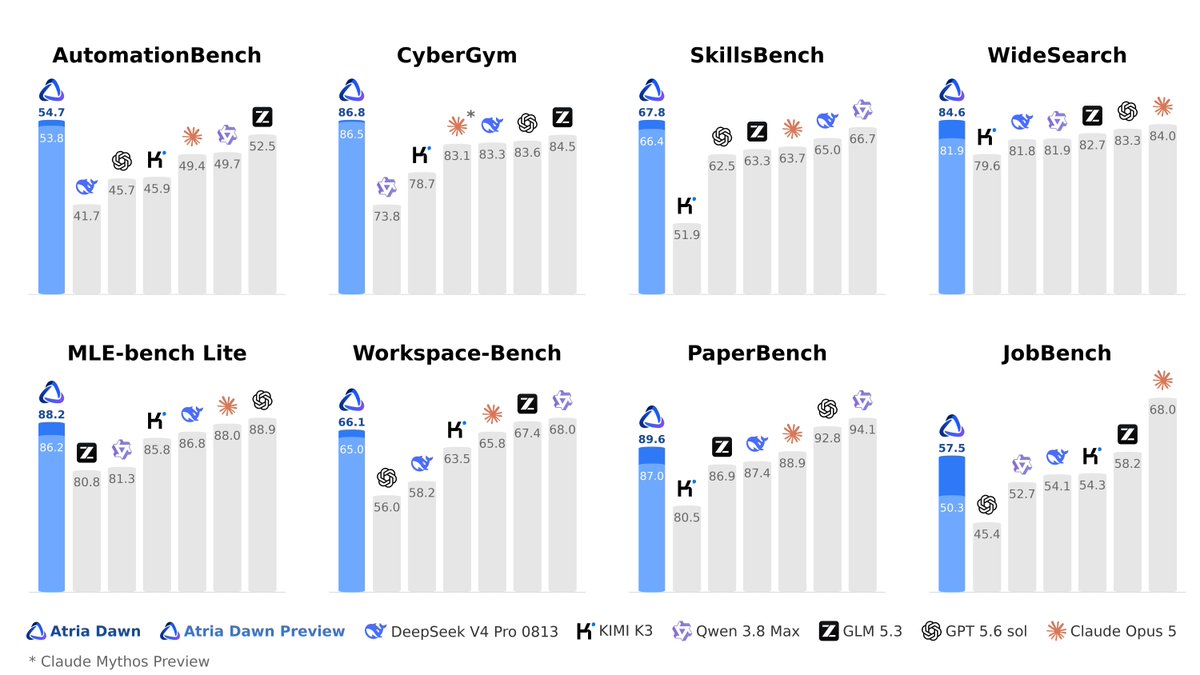
Shanghai AI Laboratory has moved Atria Dawn from Preview to a full release, with open weights (plus an FP8 build) on Hugging Face under internlm/Atria-Dawn and on ModelScope, MIT licensed. Built on the 744B-parameter MoE GLM-5.2, it targets long-horizon research and engineering agent work; context doubles from the Preview's 256K to 512K and input is text only. The vendor table shows it leading the listed models on AutomationBench, CyberGym and SkillsBench, while still trailing Claude Opus 5 on coding tests such as SWE-bench Pro and Terminal-Bench 2.1 (all vendor-reported).
Zoom
Key Takeaways
512K context, double the Preview's 256K; built on the 744B-parameter MoE GLM-5.2, text input only
On 2026-10-23 (17:15 UTC) the official @Kimi_Moonshot account launched Kimi K3.1 Pro, alongside K3.1 Pro Highspeed (2-3x faster). Both are live on Kimi.ai, Kimi Work, Kimi Code and the Kimi API, and full weights are promised by 2026-11-04. The official tech blog describes it as a post-trained version of K3 with much larger multi-domain joint RL: a 2.8T-total / 104B-active MoE, 1M-token context, multimodal. Vendor-reported scores: 65.7% on Terminal-Bench 4.0 (GPT-6 Astra 58.2%, Claude Opus 5.5 66.4%) and 92.7% on BenchCAD with tools. The Kimi API pricing page lists kimi-k3.1-pro at $2 input, $10 output and $0.20 cached input per million tokens, down from K3 at $3/$15.
Zoom
Key Takeaways
2.8T-total / 104B-active MoE, 1M-token context, multimodal; full weights promised by 2026-11-04 (official blog)
Vendor-reported: 65.7% on Terminal-Bench 4.0, ahead of GPT-6 Astra (58.2%) and just behind Claude Opus 5.5 (66.4%); 61.2% on the internal Kimi Code Bench 3.0 Long-horizon (K3: 55.95%)
API pricing: kimi-k3.1-pro at $2 input / $10 output / $0.20 cached input per million tokens; Highspeed at $4 / $20 (pricing page)
On the internal Kimi Hallu Bench Hard stress test, claim-level hallucination fell from 23.4% (K3) to 8.3%; Moonshot notes this is not a daily-use error rate
Cyber-related data was removed from mid-training and RL for the open-weight release: xdev-bench-hard pass@3 drops from 90.5% (unmitigated checkpoint) to 81.0%
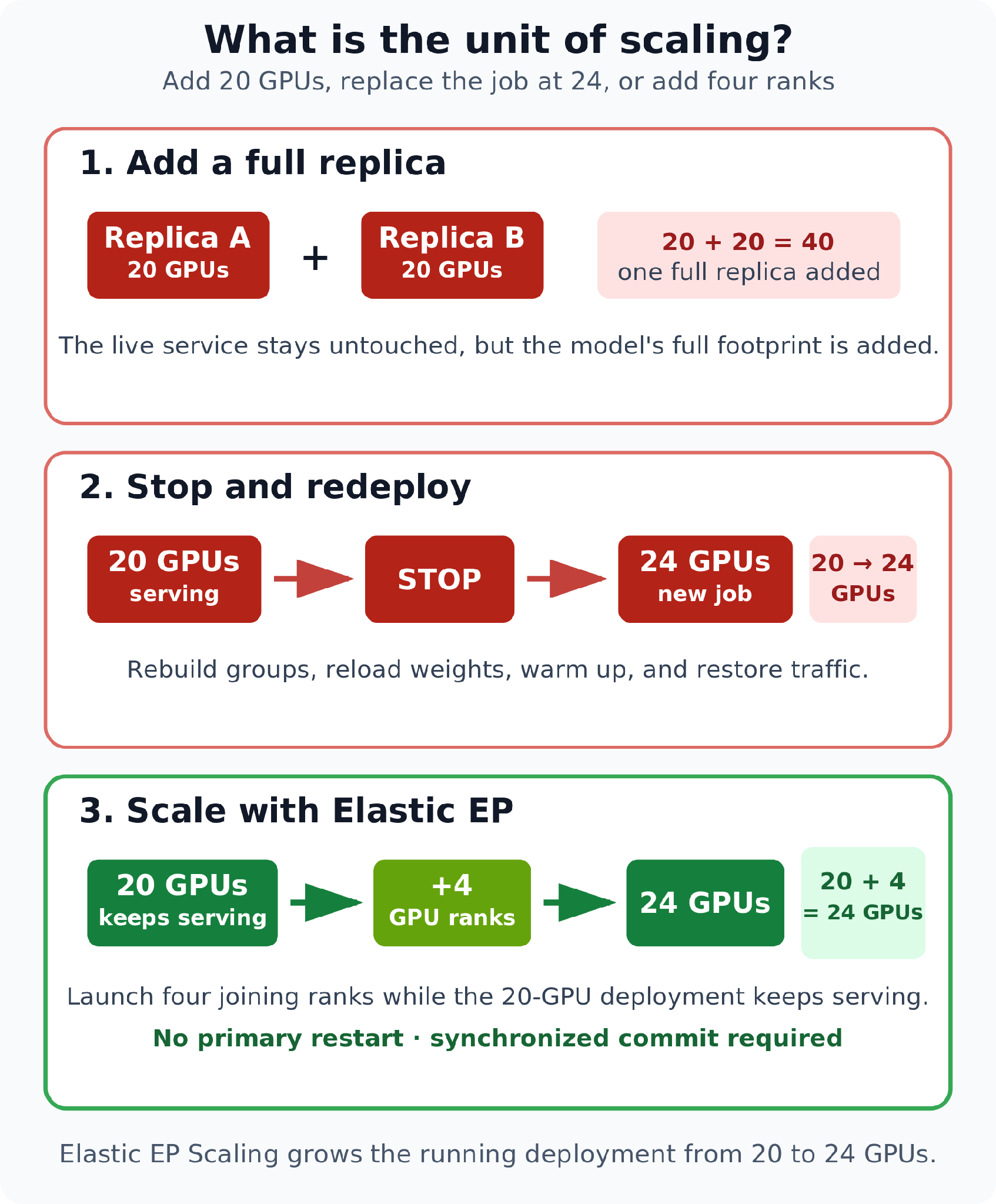
LMSYS Org in collaboration with the NVIDIA Dynamo team officially unveiled Elastic Expert Parallelism (Elastic EP) with NIXL backend integration in SGLang (@lmsysorg). Addressing the critical vulnerability of large-scale MoE deployments (such as DeepSeek-V3/V4) where static EP causes entire cluster crashes upon single-node failures and prevents live capacity resizing, Elastic EP decouples rigid expert-to-GPU bindings. Leveraging NVIDIA NIXL device APIs and Mooncake orchestrators, SGLang enables live scaling of active MoE serving deployments (e.g. dynamically expanding from 20 to 24 GPUs) without draining traffic or restarting clusters, while delivering resilient fault tolerance.
Zoom
Key Takeaways
LMSYS Org and NVIDIA Dynamo team roll out Elastic EP in SGLang, enabling live scaling of production MoE clusters
Eliminates the single-point-of-failure bottleneck in static EP deployments, enabling instantaneous fault-tolerant degradation
Integrates NVIDIA NIXL device primitives (--moe-a2a-backend nixl) with native RDMA and NVLink zero-copy token routing
Demonstrates zero-downtime live expansion, seamlessly growing active deployments (e.g. from 20 to 24 GPUs) under live query load
Recursive, founded by Richard Socher, has officially open-sourced Flint (RecursiveSI/flint), a 39.8B Mixture-of-Experts (MoE) coding agent model under Apache 2.0 with day-zero Ollama support (ollama run flint). Activating just 2.5B parameters per token across 47 MoE layers with a 262K context window, Flint hits 125+ tokens/sec on an M4 Pro MacBook Pro. It sets new benchmarks for sub-50B local models, scoring 74.2% on SWE-bench Verified and 89.7% on SWE-bench Pro v2.
Zoom
Key Takeaways
Flint employs a 49-layer architecture (2 dense + 47 MoE layers) with 39.8B total and 2.5B active parameters per token
On Oct 21, Recursive, the startup founded by Richard Socher, released its first model, Flint: a 39.8B-total MoE coding model with about 2.5B active parameters per token, with weights on Hugging Face under Apache 2.0. Recursive says it leads sub-50B MoE models on SWE-Bench Pro v2, Terminal-Bench 2.1 and SWE-Bench Verified, runs at 125+ tok/s on an M4 Pro MacBook Pro, and was built from scratch in under four months with its automated research system, the Eureka Machine, contributing to nearly every part of the stack.
At GTC Berlin, Mistral AI and NVIDIA announced a strategic partnership dedicated to advancing AI for industrial engineering, computational physics, and electronic design automation (EDA). The alliance couples Mistral frontier architectures with NVIDIA CUDA-X libraries, Warp physics simulation frameworks, and Omniverse digital twins. Mistral simultaneously revealed architectural specifics for its forthcoming flagship, Mistral Large 4: spanning roughly 1 trillion total parameters with 49 billion active parameters (MoE), trained on 3,800 Grace Blackwell GPUs, with open weights slated for official release at the end of October 2026.
Zoom
Key Takeaways
Mistral AI and NVIDIA launched a strategic alliance applying frontier foundation models to CAE, physics AI, and EDA semiconductor design
Integrates NVIDIA Warp, CUDA-X simulation libraries, and Omniverse to establish open physics datasets and industrial agent benchmarks
Disclosed architectural parameters for Mistral Large 4: ~1T total parameters with 49B active sparse MoE, trained on 3,800 Grace Blackwell GPUs
Weights for Mistral Large 4 are scheduled for open-source release at the end of October 2026, joining the Nemotron Coalition
Krafton AI, the research division of global gaming giant Krafton, officially announced the open-weights release of Raon-1 mini under Apache 2.0. Pretrained from scratch, Raon-1 mini features a sparse Mixture-of-Experts (MoE) architecture with 30 billion total parameters and only 4 billion active parameters per token. The release is accompanied by a dedicated DFlash speculative drafting model and a live interactive playground. Internal evaluations reveal that Raon-1 mini matches Meta's Muse Glimmer across agentic tool-use and coding benchmarks while requiring substantially lower VRAM and sustaining lower generation latency.
Zoom
Key Takeaways
Krafton AI released Raon-1 mini under Apache 2.0, architecting a 30B total / 4B active parameter sparse MoE model
Trained entirely from scratch, matching Meta's Muse Glimmer across agentic coding and multi-turn tool orchestration
Bundled with a dedicated DFlash draft model for high-throughput speculative decoding on consumer-grade workstations
Accompanied by a live public evaluation playground, providing a viable open backbone for local gaming and coding copilots
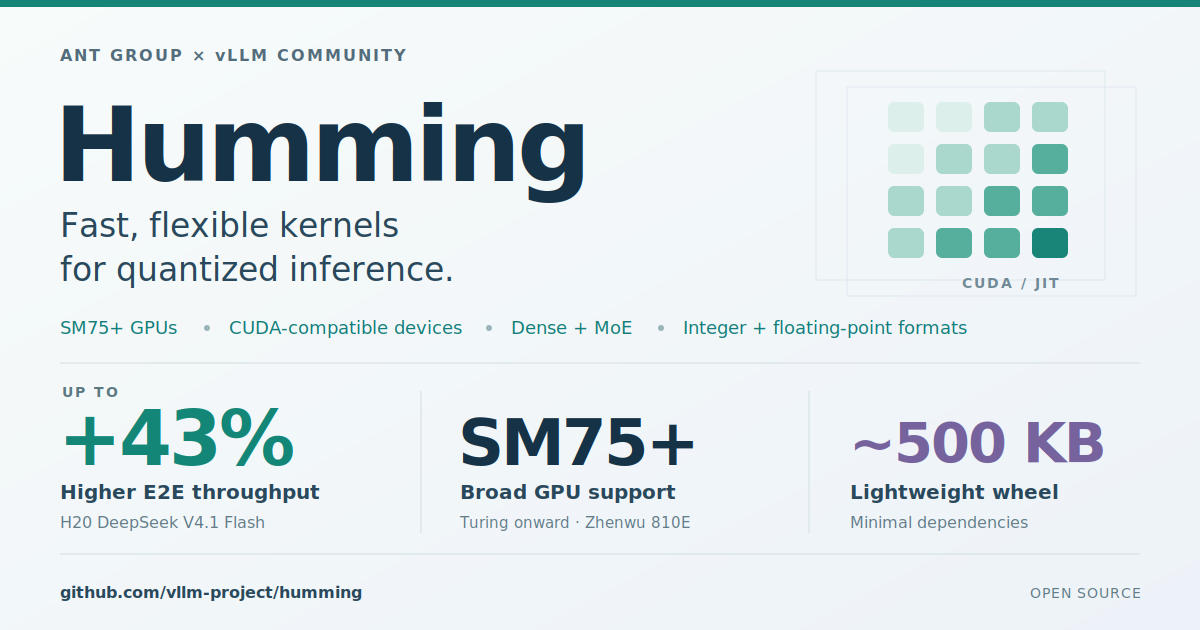
The vLLM project team and Ant Group officially open-sourced Humming (humming-kernels), a specialized high-performance kernel library designed for serving quantized MoE and dense LLMs at massive scale. Humming natively supports WnA16, W8A8, W4A8, and W4A4 across INT1–INT8 and FP4–FP8 formats, spanning NVIDIA architectures from Turing through Blackwell as well as T-Head Zhenwu 810E silicon. In production benchmarks, Humming kernels outpace cuBLAS by 3–4x at small batch sizes and surpass Marlin by 2x on H200 clusters. Serving DeepSeek-V4.1-Flash across 8x H20 GPUs, Humming drives a +43.3% throughput gain under 64 concurrent requests while reducing time-to-first-token (TTFT) by 32%, pre-integrated directly into vLLM v0.29.0+.
Zoom
Key Takeaways
vLLM and Ant Group open-sourced Humming (humming-kernels), integrated out-of-the-box into vLLM v0.29.0+
Covers WnA16, W8A8, W4A8, and W4A4, compiling JIT kernels in just 1.82 seconds versus 23.35 seconds for CUTLASS
Serving DeepSeek-V4.1-Flash on 8x H20 GPUs yields a +43.3% throughput boost at 64 concurrency (442 to 634 tokens/sec)
Cuts time-to-first-token (TTFT) by 25% to 32% while delivering up to 5x kernel speedups on Blackwell B300 systems
On Oct 21 the vLLM community and Ant Group open-sourced Humming (Apache 2.0), a quantized-inference library that JIT-compiles GEMM kernels on demand. It supports every NVIDIA architecture from Turing on plus T-Head's Zhenwu 810E, and covers weight and activation combinations from INT1-INT8 and FP4-FP8 for dense and MoE workloads. In vLLM's microbenchmarks it runs 2-5x faster than vLLM Marlin, FlashInfer or DeepGEMM in some cases; on 8 H20 GPUs, switching DeepSeek-V4.1-Flash MoE from Marlin W4A16 to Humming W4A8 raised throughput 14-43%. vLLM 0.29.0 ships it built in.
Zoom
Key Takeaways
One JIT kernel framework instead of a hand-written kernel per format: WNA16, W8A8, W4A8, W4A4, INT1-INT8 and FP4-FP8 weights, dense and MoE
Hardware: every NVIDIA GPU from Turing (SM75) on, including Blackwell SM100/103/120/121, plus T-Head Zhenwu 810E
End to end: DeepSeek-V4.1-Flash on 8x H20 at TP=8, Humming W4A8 beats Marlin W4A16 by 14-43% in throughput and cuts mean TTFT 25-32%; at concurrency 64 output goes from 442 to 634 tok/s
Microbenchmarks run by the vLLM community: W4A8-MXFP4 on H200 is about 4.5x DeepGEMM W8A8, and the B300 MoE Grouped path is about 5x Marlin; one W4A16 kernel compiles in 1.82 s versus 23.35 s for CUTLASS
Use: pip install humming-kernels (about a 500 KB wheel); built into vLLM 0.29.0+, enable with --linear-backend humming --moe-backend humming
The Shanghai Artificial Intelligence Laboratory published the technical report for Sage-A1.5 on arXiv:2610.28578, introducing an open-weights 35B Mixture-of-Experts (MoE) foundation model purpose-built for agentic tasks. Building on the Agents-A1 lineage, Sage-A1.5 focuses on scaling the agent execution horizon rather than model parameters through adaptive capability composition. Tailored for complex repository-level software engineering and multi-step scientific hypothesis exploration, Sage-A1.5 consistently outperforms dense 70B+ baselines on long-horizon reasoning benchmarks while maintaining lightweight deployment footprints.
Zoom
Key Takeaways
Shanghai AI Lab published Sage-A1.5 (arXiv:2610.28578), open-sourcing a 35B MoE agentic foundation model
Pioneers horizon scaling over raw parameter expansion, sustaining consistent focus across 100+ execution steps
Optimized for repository-level software engineering bug fixes, matching dense 70B+ baselines on complex git issue resolution
Features intrinsic scientific exploration and hypothesis generation capabilities, tailored for local on-prem cluster deployment
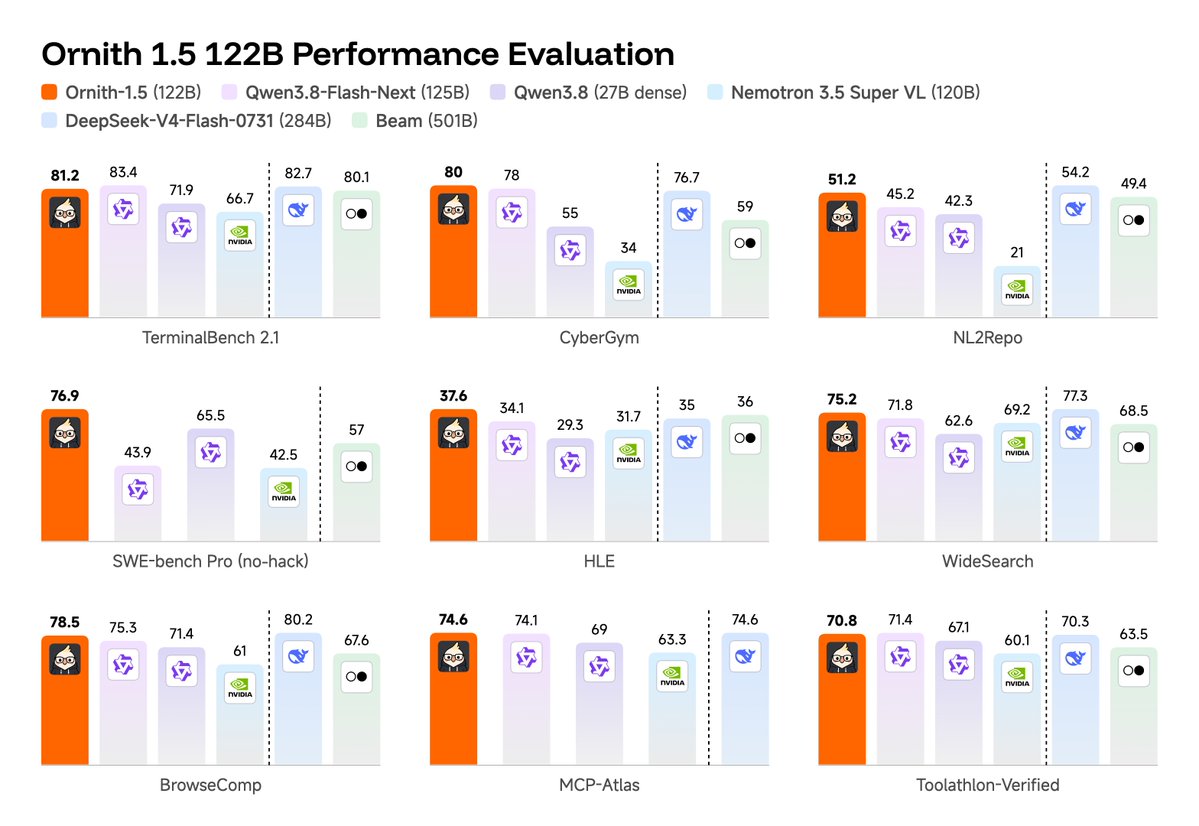
The Ornith AI team officially released Ornith-1.5-122B under the permissive MIT license, a 122-billion parameter mixture-of-experts (MoE) reasoning model optimized to execute on a single GPU node (such as a single DGX). The model is immediately available across vLLM (0.19.1+), SGLang (0.5.9+), Hugging Face, and Ollama (ornith-1.5:122b) with native FP8, GGUF, and MLX quantization. Across independent agentic evaluations in the OpenHands harness, Ornith-1.5-122B registered 84.5 on SWE-bench Verified, 76.9 on SWE-bench Pro (surpassing Qwen3.8-Flash-Next's 43.9 by 33 points), 81.2 on TerminalBench 2.1, and 74.6 on MCP-Atlas.
Zoom
Key Takeaways
Ornith-1.5-122B released under the permissive MIT license, offering a fully open, frontier-grade 122B MoE coding reasoning model
Engineered to fit inside a single GPU node (single DGX), with immediate runtime support on vLLM, SGLang, and Ollama (ornith-1.5:122b)
Achieves 76.9 on SWE-bench Pro, drastically outperforming the comparable open-weight baseline Qwen3.8-Flash-Next (43.9)
Delivers balanced agentic performance with 81.2 on TerminalBench 2.1, 80.0 on CyberGym, and 74.6 on MCP-Atlas