AI Coding Live News

Meituan ships LongCat-2.5, a 1.6T-parameter (about 48B active) native multimodal agentic model, with API pricing of $0.30/$1.20 per 1M tokens

On Nov 2 Meituan's LongCat team listed LongCat-2.5 in its API platform change log as the full release of September 25's LongCat-2.5-Preview. The official technical blog says it has 1.6 trillion total parameters with about 48 billion activated per token, builds on LongCat-2.0 with stronger native visual understanding and agentic coding, and was trained and served with W4A4 inference on domestic AI accelerators. Vendor-reported scores include 88.4 on Terminal Bench v2.1, 38.5 on Terminal Bench v4.0, 91.9 on BrowseComp and 83.1 on MCP Atlas. The API speaks both OpenAI and Anthropic formats with a 1M-token context and up to 128K output tokens, at a limited-time price of $0.30 per 1M uncached input tokens, $0.006 cached input and $1.20 output.

Meituan ships LongCat-2.5, a 1.6T-parameter (about 48B active) native multimodal agentic model, with API pricing of $0.30/$1.20 per 1M tokens

Key Takeaways

  • Scale: a 1.6-trillion-parameter MoE with about 48B active per token, a 1M-token context and up to 128K output tokens (official blog, API docs)
  • Code agents (vendor-reported): Terminal Bench v2.1 88.4 (Claude Opus 5 89.1, GPT-5.6-Sol 88.8), Terminal Bench v4.0 38.5 (GPT-5.6-Sol 37.3, Claude Opus 5 53.9), DeepSWE v1.1 64.6
  • General agents (vendor-reported): BrowseComp 91.9, MCP Atlas 83.1, AutomationBench v1.0.6 51.8, HLE with tools 63.1; AutomationBench jumps from 15.8 on LongCat-2.0
  • Pricing: limited-time $0.30 per 1M uncached input tokens, $0.006 cached input and $1.20 output (pricing page)
  • Engineering: W4A4 inference raises prefill throughput 43.3% and decode throughput 42.77% over a W8A8 baseline; FSDP gives 86% higher per-device throughput than DDP in long-sequence SFT
Read full story

Aramco closes deal for 49% of HUMAIN: PIF keeps 51%, about $2.6B cash in 2026, 3 GW of AI data centers targeted by 2030

Saudi Arabia's Public Investment Fund (PIF) and Aramco announced on November 1 that their deal has closed: Aramco, through a wholly owned subsidiary, takes a 49% stake in Saudi AI company HUMAIN, while PIF keeps 51% control. Besides transferring its own AI, compute and digital assets, Aramco will contribute about SAR 9.9 billion (roughly $2.6 billion) in cash to HUMAIN in 2026. HUMAIN plans to deploy 3 GW of AI data center capacity by 2030 and keeps developing ALLaM, its multimodal Arabic large language model.

Key Takeaways

  • Ownership: Aramco 49% (through a wholly owned subsidiary) and PIF 51%; the deal closed on 2026-11-01 (Aramco press release)
  • Money: about SAR 9.9 billion (roughly $2.6 billion) in cash during 2026, plus AI, compute and digital assets (official figures)
  • Compute goal: 3 GW of AI data center capacity by 2030 (official figure)
  • Aramco says it has realized $11.3 billion in "Technology Realized Value" since 2023, much of it from AI solutions (CEO Amin Nasser, company figure)
  • HUMAIN launched in May 2025 and works in four areas: data centers, cloud platforms, the ALLaM models and industry solutions
Read full story
Linked Models & Agents:

Mistral releases the open weights of Mistral Large 4 "Le Chonk": a 1T-total, ~52B-active multimodal MoE that Mistral says leads open models on FrontierCode 2.0

On Oct 29 Mistral released an improved Mistral Large 4 (Le Chonk) with open weights on Hugging Face (plus an NVFP4 quantized checkpoint), served on its API as mistral-large-4. After about three more weeks of reinforcement learning since the early-October preview, Mistral reports 19.7% on FrontierCode 2.0, Terminal-Bench 4.0 up from 28% to 41%, and new low/medium/high reasoning modes. The license is a modified MIT that allows commercial use, but running a model-as-a-service business needs a separate commercial license.

Mistral releases the open weights of Mistral Large 4 "Le Chonk": a 1T-total, ~52B-active multimodal MoE that Mistral says leads open models on FrontierCode 2.0

Key Takeaways

  • Specs: about 1T total parameters with 49B active per token (about 52B including embeddings and output layers), 128 routed experts with 4 active plus 1 shared expert, 1M context, text and image input
  • Per Mistral: 19.7% on Cognition's FrontierCode 2.0, ahead of DeepSeek V4.1 Flash at 19.3% and GLM-5.3 at 17.8%, first among open models
  • 48% on the Artificial Analysis Coding Agent Index, roughly tied with GLM-5.3 while using 47% fewer tokens per task on average; Terminal-Bench 4.0 rose from 28% in preview to 41%
  • 51% on the Artificial Analysis Cyber Index, and a 96.6% average refusal rate on malicious cyber requests, which Mistral says is the highest among open models
  • Trained from scratch on 3,800 NVIDIA Grace Blackwell GPUs in Mistral's own European datacenters; in Surge Code blind pairwise tests it ranked behind only Claude Opus 5.5
Read full story
Linked Models & Agents:

Moonshot launches Kimi K3.1 Pro: 2.8T-total / 104B-active open-weight MoE with 1M context, 65.7% on Terminal-Bench 4.0, API at $2/$10, weights by Nov 4

On 2026-10-23 (17:15 UTC) the official @Kimi_Moonshot account launched Kimi K3.1 Pro, alongside K3.1 Pro Highspeed (2-3x faster). Both are live on Kimi.ai, Kimi Work, Kimi Code and the Kimi API, and full weights are promised by 2026-11-04. The official tech blog describes it as a post-trained version of K3 with much larger multi-domain joint RL: a 2.8T-total / 104B-active MoE, 1M-token context, multimodal. Vendor-reported scores: 65.7% on Terminal-Bench 4.0 (GPT-6 Astra 58.2%, Claude Opus 5.5 66.4%) and 92.7% on BenchCAD with tools. The Kimi API pricing page lists kimi-k3.1-pro at $2 input, $10 output and $0.20 cached input per million tokens, down from K3 at $3/$15.

Moonshot launches Kimi K3.1 Pro: 2.8T-total / 104B-active open-weight MoE with 1M context, 65.7% on Terminal-Bench 4.0, API at $2/$10, weights by Nov 4

Key Takeaways

  • 2.8T-total / 104B-active MoE, 1M-token context, multimodal; full weights promised by 2026-11-04 (official blog)
  • Vendor-reported: 65.7% on Terminal-Bench 4.0, ahead of GPT-6 Astra (58.2%) and just behind Claude Opus 5.5 (66.4%); 61.2% on the internal Kimi Code Bench 3.0 Long-horizon (K3: 55.95%)
  • API pricing: kimi-k3.1-pro at $2 input / $10 output / $0.20 cached input per million tokens; Highspeed at $4 / $20 (pricing page)
  • On the internal Kimi Hallu Bench Hard stress test, claim-level hallucination fell from 23.4% (K3) to 8.3%; Moonshot notes this is not a daily-use error rate
  • Cyber-related data was removed from mid-training and RL for the open-weight release: xdev-bench-hard pass@3 drops from 90.5% (unmitigated checkpoint) to 81.0%
Read full story
Linked Models & Agents:
ADSponsored

Microsoft Research Open-Sources WildAWM: Generalist Agent World Model in the Wild for GUI & Web Simulation

Microsoft Research (MSRA) researchers published and open-sourced WildAWM (arXiv:2610.26828, GitHub: MSR-Orchard/WildAWM), a generalist agent world model designed for open-ended 'in the wild' digital environments. Traditional computer-use agents rely on slow, brittle, and expensive live web/OS sandboxes for training and evaluation. WildAWM establishes a scalable multimodal world model that accurately predicts visual screen transitions and DOM mutations conditioned on agent actions (click, type, scroll). By replacing live execution environments with a high-fidelity neural simulator, WildAWM unlocks safe, accelerated offline reinforcement learning for GUI agents.

Microsoft Research Open-Sources WildAWM: Generalist Agent World Model in the Wild for GUI & Web Simulation

Key Takeaways

  • Microsoft Research open-sources WildAWM (arXiv:2610.26828), establishing the first generalist world model for wild web and GUI domains
  • Eliminates dependency on fragile, expensive live web sandboxes that risk side-effects during agent trial-and-error training
  • Employs an action-conditioned multimodal autoregressive design predicting high-fidelity visual rollouts following clicks, typing, and scrolling
  • Decisively outperforms prior state-transition baselines across e-commerce, enterprise software, and desktop GUI simulations
Read full story

NVIDIA Launches Nemotron 3.5 Open Model Family, Cosmos World Models, and 13x Faster BioNeMo RFD4-Proteina

During the GTC Berlin keynote, NVIDIA unleashed a sweeping array of open-weights domain-specific foundation models. The release highlights include the multimodal Nemotron 3.5 Super VL, the lightweight Nemotron 3.5 Bolt series, and the end-to-end Nemotron Retriever suite for embedding, reranking, and document OCR. For physical AI, NVIDIA debuted the Cosmos world models and Alpamayo 2 Edge autonomous driving models. In life sciences, NVIDIA and the Baker Lab released BioNeMo RFD4-Proteina, which establishes state-of-the-art accuracy across more than 10 protein design benchmarks while synthesizing 200-amino-acid binders roughly 13x faster than RFdiffusion3.

NVIDIA Launches Nemotron 3.5 Open Model Family, Cosmos World Models, and 13x Faster BioNeMo RFD4-Proteina

Key Takeaways

  • NVIDIA released an extensive open-weights portfolio at GTC Berlin: Nemotron 3.5 Super VL, Bolt 4GB edge variants, and Cosmos world models
  • Unveils the full Nemotron Retriever suite for embedding, reranking, and multimodal document parsing, boosting enterprise RAG fidelity
  • Co-developed BioNeMo RFD4-Proteina with the Baker Lab, leading on over 10 structural protein design benchmarks
  • Synthesizes 200-amino-acid de novo proteins 13x faster than RFdiffusion3, dramatically shortening computational drug discovery timelines
Read full story
Linked Models & Agents:
⚡ Nemotron 3.5 Super VL⚡ Nemotron 3.5 Bolt⚡ BioNeMo RFD4-Proteina⚡ Cosmos🌐 NVIDIA🌐 Baker Lab

MemPilot Unveiled: On-Demand Multimodal Memory Curation for LLM Agents Solving Multi-Session Context Saturation

Researchers introduced MemPilot (arXiv:2610.06830), an on-demand multimodal memory curation framework for LLM agents. Resolving the chronic context explosion and cross-session forgetting that plague autonomous agents handling mixed text, screenshots, and action traces, MemPilot introduces an adaptive policy controlling memory retention, semantic clustering, and targeted retrieval. Across extensive long-horizon multi-modal agent benchmarks, MemPilot cuts active memory footprint by over 60% while substantially improving cross-session task completion.

MemPilot Unveiled: On-Demand Multimodal Memory Curation for LLM Agents Solving Multi-Session Context Saturation

Key Takeaways

  • Researchers introduced MemPilot (arXiv:2610.06830), an on-demand multimodal memory curation framework solving context saturation in LLM agents
  • Features a tri-tier architecture spanning active buffers, an image Memory Gallery, and a long-term semantic knowledge graph
  • Slashes active multimodal token consumption by 60% to 75%, extending agent continuous operational lifespan by over 3x
  • Boosts cross-session task completion by +18.5% over text-only RAG, providing a scalable blueprint for persistent computer-use agents
Read full story
Linked Models & Agents:

Adobe & Brown University Release OmniXRef: Unified Multi-Reference Video Editing Slashing Camera Trajectory Error by 5x

Adobe Research and Brown University released OmniXRef (arXiv:2610.22744), a unified framework for multimodal multi-reference video editing. Overcoming the limitations of prior systems constrained to text prompts or single visual exemplars, OmniXRef utilizes a single-stream Diffusion Transformer with Mix-Patchify and Reference-Relative RoPE (R2-RoPE) to jointly control camera motion, subject content, dynamic motion, style, and visual effects (VFX). In camera trajectory evaluations, OmniXRef cuts rotation and translation errors by more than 5x compared to leading commercial engines.

Adobe & Brown University Release OmniXRef: Unified Multi-Reference Video Editing Slashing Camera Trajectory Error by 5x

Key Takeaways

  • Adobe Research and Brown University released OmniXRef (arXiv:2610.22744), a unified framework for multi-reference video editing across text, images, and videos
  • Features a single-stream Diffusion Transformer with Mix-Patchify and R2-RoPE for multimodal cross-attention
  • Cuts camera trajectory error by more than 5x over commercial flagship Seedance 2.5, recording 0.874 RotErr and 3.961 TransErr
  • Achieves modular control across Camera, Motion, Content, Style, and VFX with an interactive project page now live
Read full story
Linked Models & Agents:

Xiaomi AI Lab Introduces Xiaomi-Lens-0: 4B MLLM Built on Qwen3.5 Sets SOTA on RefCOCO with Native Pixel-Level Mask Decoding

Multimodal LLMs excel at holistic image captioning but struggle with pixel-level spatial grounding due to lack of spatial supervision. Xiaomi AI Lab unveiled Xiaomi-Lens-0 (arXiv:2610.23279), a 4B MLLM based on Qwen3.5 that natively predicts pixel masks. A lightweight decoder integrates patch embeddings, visual latents, and mask-token activations, driving RefCOCO comprehension (REC [email protected]: 94.6% / 92.1% / 92.5%) and segmentation (RES cIoU: 83.4% / 79.9% / 81.1%) past Florence-2 and LISA-7B while preserving a 69.7% MME-RW score.

Xiaomi AI Lab Introduces Xiaomi-Lens-0: 4B MLLM Built on Qwen3.5 Sets SOTA on RefCOCO with Native Pixel-Level Mask Decoding

Key Takeaways

  • Xiaomi AI Lab released Xiaomi-Lens-0 (arXiv:2610.23279), a 4B MLLM based on Qwen3.5 that natively generates pixel-level masks
  • Outperforms Florence-2 and Grounding-DINO-L on RefCOCO/RefCOCO+/RefCOCOg REC benchmarks with 94.6%, 92.1%, and 92.5% [email protected]
  • Achieves 83.4% / 79.9% / 81.1% cIoU on RES segmentation, substantially surpassing 7B models like LISA and GSVA
  • Maintains superior general perception, scoring 69.7% on MME-RW-en and outperforming Qwen2.5-VL 7B
Read full story
Linked Models & Agents:

Judge-Free Test-Time Scaling Tops WebArena Infinity at 74.6%: Salesforce Introduces CLIFT, Alongside MMSearch-OPD and SCOPED-8B Beating 32B VLMs

Three new frameworks advance web and multimodal agent post-training: Salesforce AI Research's CLIFT (arXiv:2610.06829) certifies URL-conditional self-verification questions for dense RL rewards and judge-free Conformal Trajectory Selection (CTS), propelling Gemma-4 31B to a 74.6% SOTA on WebArena Infinity (beating Gemini 3 Flash at 70.1%) and lifting GPT-5.5 to 53.7% on VisualWebArena. Meanwhile, MMSearch-OPD (arXiv:2610.22240) boosts 9B multimodal deep search by +15.3 points to 60.2%, and Northeastern University's SCOPED-8B (arXiv:2610.22217) uses skill-decoupled on-policy expert distillation to reach 73.13% across 8 benchmarks—surpassing Qwen3-VL-32B (72.01%) and Claude Opus 4.6 (72.86%).

Judge-Free Test-Time Scaling Tops WebArena Infinity at 74.6%: Salesforce Introduces CLIFT, Alongside MMSearch-OPD and SCOPED-8B Beating 32B VLMs

Key Takeaways

  • Salesforce's CLIFT conformal self-verification propels Gemma-4 31B to 74.6% on WebArena Infinity (+12.8 pts over base, beating Gemini 3 Flash at 70.1%) with judge-free test-time trajectory selection
  • Transferring the open-trained CLIFT question bank to GPT-5.5 sets a 53.7% SOTA on VisualWebArena, while MMSearch-OPD boosts 9B multimodal deep search accuracy by +15.3 points to 60.2%
  • Northeastern University's SCOPED-8B reaches 73.13% average accuracy across 8 VLM benchmarks via skill-decoupled on-policy expert distillation, beating Qwen3-VL-32B (72.01%) and Claude-Opus-4.6 (72.86%)
Read full story
Linked Models & Agents:
ADSponsored

Google AI Studio Opens Gemini 4 Argon in Build & Playground for Pro Users; Transformers v5.20.1 Adds Native Reflection AI Beam and Meta 816B Muse Spark Open

Google AI Studio launched Gemini 4 Argon access in AI Studio Build and Playground for Google AI Pro subscribers, while Hugging Face Transformers v5.20.0 and v5.20.1 added native support for Reflection AI's frontier coding model Beam, Meta's 816B-parameter (42B active, 1M context) multimodal agentic coding model Muse Spark Open, InclusionAI's Ling 3.0 Flash, and OpenBMB's MiniCPM-V 4.7.

Google AI Studio Opens Gemini 4 Argon in Build & Playground for Pro Users; Transformers v5.20.1 Adds Native Reflection AI Beam and Meta 816B Muse Spark Open

Key Takeaways

  • Google AI Studio opens Gemini 4 Argon in AI Studio Build and Playground (https://ai.studio/build) for Google AI Pro subscribers
  • Hugging Face Transformers v5.20.1 natively integrates Reflection AI's token-efficient coding model Beam and fixes DeepGEMM Mega MoE under expert parallelism
  • Adds native support for Meta's 816B-parameter (42B active, 1M context, BF16/NVFP4) omni-modal coding model Muse Spark Open and InclusionAI's KDA+MLA hybrid Ling 3.0 Flash
Read full story
Linked Models & Agents:

Perplexity Releases Open-Weight Multimodal Decision Models pplx-decider-v1.2 (27B) and Flash (4B) on OpenRouter and Vercel AI Gateway

Perplexity Developers (@perplexitydevs) announced the launch of pplx-decider-v1.2 (27B) and pplx-decider-flash-v1.2 (4B) across OpenRouter and Vercel AI Gateway. Taking both text and images as input, these open-weight multimodal decision models return typed answers with calibrated probabilities at just $0.02 per million input tokens for the 27B checkpoint and half the cost for the 4B Flash variant.

Perplexity Releases Open-Weight Multimodal Decision Models pplx-decider-v1.2 (27B) and Flash (4B) on OpenRouter and Vercel AI Gateway

Key Takeaways

  • Dual open-weight multimodal decision models: launches 27B pplx-decider-v1.2 and 4B pplx-decider-flash-v1.2 taking text or images and returning typed answers with probabilities
  • Ultra-low $0.02/1M token pricing: 27B checkpoint costs $0.02 per million input tokens, while 4B Flash runs faster at half the price
  • Live on OpenRouter and Vercel AI Gateway: provides drop-in rolling aliases for low-latency agent routing and multimodal classification
Read full story
Linked Models & Agents:

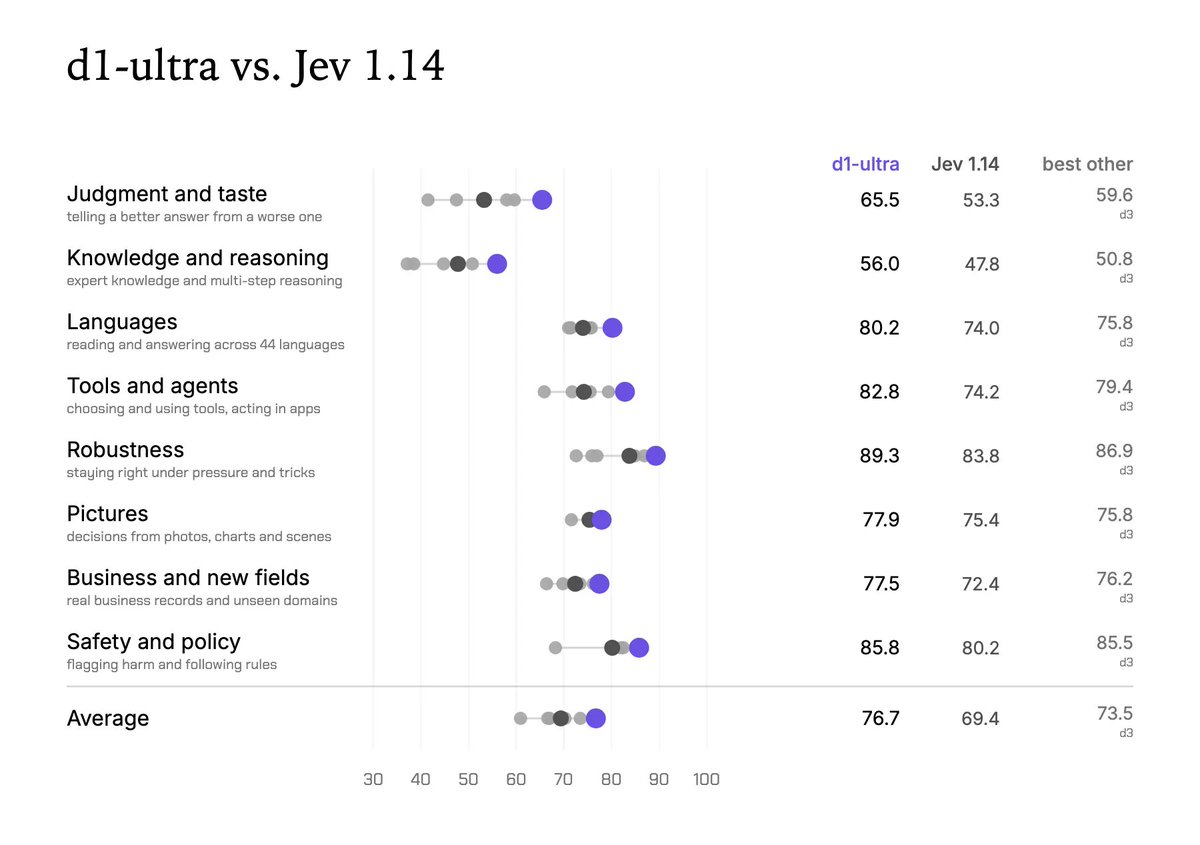
Liquid AI releases d1-ultra decision model: calibrated probabilities with zero generated tokens, #1 on Artificial Analysis Decision Index (65), $0.042 per M input tokens

Liquid AI released d1-ultra on Oct 15: a multimodal decision model that takes text and images and, in one forward pass, returns probabilities for yes/no, choice and score questions without generating tokens; billed on input only. Artificial Analysis ranks it #1 on Decision Index v1.0 at 65, at least 8 points ahead, with an 85% non-hallucination rate. Available on the Liquid API, Vercel AI Gateway and OpenRouter.

Liquid AI releases d1-ultra decision model: calibrated probabilities with zero generated tokens, #1 on Artificial Analysis Decision Index (65), $0.042 per M input tokens

Key Takeaways

  • Artificial Analysis Decision Index v1.0: 65, ranked #1 and at least 8 points ahead (independent)
  • AA-Omniscience-Decision non-hallucination 85% vs 40% for runner-up Microsoft-Decision-1; more abstention drops accuracy to 32% vs d1's 41%
  • $0.042 per M input tokens, output free; a 1024x1024 image counts as 1,536 tokens
  • 32,768-token context, 44 languages, leads all eight categories of Liquid's 112-eval suite (vendor)
  • Call via Liquid /decisions/v1/systemone with model d1-ultra, or liquid/d1-ultra on Vercel AI Gateway / OpenRouter
Read full story
Linked Models & Agents:

Meta open-sources Muse Spark Open: 816B-total / 42B-active MoE with 1M context, billed as the most capable US open-weight model to date

On 2026-10-15 Meta released weights for Muse Spark Open, a natively multimodal MoE (~816B total / ~42B active per token, 1M context) aimed at long-horizon coding and agents. Weights are on Hugging Face and peers; hosted APIs include Together, Fireworks, Groq and OpenRouter. Reported figures include DeepSWE 60%, MCP-Atlas 89.2% and JobBench 61.8% (see Meta’s evaluation methodology).

Meta open-sources Muse Spark Open: 816B-total / 42B-active MoE with 1M context, billed as the most capable US open-weight model to date

Key Takeaways

  • Scale: ~816B total / ~42B active per token; 256 experts/layer with top-8 routing; 62 layers, hidden 8192; context up to 1,048,576 (HF blog)
  • Coding/agents (Meta scorecard / AA, xhigh): DeepSWE 60.0%; SWE-Atlas Codebase QnA 58.0%; MCP-Atlas 89.2%; JobBench 61.8%; Toolathlon-Verified 72.8% (eval methodology)
  • Throughput (NVIDIA tech blog, agentic on GB300 NVL72): up to ~50K tok/s/GPU and ~600 tok/s/user; NVFP4 checkpoints published (NVIDIA blog)
  • Deploy: Muse Model License with limited commercial terms; SGLang / vLLM / TensorRT-LLM / MLX / llama.cpp; Meta demos two Apple M5 Ultra Mac Studios for on-desk local run
  • Third-party index: Artificial Analysis Intelligence Index ~38.9–39 (xhigh, as of 2026-10-07)—behind closed frontier, but a key open-weight reference (AA)
Read full story
Linked Models & Agents:
⚡ Muse Spark Open⚡ Muse Spark Open 816B-A42B🤖 Muse Code🌐 Meta🌐 NVIDIA🌐 Hugging Face🌐 Apple

Meta open-sources Muse Spark Open: 816B/42B natively multimodal US open-weight flagship, runs on two M5 Ultra Mac Studios

On 2026-10-15 Meta released Muse Spark Open open weights: an 816B-total / 42B-active MoE with a Perception Encoder, natively multimodal (text/image/video/audio in → text out), 1M context, aimed at coding and long-horizon agents. Weights are on Hugging Face (BF16/NVFP4), SageMaker, Model Garden and Foundry; APIs include OpenRouter, Together, Fireworks and Groq. Meta calls it the most capable US open-weight model to date and, with Apple, optimized it to run locally across two M5 Ultra Mac Studios via MLX.

Meta open-sources Muse Spark Open: 816B/42B natively multimodal US open-weight flagship, runs on two M5 Ultra Mac Studios

Key Takeaways

  • Specs: MoE 816B total / 42B active (256 experts, top-8), 62 layers, 1M context; text+image+video+audio in → text out (model card)
  • Local: NVFP4 needs ≥~700GB VRAM, BF16 ~2TB; or two Apple M5 Ultra Mac Studios via MLX (Meta blog)
  • Agentic benches (xhigh, official table): MCP-Atlas 89.2, JobBench 61.8, OSWorld Verified 80.4, Terminal-Bench 2.1 76.4, DeepSWE 1.1 60, AA Intelligence Index 39
  • Serve with SGLang / vLLM / TensorRT-LLM / Transformers / llama.cpp / Unsloth / MLX; Helion kernels claim 1.03–3.95× kernel speedups on NVIDIA/AMD
  • License: Muse Model License (display “Built with Muse Spark Open”; MaaS over $20M/yr needs a separate deal); OpenRouter ~$1.25/M in, $4.25/M out
Read full story
Linked Models & Agents: