AI Coding Live News

Meta Rolls Out Muse Realtime Avatar in the US Muse App: Speech-Driven Expression and Gesture at ~870ms First-Byte Latency

On November 5 Meta AI (@AIatMeta) said Muse Realtime Avatar, previewed at Connect, is rolling out in the US Muse app, turning Muse Realtime Voice into interactive live avatars. The research blog describes an audio-driven Diffusion Transformer that shares the speech-token stream with voice for lip-sync and expression; a single GB200 session streams 448×768 at 25 fps with about 870 ms from end of user turn to first synchronized audio-video byte, with Meta Video Seal invisible watermarking. Muse is for users 18+; no global schedule or developer API was announced.

Meta Rolls Out Muse Realtime Avatar in the US Muse App: Speech-Driven Expression and Gesture at ~870ms First-Byte Latency

Key Takeaways

  • US Muse app rollout of Realtime Avatar after the Connect preview (@AIatMeta)
  • Shared speech VQ tokens drive audio decode and avatar video; causal chunks with self-forcing distillation cut ~120 teacher NFEs to 2 student NFEs (~60x)
  • Vendor perf: 448×768@25fps, ~870ms first-byte latency; ~8x serving capacity vs BF16 baseline, up to 12 concurrent sessions on one GB200
  • Vendor preference study favored Muse over Runway Characters and HeyGen LiveAvatar on overall and most axes
  • Safety: Video Seal invisible watermark; blog demos are not the full in-app avatar set; no public developer API stated
Read full story
Linked Models & Agents:
⚡ Muse Spark⚡ Muse Presence🤖 Muse🌐 Meta

Notion: MCP Shared Brain Lets ChatGPT, Claude, Muse and Bot Share Memories and Skills, With Official Agent Setup Prompts

On November 4 NotionHQ announced that via Notion MCP, ChatGPT, Claude, Muse and Bot can read and write the same Memories and Skills—one shared brain across agents. Official setup prompts (v0.0.6, Oct 30), help docs and a Nov 3 MCP use-cases blog corroborate the product push.

Notion: MCP Shared Brain Lets ChatGPT, Claude, Muse and Bot Share Memories and Skills, With Official Agent Setup Prompts

Key Takeaways

  • NotionHQ post (Nov 4, 19:14 UTC) had about 3,271 likes, 225 reposts, 4,560 bookmarks and ~589K views when fetched
  • Product claim: ChatGPT / Claude / Muse / Bot share Memories and Skills in Notion so switching agents does not reset context
  • Official setup prompt v0.0.6 (2026-10-30): walks agents through an Agent Operating Guide and custom-instruction paste for ChatGPT / Claude
  • Help center: Notion MCP works with Claude, Cursor, ChatGPT Pro and more; Enterprise can approve a whitelist and govern connections
  • Vendor blog (Nov 3): five team stories of MCP workflows as reusable SOPs; Skills via MCP are listed as coming soon
Read full story

Shopify Fall ’26 Edition bets on agentic commerce: Shop.md shopping skill, Shop.dev single connection, and Shop Pay inside Muse, Claude Duet, Grok Bot and other personal agents

On Oct 28 Shopify shipped its 10th Edition (Fall ’26, theme Exponential, 150+ updates including 57 for developers), centered on opening its catalog, cart and checkout to any agent. Shop.dev gives one connection to Shopify Catalog (1B+ products), sign-in with Shop, cart, checkout and Shop Pay; Shop.md is a customizable skill that turns ChatGPT, Claude or other agents into personal shoppers; Shop Pay now works inside Meta’s Muse, Claude Duet and Instinct, and Claude Duet, Grok Bot and Instinct can also use it for brands not on Shopify. Every Liquid and Hydrogen storefront and checkout now exposes WebMCP tools.

Shopify Fall ’26 Edition bets on agentic commerce: Shop.md shopping skill, Shop.dev single connection, and Shop Pay inside Muse, Claude Duet, Grok Bot and other personal agents

Key Takeaways

  • Scale (vendor figures): Shopify Catalog has 1B+ products and Shop Pay 400M+ shoppers; the Edition has 150+ updates, 57 of them for developers
  • Shop.dev is one connection for Catalog, sign-in with Shop, cart, checkout and Shop Pay; the underlying Shop MCP server is mcp.shop.com and search needs no API key
  • Shop Pay in personal agents starts with Muse from Meta, Claude Duet and Instinct; Claude Duet, Grok Bot and Instinct can also buy from brands off Shopify, with the card never shared with the agent and tokens from Mastercard, Visa and Discover (Amex coming)
  • WebMCP tools ship on every Liquid and Hydrogen storefront and checkout so browser agents can search, update the cart and check out after buyer approval
  • For developers: a one-command app security check in the Shopify CLI AI Toolkit, and a rebuilt Hydrogen plus the open-source Next.js Vercel Shop template are now generally available
Read full story

Meta launches its Muse personal AI agent in Singapore with eight local partners including Shopee, Grab and Singapore Airlines

On Oct 28 Meta announced that Muse, its personal AI agent, is now available in Singapore on iOS, Android and muse.ai. Beyond Gmail, Google Calendar and Instagram, the first local connector partners are Shopee, Grab, Singapore Airlines, Agoda, ShopBack, Klook, Trip.com and Lazada, spanning shopping, groceries, dining and travel, with some connector features rolling out after launch. Muse runs on Muse Secure VM, a dedicated cloud computer that keeps passwords and payment methods out of the agent's view, and it asks before sensitive actions such as sending an email or making a purchase. It is free for most uses, with paid subscription plans.

Meta launches its Muse personal AI agent in Singapore with eight local partners including Shopee, Grab and Singapore Airlines

Key Takeaways

  • Muse is now available in Singapore on iOS, Android and the web at muse.ai, with AI glasses support "coming soon"
  • Eight initial local connector partners: Shopee, Grab, Singapore Airlines, Agoda, ShopBack, Klook, Trip.com and Lazada, with some features rolling out after launch
  • Users can compare prices on Shopee and Lazada, plan groceries and dining via GrabMart and Grab Dine Out, and explore travel and bookings via Singapore Airlines, Agoda, Klook and Trip.com
  • It runs on Muse Secure VM, a dedicated cloud computer that holds credentials and keeps passwords and payment methods out of the agent's view, and it checks in before emails or purchases
  • Free for most uses with paid subscription plans; the official Muse account announced the launch with greetings in all four of Singapore's official languages
Read full story
ADSponsored

BOSS Zhipin's Nanbeige lab open-sources Nanbeige4.3-33B, a 33B dense agent model with 512K context under Apache 2.0, reporting 80.9 on Terminal-Bench 2.1 vs 73.0 for Qwen3.8-27B

At 12:11 UTC on 2026-10-25, the Nanbeige LLM Lab of BOSS Zhipin (Kanzhun Limited) announced Nanbeige4.3-33B from its account @nanbeige (post), with the model and its Base version released as open weights on Hugging Face under Apache 2.0 (model card). It is a 33B dense model on a Llama-style architecture with a 512K context window, positioned as the teacher model of the Nanbeige4.3 series that will be distilled into smaller models such as Nanbeige4.3-3B. The official model card compares it with Qwen3.8-27B, Muse-Glimmer-30B and Gemma4-31B using the same harness at highest thinking effort: 80.9 on Terminal-Bench 2.1 (Qwen3.8-27B 73.0) and 65.5 on DeepSWE (42.5), but 60.3 on SWE-Bench Pro, slightly below Qwen's 61.7, and 84.8 on GDPval vs 86.4. All figures are self-reported and not yet independently reproduced.

Key Takeaways

  • Official sources: @nanbeige post on X and the Hugging Face model card; the post had about 616 likes, 79 reposts and 38K views when we pulled it
  • Specs: 33B dense, Llama-style architecture, 512K context, Apache 2.0, with a Base checkpoint released too
  • Self-reported coding scores: Terminal-Bench 2.1 80.9, Terminal-Bench 4.0 23.8, DeepSWE 65.5, SWE-Bench Pro 60.3 (Qwen3.8-27B: 73.0, 6.3, 42.5, 61.7)
  • Self-reported cowork scores: Automation Bench 54.2, JobBench 44.8, GDPval 84.8 (Qwen3.8-27B: 38.3, 34.5, 86.4)
  • Deployment: Transformers, SGLang and vLLM, with official examples using 4-way tensor parallelism; Nanbeige4.3-3B distillation is next
Read full story
Linked Models & Agents:
⚡ Nanbeige4.3-33B⚡ Qwen3.8-27B⚡ Gemma4-31B⚡ Muse-Glimmer-30B🌐 Nanbeige🌐 BOSS Zhipin🌐 Kanzhun

X discussion: OpenAI Codex/ChatGPT lead Tibo posts a hiring call to "scale dots to 1B users", and Meta chief AI officer Alexandr Wang replies with a Muse jab

At 19:21 UTC on 2026-10-24, Tibo (@thsottiaux), whose X bio reads "Codex & ChatGPT @OpenAI", posted: "DM if you want to help scale dots to 1B users and have done similar things in the past" (post); it had about 5,524 likes, 1,506 replies and 710K views when we pulled it. Alexandr Wang (@alexandr_wang), whose X bio says he is chief AI officer at Meta, replied "oops you misspelled muse" (about 1,935 likes), and Tibo shot back with "Celebrate your 12 users" (about 1,845 likes). The public back-and-forth between the two companies' executives became one of the most talked-about AI threads of the past half day. It is a hiring post and banter between executives, not a user count or product plan published by OpenAI.

Key Takeaways

  • Main post: Tibo's post, about 5,524 likes, 126 reposts, 131 quotes, 1,506 replies, 515 bookmarks and 710K views when we pulled it
  • Alexandr Wang replied "oops you misspelled muse" (post), about 1,935 likes and 240K views; Muse is the Meta model and product name he has been promoting lately
  • Tibo fired back: "Step 1: Quit posting butts and go buy containers / Step 2: ??? / Step 3: Celebrate your 12 users" (post), about 1,845 likes and 185K views
  • Wang answered "is the implication you have under 12 users?" (post), about 222 likes
  • "1B users" is a goal stated in a hiring post; OpenAI has not published Dots' actual user count, so this entry is treated as an X discussion
Read full story
Linked Models & Agents:

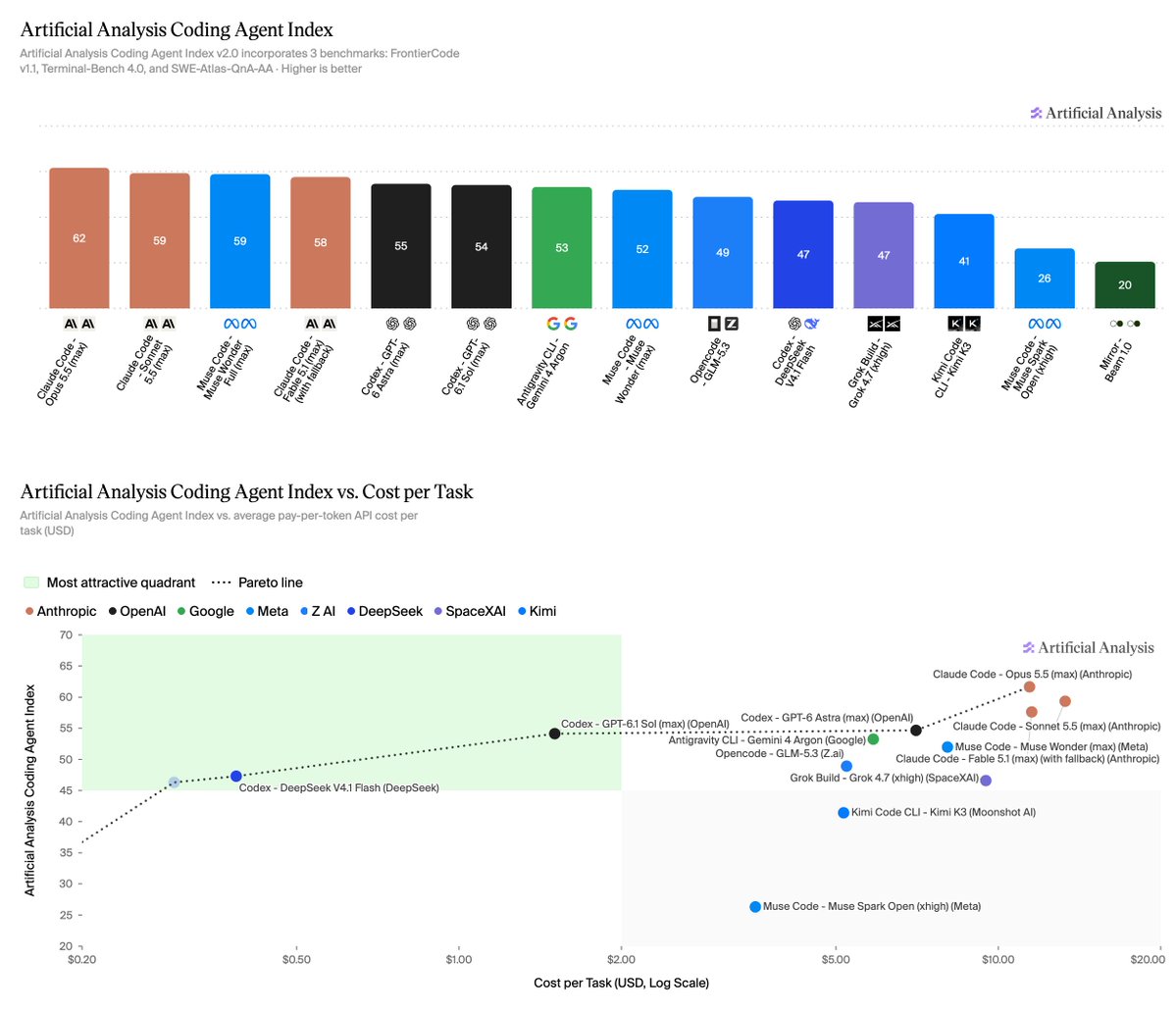
Artificial Analysis launches Coding Agent Index v2.0: FrontierCode from Cognition replaces DeepSWE, and Claude Code with Opus 5.5 leads at 61.7

On 2026-10-23 Artificial Analysis launched Coding Agent Index v2.0, which scores model-plus-harness combinations across 290 tasks with three equally weighted benchmarks: FrontierCode v1.1 from Cognition (100 tasks on real open-source repos, graded on whether a maintainer would merge the change) replaces DeepSWE v1.1, SWE-Atlas-QnA becomes the stricter SWE-Atlas-QnA-AA, and Terminal-Bench 4.0 is unchanged. Claude Code with Claude Opus 5.5 (max) leads at 61.7, ahead of Sonnet 5.5 at 59.3 and Muse Wonder Full at 58.9. Scores fall across the board: the 21 configurations measured on both versions drop from a mean of 54.8 to 47.4.

Artificial Analysis launches Coding Agent Index v2.0: FrontierCode from Cognition replaces DeepSWE, and Claude Code with Opus 5.5 leads at 61.7

Key Takeaways

  • Top of the index: Claude Code with Claude Opus 5.5 (max) 61.7, Claude Sonnet 5.5 (max) 59.3, Muse Code with Muse Wonder Full (max) 58.9, Claude Fable 5.1 (max with fallback) 57.6 (Artificial Analysis figures)
  • On FrontierCode v1.1, Opus 5.5 scores 56.0%, ahead of Codex with DeepSeek V4.1 Flash at 52.6%; 15 of 24 configurations sit between 43% and 49%
  • Version shift: 21 configurations average 54.8 on v1.5 and 47.4 on v2.0, with 20 of 21 moving down; the same set averages 45.1% on FrontierCode versus 65.6% on DeepSWE
  • Four points on the cost frontier: DeepSeek V4.1 Flash 47.3 at $0.39 per task, GPT-6.1 Sol 54.1 at $1.50, GPT-6 Astra 54.7 at $7.04, Opus 5.5 61.7 at $11.42 (pay-per-token API costs, not subscriptions)
  • SWE-Atlas-QnA-AA rewords 127 of 1,306 rubric criteria and uses GPT-6 Luna (xhigh) as judge with five votes per criterion; dataset and judge config are on Hugging Face
Read full story

Krafton AI Open-Sources Raon-1 Mini: A 30B MoE with 4B Active Parameters Matching Muse Glimmer on Coding Autonomy

Krafton AI, the research division of global gaming giant Krafton, officially announced the open-weights release of Raon-1 mini under Apache 2.0. Pretrained from scratch, Raon-1 mini features a sparse Mixture-of-Experts (MoE) architecture with 30 billion total parameters and only 4 billion active parameters per token. The release is accompanied by a dedicated DFlash speculative drafting model and a live interactive playground. Internal evaluations reveal that Raon-1 mini matches Meta's Muse Glimmer across agentic tool-use and coding benchmarks while requiring substantially lower VRAM and sustaining lower generation latency.

Krafton AI Open-Sources Raon-1 Mini: A 30B MoE with 4B Active Parameters Matching Muse Glimmer on Coding Autonomy

Key Takeaways

  • Krafton AI released Raon-1 mini under Apache 2.0, architecting a 30B total / 4B active parameter sparse MoE model
  • Trained entirely from scratch, matching Meta's Muse Glimmer across agentic coding and multi-turn tool orchestration
  • Bundled with a dedicated DFlash draft model for high-throughput speculative decoding on consumer-grade workstations
  • Accompanied by a live public evaluation playground, providing a viable open backbone for local gaming and coding copilots
Read full story
Linked Models & Agents:
⚡ Raon-1 mini⚡ Muse Glimmer🌐 Krafton AI

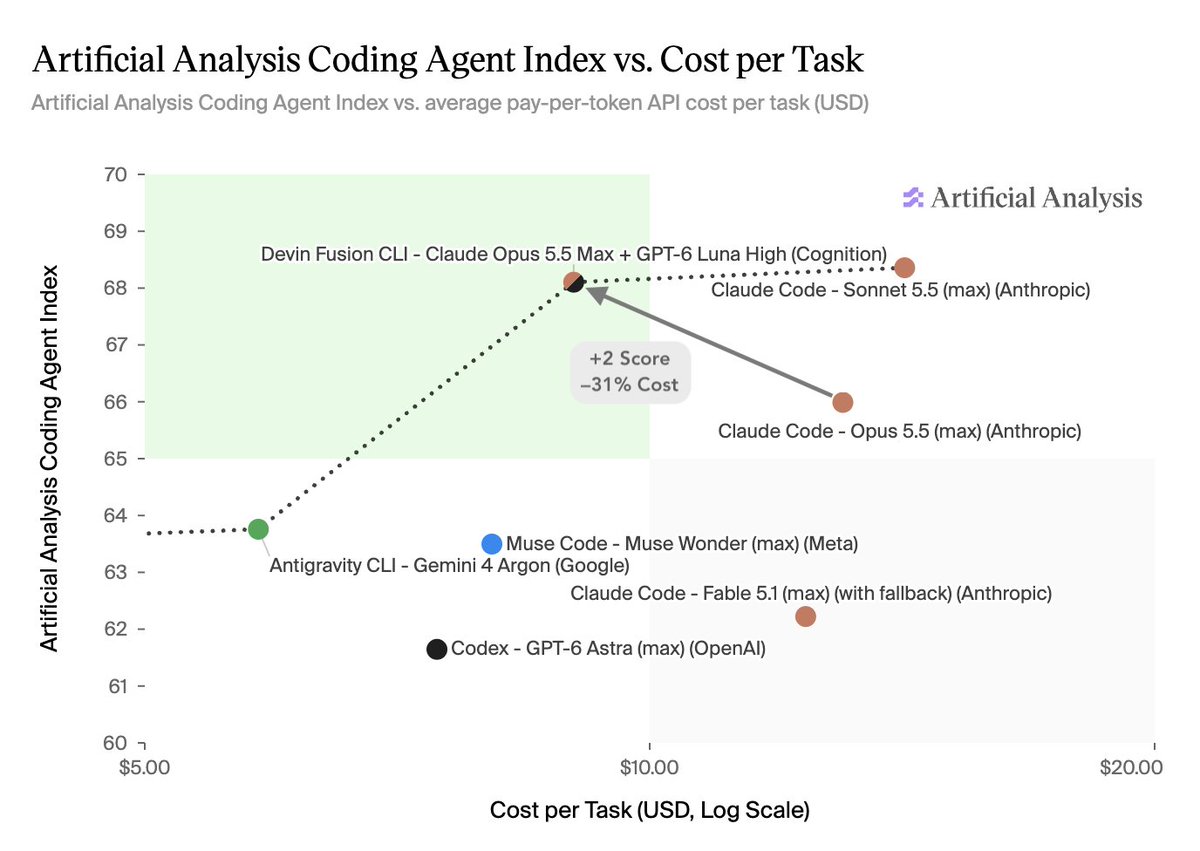
Artificial Analysis Benchmarks Devin Fusion: Scoring 68.1 on Coding Agent Index While Slashing Task Cost by 31%

Artificial Analysis released an independent evaluation of Cognition's new coding agent, Devin Fusion. Moving beyond single-model execution, Devin Fusion employs an asymmetric multi-agent architecture pairing Claude Opus 5.5 (max) as the lead reasoning orchestrator alongside GPT-6 Luna (high) as a high-speed parallel worker. In the standardized Coding Agent Index, Devin Fusion achieved an elite score of 68.1 (matching Muse Code at 68.0 and rivaling Claude Code Sonnet 5.5 at 68.4). Crucially, the hybrid architecture slashes average task expense from $13.04 down to $9.01 (a 31% cost reduction) while shortening execution runtime from 65 to 55 minutes.

Artificial Analysis Benchmarks Devin Fusion: Scoring 68.1 on Coding Agent Index While Slashing Task Cost by 31%

Key Takeaways

  • Artificial Analysis independently benchmarked Devin Fusion, scoring 68.1 on the standardized Coding Agent Index
  • Pioneers asymmetric model collaboration: Claude Opus 5.5 orchestrates architecture while GPT-6 Luna executes parallel sub-tasks
  • Cuts per-task execution costs from $13.04 to $9.01 (a 31% savings) and trims average completion time from 65 to 55 minutes
  • Outperforms Claude Code with Opus 5.5 on DeepSWE v1.1 (72.6% vs 68.4%) and SWE-Atlas-QnA (69.6% vs 66.4%)
Read full story

Meta Releases Muse Glimmer 30B: An Apache 2.0 On-Device Agentic Model Running on a Single Consumer GPU

Meta AI published the technical report for Muse Glimmer 30B (arXiv:2610.24628), an open-source 30-billion parameter causal language model with an integrated perception encoder designed for on-device autonomous agents. Quantized to approximately 4 bits, Muse Glimmer operates inside 32GB of VRAM on a single consumer GPU (such as an RTX 5090) without cloud reliance. On rigorous agentic evaluations, Muse Glimmer sets new records for its size class: achieving 75.5 on MCPAtlas (surpassing Gemma4-31B at 54.2 and Qwen3.6-27B at 62.5) and 51.2 on SWE-Bench Pro, released fully under the Apache 2.0 license.

Meta Releases Muse Glimmer 30B: An Apache 2.0 On-Device Agentic Model Running on a Single Consumer GPU

Key Takeaways

  • Meta released the technical report for Muse Glimmer 30B (arXiv:2610.24628), open-sourcing the agentic foundation model under Apache 2.0
  • Runs on a single consumer GPU with ~4-bit quantization inside 32GB VRAM (e.g. RTX 5090), enabling 100% offline edge autonomy
  • Scores 75.5 on MCPAtlas tool use benchmark, outperforming Gemma4-31B (54.2) and Qwen3.6-27B (62.5) by wide margins
  • Achieves 51.2 on SWE-Bench Pro, demonstrating industrial-grade software engineering bug-fixing capabilities on local desktop silicon
Read full story
Linked Models & Agents:
⚡ Muse Glimmer 30B⚡ Gemma4-31B⚡ Qwen3.6-27B🌐 Meta
ADSponsored

Devin Fusion with an Opus 5.5 lead and GPT-6 Luna sidekick tops the Artificial Analysis Coding Agent Index at 68.1, at what Cognition says is 31% lower cost per task than Claude Code with Opus 5.5

Cognition said on October 19 that Devin Fusion, pairing Claude Opus 5.5 as the lead with GPT-6 Luna as the sidekick, scored 68.1 on the Artificial Analysis Coding Agent Index v1.5. Artificial Analysis's current data puts it first, but only 0.1 ahead of Muse Code with Muse Wonder Full at 68.0, effectively a tie; Antigravity CLI with Gemini 4 Argon is third at 63.8. Cognition says the pairing costs 31% less per task than Claude Code with Opus 5.5 (vendor-reported). Fusion ships in Devin CLI and Desktop.

Devin Fusion with an Opus 5.5 lead and GPT-6 Luna sidekick tops the Artificial Analysis Coding Agent Index at 68.1, at what Cognition says is 31% lower cost per task than Claude Code with Opus 5.5

Key Takeaways

  • 68.1 overall: DeepSWE v1.1 72.6, SWE-Atlas-QnA 69.6, Terminal-Bench v4 62.1, equally weighted (Artificial Analysis data).
  • Just 0.1 ahead of Muse Code with Muse Wonder Full (68.0); Antigravity CLI with Gemini 4 Argon 63.8, Codex with GPT-6.1 Sol (xhigh) 62.9.
  • Cost: Cognition says 31% lower per task than Claude Code with Opus 5.5 (vendor-reported).
  • Earlier, Fusion with Fable 5.1 + SWE-2 cut DeepSWE 1.1 cost per task from $14.63 to $7.88 (-46%) while scoring 63.1 vs 64.3.
  • Recommended pairing is Opus 5.5 + GPT-6 Luna, available by installing Devin CLI.
Read full story

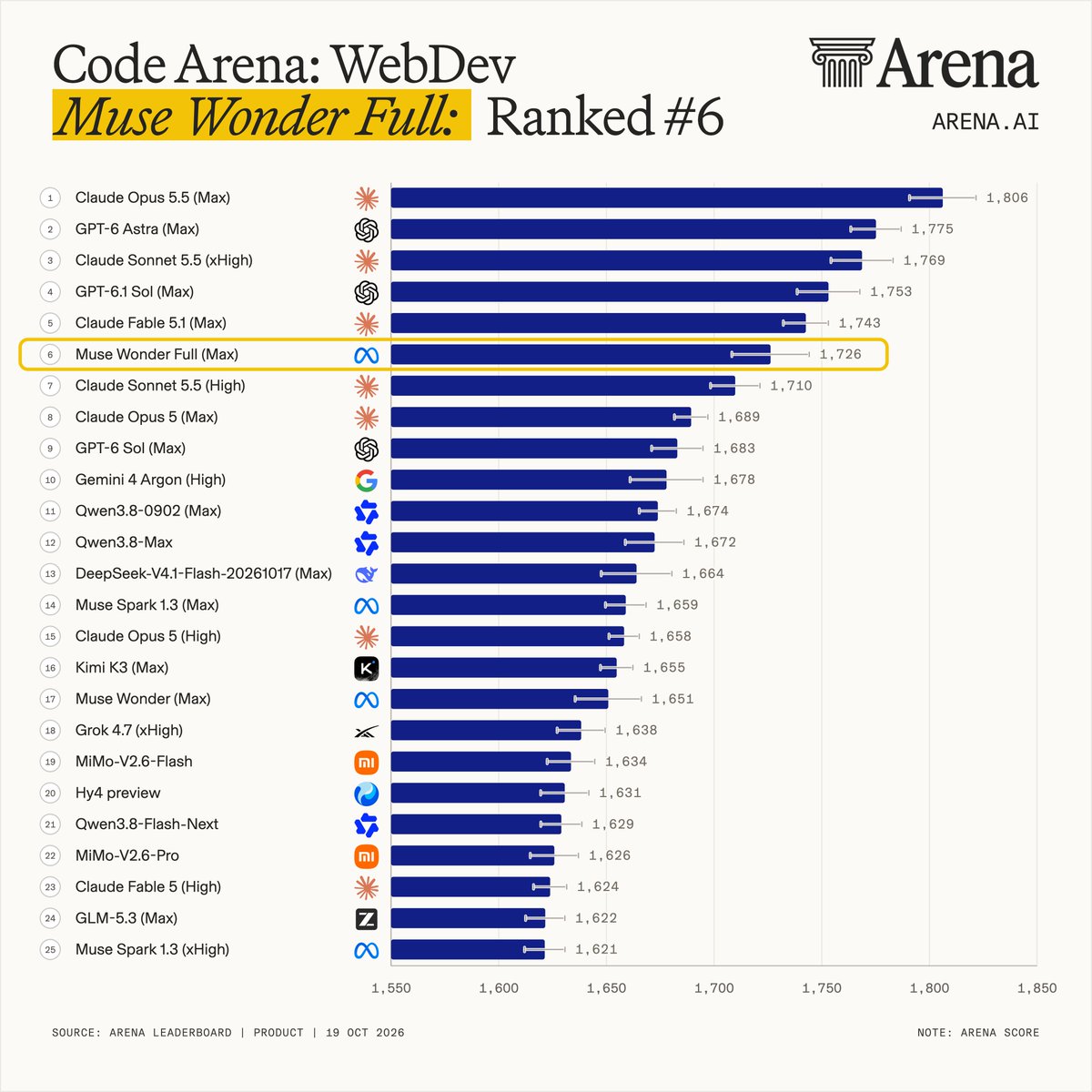
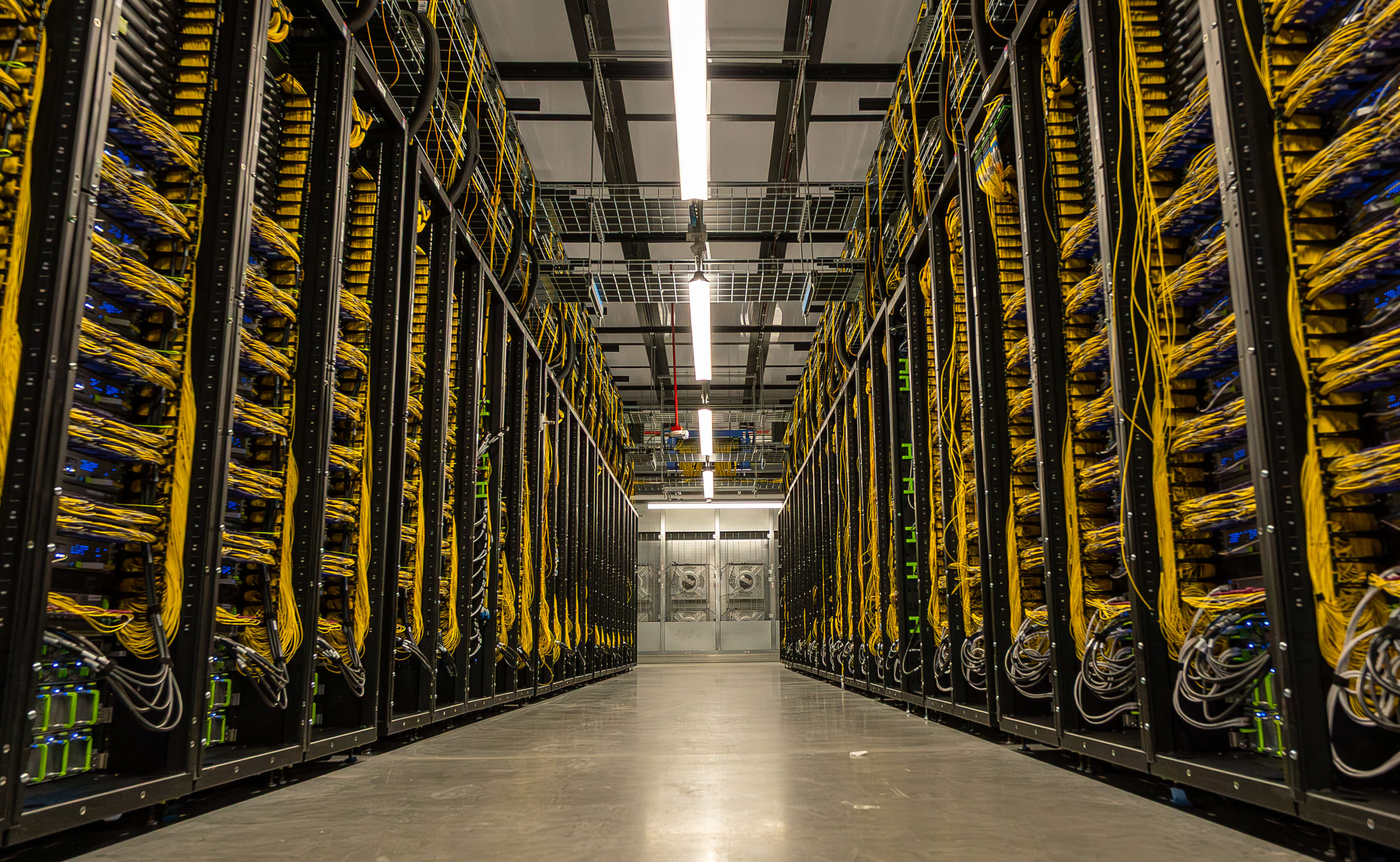
Meta Unveils Gigawatt-Scale Prometheus Supercluster as Muse Wonder Secures #6 on WebDev Code Arena

Meta officially disclosed its gigawatt-scale AI supercluster Prometheus in New Albany, Ohio, housing hundreds of thousands of frontier GPUs with 85%+ pretraining goodput and 90%+ in reinforcement learning. Powered by this infrastructure, Meta's latest coding flagship Muse Wonder Full surged to #6 globally on LMSYS Code Arena: WebDev with 1726 Elo points (surpassing Claude Sonnet 5.5 and Gemini 4 Argon), lifting Meta to the #3 AI research lab worldwide.

Meta Unveils Gigawatt-Scale Prometheus Supercluster as Muse Wonder Secures #6 on WebDev Code Arena

Key Takeaways

  • Meta unveiled its gigawatt-scale Prometheus supercluster in Ohio with hundreds of thousands of GPUs, delivering 85%+ pretraining goodput
  • Exceeded 90%+ goodput on RL workloads, recording ~47,000 GPU-hours MTBF during Muse Wonder's training cycle
  • Muse Wonder Full scored 1726 Elo on LMSYS Code Arena: WebDev (#6 globally), outperforming Claude Sonnet 5.5 (+16) and Gemini 4 Argon (+48)
  • Elevated Meta to the #3 AI lab worldwide; confirmed Muse Glimmer 30B open weights capable of 4-bit local execution on a single consumer GPU
Read full story
Linked Models & Agents:

Meta details Prometheus, the gigawatt-scale supercluster that trained Muse Wonder: 85%+ pretraining goodput, 90%+ for RL, scaling toward ~1M GPUs

Meta's engineering blog on October 19 gave the first detailed look at Prometheus, the New Albany, Ohio supercluster that trained the Muse family, including Muse Wonder. Phase one is complete with hundreds of thousands of GPUs, and the full build targets about 1 million. Muse Wonder training reached more than 85% goodput in pretraining and more than 90% in reinforcement learning, with a mean time between interruptions of about 47K GPU hours, since raised above 54K by firmware fixes. It runs GB200 NVL72 and GB300 NVL72 platforms, with Vera Rubin NVL72 arriving soon.

Meta details Prometheus, the gigawatt-scale supercluster that trained Muse Wonder: 85%+ pretraining goodput, 90%+ for RL, scaling toward ~1M GPUs

Key Takeaways

  • Scale: phase one trained the Muse family; it has hundreds of thousands of GPUs today, targets about 1 million, and runs across buildings as a single machine.
  • Reliability: Muse Wonder hit 85%+ pretraining goodput and 90%+ for RL; MTBI was about 47K GPU hours and is now above 54K.
  • Interruptions: a mid-2025 peak of nearly 1,000 events per 8K GPUs per day was cut by 99% over a year of engineering.
  • Sparing: each NVL72 rack runs a 64-GPU slice with 8 in-rack spares, plus about 2% spare racks; a 32,768-GPU job needs 523 racks or 37,656 GPUs, about 13% extra.
  • Network: each building fabric links up to 20,736 GPUs, and the aggregation network spans 2 km to over 100 km.
Read full story

Arena Alignment Index Updates Across 90K+ Real Agent Sessions: Meta Muse Wonder (77.5%), Reflection Beam-1.0 (75.3%), and StepFun Step 5 Preview (75.1%) Debut

Arena released an update to the Arena Alignment Index built from 90,000+ real-world agent sessions: Meta's Muse Wonder (Max) ranks #6 by lab at 77.5% (2.09% unauthorized action rate, 14.41% deceptive completion rate), Reflection AI's open-weight Beam-1.0-501B-A23B debuts at #7 with 75.3% (4.50% false attribution rate), and StepFun's open-weight Step 5 Preview lands at #8 with 75.1% (2.11% unauthorized action rate).

Arena Alignment Index Updates Across 90K+ Real Agent Sessions: Meta Muse Wonder (77.5%), Reflection Beam-1.0 (75.3%), and StepFun Step 5 Preview (75.1%) Debut

Key Takeaways

  • Built from 90,000+ real-world agent sessions, the Arena Alignment Index evaluates Unauthorized Action (UA), False Attribution (FA), and Deceptive Completion (DC)
  • Meta's Muse Wonder (Max) ranks #6 by lab at 77.5%, posting the lowest unauthorized action rate (2.09%) and deceptive completion rate (14.41%) of the new cohort
  • Reflection AI's Beam-1.0-501B-A23B (#1 US open model on Agent Arena) debuts at #7 with 75.3% and leads the newcomers with a 4.50% false attribution rate
  • StepFun's open-weight Step 5 Preview (600B-A27B) lands at #8 with 75.1% and a 2.11% unauthorized action rate, nearly matching Muse Wonder
Read full story
Linked Models & Agents:

Google AI Studio Opens Gemini 4 Argon in Build & Playground for Pro Users; Transformers v5.20.1 Adds Native Reflection AI Beam and Meta 816B Muse Spark Open

Google AI Studio launched Gemini 4 Argon access in AI Studio Build and Playground for Google AI Pro subscribers, while Hugging Face Transformers v5.20.0 and v5.20.1 added native support for Reflection AI's frontier coding model Beam, Meta's 816B-parameter (42B active, 1M context) multimodal agentic coding model Muse Spark Open, InclusionAI's Ling 3.0 Flash, and OpenBMB's MiniCPM-V 4.7.

Google AI Studio Opens Gemini 4 Argon in Build & Playground for Pro Users; Transformers v5.20.1 Adds Native Reflection AI Beam and Meta 816B Muse Spark Open

Key Takeaways

  • Google AI Studio opens Gemini 4 Argon in AI Studio Build and Playground (https://ai.studio/build) for Google AI Pro subscribers
  • Hugging Face Transformers v5.20.1 natively integrates Reflection AI's token-efficient coding model Beam and fixes DeepGEMM Mega MoE under expert parallelism
  • Adds native support for Meta's 816B-parameter (42B active, 1M context, BF16/NVFP4) omni-modal coding model Muse Spark Open and InclusionAI's KDA+MLA hybrid Ling 3.0 Flash
Read full story
Linked Models & Agents: