
AI Coding Live News

OpenBMB open-sources the MiniCPM-OCR suite: a 1.3B parser scoring 93.68 on Real5-OmniDocBench, plus a 2B judge model that flags OCR errors

On Oct 27 OpenBMB (ModelBest) open-sourced the MiniCPM-OCR suite with two models: MiniCPM-OCR 1.0, a 1.3B-parameter document parser that scores 93.68 on Real5-OmniDocBench and 54.7 on OCRBench v2 (vendor-reported), and MiniCPM-OCR Jev, a 2B OCR quality judge that scores any parser's output region by region from 0 to 1 and flags content that needs human review. Code and weights are Apache 2.0, with day-one support for vLLM, SGLang, llama.cpp, Ollama and multiple chip platforms.

OpenBMB open-sources the MiniCPM-OCR suite: a 1.3B parser scoring 93.68 on Real5-OmniDocBench, plus a 2B judge model that flags OCR errors

Key Takeaways

  • MiniCPM-OCR 1.0 has just 1.3B parameters and scores 93.68 on Real5-OmniDocBench and 54.7 on OCRBench v2 (vendor-reported, both claimed SOTA)
  • The 2B MiniCPM-OCR Jev judge reaches 93.6 AUROC on JevOCRBench, above JEV-35B-A3B at 90.1 and close to Qwen3.5-397B-A17B at 93.8 (vendor-reported)
  • Jev is parser-agnostic: AUROC stays between 91.9 and 93.4 on outputs from MiniCPM-OCR, GLM-OCR, PaddleOCR-VL-1.6 and Xiaomi-OCR-0
  • Throughput is about 1.49x PaddleOCR-VL-1.6 and 3.62x MinerU2.5 Pro, reaching up to about 128 pages per minute with SDK concurrency (vendor-reported)
  • Code and weights on GitHub are all Apache 2.0, with GGUF/AWQ/GPTQ quantized builds and a SKILL.md for coding agents
Read full story
Linked Models & Agents:
⚡ MiniCPM-OCR 1.0⚡ MiniCPM-OCR Jev⚡ PaddleOCR-VL-1.6⚡ MinerU2.5 Pro⚡ Qwen3.5-397B-A17B🌐 OpenBMB🌐 ModelBest🌐 Intel🌐 NVIDIA🌐 Arm
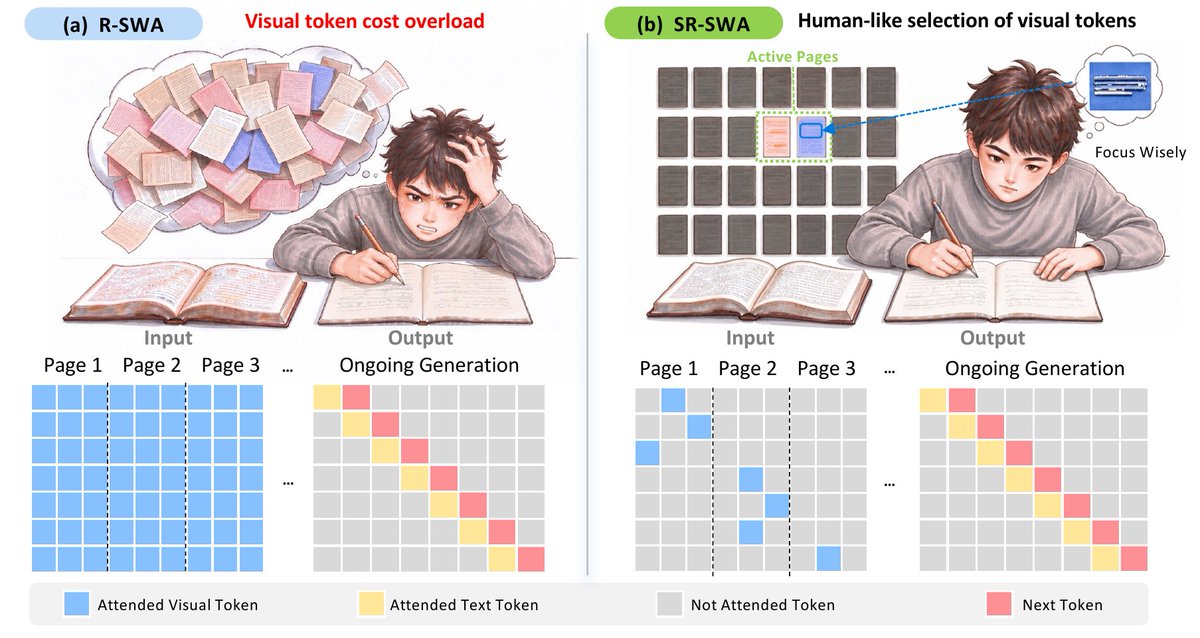

Baidu open-sources Unlimited OCR 2: SR-SWA keeps memory and latency nearly flat on very long documents, scoring 77.1 on MarathonDocBench per Baidu

On Oct 27, Baidu's official @Baidu_Inc account announced the open-source release of Unlimited OCR 2 on Hugging Face under the MIT license. Its new SR-SWA attention compresses text-visual interactions into a fixed-size reference set, which Baidu says lets it parse documents of any length within a finite context window. Baidu reports 84.6 on MPDocBench (dozens of pages) and 77.1 on MarathonDocBench (hundreds of pages), both self-reported.

Baidu open-sources Unlimited OCR 2: SR-SWA keeps memory and latency nearly flat on very long documents, scoring 77.1 on MarathonDocBench per Baidu

Key Takeaways

  • SR-SWA compresses text-visual attention over very long sequences into a fixed-size reference set (e.g. 512 tokens), which Baidu says keeps per-step decode latency and memory nearly flat as page count grows
  • Per Baidu: 84.6 overall on MPDocBench, 6.3 points above the next best, Qwen3.8-Max (78.3)
  • Per Baidu: 77.1 overall on MarathonDocBench, 43.3 points above the next best, Kimi-K3 (33.7); the first Unlimited-OCR scores 0 there
  • Weights are on Hugging Face under MIT, about 3.3B parameters by the HF weight count, with Transformers and a customized SGLang build for serving
  • All scores are Baidu's own measurements with no third-party reproduction yet
Read full story
Linked Models & Agents:
⚡ Unlimited OCR 2⚡ Unlimited-OCR⚡ DeepSeek-OCR🌐 Baidu

NVIDIA Launches Nemotron 3.5 Open Model Family, Cosmos World Models, and 13x Faster BioNeMo RFD4-Proteina

During the GTC Berlin keynote, NVIDIA unleashed a sweeping array of open-weights domain-specific foundation models. The release highlights include the multimodal Nemotron 3.5 Super VL, the lightweight Nemotron 3.5 Bolt series, and the end-to-end Nemotron Retriever suite for embedding, reranking, and document OCR. For physical AI, NVIDIA debuted the Cosmos world models and Alpamayo 2 Edge autonomous driving models. In life sciences, NVIDIA and the Baker Lab released BioNeMo RFD4-Proteina, which establishes state-of-the-art accuracy across more than 10 protein design benchmarks while synthesizing 200-amino-acid binders roughly 13x faster than RFdiffusion3.

NVIDIA Launches Nemotron 3.5 Open Model Family, Cosmos World Models, and 13x Faster BioNeMo RFD4-Proteina

Key Takeaways

  • NVIDIA released an extensive open-weights portfolio at GTC Berlin: Nemotron 3.5 Super VL, Bolt 4GB edge variants, and Cosmos world models
  • Unveils the full Nemotron Retriever suite for embedding, reranking, and multimodal document parsing, boosting enterprise RAG fidelity
  • Co-developed BioNeMo RFD4-Proteina with the Baker Lab, leading on over 10 structural protein design benchmarks
  • Synthesizes 200-amino-acid de novo proteins 13x faster than RFdiffusion3, dramatically shortening computational drug discovery timelines
Read full story
Linked Models & Agents:
⚡ Nemotron 3.5 Super VL⚡ Nemotron 3.5 Bolt⚡ BioNeMo RFD4-Proteina⚡ Cosmos🌐 NVIDIA🌐 Baker Lab

Fixing LLM & VLM Evaluation Blind Spots: Exact Two-Factor MCQ Option-Bias Identity, 61M-Edit semCER for OCR, and 14.5x SAE Feature Reproducibility Scaling

Three new evaluation and interpretability studies resolve critical measurement blind spots: POSTECH and KAIST researchers (arXiv:2610.20993) prove across 41 checkpoints and 12 benchmarks that multiple-choice pooled selection-rate SD equals the exact product of Flip Rate and Positional Skew, revealing that forward-reverse order aggregation lowers flip rates partly by locking onto wrong answers; semCER (arXiv:2610.20461) open-sources 61 million LLM-judged grapheme edits across 16 languages for severity-weighted OCR evaluation; and IISc/UVA researchers (arXiv:2610.20680) show that while SAE reconstruction converges with little data, strict 1-to-1 feature reproducibility on Gemma-2-2B BatchTopK jumps 14.5x from 2% at 5M tokens to 29% at 50M tokens.

Fixing LLM & VLM Evaluation Blind Spots: Exact Two-Factor MCQ Option-Bias Identity, 61M-Edit semCER for OCR, and 14.5x SAE Feature Reproducibility Scaling

Key Takeaways

  • POSTECH/KAIST prove that multiple-choice pooled selection-rate SD equals Flip Rate × Positional Skew across 41 checkpoints and 12 benchmarks, showing order aggregation lowers flip rates partly by locking onto wrong answers
  • semCER open-sources 61 million severity-judged grapheme edits across 16 languages and reveals that VLM character errors form real words far above chance compared to classical OCR
  • Testing 4 SAE architectures from 5M to 500M tokens shows functional reconstruction converges early while Gemma-2-2B BatchTopK 1-to-1 feature reproducibility jumps 14.5x from 2% (5M) to 29% (50M)
Read full story
Linked Models & Agents:
ADSponsored

WorldGuide: MBZUAI and ANU Introduce Goal-Directed Closed-Loop Video World Model for Procedural Task Execution

Modern video foundation models synthesize photorealistic visual dynamics, yet struggle on long-horizon procedural tasks requiring sequential causal execution—such as equipment maintenance, cooking, or laboratory experiments. Current architectures rely on open-loop generation that cannot adapt to intermediate video outputs, resulting in disordered task sequences, hallucinated progress, and premature task termination. Researchers from MBZUAI and the Australian National University introduce WorldGuide (arXiv:2610.12459, repository: github.com/mbzuai-oryx/WorldGuide, site: mbzuai-oryx.github.io/WorldGuide/), formalizing procedural video generation as closed-loop task execution in visual world space. Given solely an initial image and a high-level task goal, WorldGuide iteratively predicts the next atomic action, generates the corresponding visual video clip, and inspects the synthesized state to dynamically route subsequent actions or determine task completion. A hierarchical visual memory maintains state history under bounded token footprints. To bridge supervision gaps, the authors release WorldGuide-Bench comprising approximately 59K step-annotated videos across 245 tasks and 27 procedural categories. WorldGuide achieves 33.33% Task Success on WorldGuide-Bench, outscoring the strong MiniMax-H3 model (29.90%) even when MiniMax-H3 is provided with reference plans, and surges to 47.69% on VideoCraft-Bench compared to 32.73% for MiniMax-H3 under goal-only conditioning.

Key Takeaways

  • MBZUAI and ANU introduce WorldGuide, formalizing procedural video generation as closed-loop task execution in world space
  • Achieves 33.33% Task Success on WorldGuide-Bench and 47.69% on VideoCraft-Bench, decisively outperforming MiniMax-H3
  • Open-sources WorldGuide-Bench with ~59K step-annotated videos, reducing procedural ordering errors from 62% to under 4%
Read full story
Linked Models & Agents:

Perplexity open-sources pplx-embed-v2-late: 0.6B/9B multimodal ColBERT retrievers, OCR-free PDFs, small model queries the big model's index

On Oct 7 Perplexity released pplx-embed-v2-late, multimodal late-interaction (ColBERT) retrievers in 0.6B (340M active) and 9B (7.4B active) sizes, built on Qwen3.5 with bidirectional attention. Each token gets a 128-dim vector scored by MaxSim, covering text, images and rendered PDFs or slides without OCR. Both sizes share one embedding space, so the 0.6B model can query a 9B-built index. Public ViDoRe v3 image nDCG@10 is 62.3% / 65.2%; MIT-licensed weights are on Hugging Face.

Key Takeaways

  • Public ViDoRe v3 nDCG@10: 0.6B 62.3% image / 61.2% markdown; 9B 65.2% image / 64.7% markdown (0.6B model card)
  • Perplexity says the 0.6B model matches models with about 5x the active parameters on ViDoRe V3 (blog)
  • Shared embedding space: index with 9B, query online with 0.6B to cut query-time cost
  • Training: distilled from an internal 18B ColBERT teacher with a token-level LEAF-style objective; 9B fully fine-tunes the last 8 layers and uses LoRA elsewhere, including the vision encoder
  • Setup: sentence-transformers >= 6.0.0 and transformers >= 5.4.0, MIT license; encode text-only and image-only batches separately (9B model card)
Read full story
Linked Models & Agents:
⚡ pplx-embed-v2-late-0.6b⚡ Pplx Embed V2 Late 9b⚡ Pplx Embed V2 Context⚡ Qwen3.5🌐 Perplexity🌐 Hugging Face

Cloudflare AI Search goes GA: native multimodal embeddings + PDF OCR; billing from Nov 1; hybrid search default

On 2026-10-01 Cloudflare made AI Search generally available: managed index/retrieval (Workers AI + Vectorize + R2 + Browser Run) ships native multimodal embeddings (Qwen3-VL-Embedding), OCR for scanned PDFs, 10 MiB text/OCR PDF limits, hybrid search by default, and billing from 2026-11-01 with a free allotment.

Cloudflare AI Search goes GA: native multimodal embeddings + PDF OCR; billing from Nov 1; hybrid search default

Key Takeaways

  • GA 2026-10-01: changelog + blog.cloudflare.com/ai-search-ga/
  • Multimodal embeddings: @cf/qwen/qwen3-vl-embedding-2b and google-ai-studio/gemini-embedding-2; image queries via REST/public endpoint
  • OCR on all accounts; text/code + OCR PDFs up to 10 MiB (non-OCR PDFs stay 4 MiB)
  • Hybrid search default; Workers AI embed/rerank folded into AI Search pricing (not Workers AI bill)
  • Pricing: $0.75/1M ingest tokens, $2/GB-mo storage, $0.75/1k semantic, $0.10/1k full-text; free tier 5M ingest / 10 GB / 1k+1k queries; bill from Nov 1, 2026
Read full story
Linked Models & Agents:

llama.cpp v0.5.0: CUDA conv2d implicit GEMM, Metal MoE/SSM fusion, MiMo-V2.6 & HunyuanOCR & Mimir 1B

llama.cpp v0.5.0 (2026-09-23) accelerates CUDA conv2d via implicit GEMM, adds Metal MoE and SSM_CONV fusion, lets the server bind multi-address/--host lists and UNIX sockets, and adds HRM-Text (DFM Mimir 1B), MiMo-V2.6, and HunyuanOCR (DFlash) conversion plus ggml 0.25.0 backends.

llama.cpp v0.5.0: CUDA conv2d implicit GEMM, Metal MoE/SSM fusion, MiMo-V2.6 & HunyuanOCR & Mimir 1B

Key Takeaways

  • Shipped v0.5.0 on 2026-09-23 — major step past the prior v0.4.1 line
  • Perf: CUDA conv2d implicit GEMM; Metal MoE + SSM_CONV fusion; CUDA graphs for MTP drafting
  • Models: HRM-Text/Mimir 1B, MiMo-V2.6 convert, HunyuanOCR DFlash, Qwen4Exp sparse FA, Nemotron MTP/H
  • Server: multi-address/--host lists + UNIX sockets; input_image on function-call outputs; router race fixes
  • API: LoRA from FILE*; sampler env vars; llama-bench --version
Read full story
Linked Models & Agents:
⚡ qwen⚡ deepseek⚡ nemotron🌐 ggml-org

Alibaba open-sources Open Code Review: line-level AI review CLI; higher precision/F1 than Claude Code at ~1/9 tokens

Community coverage notes Alibaba open-sourced its internal AI code-review assistant as Open Code Review (github.com/alibaba/open-code-review; npm @alibaba-group/open-code-review at 1.12.0). The CLI reads Git diffs, uses a tool-using agent for line-level structured comments, supports ocr scan for whole-file audits, and plugs into Claude Code, Codex, and Cursor. Official bench: 50 repos / 200 PRs / 10 languages with 1,505 annotated issues; same base model yields higher Precision and F1 than general-purpose Claude Code at ~1/9 the tokens, trading some recall for less noise.

Key Takeaways

  • Alibaba open-sourced Open Code Review (alibaba/open-code-review); npm @alibaba-group/open-code-review at 1.12.0.
  • Line-level diff review plus ocr scan; works with Claude Code, Codex, and Cursor.
  • AACR-Bench: higher Precision/F1 vs Claude Code at ~1/9 tokens (recall traded for precision).
Read full story

dsh-ios: iOS Simulator and USB devices inside DSH chat with 22 build/UI/OCR agent tools

Open-source dsh-ios (DeepSeek Harness plugin) wires the iOS Simulator and USB devices into the chat: 22 tools cover build, boot, logs, OCR, accessibility tree, and UI control, with a live sidebar for tap/drag. Device signing follows configurable Xcode teams and stays local with short-lived signatures; requires macOS and full Xcode (github.com/ZSeven-W/dsh-ios).

Key Takeaways

  • Role: DSH plugin putting Simulator/USB devices inside the coding-agent chat.
  • Tools: 22 for build, logs, OCR, accessibility tree, UI ops, live sidebar.
  • Constraints: macOS + full Xcode; local short-lived device signing.
Read full story
Linked Models & Agents:
ADSponsored

LatentPress: compress long chats/docs into continuous memory tokens for frozen LLMs

LatentPress stores conversational histories and long documents as continuous memory tokens a frozen decoder reads through its input-embedding interface—no text reconstruction at inference. A small reader-matched writer (4.2M–26.2M adapter params, ~0.1% of the decoder) compresses 4–16×. On LongMemEval it reaches 0.504 accuracy at 7.70× compression vs 0.490 uncompressed, beating text summaries and OCR; writing is ~43ms per conversation and reading is 5–9× faster than raw context—useful for long-context agent memory.

Key Takeaways

  • Rep: continuous memory tokens read via embedding interface; no text reconstruction.
  • Compression: 4–16×; LongMemEval 0.504 at 7.70× vs 0.490 uncompressed.
  • Speed: ~43ms write per conversation; reading 5–9× faster than raw context for long-context agents.
Read full story
Linked Models & Agents:

Cohere Launches Parse 5: Agent-Ready Document Intelligence at $1.50 per 1,000 Pages

Cohere launched Parse 5, a document intelligence model for high-volume enterprise RAG and document agents scoring 79.2 on ParseBench (beating Mistral OCR 4 and Azure) priced at $1.50 per 1,000 pages.

Key Takeaways

  • Outperforms Mistral OCR 4 (74.5) and Azure Document Intelligence (74.3) with a 79.2 score on ParseBench;
  • Priced up to 95% below frontier vision models and 63% below Mistral at $1.50 per 1,000 pages;
  • Delivers machine-readable structured bounding boxes across Cohere API, AWS SageMaker, and Microsoft Foundry.
Read full story
Linked Models & Agents: