
AI Coding Live News

GitHub Universe 2026: Copilot Fusion is generally available, routing and orchestrating models automatically, with Fusion Max scoring 60 on the Artificial Analysis Coding Agent Index at about half the cost of Claude Code with Opus 5.5 Max

At GitHub Universe 2026 on Oct 28, GitHub made Copilot Fusion generally available. It merges the multi-model orchestration of the Project HydraFusion research preview with Copilot auto model selection: users pick Copilot Fusion and an effort level (Standard, High or Max) in the model picker, and the system decides which models to use and whether to run a Single, Cascade or Critique workflow. GitHub says Fusion Max scored 60 on the Artificial Analysis Coding Agent Index, two points below Claude Code with Opus 5.5 Max, at about half the API cost per task, about half the tokens and about 40% less time. Each underlying model is billed at its standard rate, and paid plans get 30% off through Nov 30.
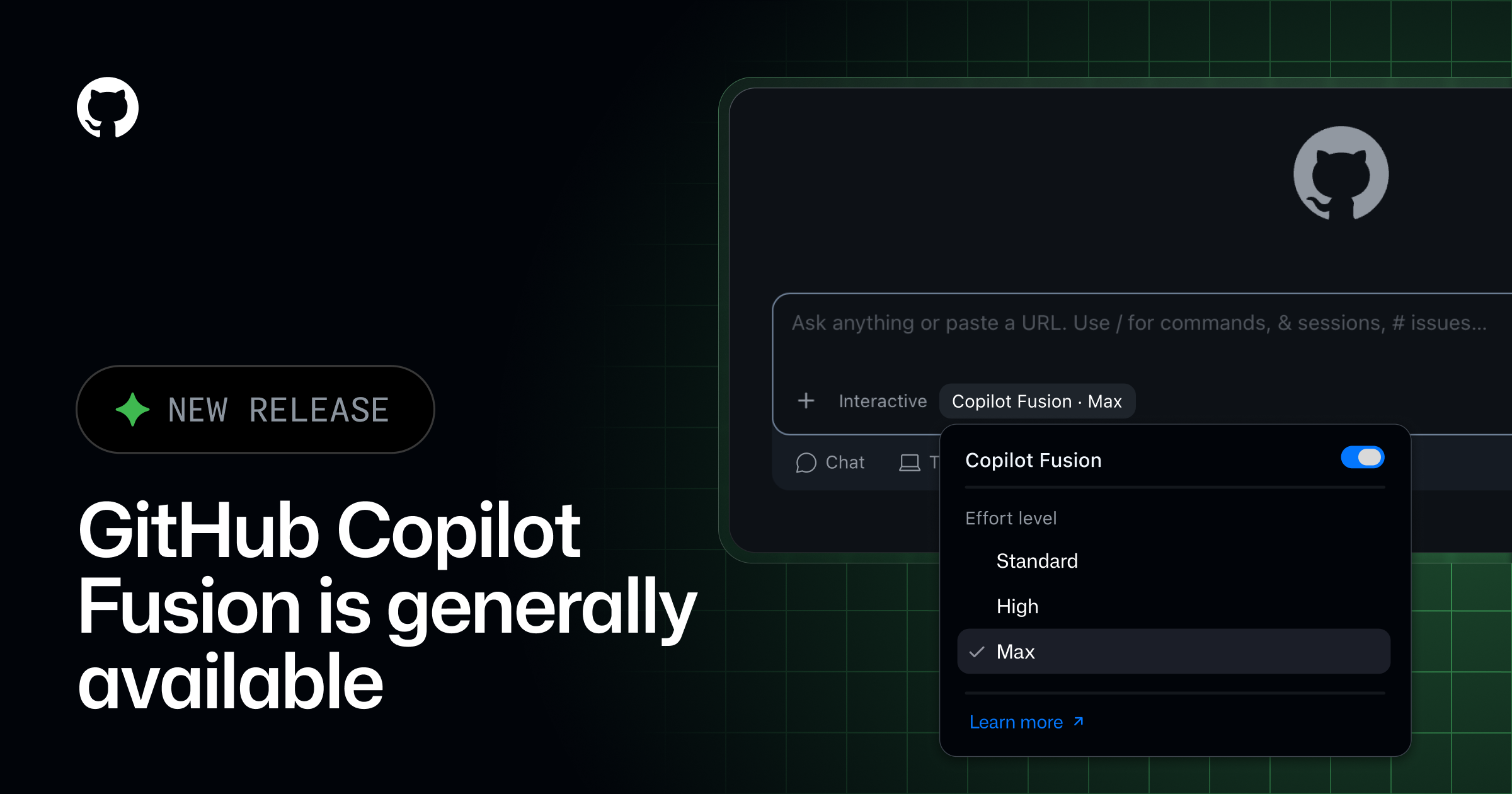
GitHub Universe 2026: Copilot Fusion is generally available, routing and orchestrating models automatically, with Fusion Max scoring 60 on the Artificial Analysis Coding Agent Index at about half the cost of Claude Code with Opus 5.5 Max

Key Takeaways

  • Scores (Artificial Analysis Coding Agent Index v2.0): Fusion Max 60 versus 62 for Claude Code with Opus 5.5 Max; $5.59 per task versus $11.42, while the Devin Fusion pairing scores 62 at $8.00
  • Breakdown: a slight lead on Terminal-Bench 4.0 at 71, third on FrontierCode at 51 (Claude Code 56, Devin Fusion 54), and a weaker 57 on SWE-Atlas-QnA-AA
  • Efficiency: about 7.2M tokens per task, roughly half of Claude Code with Opus 5.5 and 30% fewer than Devin Fusion; GitHub reports about 40% less time per task
  • The pool includes Claude Opus 5.5, Claude Sonnet 5.5, GPT-6 Astra and GPT-6 Sol; admins can disable individual models for Fusion only and set Fusion as the default
  • Availability: all Copilot plans in VS Code, the Copilot app, Copilot CLI and JetBrains IDEs; existing auto, HydraFusion and HydraFusion Max selections migrate to matching effort levels
Read full story

Perplexity Computer Launches Natively on macOS: Full On-Device Model and Agent Execution Without Cloud Roundtrips

Perplexity officially unveiled that Perplexity Computer now operates 100% locally on macOS through the native desktop application. Breaking away from cloud-dependent computer-use paradigms that ship continuous video feeds across the internet, Perplexity Computer executes both the underlying inference model and the agent orchestration runtime directly on local Mac silicon. By interfacing natively with macOS Accessibility APIs, the system eliminates network latency, guarantees complete screen privacy, and empowers autonomous desktop copilots to orchestrate multi-application workflows entirely offline.

Perplexity Computer Launches Natively on macOS: Full On-Device Model and Agent Execution Without Cloud Roundtrips

Key Takeaways

  • Perplexity launched Perplexity Computer inside the native macOS app, hosting both model inference and agent loops locally
  • Eliminates privacy vulnerabilities of cloud-based GUI agents by keeping all screen frames and keystrokes strictly on-device
  • Achieves near-instantaneous interaction latency leveraging Apple Silicon unified memory and the Neural Engine
  • Seamlessly interfaces with native macOS Accessibility APIs and app sandboxes for cross-application workflow automation
Read full story

Alibaba Synthesizes 64.9K Interactive Environments in Cowork-Gym (27B Beats 100B+ on ClawEval) & Harvard/MIT Open-Source Market-Based Agent Swarms (MPT)

Alibaba researchers introduce Cowork-Gym (arXiv:2610.17670), synthesizing 64,900 interactive human-agent coworking environments paired with a stateful user simulator that dynamically edits the shared workspace; post-training a 27B Qwen model yields #1 scores on PawBench and ClawEval, outperforming 100B+ parameter models. Concurrently, Harvard and MIT researchers open-source Market-Based Post-Training (MPT, arXiv:2610.22322), enabling decentralized agent swarms to jointly learn action policies and bidding-based self-orchestration without a central coordinator.

Alibaba Synthesizes 64.9K Interactive Environments in Cowork-Gym (27B Beats 100B+ on ClawEval) & Harvard/MIT Open-Source Market-Based Agent Swarms (MPT)

Key Takeaways

  • 64.9K synthesized environments in Cowork-Gym: pairs a build-execute-revise loop with a stateful user simulator that edits shared workspaces alongside the agent
  • 27B model beats 100B+ giants on PawBench & ClawEval: post-trained Qwen models gain up to +8.7 average points across 6 agentic benchmarks
  • Market-Based Post-Training (MPT) for agent swarms: Harvard and MIT open-source a bidding-based RL framework for decentralized self-orchestration
Read full story

OpenAI Upgrades GPT-6 Astra Pro in ChatGPT with Parallel Multi-Agent Execution and Showcases Always-On 'dots' Triaging 3 AM Incidents via Codex

OpenAI announced a major upgrade to GPT-6 Astra Pro in ChatGPT for Pro users, introducing faster response times, stronger plugin and tool orchestration, and native parallel multi-agent execution where multiple agents tackle different parts of a complex task simultaneously. Concurrently, OpenAI Developers showcased how internal engineers put always-on 'dots' agents on call to autonomously triage 3 AM production incidents, launch Codex debugging threads, and clear codebase maintenance backlogs.

OpenAI Upgrades GPT-6 Astra Pro in ChatGPT with Parallel Multi-Agent Execution and Showcases Always-On 'dots' Triaging 3 AM Incidents via Codex

Key Takeaways

  • Parallel multi-agent execution in GPT-6 Astra Pro: upgrades speed and tool use while enabling multiple agents to work on different task components concurrently in ChatGPT Pro
  • Always-on 'dots' on-call incident triage: autonomously investigates 3 AM production alerts and initiates Codex coding threads before waking the engineer
  • Mobile steering & backlog automation: engineers supervise Codex fixes from the ChatGPT mobile app and deploy Codex to continuously clear repository maintenance backlogs
Read full story
Linked Models & Agents:
ADSponsored

GitHub Copilot updates HydraFusion and adds HydraFusion Max, with Claude Opus 5.5 and the GPT-6 family in its model pool

On 2026-10-14 GitHub updated HydraFusion, Copilot's multi-model orchestration feature, and added HydraFusion Max for harder tasks. The pool now includes Claude Opus 5.5, GPT-6 Astra, GPT-6.1 Sol and GPT-6 Luna; effort is tuned per stage (medium for drafts, high for review), Cascade gains a judging step, and Critique now inspects the workspace with tools using parallel critics. Both remain in research preview across VS Code, the Copilot app and Copilot CLI.

Key Takeaways

  • Pool: Claude Opus 5.5, GPT-6 Astra, GPT-6.1 Sol, GPT-6 Luna, chosen per workflow (GitHub Changelog)
  • Per-stage effort: medium for drafts, high for review (previously each model's default)
  • Cascade adds a judge that requests repair only when needed; Critique uses tools on the workspace plus parallel critics
  • Two tiers: HydraFusion (balanced) and HydraFusion Max (deepest reasoning, orchestration still minds tokens)
  • Available in VS Code, Copilot app and Copilot CLI on Pro, Pro+, Business and Enterprise with preview features enabled
Read full story

Beyond Pure Neural Prompt Loops: ABCAgent Treats Agent Behavior as Code, Achieving Over 92% Reusability and Robust Execution

Mainstream LLM agents predominantly rely on purely neural orchestration loops (such as ReAct), generating each step, tool call, and control decision through unconstrained language token generation. This paradigm suffers from high API latency, steep operational costs, rapid error cascading, and an inability to reuse verified execution logic across recurring task instances. Researchers from Uniphore introduce ABCAgent (arXiv:2610.04824), an innovative neuro-symbolic framework treating Agent Behavior as Code. ABCAgent decouples agent design from execution: a foundation model serves as a runtime designer to author and edit explicit programmatic specifications (Python programs with embedded neural functions), while a deterministic executor handles control flow, variable bindings, and state transitions. Evaluated across GAIA, Augmented GAIA, GSM-Symbolic, τ²-bench, and WorkArena, ABCAgent matches or exceeds neural agent accuracy while demonstrating superior stability. Crucially, it solves 92.6% of GSM-Symbolic and 20.1% of Augmented GAIA task instances without code synthesis simply by rebinding parameters into existing programs, slashing latency and inference overhead.

Key Takeaways

  • ABCAgent introduces a neuro-symbolic framework specifying agent behavior as executable Python programs
  • Solves 92.6% of GSM-Symbolic tasks via parameter rebinding without LLM re-authoring, drastically cutting cost and latency
  • Exhibits superior stability on τ²-bench and WorkArena over neural loops, eliminating error compounding in loops
Read full story

TokenRouter: Tsinghua Unveils NeurIPS 2026 Serving System for Token-Level LLM Routing, Boosting Throughput by up to 64x

Token-level LLM routing—routing easy tokens to small models and switching to frontier models for critical reasoning tokens—presents an optimal trade-off between output quality and inference cost. However, current LLM serving engines (such as vLLM and TGI) are architected for single-model execution, suffering severe step desynchronization, batch admission latency, and extreme orchestration complexity when handling high-frequency token transfers across heterogeneous models. Researchers from Tsinghua University's NICS Lab present TokenRouter (arXiv:2610.12242, accepted at NeurIPS 2026, code: github.com/thu-nics/TokenRouter), an efficient and developer-friendly serving system engineered for token-level routed LLM inference. TokenRouter introduces a 'request-centric programming and model-centric execution' paradigm, enabling developers to write routing logic intuitively per request while the runtime handles asynchronous execution across subservers. Incorporating a Delayed-Batching Scheduler parameterized via discrete-time Markov chain modeling, a decoupled tri-loop architecture, and an instant handoff-resume mechanism, TokenRouter achieves 2.01x to 64.15x higher decoding throughput compared to existing serving platforms across diverse routing workloads, with complete code open-sourced.

TokenRouter: Tsinghua Unveils NeurIPS 2026 Serving System for Token-Level LLM Routing, Boosting Throughput by up to 64x

Key Takeaways

  • Tsinghua University open-sources TokenRouter (NeurIPS 2026), an optimized serving architecture for token-level LLM routing
  • Introduces request-centric programming and a delayed-batching scheduler, delivering 2.01x to 64.15x higher decoding throughput
  • Decoupled tri-loop execution cuts P99 inter-token latency by 43.6%, reducing enterprise cloud GPU costs by 50% to 70%
Read full story
Linked Models & Agents:

Claude Managed Agents dynamic workflows hit public beta: the lead agent writes an orchestration program running up to 64 concurrent threads and 1,000 agents per run

Anthropic expanded dynamic workflows in Claude Managed Agents to public beta. With workflows enabled in an agent's multiagent block, Claude writes a workflow program that runs many agents in background phases and combines their results, aimed at audits, migrations, deep research and cross-checking.

Key Takeaways

  • Enable with multiagent.type: "multiagent_20261001" and workflows: {"type":"enabled"} under the managed-agents-2026-04-01 beta header
  • Up to 64 threads working at once per run and 1,000 agents over a run's life (thread_limit_error beyond)
  • Runs last 24h by default; 10 open runs per session by default; runs don't nest
  • No separate run price: thread tokens bill at model rates and count toward the session budget, which pauses runs when reached
Read full story
Linked Models & Agents:

Google Cloud launches Gemini agent: universal work agent with Gemini+Claude routing, sub-agents and coworker identities, multi-day cloud persistence

At Gemini at Work 2026 (Oct 8) Google launched the Gemini agent: objectives from one prompt box spanning Q&A, knowledge work, media, and code; cloud-persistent memory with sub-agent/coworker orchestration and Gemini+Claude model choice. Private preview now.

Google Cloud launches Gemini agent: universal work agent with Gemini+Claude routing, sub-agents and coworker identities, multi-day cloud persistence

Key Takeaways

  • One universal work agent for Q&A, knowledge work, media, and coding from objectives not step lists
  • Sub-agents plus coworker agents with dedicated identity/@agents.company.com; multi-hour/day runs
  • Model choice decoupled: routes across Gemini family and Anthropic Claude today
  • Governance: Agent Identity, Gateway, sandbox, Smart Routing, per-project spend caps
  • Availability: private preview now; broader for select Workspace Business/Enterprise
Read full story

GitHub Copilot Dynamic Workflows public preview: code-defined multi-agent orchestration across CLI, app, and SDK

GitHub’s 2026-10-01 Changelog launched Dynamic Workflows in public preview for Copilot CLI, the Copilot app, and the SDK: code-defined reusable orchestration (sequential/parallel steps, pause checkpoints, subagent cross-checks)—unlike Autopilot or /fleet, where Copilot invents the plan each run. CLI needs --experimental or /experimental on; available on all Copilot plans.

Key Takeaways

  • Anchors: Oct 1 Changelog + docs concepts + how-to pages linked above
  • Code defines steps/conditions/handoffs; agents handle judgment. Distinct from Autopilot and /fleet
  • Surfaces: CLI workflow run + /workflows; App Workflows button; SDK/extension canvases; share via personal or repo extensions
  • Limits: max concurrent/total subagents, timeoutSeconds, approx maxAiCredits; prompt > workflow code > personal defaults
  • Public preview; CLI experimental flag; no published agent-bench deltas—don’t conflate with HydraFusion or Computer Use
Read full story
ADSponsored

OpenHands v1.23.0 Released: Upgraded Multi-Agent Orchestration & Autonomous Regression Validation

OpenHands (@OpenHandsAI, formerly OpenDevin) has released v1.23.0. This release significantly upgrades the multi-agent execution pipeline and sandboxed runtime, introduces automated regression evaluation suites for complex repositories, and enhances compatibility with local inference backends like vLLM and Ollama.

OpenHands v1.23.0 Released: Upgraded Multi-Agent Orchestration & Autonomous Regression Validation

Key Takeaways

  • Introduces tri-agent architecture (Planner, Coder, Verifier) for robust end-to-end PR resolution.
  • Local Docker sandbox runtime execution latency reduced by 35% with real-time file event watchers.
  • Built-in SWE-bench Verified regression runner for local evaluation of custom agent policies.
  • Full source code and container images released on GitHub with native local backend support.
Read full story

JetBrains launches Air: an open agentic product system for developers, teams, and governance

JetBrains (@jetbrains) announced JetBrains Air, an open product system for agentic software development that connects IDE-side agent orchestration, team workflows, and organizational governance (formerly JetBrains Central). Air is multi-vendor: steer Claude, Codex, Gemini CLI, and JetBrains Junie inside JetBrains IDEs, and plug in other harnesses via the Agent Client Protocol (ACP). The company blog also outlines Air Teams and Air Governance.

JetBrains launches Air: an open agentic product system for developers, teams, and governance

Key Takeaways

  • Air unifies IDE agent UX, team workflows, and org governance as one open system.
  • Orchestrate multi-vendor agents (including Junie) in JetBrains IDEs; ACP for compatible harnesses.
  • Air Governance (ex-Central) covers policy, visibility, audit, and AI cost control.
Read full story
Linked Models & Agents:

OpenAI Agents API Adds Production Subagent Delegation & Parallel Workflow Orchestration

OpenAI upgraded its Agents API to generally support production-grade subagent delegation. A primary orchestrator agent can dynamically fork hundreds of lightweight, specialized child agents to execute asynchronous multi-file refactors and CI test repairs before synthesizing results back to main context.

Key Takeaways

  • Primary agent dynamically forks hundreds of dedicated child agents for parallel workloads
  • Native hierarchical context scoping and sandbox fencing eliminate single-thread bottlenecks
  • Radically simplifies enterprise-scale distributed agent workflow orchestration
Read full story

Coding Agent Core Loops Converge: Industry Focus Shifts to Orchestration & Context Governance

An industry synthesis report shows coding agents across leading vendors have converged on the canonical read-edit-test loop. Differentiation has decisively shifted toward workflow orchestration, persistent project-level context caches, and automated sandbox rollback protections.

Key Takeaways

  • Model differences on raw syntax completion are increasingly commoditized
  • Workflow orchestration (DAG dispatch, subagent concurrency) dictates task success
  • Persistent project context and self-healing sandboxes emerge as the true differentiators
Read full story

Agent Conf 2026 Warsaw: Industry Consensus Pivots from Prompt Hacking to Resilient Orchestration

At Agent Conf 2026 in Warsaw, top systems engineers established a decisive consensus: single prompts and rudimentary ReAct loops are obsolete for mission-critical software. The field is adopting deterministic state machines, topological DAG orchestrators, and dual-sandbox rollback guards.

Key Takeaways

  • Marks transition from chat helpers to deterministic, stateful multi-agent systems
  • Spotlights rollback snapshots and auto-healing sandboxes to prevent catastrophic drift
  • Releases multi-framework open benchmarks to standardize long-horizon task verification
Read full story
Linked Models & Agents: