
AI Coding Live News

Perplexity CEO shares early Gemini 4 Carbon evals: a record 0.857 on the WANDR deep-research benchmark at $5.86 per task, ahead of Argon and GPT-6 Astra

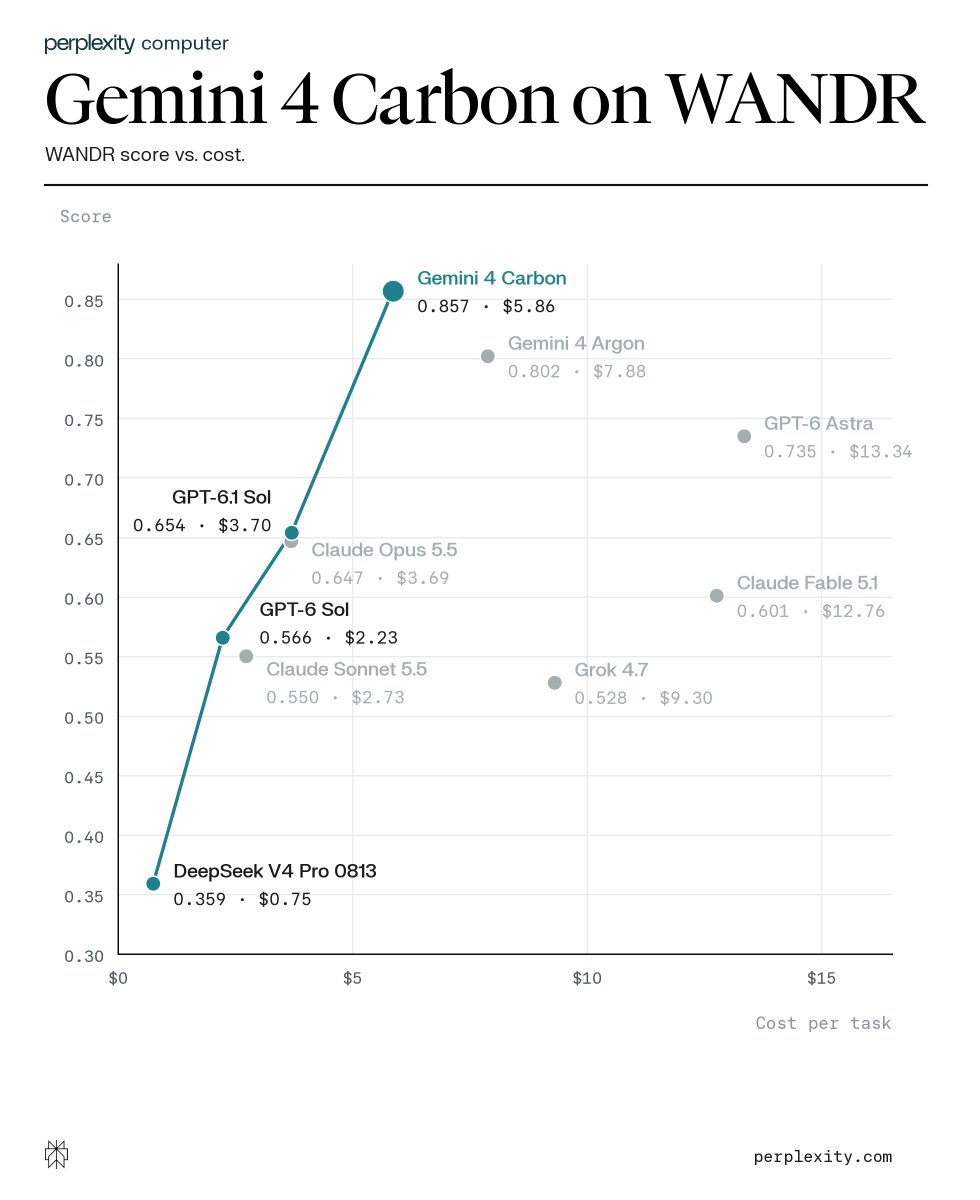
Perplexity CEO Aravind Srinivas posted early evals of Gemini 4 Carbon on X: it scored a record 0.857 on Perplexity's Wide-And-Deep-Research (WANDR) long-form research benchmark at $5.86 per task, versus 0.802 ($7.88) for Gemini 4 Argon and 0.735 ($13.34) for GPT-6 Astra. He called Carbon the strongest model Perplexity has seen for long-form research and answer quality, and said it will come to all Pro and Max users inside Perplexity Computer once there is enough token capacity.
Perplexity CEO shares early Gemini 4 Carbon evals: a record 0.857 on the WANDR deep-research benchmark at $5.86 per task, ahead of Argon and GPT-6 Astra

Key Takeaways

  • WANDR scores (per Perplexity): Gemini 4 Carbon 0.857, Gemini 4 Argon 0.802, GPT-6 Astra 0.735, GPT-6.1 Sol 0.654, Claude Opus 5.5 0.647, Claude Fable 5.1 0.601
  • Cheaper too: Carbon costs $5.86 per task, below Argon at $7.88 and GPT-6 Astra at $13.34
  • Cost frontier in Perplexity's chart: DeepSeek V4 Pro 0813 (0.359, $0.75), GPT-6 Sol (0.566, $2.23), GPT-6.1 Sol (0.654, $3.70) and Carbon
  • Claude Sonnet 5.5 scored 0.550 ($2.73) and Grok 4.7 scored 0.528 ($9.30)
  • Not live yet: Carbon reaches Perplexity Pro and Max users only once token capacity allows, and Google still limits early access to cyber defenders in its Fairwind program
Read full story

Perplexity Computer Launches Natively on macOS: Full On-Device Model and Agent Execution Without Cloud Roundtrips

Perplexity officially unveiled that Perplexity Computer now operates 100% locally on macOS through the native desktop application. Breaking away from cloud-dependent computer-use paradigms that ship continuous video feeds across the internet, Perplexity Computer executes both the underlying inference model and the agent orchestration runtime directly on local Mac silicon. By interfacing natively with macOS Accessibility APIs, the system eliminates network latency, guarantees complete screen privacy, and empowers autonomous desktop copilots to orchestrate multi-application workflows entirely offline.

Perplexity Computer Launches Natively on macOS: Full On-Device Model and Agent Execution Without Cloud Roundtrips

Key Takeaways

  • Perplexity launched Perplexity Computer inside the native macOS app, hosting both model inference and agent loops locally
  • Eliminates privacy vulnerabilities of cloud-based GUI agents by keeping all screen frames and keystrokes strictly on-device
  • Achieves near-instantaneous interaction latency leveraging Apple Silicon unified memory and the Neural Engine
  • Seamlessly interfaces with native macOS Accessibility APIs and app sandboxes for cross-application workflow automation
Read full story

Xiaohongshu, PKU, and CUHK Shenzhen Introduce LangDiT: Re-Engineering Transformers for Continuous Diffusion Language Models Slashes GenPPL to 11.33

Continuous diffusion language models (CDLMs) currently transplant architectures from causal LLMs or vision DiTs that are not optimized for parallel diffusion. Researchers from Xiaohongshu (Dots Studio), Peking University, CUHK Shenzhen, and UCLA introduced LangDiT (arXiv:2610.22330). By separating feature normalization from noise modulation, detaching shortcut gradients, and introducing confidence-gated self-conditioning, LangDiT reduces generation perplexity (GenPPL) to 21.72 on LangFlow and 11.33 on Plaid across 1024-token OpenWebText rollouts.

Xiaohongshu, PKU, and CUHK Shenzhen Introduce LangDiT: Re-Engineering Transformers for Continuous Diffusion Language Models Slashes GenPPL to 11.33

Key Takeaways

  • Xiaohongshu, PKU, and CUHK Shenzhen introduced LangDiT (arXiv:2610.22330), the first transformer backbone customized for continuous diffusion language models
  • Decouples representation scaling from noise modulation via Q/K RMSNorm and stabilizes training through vocabulary shortcut detachment
  • Drives 1024-token generation perplexity on OpenWebText down to 21.72 on LangFlow and a record 11.33 on Plaid formulations
  • Maintains strong quality (27.51 GenPPL) even under 128 denoising steps, isolating transformer design as the core lever for diffusion text generation
Read full story
Linked Models & Agents:

ETH Zurich and HKU Resolve MoE Routing Exploration Dilemma with MirrorMoE: Adaptive Suppression Counteracts Shared Expert Homogenization

Modern Mixture-of-Experts architectures increasingly combine fine-grained expert segmentation with shared experts. However, ETH Zurich and HKU researchers identified an 'Exploration Dilemma' (arXiv:2610.22353, GitHub: BingcongLi/MirrorMoE): shared experts homogenize token representations, suppressing routing exploration just as fine-grained segmentation combinatorially enlarges the routing space. MirrorMoE resolves this via token-adaptive suppression of unnecessary experts, cutting pretraining perplexity across all model scales.

ETH Zurich and HKU Resolve MoE Routing Exploration Dilemma with MirrorMoE: Adaptive Suppression Counteracts Shared Expert Homogenization

Key Takeaways

  • ETH Zurich and HKU introduced MirrorMoE (arXiv:2610.22353) to solve the exploration dilemma between shared experts and fine-grained routing
  • Employs token-adaptive expert suppression to shrink the combinatorial routing space without adding runtime latency
  • Consistently reduces pretraining perplexity across scales from 100M to 2.4B (slashing 2.4B PPL from 21.17 to 20.50)
  • Lifts downstream benchmark averages by +1.64 points on the 2.4B model, highlighted by a +4.03 pt boost on BoolQ (58.53% vs 54.50%)
Read full story
Linked Models & Agents:
ADSponsored

Zero-Human-Label Step Accuracy Jumps from 48.2% to 74.7%: LeanPRM Grounds Process Supervision in Lean 4, While Cornell's CPLM Matches Full Attention at w=128

Tackling step-level verification in mathematical reasoning and in-context copying bottlenecks in Transformers, NYU/UCLA/Stanford researchers introduce LeanPRM (arXiv:2610.17697)—using the Lean 4 theorem prover to automatically label 152K steps across 10,634 natural-language proofs with zero human annotation, boosting Qwen3-4B step accuracy on LeanPRM-Bench from 48.2% to 74.7% (vs. 60.3% for PRM800K). Meanwhile, Cornell University's Copy-Paste Language Models (CPLMs, arXiv:2610.19247) add a lightweight Copy-Paste head (~3% compute overhead) that relieves the LM head gradient bottleneck, boosting LAMBADA accuracy by +2.5-4.0 points and allowing a w=128 sliding-window CPLM to match full-attention perplexity.

Zero-Human-Label Step Accuracy Jumps from 48.2% to 74.7%: LeanPRM Grounds Process Supervision in Lean 4, While Cornell's CPLM Matches Full Attention at w=128

Key Takeaways

  • LeanPRM uses the Lean 4 proof assistant and a syntax-error filter to generate 152K step-level labels across 10,634 proofs with zero human annotation
  • A Qwen3-4B verifier trained on LeanPRM reaches 74.7% step accuracy on LeanPRM-Bench (vs. 48.2% base and 60.3% with PRM800K) and improves 0.6B-8B verifiers on Hard2Verify and IMO-GradingBench
  • Cornell's Copy-Paste Language Models (CPLMs) add a ~3%-overhead copy head that relieves the LM head gradient bottleneck, boosting LAMBADA by +2.5-4.0 points and matching full-attention perplexity with a w=128 sliding window
Read full story
Linked Models & Agents:

Perplexity Releases Open-Weight Multimodal Decision Models pplx-decider-v1.2 (27B) and Flash (4B) on OpenRouter and Vercel AI Gateway

Perplexity Developers (@perplexitydevs) announced the launch of pplx-decider-v1.2 (27B) and pplx-decider-flash-v1.2 (4B) across OpenRouter and Vercel AI Gateway. Taking both text and images as input, these open-weight multimodal decision models return typed answers with calibrated probabilities at just $0.02 per million input tokens for the 27B checkpoint and half the cost for the 4B Flash variant.

Perplexity Releases Open-Weight Multimodal Decision Models pplx-decider-v1.2 (27B) and Flash (4B) on OpenRouter and Vercel AI Gateway

Key Takeaways

  • Dual open-weight multimodal decision models: launches 27B pplx-decider-v1.2 and 4B pplx-decider-flash-v1.2 taking text or images and returning typed answers with probabilities
  • Ultra-low $0.02/1M token pricing: 27B checkpoint costs $0.02 per million input tokens, while 4B Flash runs faster at half the price
  • Live on OpenRouter and Vercel AI Gateway: provides drop-in rolling aliases for low-latency agent routing and multimodal classification
Read full story
Linked Models & Agents:

Perplexity Open-Sources SPACE: Rust & Firecracker microVM Sandbox Platform Powering Perplexity Computer Under Apache 2.0

Perplexity has open-sourced SPACE (Sandboxed Platform for Agentic Code Execution) under the Apache 2.0 license—the core Rust-based sandbox infrastructure that executes every agent task in Perplexity Computer. SPACE provisions an isolated Firecracker microVM for each task while enforcing credential injection and outbound network traffic control strictly outside the VM boundary, surging past 1,100 GitHub stars within hours.

Perplexity Open-Sources SPACE: Rust & Firecracker microVM Sandbox Platform Powering Perplexity Computer Under Apache 2.0

Key Takeaways

  • Open-sourced under Apache 2.0: Perplexity releases SPACE, the Rust-based sandbox platform powering every task in Perplexity Computer (1,130+ GitHub stars)
  • Per-task Firecracker microVM isolation: provisions dedicated microVMs with pluggable runtime support for hardware-level tenant isolation
  • Out-of-VM credential & egress control: manages secrets and filters outbound traffic strictly outside the VM boundary to prevent prompt-injection exfiltration
Read full story

vLLM Semantic Router open-sources Decision 3.0: six multimodal decision models from 0.6B to 27B, #1 on Jev Decision Index in its own evaluation

On Oct 11 the vLLM Semantic Router (vllm-sr) team released the Decision 3.0 family (d3, d3-flash, d3-mini, d3-nano, d3-lite, d3-edge) on Hugging Face under Apache-2.0. Built on Qwen3.5/3.8, the models take text, images and video and return probabilities for choice, yes/no and score questions in one call without generating text. Vendor-reported: the 27B d3 scores 64.7 on Jev Decision Index 0.3.1, ahead of Perplexity Decider v1.1 (62.8) and Decision 2.0 (55.9), with a 55 ms median text latency on one AMD MI325X.

vLLM Semantic Router open-sources Decision 3.0: six multimodal decision models from 0.6B to 27B, #1 on Jev Decision Index in its own evaluation

Key Takeaways

  • Six sizes: d3-edge 0.59B, d3-lite 0.85B, d3-nano 2.2B, d3-mini 4.5B, d3-flash 8.4B, d3 26.1B, all Apache-2.0 (HF collection)
  • Vendor-reported Jev Decision Index 0.3.1: d3 64.7 vs Perplexity Decider v1.1 62.8, Jev 60.1, Decision 2.0 55.9
  • Vision Index 0.3.1: d3 71.6 vs Perplexity Decider v1.1 70.6 and JEV-27B-VL 69.6
  • Median latency on one AMD MI325X, batch 1: d3 55 ms text / 273 ms image / 553 ms 10-second video; d3-edge 6.7 ms text
  • No text generation: every option gets a probability, and several Choice / Yes-No / Score questions share one call
Read full story
Linked Models & Agents:
⚡ Decision 3.0⚡ d3⚡ D3 Flash⚡ D3 Edge⚡ Qwen3.5⚡ Qwen3.8🌐 vLLM🌐 vLLM Semantic Router

Incremental Open-Ended Deep Research (IOEDR): Tsinghua and RUC Introduce Structured Harness for Autonomous Research Agents, Slashing Searches by 61%

Autonomous deep research agents (such as OpenAI Deep Research and Perplexity) represent a powerful leap toward automated knowledge synthesis. However, on open-ended and comprehensive inquiries, existing agents rely primarily on unconstrained search-and-generate loops. This leads to three systemic failures: redundant query loops, conflicting claims across sections, and runaway token expansion. Researchers from Tsinghua University and Renmin University of China unveil IOEDR (arXiv:2610.11566), a framework for Incremental Open-Ended Deep Research with a Structured Harness. IOEDR models the evolving research report as a dynamic hierarchical state graph coupled with a persistent, deduplicated evidence pool. Rather than executing open-ended browsing, the agent uses structured harness constraints to incrementally plan sections, identify specific evidential gaps, and trigger precision queries with dynamic termination conditions. On DeepResearch Bench, IOEDR achieves superior report coherence and verifiable fact density while reducing total token consumption by 33.2% and slashing search API requests by 61.4%.

Key Takeaways

  • Tsinghua and RUC introduce IOEDR, modeling deep research as an evolving hierarchical state graph coupled with a persistent evidence pool
  • Slashes search API queries by 61.4% and token usage by 33.2% on DeepResearch Bench while eliminating cross-section factual drift
  • Implements information-gain gating with a 92.4% noise rejection rate, establishing an efficient architectural pattern for deep research agents
Read full story

Perplexity open-sources pplx-embed-v2-late: 0.6B/9B multimodal ColBERT retrievers, OCR-free PDFs, small model queries the big model's index

On Oct 7 Perplexity released pplx-embed-v2-late, multimodal late-interaction (ColBERT) retrievers in 0.6B (340M active) and 9B (7.4B active) sizes, built on Qwen3.5 with bidirectional attention. Each token gets a 128-dim vector scored by MaxSim, covering text, images and rendered PDFs or slides without OCR. Both sizes share one embedding space, so the 0.6B model can query a 9B-built index. Public ViDoRe v3 image nDCG@10 is 62.3% / 65.2%; MIT-licensed weights are on Hugging Face.

Key Takeaways

  • Public ViDoRe v3 nDCG@10: 0.6B 62.3% image / 61.2% markdown; 9B 65.2% image / 64.7% markdown (0.6B model card)
  • Perplexity says the 0.6B model matches models with about 5x the active parameters on ViDoRe V3 (blog)
  • Shared embedding space: index with 9B, query online with 0.6B to cut query-time cost
  • Training: distilled from an internal 18B ColBERT teacher with a token-level LEAF-style objective; 9B fully fine-tunes the last 8 layers and uses LoRA elsewhere, including the vision encoder
  • Setup: sentence-transformers >= 6.0.0 and transformers >= 5.4.0, MIT license; encode text-only and image-only batches separately (9B model card)
Read full story
Linked Models & Agents:
⚡ pplx-embed-v2-late-0.6b⚡ Pplx Embed V2 Late 9b⚡ Pplx Embed V2 Context⚡ Qwen3.5🌐 Perplexity🌐 Hugging Face
ADSponsored
P
Perplexityperplexity-ai·
👀124
🔥84

Perplexity open-sources pplx-decider-v1.1-27b: Decision Index rises from 56.4 to 61.56, beating Jev by 3.6 points

Perplexity released pplx-decider-v1.1-27b (Apache-2.0, fine-tuned from Qwen3.8-27B) on Hugging Face. It returns typed, probability-calibrated answers instead of text. Overall Decision Index is 61.56 vs 56.4 for v1 and 57.9 for Jev, and it is served via the Perplexity Decisions API.

Perplexity open-sources pplx-decider-v1.1-27b: Decision Index rises from 56.4 to 61.56, beating Jev by 3.6 points

Key Takeaways

  • Overall Decision Index 61.56: +5.16 over v1 (56.4) and +3.66 over Jev (57.9) on the same Qwen3.8-27B backbone
  • Categories: Language 69.45, Retrieval 61.26, Tools 78.88, Knowledge 48.18 (still below Jev's 51.4)
  • Gains come mainly from lifting the causal mask on full-attention layers plus more training data incl. tasksource
  • Decision head is a BF16 [255, 5120] readout, not a full-vocab lm_head; ~49 GiB of weights on a CUDA GPU
  • Hosted via POST /v1/decisions with noul / choice / score questions, many per request (docs)
Read full story
Linked Models & Agents:
⚡ pplx-decider-v1.1-27b⚡ Pplx Decider V1 27b⚡ Qwen3.8-27B⚡ Jev🌐 Perplexity

@ai-sdk/perplexity 5.0.0: breaking migrate from Sonar Chat Completions to Perplexity Agent API

Vercel AI SDK shipped @ai-sdk/[email protected] (2026-09-26), a breaking migration from Sonar Chat Completions to Perplexity Agent API. Replace Sonar model IDs and provider options with Agent API presets, models, and tools; request/response metadata, raw stream events, and usage/cost shapes change; Sonar PDF input and image/video results are unsupported. Follow-up fixes recover terminal text, accept native tool traces (e.g. finance), and dedupe URL citation sources while preserving search-result IDs.

@ai-sdk/perplexity 5.0.0: breaking migrate from Sonar Chat Completions to Perplexity Agent API

Key Takeaways

  • Shipped: @ai-sdk/[email protected] on GitHub Releases / npm 5.0.0
  • Breaking: language generation moves to Perplexity Agent API; rewrite Sonar model IDs and provider options to presets/models/tools
  • Dropped: Sonar PDF input and image/video results; usage/cost and raw stream metadata shapes change
  • Streaming: recover missing text from terminal events/output items (incl. incomplete) without duplicating deltas
  • Citations: emit each source URL once while keeping search-result IDs; accept native Agent API tool traces (e.g. finance) without web-search validation
Read full story
Linked Models & Agents:

Perplexity used hundreds of AI coding agents to build CobbleDB for its search stack

Perplexity says two engineers worked with hundreds of AI coding agents to build CobbleDB, a custom Rust database replacing DynamoDB reads in its search stack. The case shows coding agents contributing at real infrastructure scale while keeping production execution outside the agents’ permissions.

Key Takeaways

  • Two engineers coordinated hundreds of AI coding agents to build the custom Rust CobbleDB database
  • CobbleDB replaces DynamoDB read paths in Perplexity’s search stack
  • Agents built the system but were not allowed to run the database, separating coding from production authority
Read full story
Linked Models & Agents:

Perplexity: two engineers + hundreds of AI agents built CobbleDB in two months, ~5× lower latency vs DynamoDB

Perplexity (@perplexity_ai) published CobbleDB: a key-value store built in two months by two engineers and hundreds of proactive always-on AI agents for Perplexity search web-content serving. After replacing DynamoDB, median batch-read latency fell from 31.4 ms to 5.60 ms and p99 from 123 ms to 24.2 ms; they plan to open-source it for other AI search teams.

Key Takeaways

  • Two engineers plus hundreds of AI agents built production CobbleDB in two months.
  • Vs DynamoDB, median/p99 batch-read latency dropped ~5× (31.4→5.6 ms, 123→24.2 ms).
  • Perplexity plans to open-source CobbleDB for other AI search teams.
Read full story
Linked Models & Agents:

Perplexity Portable Computer hits Windows: local agents on 24GB+ NVIDIA RTX with MCP and scheduled tasks

Perplexity says Portable Computer is now available on Windows PCs with NVIDIA RTX GPUs: run the harness, agents, and models locally, work with local files and apps, and fall back to frontier cloud models when needed. On-device work does not consume Computer credits; follow-ups add local MCP and scheduled tasks, and NVIDIA confirms 24GB+ VRAM.

Key Takeaways

  • Portable Computer now runs on Windows with NVIDIA RTX for local harness/agents/models.
  • On-device work skips Computer credits; cloud frontier models remain optional.
  • Adds local MCP and scheduled tasks; NVIDIA lists GeForce/RTX PRO 24GB+ VRAM.
Read full story
Linked Models & Agents: