
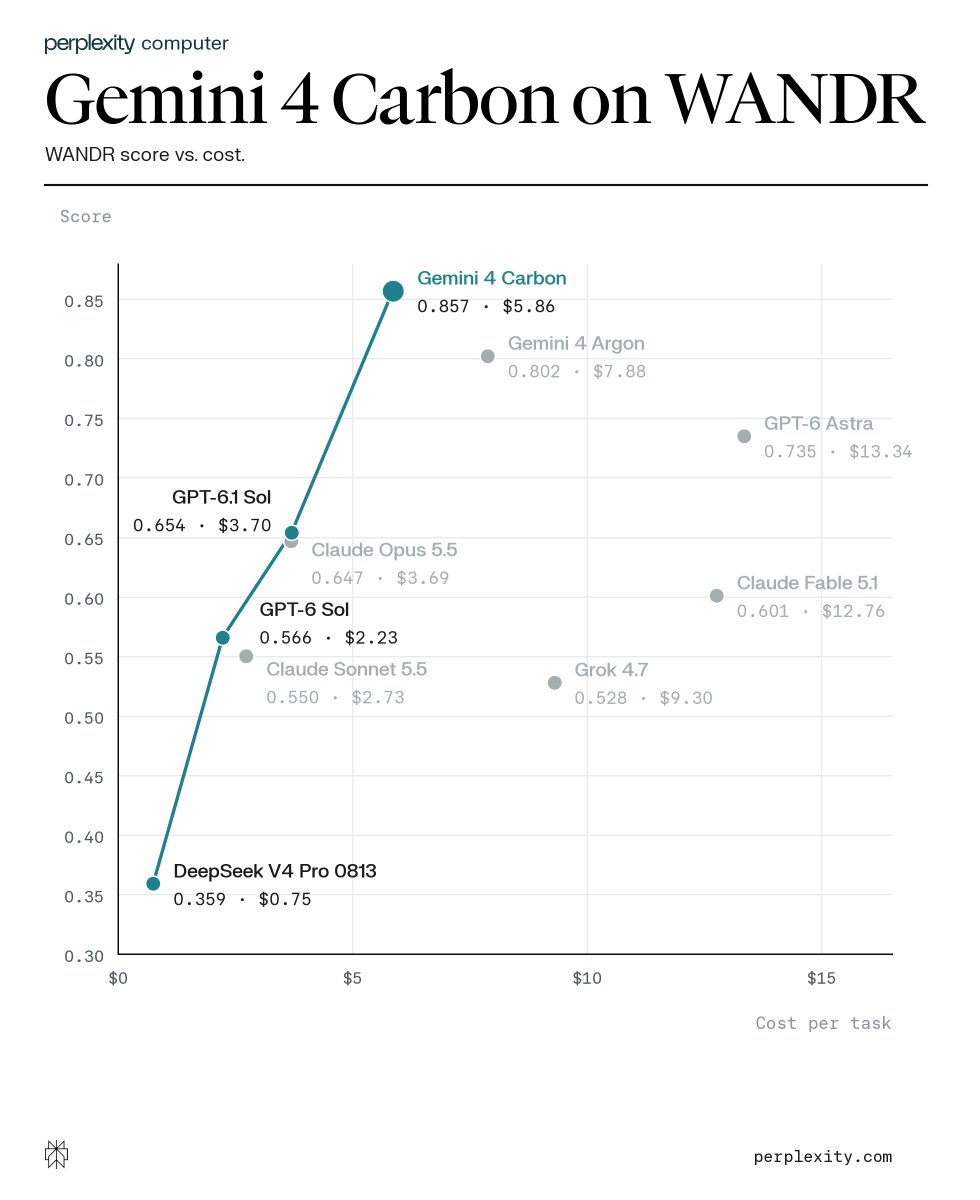
Perplexity CEO Aravind Srinivas posted early evals of Gemini 4 Carbon on X: it scored a record 0.857 on Perplexity's Wide-And-Deep-Research (WANDR) long-form research benchmark at $5.86 per task, versus 0.802 ($7.88) for Gemini 4 Argon and 0.735 ($13.34) for GPT-6 Astra. He called Carbon the strongest model Perplexity has seen for long-form research and answer quality, and said it will come to all Pro and Max users inside Perplexity Computer once there is enough token capacity.
Key Takeaways
- ✓WANDR scores (per Perplexity): Gemini 4 Carbon 0.857, Gemini 4 Argon 0.802, GPT-6 Astra 0.735, GPT-6.1 Sol 0.654, Claude Opus 5.5 0.647, Claude Fable 5.1 0.601
- ✓Cheaper too: Carbon costs $5.86 per task, below Argon at $7.88 and GPT-6 Astra at $13.34
- ✓Cost frontier in Perplexity's chart: DeepSeek V4 Pro 0813 (0.359, $0.75), GPT-6 Sol (0.566, $2.23), GPT-6.1 Sol (0.654, $3.70) and Carbon
- ✓Claude Sonnet 5.5 scored 0.550 ($2.73) and Grok 4.7 scored 0.528 ($9.30)
- ✓Not live yet: Carbon reaches Perplexity Pro and Max users only once token capacity allows, and Google still limits early access to cyber defenders in its Fairwind program
Key Decision Metrics at a Glance
Turn your technical choice into a development budget
Compare 40 dev plans & simulate token costs vs $20/mo subscriptions
Project Links & Resources
Direct AccessIn-Depth Technical Analysis
Background and the problem
Since Gemini 4 Carbon launched on October 28, Google has limited early access to cyber defenders in its Fairwind program, so most public numbers have been vendor-run. After Cognition published FrontierCode 2.0 results, Perplexity has now shared its own evals, focused on long-form research and answer quality, the core use case of Perplexity Computer.
Architecture and how it works
The evals come from a post on X by Perplexity CEO Aravind Srinivas himself, with a Perplexity Computer chart plotting WANDR score against cost per task. WANDR stands for Wide-And-Deep-Research, which by its name tests both breadth and depth of research. The post does not describe the task set or scoring, so all numbers below are Perplexity's own and have not been independently reproduced.
Benchmarks and measured results
From Perplexity's chart: Gemini 4 Carbon 0.857 ($5.86 per task), Gemini 4 Argon 0.802 ($7.88), GPT-6 Astra 0.735 ($13.34), GPT-6.1 Sol 0.654 ($3.70), Claude Opus 5.5 0.647 ($3.69), Claude Fable 5.1 0.601 ($12.76), GPT-6 Sol 0.566 ($2.23), Claude Sonnet 5.5 0.550 ($2.73), Grok 4.7 0.528 ($9.30) and DeepSeek V4 Pro 0813 0.359 ($0.75). Carbon has the top score and also costs less than Argon and Astra.
Practical guide for developers
Teams building research agents can treat this as another vendor data point on Carbon, alongside Cognition's coding results. Carbon is still not broadly available, and Perplexity says it will reach Pro and Max users only once token capacity allows. Until then, GPT-6.1 Sol and Claude Opus 5.5 score about 0.65 at roughly $3.70 per task on this chart and are the easier options to use today.
Benchmark side-by-side against alternatives, or calculate monthly token cost vs subscription break-even.
Discussion & Comments
0Sign in to join the discussion
Connect with AI developers to exchange benchmark insights.