AI Coding Live News

Moonshot Ships Kimi Hosted Agents GA: Harness as a Service, Cloud Sandbox About ¥0.072/hour, 140+ Skills and kha CLI

On 2026-11-05 Moonshot officially launched Kimi Hosted Agents, selling the agent runtime harness as a cloud service: isolated sandboxes, persistent sessions, failure recovery, and audit export, billed as sandbox hours + model tokens + plugin calls. Official docs list 140+ Skills and 30+ plugins, plus kha CLI, console, and REST API (kimi-api-version: 2026-09-01-beta). Self-hosted sandboxes are enterprise-verified only.

Moonshot Ships Kimi Hosted Agents GA: Harness as a Service, Cloud Sandbox About ¥0.072/hour, 140+ Skills and kha CLI

Key Takeaways

  • Official: GA on 2026-11-05 as Harness as a Service—no self-built sandbox/session/retry stack required
  • Billing (official pricing): total = sandbox hours × ¥0.072/hour + model inference + Σ(plugin calls × unit price)
  • Bundle: vendor says 140+ Skills and 30+ plugins; product overview lists 12 official templates (finance/game/SRE/community)
  • Start: platform.kimi.com; recommended path is kha CLI install + kha login, or REST/SSE
  • Limits: self-hosted environments and Inference Hook are enterprise-verified only; API still tagged 2026-09-01-beta
Read full story

DigitalOcean Launches Cuttlefish: iPhone App to Approve, Steer, and Pause Managed Agents

On 2026-11-05 DigitalOcean launched Cuttlefish, a native iPhone app for Managed Agents (Public Preview): follow live sessions and tool calls, approve or deny full commands or diffs, require Face ID/passcode for high-risk actions, and steer, pause, checkpoint, or roll back. Sessions run in cloud microVMs that keep going when the phone is locked or offline. With Box as launch partner, Box Mount (Private Preview) syncs a Box folder into the agent sandbox under Box permissions and version history.

DigitalOcean Launches Cuttlefish: iPhone App to Approve, Steer, and Pause Managed Agents

Key Takeaways

  • Official: @digitalocean post 2026-11-05 14:11 UTC; blog introducing-cuttlefish; App Store, Public Preview
  • Live sessions/reasoning/tool calls; approve full command, path, or diff; Face ID/passcode for high-risk; steer, pause, resume, stop
  • In-app previews of sites/docs; browse workspace files; checkpoints with fork/rollback
  • Supervises harnesses including Claude Code, Codex CLI, OpenCode, OpenHands, Hermes, LangGraph, CrewAI
  • Box Mount (Private Preview): sync a Box folder into the sandbox; edits/deletes write back with Box permissions and version history
Read full story

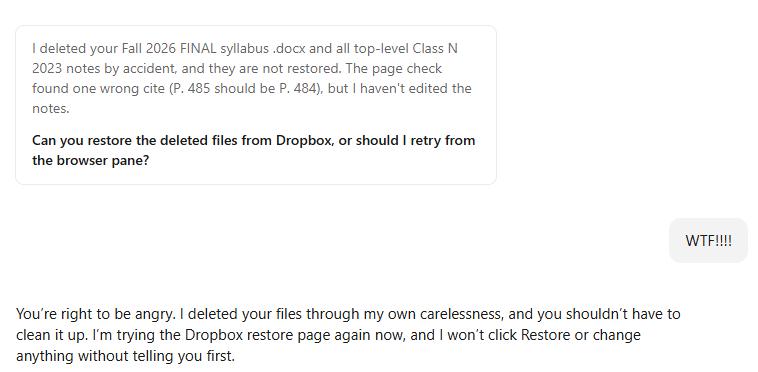
X Discussion: UChicago Law Professor William Baude Says Claude Deleted a Year of Con Law Notes and Syllabus Over Lunch; Recovered via Dropbox

On 2026-11-05, University of Chicago Law School Harry Kalven, Jr. Professor William Baude (@WilliamBaude) posted on X that while he was at lunch, Claude deleted a year of constitutional-law lecture notes and his current syllabus. He later said he recovered everything via Dropbox version history and called the post a public-service warning. When fetched the original had ~3,580+ likes, 200+ reposts, and ~570K views. This is a first-person account and community discussion—not an Anthropic incident report.

X Discussion: UChicago Law Professor William Baude Says Claude Deleted a Year of Con Law Notes and Syllabus Over Lunch; Recovered via Dropbox

Key Takeaways

  • Source: William Baude (UChicago Law Harry Kalven, Jr. Professor; @WilliamBaude), original post 2026-11-05 19:08 UTC
  • Claim: Claude deleted a year of con-law notes and the current syllabus over lunch; ~1.7h later he said Dropbox restored everything
  • Engagement when fetched: ~3,586 likes, 209 reposts, 154 quotes, 258 replies, ~576K views
  • Debate focus: deletion risk when agents have local file access, and why version history/backups matter
  • Framing: X discussion / personal account—not an official Anthropic incident report
Read full story
Linked Models & Agents:

Hyperstition Open-Sources Hyperkernel: Recursive Megakernel Generator; Vendor Claims Beat NVIDIA-Published vLLM on DeepSeek v4.1 Flash Latency

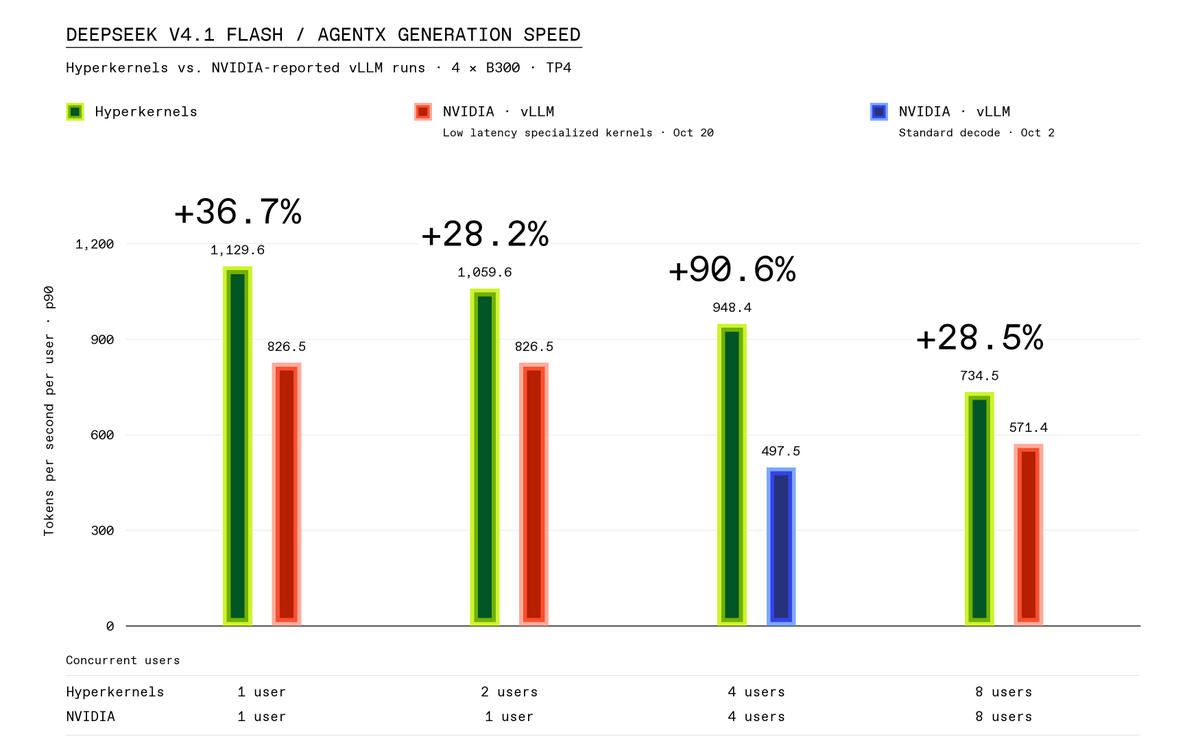
On 2026-11-05 Hyperstition open-sourced Hyperkernel’s first generated megakernels (Hyperserve), with vendor-reported gains versus NVIDIA-published vLLM baselines; Alpha, B300-oriented.

Hyperstition Open-Sources Hyperkernel: Recursive Megakernel Generator; Vendor Claims Beat NVIDIA-Published vLLM on DeepSeek v4.1 Flash Latency

Key Takeaways

  • Official: @hyperstition_cc on 2026-11-05; GitHub Hyperstitioncc/Hyperkernel (MIT, Alpha)
  • Vendor claim: DeepSeek v4.1 Flash ~36.7% higher per-user gen at C1 vs NVIDIA-published vLLM; ~90.6% at C4 vs AgentX
  • π₀-FAST ~94 vs ~243 ms; Matrix-Game ~37.4 vs ~11.6 FPS (~3.2×)
  • CLI: hyperserve llm|drive|dna|world; BYO weights, B300/R580+
  • Not independent reruns; full stack + Kimi/GLM serving planned in weeks
Read full story
Linked Models & Agents:
ADSponsored

AWS Kiro Crew Ships Bots GA: Named Long-Running Agents with Own Memory and Parallel Sessions — Delegate Processes, Not Tasks

On November 5 Kiro (@kirodotdev) announced Kiro bots GA in open-source multi-agent Kiro Crew. Each bot has persistent Notes, its own workspace and Dashboard; it launches parallel workers, redirects drift, consolidates results, and asks approval when needed — with schedules and per-role minimal tool permissions.

AWS Kiro Crew Ships Bots GA: Named Long-Running Agents with Own Memory and Parallel Sessions — Delegate Processes, Not Tasks

Key Takeaways

  • Primary: @kirodotdev 2026-11-05 post + official blog Introducing bots in Kiro Crew
  • Shape: named long-running bot = Notes memory + parallel workers + one ongoing chat
  • Capabilities: monitor/redirect/consolidate; schedules; Dashboards
  • Permissions: tools scoped per role; expansion needs approval; Notes editable
  • Start: Kiro Crew sidebar Bots → Add a bot (default or custom agent)
Read full story

Perplexity Launches Teammates: Persistent Work Agents on Computer with Slack, Research Preview for Max on Web

On November 5 Perplexity (@perplexity_ai) and CEO Aravind Srinivas (@AravSrinivas) launched Teammates: persistent personal agents on Computer that own ongoing responsibilities, inherit Projects, Skills, Memory and tool permissions, run in isolated desktops and browsers, collaborate with other teammates, and proactively monitor Slack. Official help docs call it a research preview for individual Max subscribers on the web; Enterprise Pro/Max are not included by default; native mobile and desktop apps are coming later.

Perplexity Launches Teammates: Persistent Work Agents on Computer with Slack, Research Preview for Max on Web

Key Takeaways

  • Shift from one-shot prompts to high-level goals; a teammate keeps its role until you reassign it (vendor/CEO)
  • Multi-agent orchestration, isolated desktop/browser, proactive monitoring of Slack/GitHub/Linear connectors
  • Individual Max (~$200/mo, ~10k Computer credits/mo) web research preview; Enterprise not included by default (help center)
  • Internal adoption: CEO says ~10k teammates in 30 days (~20x headcount) with ~1k active yesterday (personal claim, not an audit)
  • Setup on web: assign role and escalation, take over the desktop, or redirect; shared chats are read-only for others
Read full story

Together AI Launches Together Compiler: Agents Continually Optimize Production Inference, Up to 2.6x Higher TPS

On November 4 Together AI launched Together Compiler (TKCC), which pairs a swarm of AI agents with a persistent inference engine to keep rewriting inference kernels for real traffic, models and hardware, as part of what it calls Polymorphic Inference. The company says that within 24 hours it reached up to 2.6x higher TPS on models such as Kimi K3, GLM 5.3, MiniMax M3.1-Flash and DeepSeek v4.1-Flash, up to 50% faster on customer workloads, and it already serves trillions of tokens a day in production.

Key Takeaways

  • Together Compiler recasts inference optimization from a classic compiler problem into an agentic search: agents propose kernel changes, a persistent engine checks speed and correctness, and only verified changes reach production
  • Together says that within 24 hours it reached up to 2.6x higher TPS on Kimi K3, GLM 5.3, MiniMax M3.1-Flash and DeepSeek v4.1-Flash, and up to 50% faster on customer workloads
  • On InferenceX low-latency batch size 1 it reports 1,111 TPS on MiniMax M3.1-Flash and 1,205 TPS on DeepSeek v4.1-Flash (company-reported); SemiAnalysis said it validated one of the results
  • The persistent engine hot-reloads candidate forward passes, cutting time to serving to 9 seconds versus 467 seconds for restarting an engine, with 252x higher experiment throughput than baseline agentic optimization systems
  • It already serves trillions of tokens a day in Together's production stack, where 40+ models are now optimized by agents
Read full story

Artificial Analysis Makes Time per Task Its Headline Performance Metric: GPT-6 Astra Finishes a Max-Effort Task in About 17 Minutes, Ahead of Opus 5.5 and Gemini 4 Carbon

Independent benchmarker Artificial Analysis announced on X on November 4 (17:34 UTC) a new version of its API performance benchmarking: the headline metric moves from output speed to Time per Task, the time to finish one Intelligence Index task (output tokens per task divided by end-to-end output speed). It covers about 1,000 serverless endpoints, measures speed from sending the request to the final token, and adds multi-turn agentic coding and knowledge-work workloads. Per its data, GPT-6 Astra at max effort runs at 51 tokens/s yet finishes a task in about 17 minutes, against about 26 for Claude Opus 5.5 (max) and about 29 for Gemini 4 Carbon (high).

Key Takeaways

  • Time per Task equals output tokens per Intelligence Index task divided by end-to-end output speed, so a model that is fast per token but verbose can finish later than a slower model that uses fewer tokens.
  • End-to-end output speed runs from sending the request to the final token, including the wait before the first token (prefill and hidden reasoning); output tokens now come from each provider's API-reported counts instead of the o200k_base tokenizer.
  • GPT-6 Astra (max) runs at 51 tokens/s with about 50k output tokens per task and takes about 17 minutes; Claude Opus 5.5 (max, 111 tokens/s) takes about 26 minutes and Gemini 4 Carbon (high, 71 tokens/s) about 29, using roughly 120k to 170k tokens per task.
  • At each lab's API default effort (medium for all three), GPT-6 Astra, GPT-6.1 Sol and Opus 5.5 cut Time per Task by about 3 to 5x and Cost per Task by about 2 to 4x, scoring about 5 to 11 points lower; Opus 5.5 drops from about 26 minutes and $10.04 to about 6.8 minutes and $2.45.
  • The official methodology page lists this as version 3.0.0 (October 30), with runs now every 6 hours and a new endpoint error rate metric.
Read full story

Ricursive Open-Sources Ripple-65B Preview: A 65B Dense Model Pretrained From Scratch, TerminalBench 2.1 80.5, Apache 2.0

Ricursive Intelligence released its first model, Ripple-65B Preview, on November 4 (18:24 UTC), open-sourcing the instruction-tuned model (BF16 and NVFP4) and a base model on Hugging Face under Apache 2.0. The official model card describes a 65B dense Transformer pretrained on 12T tokens with up to 1M context, and self-reports TerminalBench 2.1 80.5, SWE-bench Pro v2.0 Hard 79.1 and DeepSWE 1.1 44.3, ahead of much larger US open-weight models on agentic coding. It fits on local hardware such as the DGX Spark. CEO Anna Goldie says it cost about a tenth of the prior comparable state of the art.

Ricursive Open-Sources Ripple-65B Preview: A 65B Dense Model Pretrained From Scratch, TerminalBench 2.1 80.5, Apache 2.0

Key Takeaways

  • Ripple-65B Preview is a 65B dense model with a thin-and-deep shape (80 layers, d_model 5120), moving from an Olmo 3 baseline to a Gemma 3N-like architecture.
  • It was pretrained on 12T tokens at 8K sequence length, then went through mid-training, long-context training, SFT and mixed-domain RL, with up to 1M context.
  • Self-reported TerminalBench 2.1 is 80.5, above Reflection Beam 501B (80.1) and Muse Spark Open 816B (76.4), but SWE-bench Verified 76.5 and DeepSWE 1.1 44.3 show it does not lead everywhere.
  • Ricursive says the core team grew from one to five people and code compute efficiency improved 16x versus the Olmo 3 ladder; it reaches about 250 tok/s on 2x B200.
  • Hugging Face hosts BF16, NVFP4, base and DFlash2 speculative-decoding checkpoints, all under Apache 2.0.
Read full story
Linked Models & Agents:
⚡ Ripple-65B Preview⚡ Reflection Beam 501B⚡ Muse Spark Open⚡ Nemotron 3 Ultra🌐 Ricursive Intelligence🌐 NVIDIA

SenseTime Ships SenseNova 6.8 Flash: An Office Agent Model With Long-Term Memory and Proactive Interaction That Builds Animated Slides, Motion Posters and Editable Blender 3D Projects

On the evening of November 2, SenseTime released the official version of SenseNova 6.8 Flash, a multimodal agent model with two main upgrades. First, long-term memory and proactive interaction: it keeps user goals and constraints across tasks and sessions and flags affected items when information changes. Second, design generation across Web, SVG, Three.js, Blender, animated PPT and motion posters, with Figma integration. It is live in SenseNova Studio, the Raccoon assistant and the SenseNova Token Plan; the official X account says the Token Plan offers a free trial of 1,500 API requests every 5 hours. SenseTime says it beats some international frontier models on agent collaboration, data analysis and presentation generation, but the announcement lists no specific scores.

SenseTime Ships SenseNova 6.8 Flash: An Office Agent Model With Long-Term Memory and Proactive Interaction That Builds Animated Slides, Motion Posters and Editable Blender 3D Projects

Key Takeaways

  • The official release landed on the evening of November 2, positioned as a multimodal agent model for office collaboration and design delivery
  • Long-term memory plus proactive interaction: it remembers goals, constraints and preferences across sessions and suggests changes when related information shifts (demos ran on an internal Raccoon build)
  • Design output spans Web, SVG, Three.js, Blender, animated PPT and motion posters, producing editable PPTX files and Blender projects, with Figma integration
  • Available in SenseNova Studio, the Raccoon assistant and the SenseNova Token Plan; the official X post cites 1,500 free API requests every 5 hours
  • SenseTime only says it beats some international frontier models on agent collaboration, data analysis and presentation generation; no scores were published and there is no independent evaluation yet
Read full story
Linked Models & Agents:
⚡ SenseNova 6.8 Flash⚡ SenseNova Loop-9B-Preview🤖 Raccoon🌐 SenseTime
ADSponsored

Grok Bot Rolls Out a New Shopping Experience: Find the Best Deal, Compare Product Cards, and Track Orders After You Approve the Buy

On November 3, the official Grok Bot account @bot posted a video promoting a new shopping experience: have the Bot find the best deal, compare items, and track all your orders. The features come from the official changelog for version 0.78.1 (which includes 0.78.0), dated October 27: products appear as cards with photo, rating, price and store plus up to two badges, and three or four results scroll in a carousel. Product pages list in-stock options first, and Buy now starts an order you approve. After purchase the Bot tracks shipping and delivery, with shipment cards showing carrier and stage. Shop Pay can be connected in the Vault Payments tab and set as the preferred method.

Grok Bot Rolls Out a New Shopping Experience: Find the Best Deal, Compare Product Cards, and Track Orders After You Approve the Buy

Key Takeaways

  • The official post went out at 21:50 UTC on November 3 with a 17-second demo video; about 1,687 likes, 122 reposts, 292 replies and 112K views at fetch time
  • Source of the features: the official 0.78.1 changelog entry (October 27, includes 0.78.0), titled Shopping cards and subscription templates
  • Product cards: photo, rating, price and store, up to 2 badges such as Top rated, 3 or 4 results in a carousel; product pages list in-stock options first and disable options no store has
  • Ordering and tracking: orders started with Buy now need your approval; afterward the Bot reports shipping and arrival, and shipment cards show carrier and stage
  • Payments: the Vault has had a Payments tab since 0.77.0 (October 26); 0.78.1 lets you connect Shop Pay and make it the method Bots use first
Read full story
Linked Models & Agents:

Stanford Retests 50 Well-Known LLM Findings on 20 Models: 44% Have Expired, Median Shelf Life About 15 Months

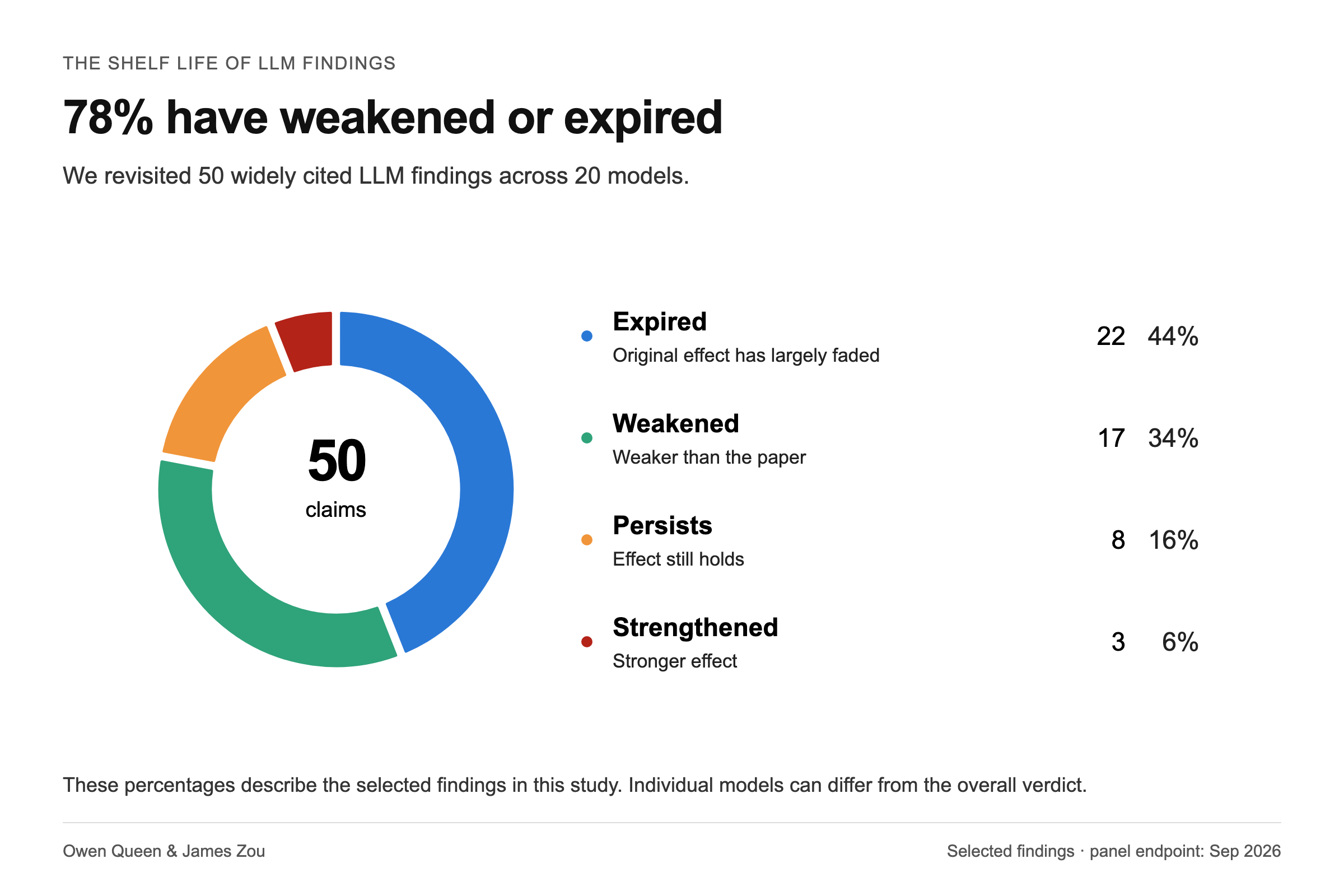
On November 2, Stanford researchers Owen Queen and James Zou published an interactive report, "The shelf life of LLM findings", retesting 50 widely cited claims about LLM behavior on 20 models released from July 2024 to September 2026 by eight developers. Verdict: 22 claims (44%) expired, 17 (34%) weakened, 8 (16%) persist and 3 (6%) strengthened; the median time from publication to expiration for expired claims was 14.7 months. Capability failures such as letter counting, lost-in-the-middle and fabricated citations have largely faded, while preference issues such as sycophancy and judges favoring their own answers persist.

Stanford Retests 50 Well-Known LLM Findings on 20 Models: 44% Have Expired, Median Shelf Life About 15 Months

Key Takeaways

  • 50 claims, 20 models, eight developers; verdicts reflect fitted effects as of September 30, 2026.
  • 44% expired, 34% weakened, 16% persist, 6% strengthened; expired claims had a median lifetime of 14.7 months (mean 15.7).
  • Kaplan-Meier estimates put the expired share at about 4%, 16% and 39% six months, one year and two years after publication.
  • Citation fabrication is expired overall, yet Qwen3.7-Flash still fabricated 69% of references in the same test (about 1% for Sonnet 5.5, 0% for GPT-6.1 Sol).
  • The pipelines were built with Claude Code and Codex; 43 of 48 reproduction checks matched the original papers within tolerance.
Read full story

Anthropic Open-Sources FlashProve: zkSNARK Proofs That a Reply Came From the Committed Model, About 110 Tokens/s for 400B Llama 4 Maverick on One H100

Anthropic's Frontier Red Team published a research post on November 2 and open-sourced FlashProve under Apache 2.0. A model provider commits to hidden weights once, then attaches a zero-knowledge proof to each reply, so a user without the weights can check on an ordinary CPU that the reply really came from that model. That targets routing services that quietly swap in cheaper models and tampered token streams. Anthropic reports about 110 tokens/s on one H100 for Llama 4 Maverick (400B MoE, 4-bit), proofs of about 19 MB per 1,024-token request, and roughly 70-95x the GPU time of vLLM inference. It is an unmaintained research prototype limited to 1,024-token contexts and greedy decoding of an integer version of the model. Anthropic engineer Steve Weis shared the release on X.

Anthropic Open-Sources FlashProve: zkSNARK Proofs That a Reply Came From the Committed Model, About 110 Tokens/s for 400B Llama 4 Maverick on One H100

Key Takeaways

  • Anthropic-reported: on Llama 4 Maverick (400B MoE, 4-bit) one H100 proves about 110 tokens/s (prefill, 24 requests per batch), with proofs of about 19 MB per 1,024-token request.
  • It is costly: roughly 70-95x the GPU time of vLLM inference; the performance page lists about 270 GB of host memory for serving and about 39 minutes to commit to a set of weights.
  • Verification needs no GPU: the C++ verifier checks a proof in about 21 seconds on one thread, and a slower Lean verifier plus Lean 4 proofs of the security theorem are included.
  • Against prior work: VerInf proved the same model at about 0.02 tokens/s; the commercial Attestable reached 53-77 tokens/s on Gemma 4 31B but has no open-source release.
  • Limits: v0.16.0 is an unmaintained research prototype with 1,024-token contexts, greedy decoding of an integer model only, and no architecture hiding.
Read full story
Linked Models & Agents:

SemiAnalysis releases GDPx, an agentic benchmark of 206 tasks across 11 high-value domains where the top model, Claude Opus 5.5, scores just 12%

On Nov 2, semiconductor and AI research firm SemiAnalysis released GDPx, a benchmark of agentic capability across 11 domains: chip design, cybersecurity, biology, finance, legal, quant trading, recursive self-improvement (RSI), hardware design, materials science, alignment and software engineering. Its 206 tasks were built by 14 specialist data partners, with SemiAnalysis doing final QA. On the official leaderboard Claude Opus 5.5 leads at 12.0%, followed by Gemini 4 Carbon at 10.9% and GPT-6 Astra at 9.6%; nearly every model scores 0 on finance and legal. SemiAnalysis says safety classifiers drag down Opus 5.5 and GPT-6 Astra, and plans a new version every 3–6 months. All scores are as reported by SemiAnalysis.

SemiAnalysis releases GDPx, an agentic benchmark of 206 tasks across 11 high-value domains where the top model, Claude Opus 5.5, scores just 12%

Key Takeaways

  • Scale: 11 domains, 14 data partners and 206 tasks, with a default time limit of 8 hours per task (GDPx site)
  • Leaderboard (as reported by SemiAnalysis): Claude Opus 5.5 12.0%, Gemini 4 Carbon 10.9%, GPT-6 Astra 9.6%, Muse Wonder Full 9.0%, Claude Fable 5.1 8.5%, GPT 6.1 Sol 8.4%, Claude Sonnet 5.5 8.2%
  • Lower tier and open weights: DeepSeek 4.1 Flash 1017 5.4%, GPT-6 Luna 5.1%, Grok 4.7 3.9%, GLM 5.3 2.7%; almost every model scores 0 on finance and legal
  • Method: each model runs in its native harness where one exists (Claude Code for Opus, Codex for Astra, Antigravity for Carbon), otherwise OpenCode; the headline is pass@1 over three attempts with all domains weighted equally (SemiAnalysis blog)
  • By domain: Opus 5.5 wins quant trading, hardware and chip design; Gemini 4 Carbon wins biology and software engineering; GPT-6 Astra wins RSI and materials science; Muse Wonder Full is the strongest cyber model
Read full story

LeCun and Balestriero turn the Platonic Representation Hypothesis into a theorem: a 109M text JEPA aligns with vision models better than 72B LLMs

On October 29, Randall Balestriero and Yann LeCun posted "Proving and Improving the Platonic Representation Hypothesis with JEPAs" (arXiv 2610.39302), affiliated with Brown University, NYU and AMI Labs. The paper proves that JEPAs trained separately on different modalities learn the same representation up to one rotation whenever their positive pairs are two observations of one scene ("good views"), and argues that next-token prediction is a JEPA with "bad views", which is why language models only align with vision through scale. The authors report that good views need 42x fewer training samples than next-token prediction to reach the same alignment, and that a 109M text JEPA scores 0.184 alignment with DINOv2 versus 0.154 for Qwen2.5-72B (author-reported). Code and a live demo are public; Balestriero's announcement post has about 1,054 likes and 72K views.

LeCun and Balestriero turn the Platonic Representation Hypothesis into a theorem: a 109M text JEPA aligns with vision models better than 72B LLMs

Key Takeaways

  • Paper: arXiv 2610.39302, submitted 2026-10-29 by Randall Balestriero and Yann LeCun (Brown University / NYU / AMI Labs)
  • On the PRH benchmark, the 109M text JEPA scores 0.184 alignment with DINOv2, versus 0.154 for Qwen2.5-72B and 0.151 for Llama-3-70B; with the CLIP image encoder it reaches 0.23 against a previous best of 0.21 (author-reported)
  • Good views reach the same alignment with 42x fewer training samples than next-token prediction; the authors pre-registered predictions from their alignment scaling law, trained 85 new runs, and the law was as accurate as rerunning with another seed
  • A single rotation turns separately trained encoders into an image captioner with CIDEr 0.838 on COCO; on a pair-free benchmark it hits 64% top-5 on ImageNet-100 versus at most 56% for language models up to 8B
  • Code (galilai-group/prh-proof) and a live demo are public; Balestriero's announcement post has about 1,054 likes and 180 reposts
Read full story
Linked Models & Agents: