AI Coding Live News

OpenAI Details Autonomous Vulnerability Pipeline: An Upcoming Cyber Model Produced Exploits and Patches for 948 Linux Kernel Privilege Escalation Bugs for $1.2M in API Costs

On November 4 OpenAI published "A thousand fewer paths to root." Its autonomous pipeline for vulnerability discovery, validation, exploitation and patching scanned the Linux kernel in mid-October with an upcoming cyber model, reproduced 1,724 vulnerabilities and produced exploits and patches for 948 distinct local privilege escalation (LPE) bugs. The run cost $1,213,430 in API credits, about $1,279 per LPE, and hundreds of reports and patches have already gone to maintainers.
OpenAI Details Autonomous Vulnerability Pipeline: An Upcoming Cyber Model Produced Exploits and Patches for 948 Linux Kernel Privilege Escalation Bugs for $1.2M in API Costs

Key Takeaways

  • Five-stage pipeline: discovery, dynamic validation, exploitability assessment, patch generation, human review
  • Of 2,308 candidate findings, 1,724 were reproduced, yielding 291 info-leak PoCs and 948 distinct LPEs
  • Total cost $1,213,430; historical Pwn2Own and TyphoonPWN bounties imply a hypothetical $18.9M to $66.3M value
  • The newer model found more than 5x the novel LPEs of a July GPT-5.6 Sol run (166)
  • The agents used at least 10 novel Linux exploitation techniques, withheld for safety reasons
Read full story
Linked Models & Agents:

Ricursive Open-Sources Ripple-65B Preview: A 65B Dense Model Pretrained From Scratch, TerminalBench 2.1 80.5, Apache 2.0

Ricursive Intelligence released its first model, Ripple-65B Preview, on November 4 (18:24 UTC), open-sourcing the instruction-tuned model (BF16 and NVFP4) and a base model on Hugging Face under Apache 2.0. The official model card describes a 65B dense Transformer pretrained on 12T tokens with up to 1M context, and self-reports TerminalBench 2.1 80.5, SWE-bench Pro v2.0 Hard 79.1 and DeepSWE 1.1 44.3, ahead of much larger US open-weight models on agentic coding. It fits on local hardware such as the DGX Spark. CEO Anna Goldie says it cost about a tenth of the prior comparable state of the art.

Ricursive Open-Sources Ripple-65B Preview: A 65B Dense Model Pretrained From Scratch, TerminalBench 2.1 80.5, Apache 2.0

Key Takeaways

  • Ripple-65B Preview is a 65B dense model with a thin-and-deep shape (80 layers, d_model 5120), moving from an Olmo 3 baseline to a Gemma 3N-like architecture.
  • It was pretrained on 12T tokens at 8K sequence length, then went through mid-training, long-context training, SFT and mixed-domain RL, with up to 1M context.
  • Self-reported TerminalBench 2.1 is 80.5, above Reflection Beam 501B (80.1) and Muse Spark Open 816B (76.4), but SWE-bench Verified 76.5 and DeepSWE 1.1 44.3 show it does not lead everywhere.
  • Ricursive says the core team grew from one to five people and code compute efficiency improved 16x versus the Olmo 3 ladder; it reaches about 250 tok/s on 2x B200.
  • Hugging Face hosts BF16, NVFP4, base and DFlash2 speculative-decoding checkpoints, all under Apache 2.0.
Read full story
Linked Models & Agents:
⚡ Ripple-65B Preview⚡ Reflection Beam 501B⚡ Muse Spark Open⚡ Nemotron 3 Ultra🌐 Ricursive Intelligence🌐 NVIDIA

webAI Open-Sources TwIL-8B: An 8.8B Reasoning Model With LiveCodeBench 81.6 and MATH-500 98.2, Under a Non-Commercial License

webAI CEO David Stout announced on X on November 4 (17:37 UTC) that the company is open-sourcing TwIL-8B. The official Hugging Face model card says it is post-trained from IBM Granite 4.2 8B with full-parameter SFT, GRPO/DAPO reinforcement learning and a length-aware RL stage, and ships in balanced and verbose variants. Self-reported scores include LiveCodeBench 81.6 (verbose), MATH-500 98.2 and IFBench 74.4, about 93% and 92% of the best frontier score, while GPQA Diamond is only 70.2. A 4.98 GiB Q4_K_M GGUF runs locally; the license is the webAI Non-Commercial License.

webAI Open-Sources TwIL-8B: An 8.8B Reasoning Model With LiveCodeBench 81.6 and MATH-500 98.2, Under a Non-Commercial License

Key Takeaways

  • TwIL-8B has 8.79B parameters, is built on IBM's ibm-granite/granite-4.2-8b, has a 131,072-token context window and is English-only, text to text.
  • Self-reported scores: MATH-500 98.2, AIME 2025 88.3, LiveCodeBench 81.6 (verbose) and IFBench 74.4 (verbose); GPQA Diamond at 70.2 trails Qwen3.5-9B (81.7) clearly.
  • The balanced variant averages about 19.5k output tokens per AIME 2026 problem, about 38% fewer than Qwen3.5-9B's 31.2k, but still roughly 4x GPT-5.5.
  • All scores are webAI internal evaluations; competitor figures are quoted from public sources and were not re-run. SWE-bench, tool use and agentic tasks were not evaluated.
  • The license is the webAI Non-Commercial License 1.0, so it cannot be used commercially as is; the Q4_K_M GGUF is about 4.98 GiB and runs with llama.cpp.
Read full story
Linked Models & Agents:
⚡ TwIL-8B⚡ Granite 4.2 8B⚡ Qwen3.5-9B⚡ Gemma 4 31B🌐 webAI🌐 IBM

AMD Q3 2026: Data Center Revenue Up 97% to $8.5B, First Helios Racks Running for Anthropic and OpenAI, Q4 Guide About $17B

AMD reported Q3 2026 results on November 3. Total revenue was $13.377B, up 45% year over year, and the Data Center segment hit a record $8.546B, up 97% year over year and 27% sequentially, driven by EPYC server CPUs and the newly launched Instinct MI450 Series GPUs. AMD says Anthropic, Meta, Microsoft, OpenAI and Oracle Cloud Infrastructure are running models and workloads on the first Helios rack-scale systems. It guided Q4 revenue to about $17B, plus or minus 3%, roughly 66% year-over-year growth at the midpoint.

Key Takeaways

  • Data Center revenue was $8.546B, up 97% year over year and 27% sequentially, about 64% of total revenue versus roughly 47% a year ago; segment operating income was $2.882B at a 34% margin
  • The first Helios racks (Instinct MI450 Series GPUs plus 6th Gen EPYC) are running models for Anthropic, Meta, Microsoft, OpenAI and Oracle Cloud, and MI455X began volume shipments this quarter
  • Total revenue was $13.377B (+45%), with 56% non-GAAP gross margin and $2.09 non-GAAP EPS; GAAP net income of $2.428B includes a $1.097B fair-value change on customer warrants
  • Q4 guidance is about $17B plus or minus 3%, roughly +66% year over year and +27% sequentially at the midpoint, with about 55% non-GAAP gross margin
  • AMD also released ROCm 10 with ROCm.AI, introduced the Helion reference architecture for rack-scale agentic systems, and announced agreements to acquire World Labs and Taalas
Read full story
ADSponsored

Google Turns Gemini and Search Off by Default for K-12 Student Accounts Until Admins Opt In, Launches Guided Learning in Classroom Globally

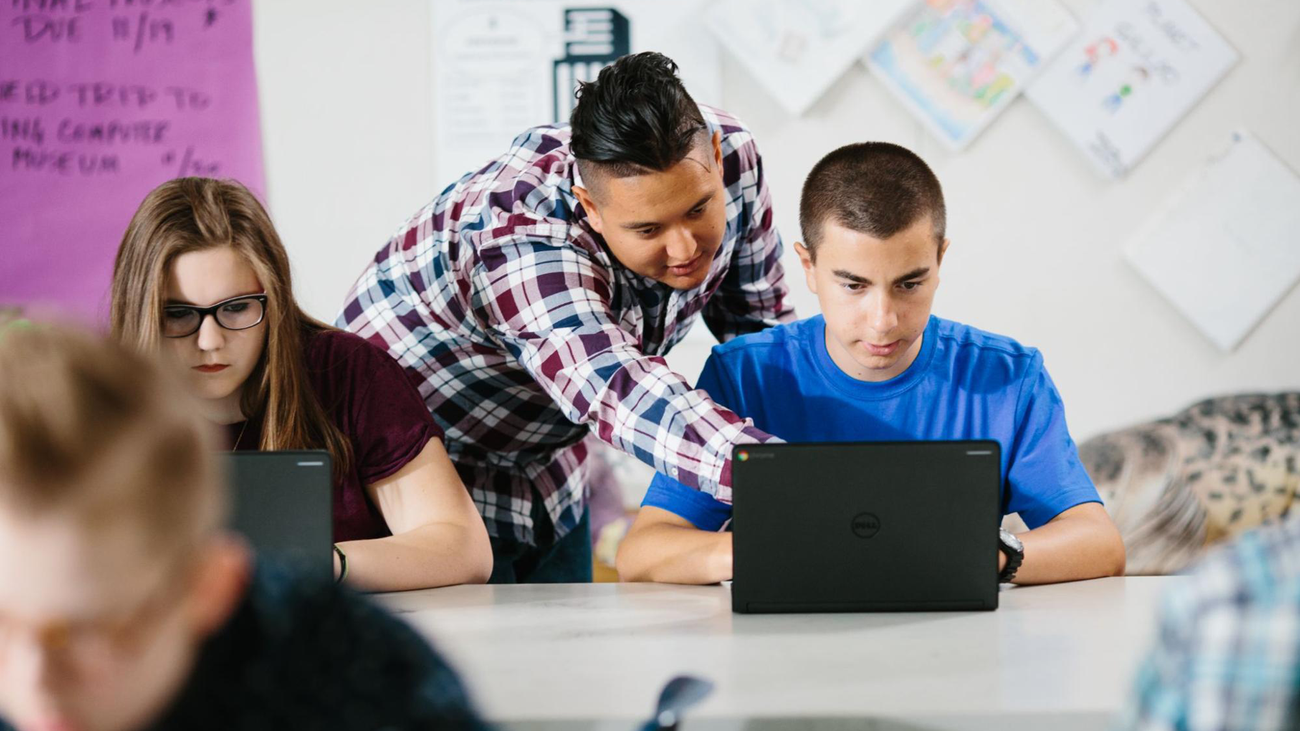
On November 3, Google VP and GM of Education Chris Phillips announced on the official Google blog that Gemini, Gemini Notebook, Gemini in Classroom and Google Search will be entirely off for K-12 student accounts until school administrators explicitly turn them on. Guided Learning is globally available in Google Classroom starting that day and is coming to Search for student accounts, with a pilot in select U.S. schools later this month. Because Search now includes AI Mode and AI Overviews, schools that want AI fully off also lose Search, which drew sharp backlash; Google later clarified on X that Search can be enabled on its own. EdWeek and AP report the change starts early next year; Google has given no exact date.

Google Turns Gemini and Search Off by Default for K-12 Student Accounts Until Admins Opt In, Launches Guided Learning in Classroom Globally

Key Takeaways

  • Off by default: Gemini, Gemini Notebook, Gemini in Classroom and Google Search are entirely off for K-12 student accounts until admins explicitly enable them (Google blog)
  • The controversy: Search now includes AI Mode and AI Overviews with no AI-free option, so student groups with AI fully off lose Search too (per EdWeek and NBC News)
  • Google clarified on X that schools can turn on Search without Gemini products, and that AI Mode and AI Overviews for students will guide them step by step instead of giving answers
  • Guided Learning is globally available in Google Classroom starting November 3; the Search version pilots in select U.S. schools later this month before wider expansion
  • Timeline: EdWeek and AP report the change starts early next year; Google only says it will share specifics in the coming months, with no exact date
Read full story
Linked Models & Agents:
⚡ Gemini🌐 Google

fal Announces $1.65B Across Series E and F for Generative Media Inference, Led by Sequoia and Bessemer with NVIDIA

fal, which hosts inference for image, video and audio models, announced on its official X account and blog on November 3 that it raised a combined $1.65B across Series E and Series F. Sequoia Capital led the Series E, closed earlier this year, and Bessemer Venture Partners led the Series F with continued investment from NVIDIA. fal did not disclose valuation or per-round amounts; Bloomberg reported the Series F at $1.3B at a $16B valuation, double the $8B from April. fal says the money funds inference capacity, hiring, and research and platform work in 2027.

fal Announces $1.65B Across Series E and F for Generative Media Inference, Led by Sequoia and Bessemer with NVIDIA

Key Takeaways

  • Confirmed by fal: $1.65B combined across Series E and F, Sequoia led E, Bessemer led F, NVIDIA continued investing (fal blog)
  • fal did not disclose valuation; Bloomberg reported the Series F at $1.3B at a $16B valuation and the Series E at $350M at $8B
  • Per Bloomberg, CEO Burkay Gur said demand spiked so much over the summer that fal had to rate limit customers, driving the large raise
  • Funds go to inference capacity, team growth and new research in 2027; fal hosts many third-party media models such as Seedance, Kling, Veo and FLUX
Read full story

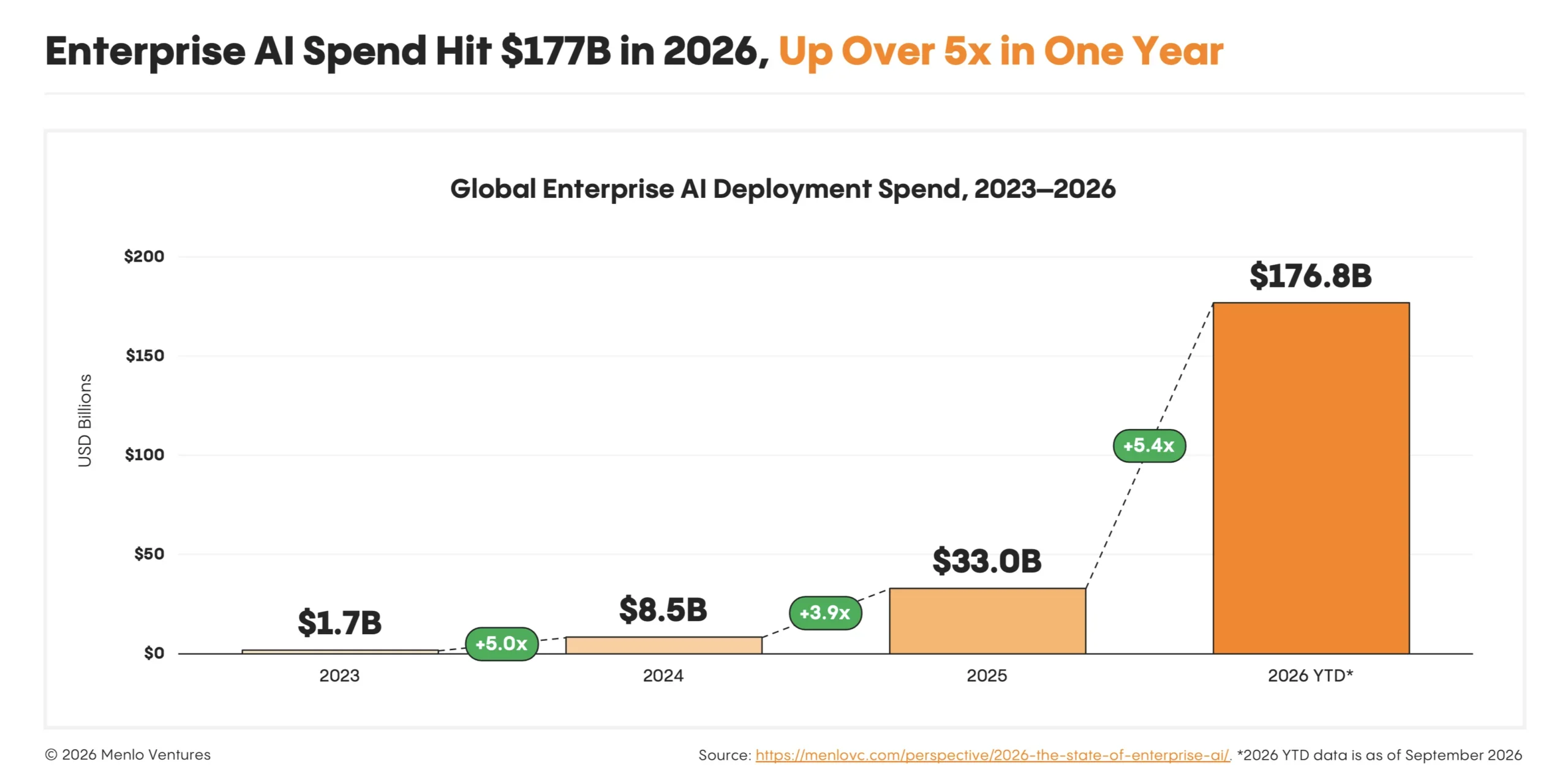
Menlo Ventures 2026 State of Enterprise AI: Enterprise AI Spend Hits $176.8B, Up 5.4x, as Anthropic Takes 55% of Enterprise API Spend

On November 3, Menlo Ventures released its fourth annual enterprise AI report. It estimates enterprise spending on using AI reached $176.8B by September 2026, up 5.4x from $33B in 2025. In enterprise LLM API spend, Anthropic rose from 40% to 55%, OpenAI from 27% to 31%, and Google fell from 21% to 9%. Coding is the largest app category at $34.0B. Figures come from a survey of about 400 US enterprise AI decision-makers plus third-party data, so they are estimates; Menlo is an Anthropic investor.

Menlo Ventures 2026 State of Enterprise AI: Enterprise AI Spend Hits $176.8B, Up 5.4x, as Anthropic Takes 55% of Enterprise API Spend

Key Takeaways

  • Enterprise AI deployment spend: $1.7B (2023) to $8.5B (2024) to $33B (2025) to $176.8B by Sep 2026, up 5.4x vs 3.9x last year (Menlo estimate)
  • Enterprise LLM API spend share: Anthropic 55% (from 40%), OpenAI 31% (from 27%), Google 9% (from 21%); open-source models are about 19% of usage but only 4% of spend
  • App-layer spend is about $77.3B: coding $34.0B and chatbots/productivity $25.0B make up 76%; Claude Code and Codex account for $24.0B (70%) of coding spend
  • On OpenRouter, agents generate 80% of tokens (about 130.9T per week), roughly 7x human usage, and have grown 37x since overtaking human traffic in February
  • 55% of incremental AI spend comes from net-new budgets and 22% from existing software budgets; the share of enterprises paying for AI rose only from 55% to 65%
Read full story

OpenAI Shares Progress on ChatGPT and Codex for Hardware Engineering: GPT-6 Astra Designs a Codex Device in Under a Week, Mazda Joins for Aerodynamics Research

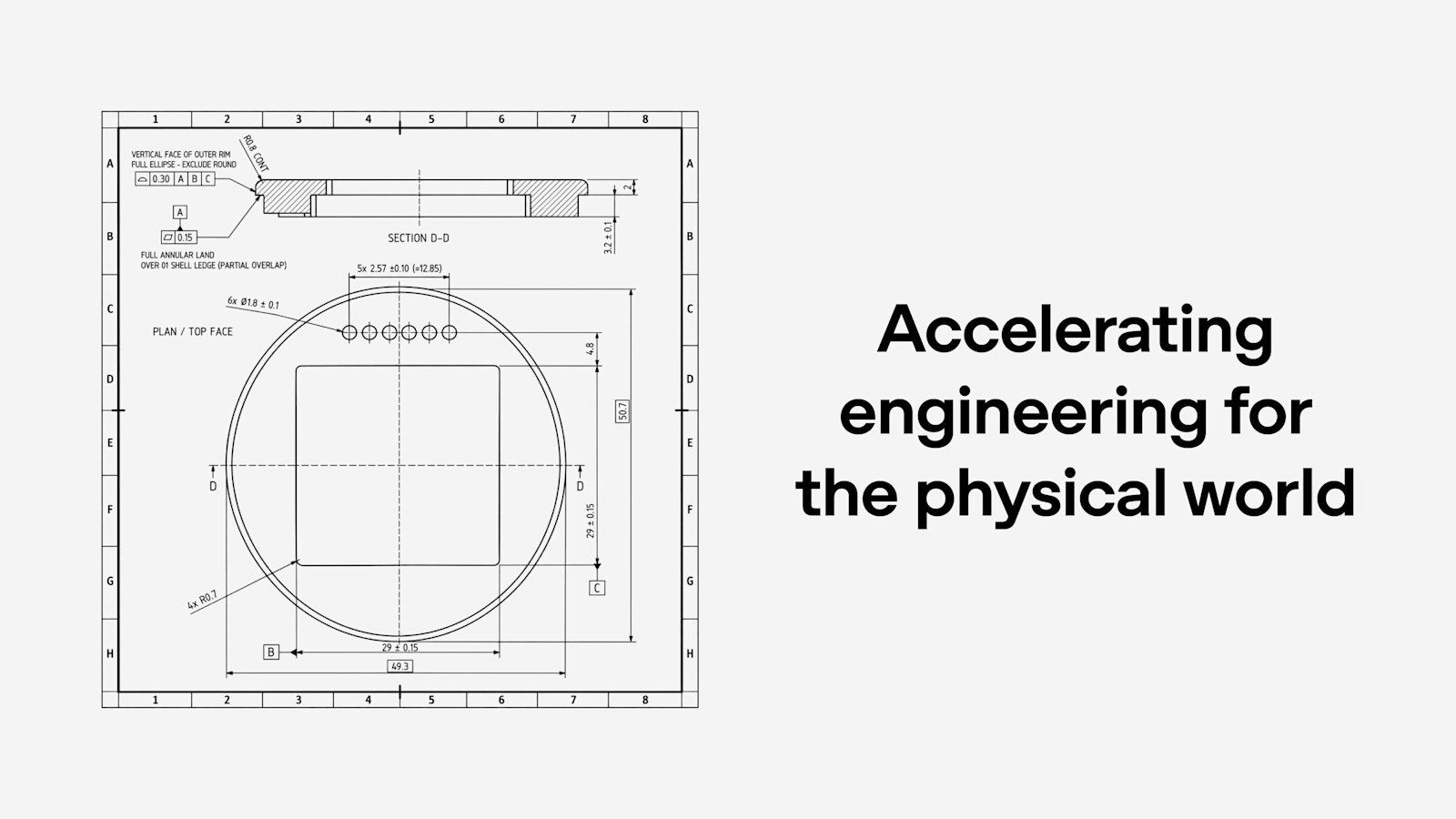
On November 3, OpenAI published "Accelerating engineering for the physical world," describing how its models help with mechanical design, electrical design and simulation. Two employees used GPT-6 Astra to design a device for talking to Codex (enclosure, PCB, firmware and software) in under a week, and a contract manufacturer built a small prototype batch in under a month, though manufacturing readiness still took several rounds of human review. Token usage across OpenAI hardware teams has grown 23-fold since February. On BenchCAD 2.0, a newer internal model averaged 0.875 versus 0.594 for GPT-6 Astra at its highest reasoning setting (OpenAI-reported). OpenAI is also expanding its work with Chip Ganassi Racing and announced a new research collaboration with Mazda.

OpenAI Shares Progress on ChatGPT and Codex for Hardware Engineering: GPT-6 Astra Designs a Codex Device in Under a Week, Mazda Joins for Aerodynamics Research

Key Takeaways

  • In a test with no direct human edits, GPT-6 Astra handled the look, enclosure structure, component selection, PCB layout, UI and firmware; two employees finished the design in under a week as a side project, and prototypes came back in under a month, per the OpenAI blog.
  • OpenAI names the gaps: Astra did not consistently account for the manufacturer's production limits, tolerances or assembly details, so manufacturing readiness took several rounds of review.
  • OpenAI hardware and infrastructure teams use Codex and ChatGPT for CAD models, 2D manufacturing drawings, simulation and FEA setup, and design reviews; token usage has grown 23-fold since February (OpenAI-reported).
  • BenchCAD 2.0 (reconstructing 3D parts and assemblies, identifying circuit-board connections): a newer internal model scored 0.875 versus 0.594 for GPT-6 Astra at its highest reasoning setting (OpenAI-reported; the internal model is unnamed and unreleased).
  • Collaborators: Chip Ganassi Racing is testing 3D-scan-to-editable-CAD and 2D drawing workflows; Mazda is working with OpenAI researchers on airflow and structural simulations for vehicle design, with results promised "in the coming months."
Read full story

Flower Labs Releases Endeavor 1.1: Multimodal, EU-Only Inference and Private Deployment With Readable Thinking Traces, Claims Parity With OpenAI and Anthropic

Flower Labs, the company behind the Flower federated learning framework, released Endeavor 1.1 on November 3, its third model this year after the UK sovereign 7B model Lizzy in April and Endeavor 1.0 in September. The update adds image input, an optional EU-only GPU inference tier, and Flower-managed, private-cloud or on-premises deployment, and promises readable thinking traces plus ownership of outputs that customers may use to train their own models. Vendor-reported scores are GPQA 94.4, HumanEval 99.9, AIME 2026 99.9 and MMMU-Pro 81.1, but the comparison uses GPT-5.6 Sol and Claude Fable 5 rather than either lab's newest models, and access is request-only for now.

Flower Labs Releases Endeavor 1.1: Multimodal, EU-Only Inference and Private Deployment With Readable Thinking Traces, Claims Parity With OpenAI and Anthropic

Key Takeaways

  • Vendor-reported: GPQA rose from 92.0 in 1.0 to 94.4 (about 30% fewer errors), HumanEval from 98.2 to 99.9; IFEval is 94.5 and MMMU-Pro 81.1.
  • In the vendor table, GPT-5.6 Sol scores GPQA 94.1, IFEval 95.9 and MMMU-Pro 83.0, and Claude Fable 5 scores GPQA 92.6; Endeavor does not lead on IFEval or MMMU-Pro.
  • New EU-only GPU inference with SLAs, with UK, Middle East, Asia and Africa regions planned.
  • The pitch is control: raw thinking traces, ownership of outputs and traces, and the right to fine-tune or train your own models on them.
  • Flower says the model builds on mature open-weight models via continual pre-training, targeted post-training and model integration, without naming the base or parameter count; access is request-only.
Read full story
Linked Models & Agents:
⚡ Endeavor 1.1⚡ Endeavor 1.0⚡ GPT-5.6 Sol⚡ Claude Fable 5⚡ Kimi K3⚡ Nemotron 3 Ultra🌐 Flower Labs

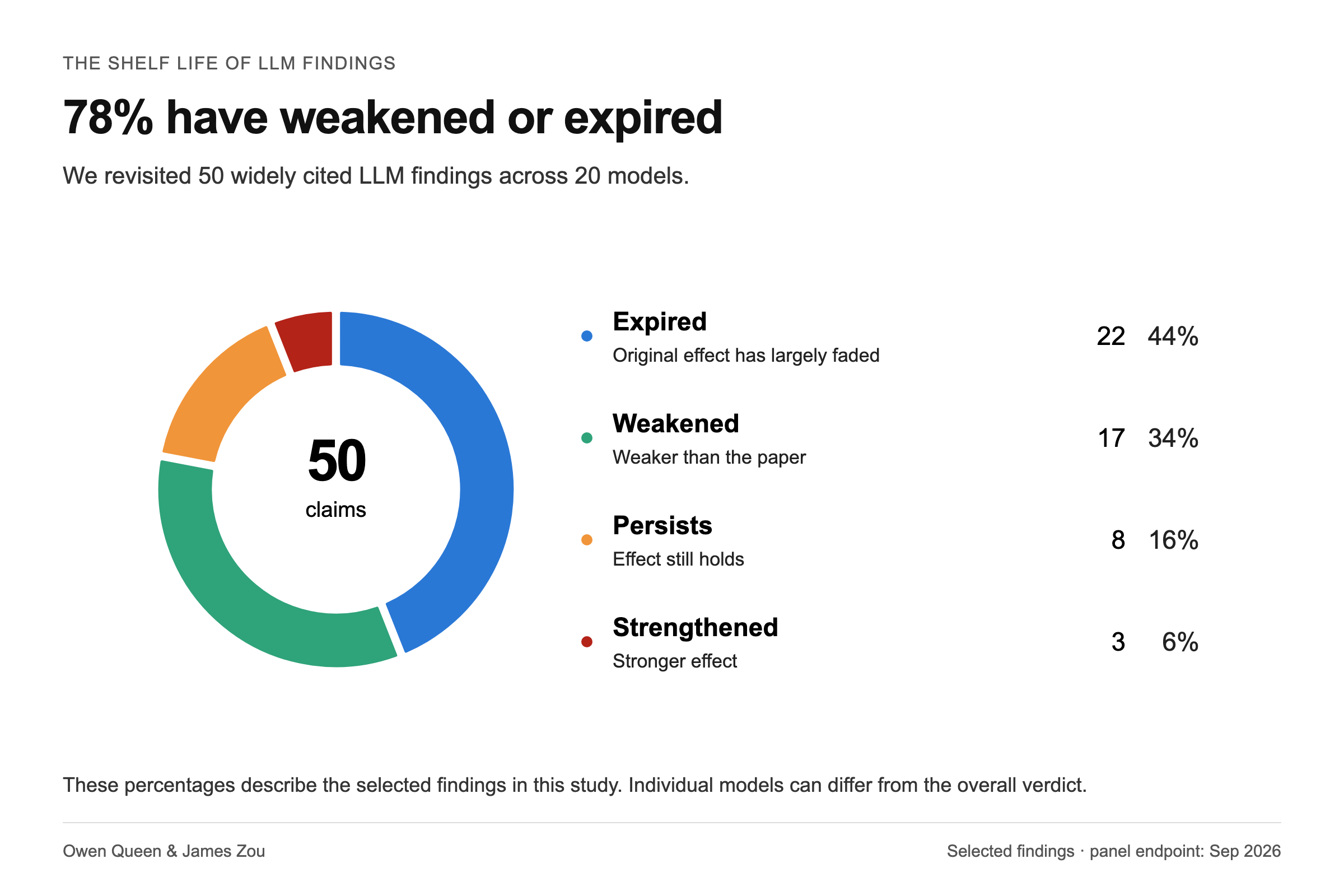
Stanford Retests 50 Well-Known LLM Findings on 20 Models: 44% Have Expired, Median Shelf Life About 15 Months

On November 2, Stanford researchers Owen Queen and James Zou published an interactive report, "The shelf life of LLM findings", retesting 50 widely cited claims about LLM behavior on 20 models released from July 2024 to September 2026 by eight developers. Verdict: 22 claims (44%) expired, 17 (34%) weakened, 8 (16%) persist and 3 (6%) strengthened; the median time from publication to expiration for expired claims was 14.7 months. Capability failures such as letter counting, lost-in-the-middle and fabricated citations have largely faded, while preference issues such as sycophancy and judges favoring their own answers persist.

Stanford Retests 50 Well-Known LLM Findings on 20 Models: 44% Have Expired, Median Shelf Life About 15 Months

Key Takeaways

  • 50 claims, 20 models, eight developers; verdicts reflect fitted effects as of September 30, 2026.
  • 44% expired, 34% weakened, 16% persist, 6% strengthened; expired claims had a median lifetime of 14.7 months (mean 15.7).
  • Kaplan-Meier estimates put the expired share at about 4%, 16% and 39% six months, one year and two years after publication.
  • Citation fabrication is expired overall, yet Qwen3.7-Flash still fabricated 69% of references in the same test (about 1% for Sonnet 5.5, 0% for GPT-6.1 Sol).
  • The pipelines were built with Claude Code and Codex; 43 of 48 reproduction checks matched the original papers within tolerance.
Read full story
ADSponsored

OpenAI Hires Former U.S. Army Secretary Dan Driscoll as Senior Counselor for National Security Modernization

On November 2 (US time) OpenAI announced on its website that Dan Driscoll, the 26th Secretary of the U.S. Army, is joining as Senior Counselor for National Security Modernization, a newly created role. He will work with senior leadership and external partners on how advanced AI can strengthen national and cyber security, with a focus on advancing responsible use with U.S. allies, and help internal teams understand the operational needs of security institutions. Reuters, CNBC and Bloomberg Law also reported the hire.

OpenAI Hires Former U.S. Army Secretary Dan Driscoll as Senior Counselor for National Security Modernization

Key Takeaways

  • The role, Senior Counselor for National Security Modernization, is newly created and works with OpenAI senior leadership and external partners.
  • Driscoll was the 26th Secretary of the Army; OpenAI says he oversaw nearly one million Active, Guard and Reserve Soldiers and more than 265,000 Army Civilians.
  • Focus: advancing responsible use of advanced AI for national and cyber security with U.S. allies, building on OpenAI's Daybreak cyber-resilience program.
  • Sam Altman framed the hire as helping spread the adoption of democratic AI with other countries and strengthening American leadership.
  • Reuters, CNBC and others report Driscoll resigned as Army Secretary earlier this year amid tensions with Defense Secretary Pete Hegseth.
Read full story
Linked Models & Agents:

Anthropic Open-Sources FlashProve: zkSNARK Proofs That a Reply Came From the Committed Model, About 110 Tokens/s for 400B Llama 4 Maverick on One H100

Anthropic's Frontier Red Team published a research post on November 2 and open-sourced FlashProve under Apache 2.0. A model provider commits to hidden weights once, then attaches a zero-knowledge proof to each reply, so a user without the weights can check on an ordinary CPU that the reply really came from that model. That targets routing services that quietly swap in cheaper models and tampered token streams. Anthropic reports about 110 tokens/s on one H100 for Llama 4 Maverick (400B MoE, 4-bit), proofs of about 19 MB per 1,024-token request, and roughly 70-95x the GPU time of vLLM inference. It is an unmaintained research prototype limited to 1,024-token contexts and greedy decoding of an integer version of the model. Anthropic engineer Steve Weis shared the release on X.

Anthropic Open-Sources FlashProve: zkSNARK Proofs That a Reply Came From the Committed Model, About 110 Tokens/s for 400B Llama 4 Maverick on One H100

Key Takeaways

  • Anthropic-reported: on Llama 4 Maverick (400B MoE, 4-bit) one H100 proves about 110 tokens/s (prefill, 24 requests per batch), with proofs of about 19 MB per 1,024-token request.
  • It is costly: roughly 70-95x the GPU time of vLLM inference; the performance page lists about 270 GB of host memory for serving and about 39 minutes to commit to a set of weights.
  • Verification needs no GPU: the C++ verifier checks a proof in about 21 seconds on one thread, and a slower Lean verifier plus Lean 4 proofs of the security theorem are included.
  • Against prior work: VerInf proved the same model at about 0.02 tokens/s; the commercial Attestable reached 53-77 tokens/s on Gemma 4 31B but has no open-source release.
  • Limits: v0.16.0 is an unmaintained research prototype with 1,024-token contexts, greedy decoding of an integer model only, and no architecture hiding.
Read full story
Linked Models & Agents:

X Discussion: MIT Team Says GPT-6 Astra Can Read and Write Neural Network Weights, Editing 0.016% of Qwen3.5-0.8B to Lift MATH-500 From 7.9% to 48.1%

On November 2, MIT CSAIL PhD student Rikiya Takehi posted "Weight-Space Programming" on X: a team (Takehi, Jayden Teoh, Alex Zhang, Omar Khattab) had GPT-6 Astra read and edit neural network weights directly, with no gradients or training. Their blog says Astra changed only 131,072 weights (0.016%) of Qwen3.5-0.8B, fixed its thinking loops and raised MATH-500 from 7.9% to 48.1%. The post drew about 24K likes and 1.77M views, and Ethan Mollick quoted it saying it is a big deal pending replication. All results are self-reported by the authors and not yet independently reproduced.

X Discussion: MIT Team Says GPT-6 Astra Can Read and Write Neural Network Weights, Editing 0.016% of Qwen3.5-0.8B to Lift MATH-500 From 7.9% to 48.1%

Key Takeaways

  • The original post (2026-11-02 17:51 UTC) had about 24,320 likes, 2,697 reposts, 2,284 quotes, 1.77M views and 15K bookmarks at fetch time; Wharton professor Ethan Mollick quoted it saying it is a pretty big deal pending replication (about 880 likes).
  • Experiment 8 (authors' figures): with a 50 forward-pass budget, Astra edited 131,072 weights (0.016%) of Qwen3.5-0.8B, raising MATH-500 from 7.9% to 48.1% and IFEval from 21.0% to 62.3%, while answers hitting the token limit fell from 93.0% to 33.1%.
  • Experiment 5 (authors' figures): with no data, gradients or tools, Astra wrote MinAtar policy networks in one shot that scored 517.4 on Breakout versus 15.8 for PPO at 100M steps and 25.3 at 500M steps; on Seaquest it scored 53.1, below the 88.9 of 500M-step PPO.
  • Limits the authors report: on Gemma 3 270M, which rarely loops, Astra's edits moved MATH-500 by no more than about a point; they conclude weight edits can remove an obstacle hiding an ability but cannot add one the model lacks.
  • Full experiment logs are public at RikiyaT/lm_understand-logs; so far there is only a blog post, with no peer-reviewed paper and no third-party replication.
Read full story
Linked Models & Agents:

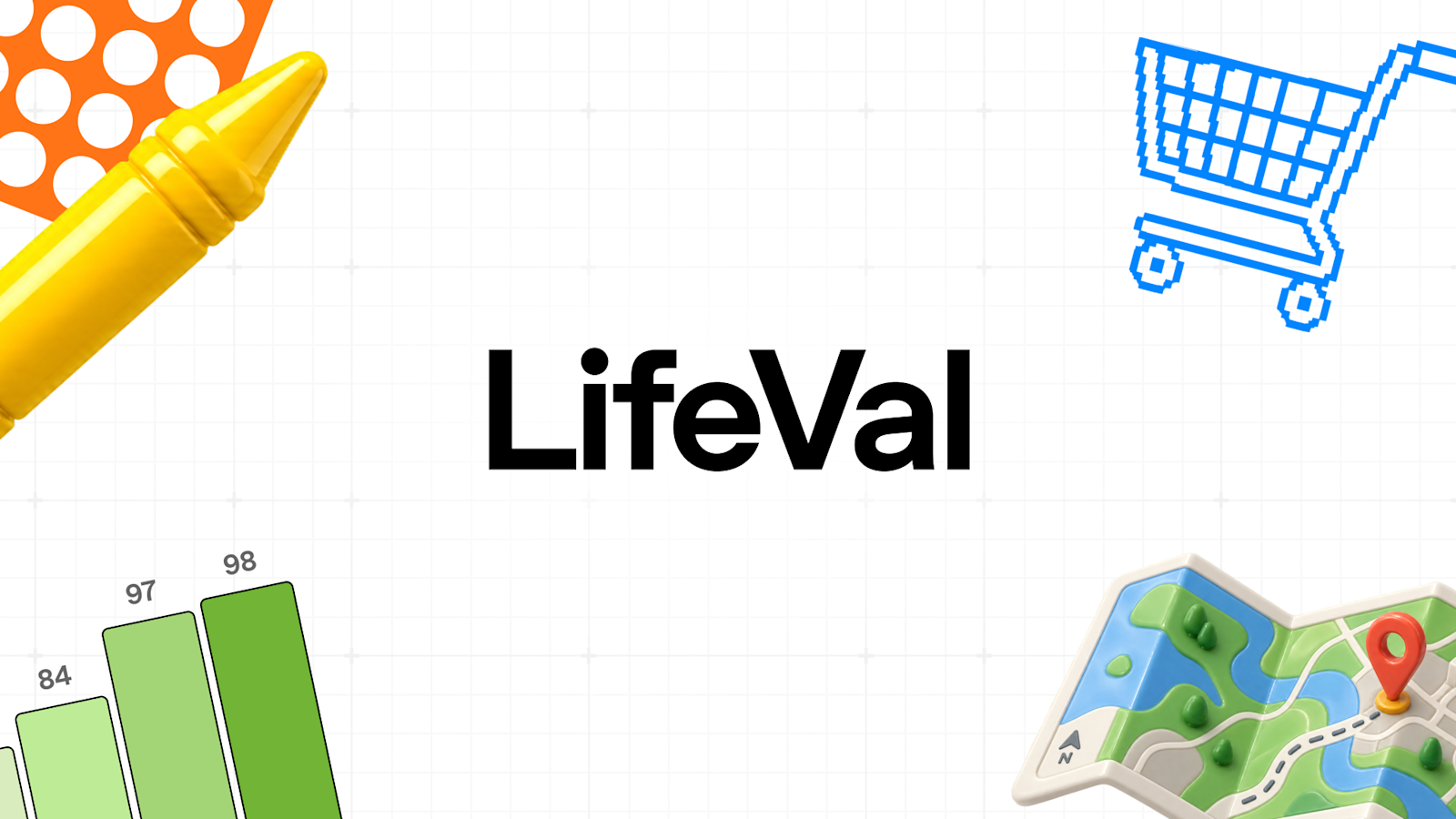
OpenAI Introduces LifeVal, a Benchmark for Everyday Life Tasks Built From Time-Use Studies and a 3,995-Person Survey

On November 2 OpenAI published LifeVal, an evaluation of whether AI can actually get everyday tasks done for ordinary people, such as finding childcare, accessing government services, budgeting, ordering groceries and adapting recipes. The task list draws on the American Time Use Survey, the Multinational Time Use Study and a new demographically representative OpenAI survey of 3,995 people. OpenAI says it has used LifeVal for the past year to track and improve its models, and it lists several best recorded GPT-6 Astra task scores, many at 100%. All scores are vendor-reported and have not been independently reproduced.

OpenAI Introduces LifeVal, a Benchmark for Everyday Life Tasks Built From Time-Use Studies and a 3,995-Person Survey

Key Takeaways

  • Task sources: the American Time Use Survey, the Multinational Time Use Study and a new representative OpenAI survey of 3,995 respondents (official blog).
  • Domains covered: caregiving, health, education, household administration, personal finances, shopping and government services.
  • Example scores (vendor-reported): kindergarten enrollment after a move 93.1%, flood volunteer coordination 98.0%, home search with deed added to cart 100%, diabetes meal plan 90.4%.
  • GPT-6 Astra's best recorded score is 100% on tasks such as booking a toddler sensory class, booking a car inspection, ordering halal groceries within budget and unsubscribing from email lists.
  • The official text we read gives no full task count or overall score, so overall figures circulating on X are not used here.
Read full story

Microsoft Open-Sources Mage-VL-Cowork, a 4B Computer-Use Agent That Chooses Between Clicking the GUI and Running Bash, Scoring 66.0% on OSWorld-Verified

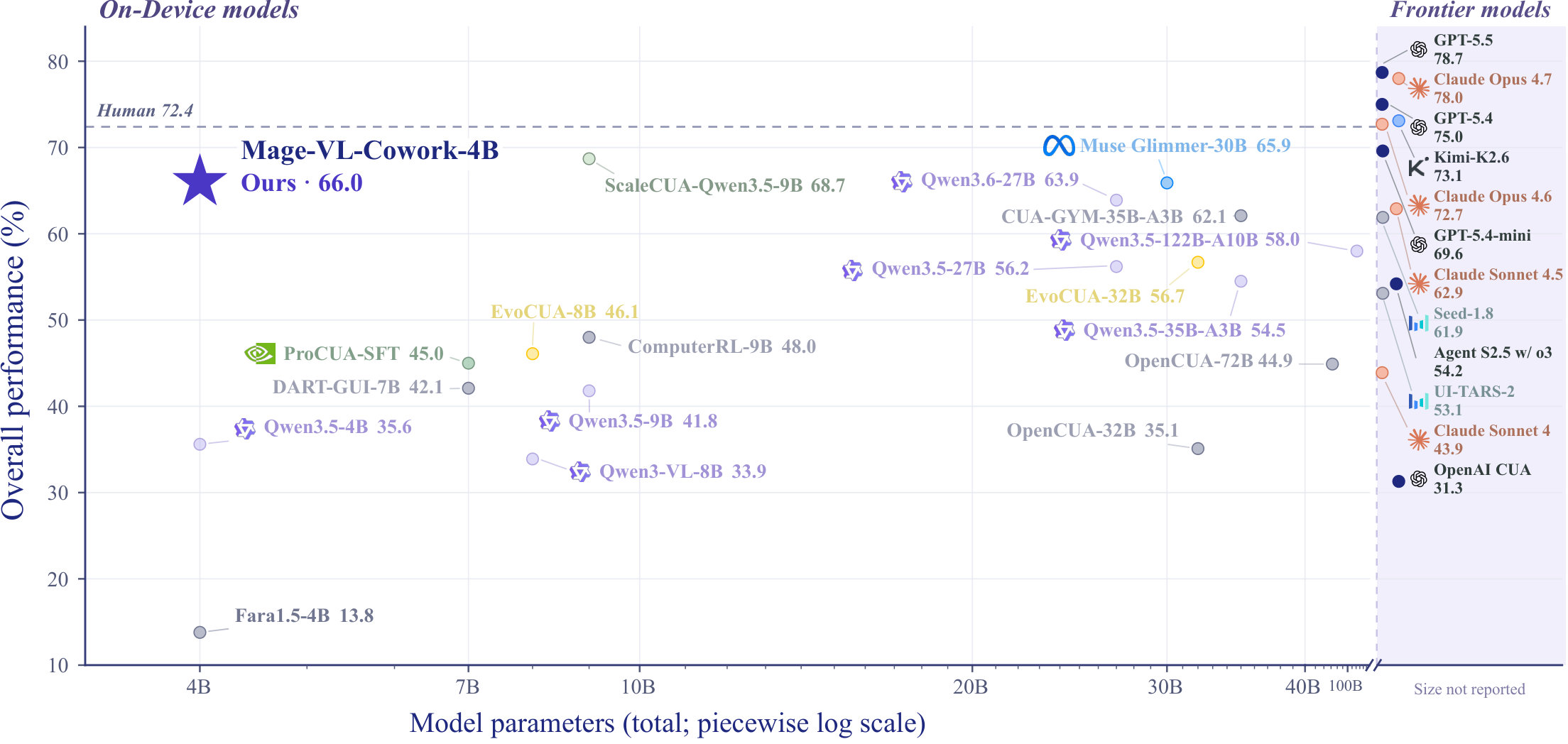
On October 30, Microsoft's Mage team released Mage-VL-Cowork on Hugging Face under Apache-2.0: a 4B multimodal computer-use agent in which a single model decides at every step whether to act through screenshots and GUI clicks (computer_use) or through bash and Python in a terminal, with no external orchestrator. Microsoft reports a two-run average of 66.0% on OSWorld-Verified (361 tasks, 50-step budget), above Qwen3.6-27B at 63.9% but below the 9B SCALECUA-Qwen3.5-9B at 68.7%.

Microsoft Open-Sources Mage-VL-Cowork, a 4B Computer-Use Agent That Chooses Between Clicking the GUI and Running Bash, Scoring 66.0% on OSWorld-Verified

Key Takeaways

  • 4B parameters, built on Mage-VL (Mage-ViT vision encoder plus Qwen3-4B-Instruct-2507); about 9.48 GB of bf16 weights under Apache-2.0.
  • On OSWorld-Verified, two independent runs scored 65.33% and 66.75% for a 66.0% average; 87.5% on operating-system tasks and 62.7% on multi-app workflows.
  • In Microsoft's side-by-side, a LibreOffice Calc chart task took 39 seconds (6 steps) via Python in the terminal, versus 9:56 (39 steps) for GUI-only Qwen3.6-27B.
  • Online RL adds 10.16 points over hybrid SFT while cutting mean model calls by 13.0% and output tokens by 25.4%.
  • Training data came from Mage-CUA-Forge, which synthesized about 294K desktop and web tasks across 6,915 skills and cut per-task generation cost from $0.906 to $0.158.
Read full story
Linked Models & Agents:
⚡ Mage-VL-Cowork⚡ Mage-VL⚡ Qwen3-4B⚡ Qwen3.6-27B🌐 Microsoft