
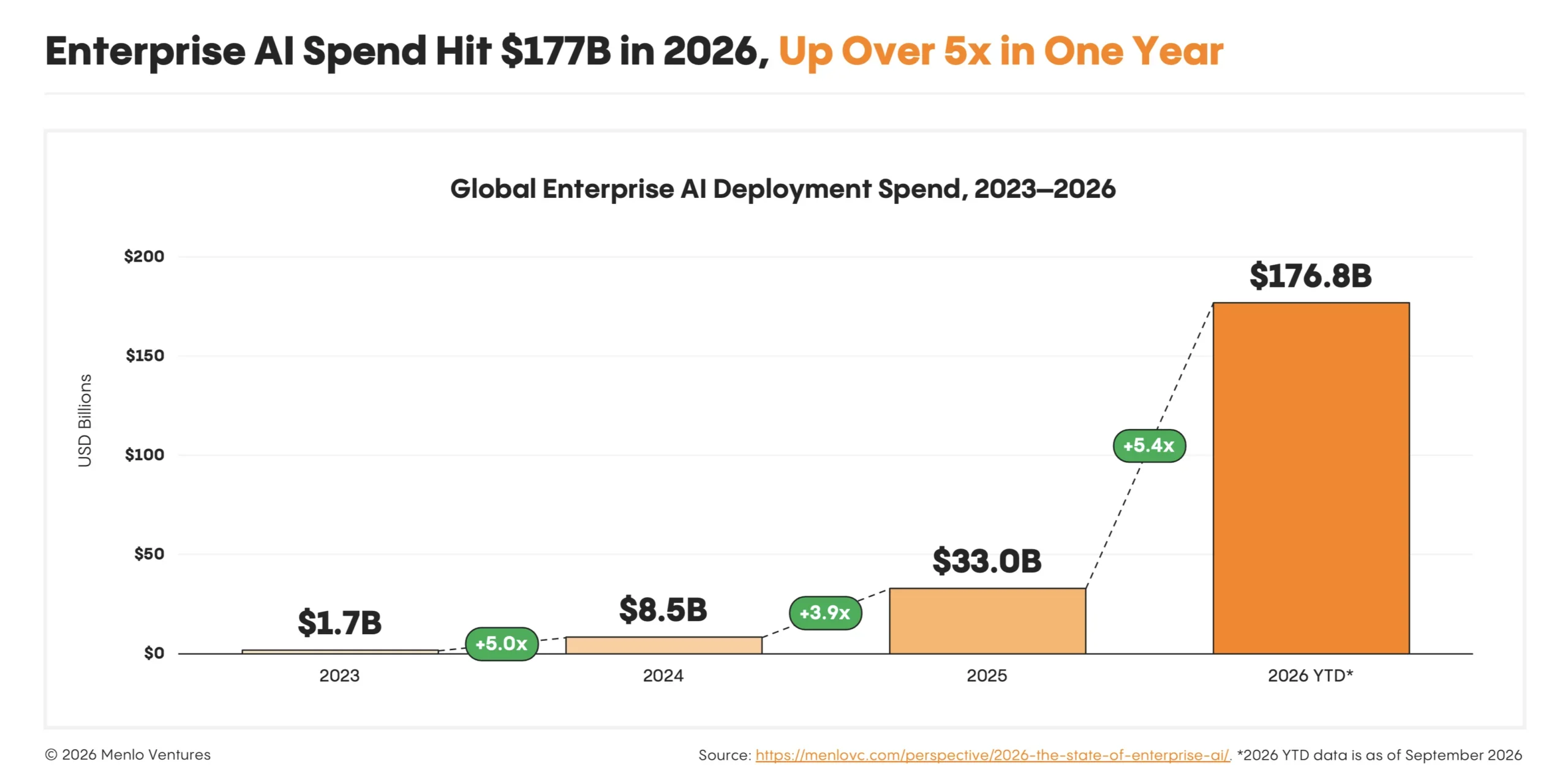
On November 3, Menlo Ventures released its fourth annual enterprise AI report. It estimates enterprise spending on using AI reached $176.8B by September 2026, up 5.4x from $33B in 2025. In enterprise LLM API spend, Anthropic rose from 40% to 55%, OpenAI from 27% to 31%, and Google fell from 21% to 9%. Coding is the largest app category at $34.0B. Figures come from a survey of about 400 US enterprise AI decision-makers plus third-party data, so they are estimates; Menlo is an Anthropic investor.
Key Takeaways
- ✓Enterprise AI deployment spend: $1.7B (2023) to $8.5B (2024) to $33B (2025) to $176.8B by Sep 2026, up 5.4x vs 3.9x last year (Menlo estimate)
- ✓Enterprise LLM API spend share: Anthropic 55% (from 40%), OpenAI 31% (from 27%), Google 9% (from 21%); open-source models are about 19% of usage but only 4% of spend
- ✓App-layer spend is about $77.3B: coding $34.0B and chatbots/productivity $25.0B make up 76%; Claude Code and Codex account for $24.0B (70%) of coding spend
- ✓On OpenRouter, agents generate 80% of tokens (about 130.9T per week), roughly 7x human usage, and have grown 37x since overtaking human traffic in February
- ✓55% of incremental AI spend comes from net-new budgets and 22% from existing software budgets; the share of enterprises paying for AI rose only from 55% to 65%
Key Decision Metrics at a Glance
Turn your technical choice into a development budget
Compare 40 dev plans & simulate token costs vs $20/mo subscriptions
Project Links & Resources
Direct AccessIn-Depth Technical Analysis
Background and industry pain points
Menlo Ventures has published an enterprise generative AI report every year since 2023; this year it is renamed "2026: The State of Enterprise AI" and remains one of the most cited estimates of enterprise AI spend. The key question this year is whether the spending boom comes from more buyers or from heavier use by existing ones. The report points to the latter: spend grew 5.4x while the share of enterprises paying for AI rose only from 55% to 65%. Note that Menlo is an Anthropic investor (marked with an asterisk in the report), and the figures are estimates from a survey of about 400 US enterprise AI decision-makers, public filings, and third-party data, not audited totals.
Architecture highlights and mechanisms
The report splits spend into using AI (deployment, $176.8B) and building models (development, $102.5B), so every $1 spent building models drives about $1.70 of enterprise usage. Agents are the main driver: token-based billing ties spend to work performed instead of seats. Menlo cites OpenRouter data showing agents now generate 80% of tokens on that platform.
Benchmarks and measured comparisons
This is market-share data, not model benchmarks (Menlo's estimates). Anthropic, OpenAI, and Google together take 69% of deployment spend ($122.7B, up from 50%); in enterprise API spend Anthropic holds 55%, OpenAI 31%, and Google 9%. Open-source models are about 19% of usage but only 4% of spend, suggesting enterprises still pay a premium for the most capable models on high-value work.
Developer adoption and getting started
For developers the clearest signal is coding: 96% of the $34.0B coding spend goes to AI-native vendors, and Claude Code plus Codex account for about $24.0B. When building agent products, favor workflows whose results can be verified (code, tests, tickets) and price per task rather than per seat. The full report and PDF are free on Menlo's site; when quoting numbers, label them as Menlo Ventures estimates.
Benchmark side-by-side against alternatives, or calculate monthly token cost vs subscription break-even.
Discussion & Comments
0Sign in to join the discussion
Connect with AI developers to exchange benchmark insights.