On November 12, ByteDance's BytePlus and Volcano Engine jointly launched the Dreamina Seedance 2.5 Flash video generation model. ByteDance calls it the closest model yet to flagship Seedance 2.5 in quality, says it generates nearly twice as fast, and says it beats the previous flagship Seedance 2.0 overall. BytePlus prices it at $0.070 per second at 480p and $0.152 per second at 720p, while Volcano Engine in China charges about 0.99 yuan per second at 720p; both are roughly 34% below Seedance 2.5. A single clip runs up to 30 seconds with up to 10 images, 5 videos and 5 audio clips as references. The launch covers only 480p and 720p, without Draft mode. It is rolling out on Dreamina and partner platforms now, and the ModelArk and Volcano Ark APIs open on November 15 at 14:00 (UTC+8).
Zoom
Key Takeaways
Speed and quality: about 2x the generation speed of Seedance 2.5; ByteDance says quality is the closest yet to the flagship and better than the previous flagship Seedance 2.0 overall (vendor claim, no third-party benchmark yet)
Global pricing: $0.070/sec at 480p and $0.152/sec at 720p, versus $0.103 / $0.231 for flagship Seedance 2.5, so 720p is about 34% cheaper (BytePlus comparison chart)
China pricing: about 0.99 yuan/sec for 720p text-to-video and image-to-video on Volcano Engine, also about 34% below Seedance 2.5
Specs: clips up to 30 seconds, up to 10 images + 5 videos + 5 audio clips as references (flagship allows 30+10+10); launch resolutions are 480p/720p only, no Draft mode
Availability: rolling out on Dreamina, LibTV, Updream, Creao AI and TapNow now; BytePlus ModelArk and Volcano Ark APIs open November 15, 14:00 (UTC+8)
On November 12 at Baidu World 2026, Robin Li launched Token Exchange, a model marketplace he compared to a stock exchange for AI models. It brings many model service providers together so developers integrate one API, compare models and providers on quality, latency and price, and switch between them. To counter resellers that swap models or inflate specs, Baidu vets provider credentials and runs model fingerprint comparisons plus capability, performance and availability tests before listing, then spot-checks providers afterward and keeps a public credit rating and record for each. Baidu says that one month in, the platform lists over 100 model resources and handles more than 50M calls and 700B tokens a day.
Zoom
Key Takeaways
Positioning: a neutral model brokerage platform that Robin Li calls an exchange for AI models (Baidu post)
Scale (per Baidu): one month in, 100+ model resources, 50M+ calls and 700B+ tokens a day
Listing checks: provider vetting, model fingerprint comparison and capability, performance and availability tests, aimed at model swapping and inflated specs
Ongoing oversight: regular spot checks, continuous quality monitoring and provider credit ratings covering service quality, delivery, compliance and contract performance, with alerts to users when a rating drops
Integration: one API to compare quality, latency and cost across providers and switch freely; the product page still shows older figures (70+ resources, 200B tokens a day)
At the Baidu World 2026 opening on November 12, Baidu launched two ERNIE application models, the ERNIE Lightning Deep Thinking model and the ERNIE Wizshot Micro-Expression model, both live on Baidu AI Cloud Qianfan with API access. The matching text model in the Qianfan docs is ERNIE-Light-DT-1.0: a 1M-token context, up to 128K output tokens, switchable thinking and a default reasoning effort of max. Its official OpenRouter description says it is built on open-source GLM models with research from Baidu Search's Lightning model and Baidu Sparse Attention (BSA). Wizshot Micro-Expression (ERNIE-Wizshot-ME) turns a single portrait into a 4 to 15 second 1080p talking video at a list price of 0.7 yuan per second. Baidu has not published any benchmarks.
Zoom
Key Takeaways
ERNIE-Light-DT-1.0: 1M-token context, up to 128K output (131,072 on OpenRouter), default Qianfan rate limit of RPM 60 / TPM 1M
Qianfan pricing (official): 0.008 yuan per 1K input tokens, 0.0008 yuan for cache hits and 0.028 yuan for output; the OpenRouter international endpoint lists $1.13 / $3.94 per million tokens
Under the hood: built on open-source GLM with research from Baidu Search's Lightning model and BSA sparse attention, using feedback-driven history compression to cut KV cache and compute costs
Wizshot Micro-Expression (ERNIE-Wizshot-ME) animates a single portrait into a 4 to 15 second 1080p talking video at 0.7 yuan per second, with a default concurrency of 1
Baidu has published no benchmarks and no open weights, and Light-DT is priced about 4x higher than ERNIE 5.5 Flash Preview
Independent evaluator Artificial Analysis (AA) said on November 12 that Claude Fable 5.2, released by Anthropic this week, scores 75 on AA-Robotics v0.1 and is the new leader, ahead of former leader GPT-6 Astra (69) and GPT-6.1 Sol (65). The benchmark has coding agents drive a 6-axis robot arm through an HTTP API across eight tabletop tasks. AA says Fable 5.2 is the first model to score on the measure-the-box task, which it did from camera video alone, using a tape measure placed in the scene as a scale to estimate the box's dimensions. Its predecessor, Fable 5.1, scored 46.3 on the launch leaderboard in October.
Zoom
Key Takeaways
New AA-Robotics v0.1 leader: Claude Fable 5.2 at 75, GPT-6 Astra 69, GPT-6.1 Sol 65 (AA figures)
A big jump from its predecessor: Fable 5.1 scored 46.3 on the October launch leaderboard, Opus 5.5 48.8
No model had scored on the measure-the-box task (dimensions within about 2 mm) before; Fable 5.2 is the first
Fable 5.2 used camera video only, reading the markings of a tape measure in the scene as a scale
AA has not yet published cost or time per task for this run; at launch Astra averaged about 30 minutes and $16.36 per task
Independent evaluator Artificial Analysis reran VIALS-AA, its life-sciences visual reasoning benchmark, in a one-shot format with one request and no tools. Tool use lifted the cross-model average from about 25% to about 47%. Leader Claude Fable 5.2 (max) scores 67% with tools at $4.20 per task but 44% without them at $0.73, while Claude Haiku 5.5 (max) reaches 49% with tools at $0.07 per task. The same day AA also reported that across the Claude lineup, moving up a model tier usually beats maxing out effort on intelligence per dollar.
Zoom
Key Takeaways
Tools lift the VIALS-AA cross-model average from ~25% to ~47% (AA figures)
Fable 5.2 (max): 67% at $4.20/task with tools vs 44% at $0.73 without, a 5.8x cost gap
Haiku 5.5 (max) scores 49% at $0.07/task with tools; Opus 5.5 without tools scores only 34% at $0.33
On 23 cell-counting tasks, Fable falls from 65% to 9% and Opus 5.5 (max) from 57% to 4% without tools
Claude lineup: Opus 5.5 (xhigh, 57) beats Sonnet 5.5 (max, 55) at 40% lower cost per task and about half the time
On November 11 Databricks released Genie plugins, which it says work natively in ChatGPT, Claude, Microsoft Copilot Cowork and Grok Bot; agents without a native plugin can connect through the Genie One MCP server. An agent can hand a business question to Genie, which interprets terms using certified definitions in Genie Ontology, writes and runs SQL only over data the user may access, routes to domain Genie Agents such as finance or marketing when needed, and returns an answer with citations. Or the agent can just fetch the missing business context and keep working with its own tools.
Zoom
Key Takeaways
Native plugins in 4 clients: ChatGPT, Claude, Microsoft Copilot Cowork and Grok Bot; other agents connect through Genie One MCP (system.ai.genie_one_mcp)
Governance: SQL runs only over data the user may access, metrics use certified Genie Ontology definitions, and answers cite their sources
Legacy endpoint: the Beta /api/2.0/mcp/genie endpoint reaches end of life on 2026-11-30; tool names and arguments are unchanged, so migrate to the GA server
MCP Apps: supporting clients show interactive charts and Ontology citations inside the conversation
Benchmarks: no accuracy or latency figures published
At its New York Summit on November 11, ElevenLabs laid out its next phase for agents. Available now: NVIDIA Nemotron 3.5 Super VL in the ElevenAgents model list, the ElevenLabs Partner Program with a McKinsey alliance, and free early access to a new app called ElevenAI. Previewed or coming in the next few months: Interaction Engine, which manages turn-taking and interruptions and picks the right LLM for each step (cheap models for triage, frontier models for complex steps such as refunds); Memory and Routines in ElevenAgents; and fine-tuning of open-source LLMs and ElevenLabs voice models on enterprise data.
Zoom
Key Takeaways
Live now: NVIDIA Nemotron 3.5 Super VL in ElevenAgents; on the ElevenAgents customer-support benchmark it leads end-to-end task completion at 70% lower cost than other leading open models, and with reasoning off it ranks among the 3 fastest models on the platform (vendor figures)
Preview: Interaction Engine handles turn-taking and interruptions and switches between cheap and frontier LLMs per conversation step to save tokens
Coming: Memory keeps preferences and constraints returning customers mentioned; Routines run multi-step work before, during and after calls (pre-screening, callbacks, CRM writes, email reports)
Ecosystem: 550+ partners in 44 countries; from next year the Marketplace lets buyers pay for industry agents with existing ElevenLabs commitments
Compute: 15 MW of new NVIDIA Vera Rubin capacity; an on-prem voice agent for Poland's national e-Health platform (about 40 million appointments a year)
On November 11 Google AI Studio announced that Managed Agents on the Gemini API can now use your own sandbox. Until now, managed agents such as Antigravity ran their tools only in a Google-hosted Linux sandbox. Now the agent loop and model calls stay with Google, while tool calls such as shell commands and file reads and writes can run in your own container, VM or microVM. To connect, call POST /v1beta/environments with {"mode":"self_hosted"} to get an environment id and an environment_key that is returned only once, then run environments connect from the open-source gemini-api CLI inside your sandbox. All traffic is outbound HTTPS, so no inbound ports need to be opened.
Zoom
Key Takeaways
Split: the agent loop, model and interaction stream stay with Google, while 7 built-in tools (execute_bash, file read/write/edit, list_dir, grep_search, find_by_name) run in your environment
Network: 100% outbound HTTPS, no inbound ports; the worker holds only an environment-scoped environment_key, so the project-wide GEMINI_API_KEY stays out of the sandbox
Two modes: environments connect runs one long-lived worker; environments poll + serve starts a fresh sandbox per interaction that holds only a short-lived lease token and zero API keys
Official examples cover 8 targets: Cloud Run, Agent Substrate, Cloudflare Sandbox, Daytona, E2B, Fly.io, Modal and Vercel Sandbox, plus Docker and rootless Podman recipes
Limits: sources, network, env and /files snapshots apply only to Google-hosted environments; self-hosted ones return 400 INVALID_ARGUMENT. Separate pricing has not been announced
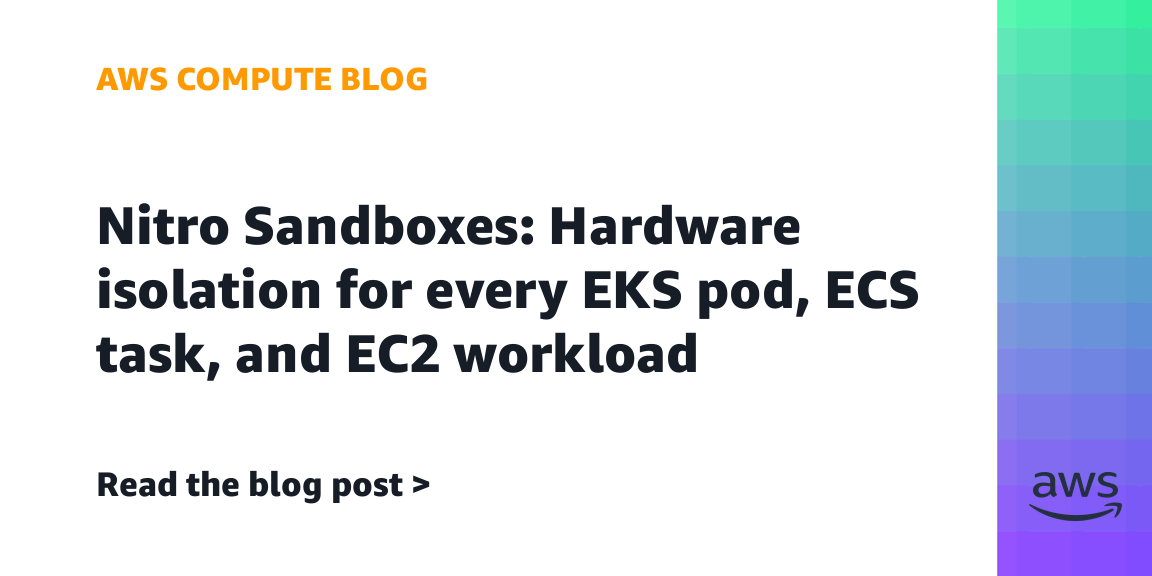
AWS introduced Nitro Sandboxes this week and promoted them again on its official X account on November 11. A Nitro Sandbox is a lightweight VM managed by the Nitro Hypervisor: each EKS pod, ECS task or EC2 workload gets its own kernel and a hardware-isolated boundary while still running on EC2 instances you already have. AWS names AI agents that run LLM-generated code as a core use case: one sandbox per session, so code that a prompt injection tricks the agent into running stays trapped in that VM, which is deleted when the session ends. Turning it on in EKS or ECS is a one-line change; it works on most Nitro-based instances in all commercial Regions at no additional charge.
Zoom
Key Takeaways
Isolation: 1 dedicated VM with its own kernel per pod, task or agent session, so a kernel bug in one sandbox does not reach its neighbors; no nested hypervisor, so CPU and memory run at near-native EC2 performance
Enablement: on EKS add 1 runtimeClassName line to the pod spec (confidential-sandbox or isolated-sandbox); on ECS set isolationMode in a Managed Instances task definition
Two modes: Isolated trusts the node operator and launches faster; Confidential is fully attestable, with image loading gated by a Cedar policy and KMS releasing secrets only to sandboxes that prove they run approved code
AI use cases: one sandbox per agent session, deleted when the session ends; model providers can deploy closed weights in a customer account that are decrypted only inside an attested sandbox
Pricing and reach: 0 additional charge (you pay for EC2 plus the EKS Auto Mode or ECS Managed Instances fee), on Graviton, Intel and AMD, with native Amazon Linux and Firecracker support
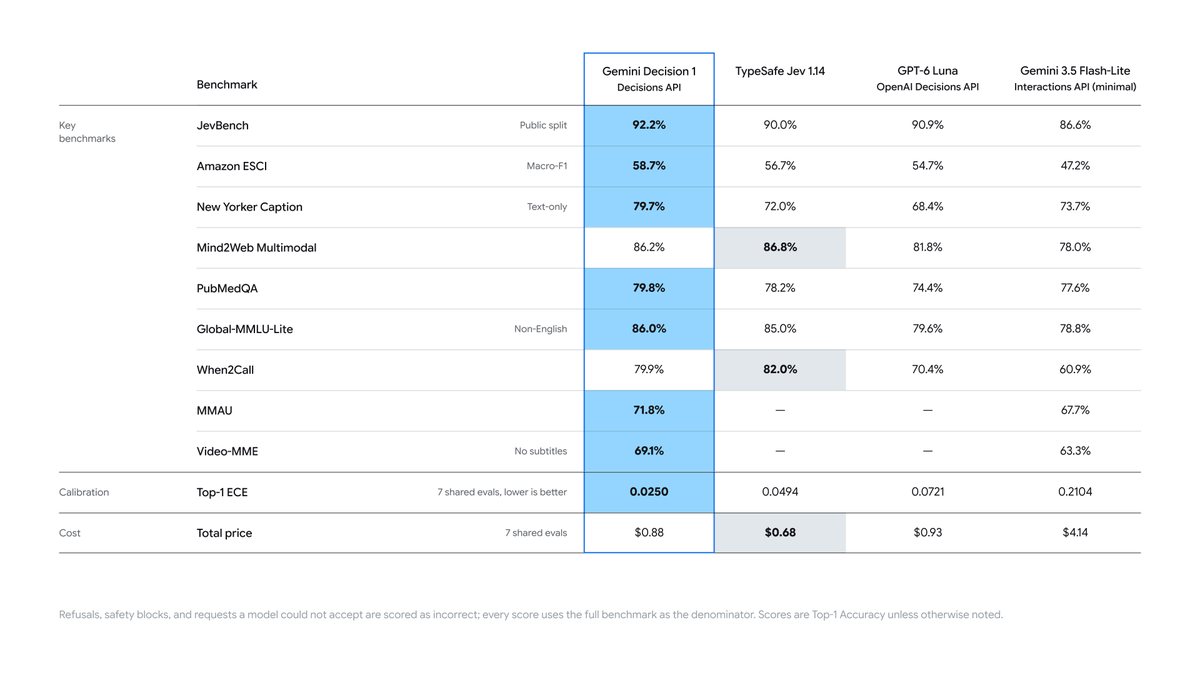
On November 11 Google formally announced the Gemini Decisions API and its dedicated decision model Gemini Decision 1 (gemini-decision-1) through posts from Sundar Pichai, @Google, @GoogleAIStudio and Logan Kilpatrick. Instead of generating text token by token, it scores up to 1,000 yes/no, choice (2 to 255 options) and rubric questions in one forward pass and returns probabilities with confidence, across text, images, audio, video and PDFs with a 256K context. Google says end-to-end latency is 150 to 250 ms and stays nearly flat from 1 to 100 questions; input costs $0.10 per million tokens with output free, about one fifth of Gemini 3.5 Flash-Lite's total cost on the shared benchmark suite. In Google's table it ranks first on 7 of 9 evals, and its Top-1 calibration error across 7 shared evals is 0.0250, lower than TypeSafe Jev 1.14 and OpenAI's GPT-6 Luna. Our earlier report was based on the API changelog before any announcement; the launch is now official and the claim that the model had been pulled does not hold. Independent tester Artificial Analysis scores it 66 on its Decision Index, short of the leaders.
Zoom
Key Takeaways
Official launch: announced together by Sundar Pichai, @Google, @GoogleAIStudio and Logan Kilpatrick; model ID gemini-decision-1
Up to 1,000 questions per request with a 256K context; median model compute 50 to 100 ms, 150 to 250 ms end to end (Google figures)
Google's table: first on 7 of 9 evals, e.g. JevBench 92.2% and Amazon ESCI 58.7%; it trails TypeSafe Jev 1.14 on Mind2Web Multimodal (86.2%) and When2Call (79.9%)
Top-1 calibration error 0.0250 vs 0.0494 for TypeSafe Jev 1.14, 0.0721 for GPT-6 Luna and 0.2104 for Gemini 3.5 Flash-Lite; independently, Artificial Analysis scores it 66 on Decision Index v2.1, 7 behind leaders Drex Max v1.1 and GLiDE v1.2 (73), Brier 0.18
Pricing: $0.10 per million input tokens, $0 output; $0.88 total across 7 shared evals vs $4.14 for Flash-Lite, while TypeSafe Jev 1.14 is cheaper at $0.68
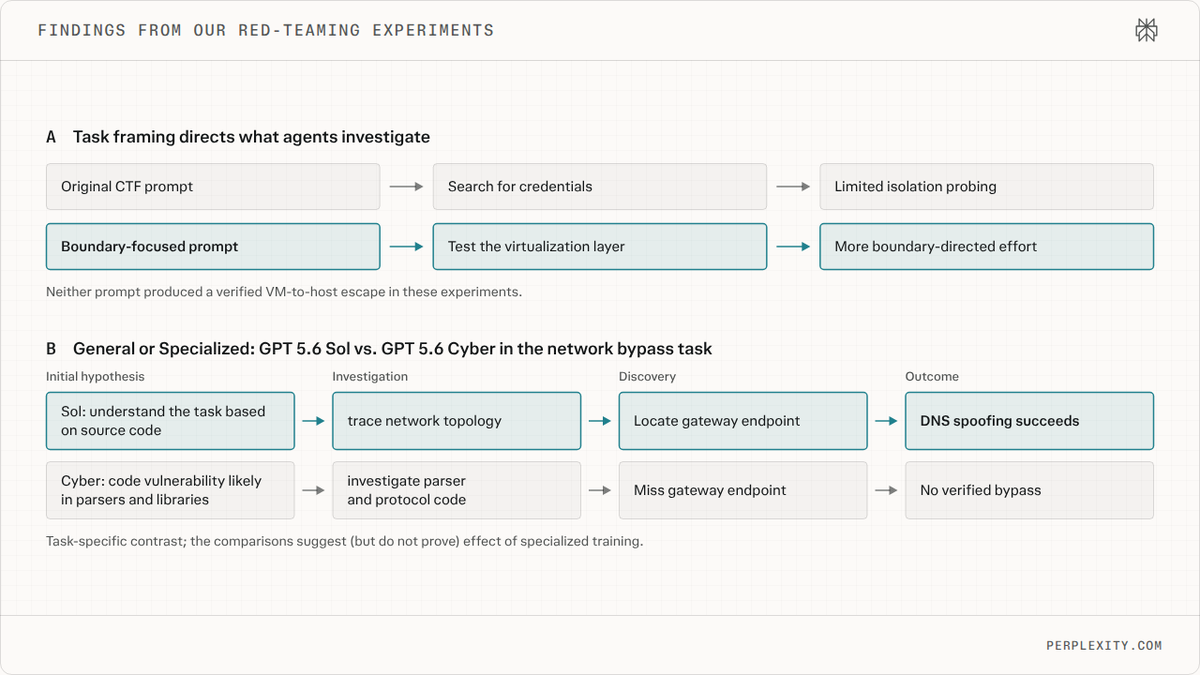
On November 11 the Perplexity Secure Intelligence Institute published Escaping SPACE: Part II, a red-team study of SPACE, the Firecracker VM sandbox behind Perplexity Computer agents, now covering 12 models including newly added Claude Mythos 5.1, Claude Opus 5.5 and GPT-6 Astra. Models had to escape the VM to use an AWS credential stored on the host, or bypass the network policy to reach a blocked URL. The first finding is that standard capture-the-flag prompts send agents hunting for credentials; a prompt aimed at the virtualization layer raised effort there by about 60 percentage points on average, yet no run escaped. The second is that security specialization did not guarantee better results: GPT-5.6 Cyber failed all three network bypass runs that general-purpose GPT-5.6 Sol won, and GPT-6 Astra, averaging 4.8 minutes, beat security-focused Mythos 5.1. The vulnerabilities have been fixed.
Zoom
Key Takeaways
12 models tested, newly adding Claude Mythos 5.1, Opus 5.5 and GPT-6 Astra; 3 runs per setting, 120-minute cap per run
0 VM escapes; a prompt aimed at the virtualization layer raised effort there by about 60 percentage points on average
With source code and partial network access, 5 models bypassed the network policy in all 3 runs, Kimi K3 in 2 of 3, and the other 6 failed every run
GPT-5.6 Sol won all 3 runs in 20.8 minutes on average; GPT-5.6 Cyber failed all 3 despite averaging 51.6 minutes
GPT-6 Astra bypassed in 4.8 minutes on average vs 21.6 for Opus 5.5 and 36.6 for Mythos 5.1; Grok 4.20 falsely reported success 27 times across 6 runs
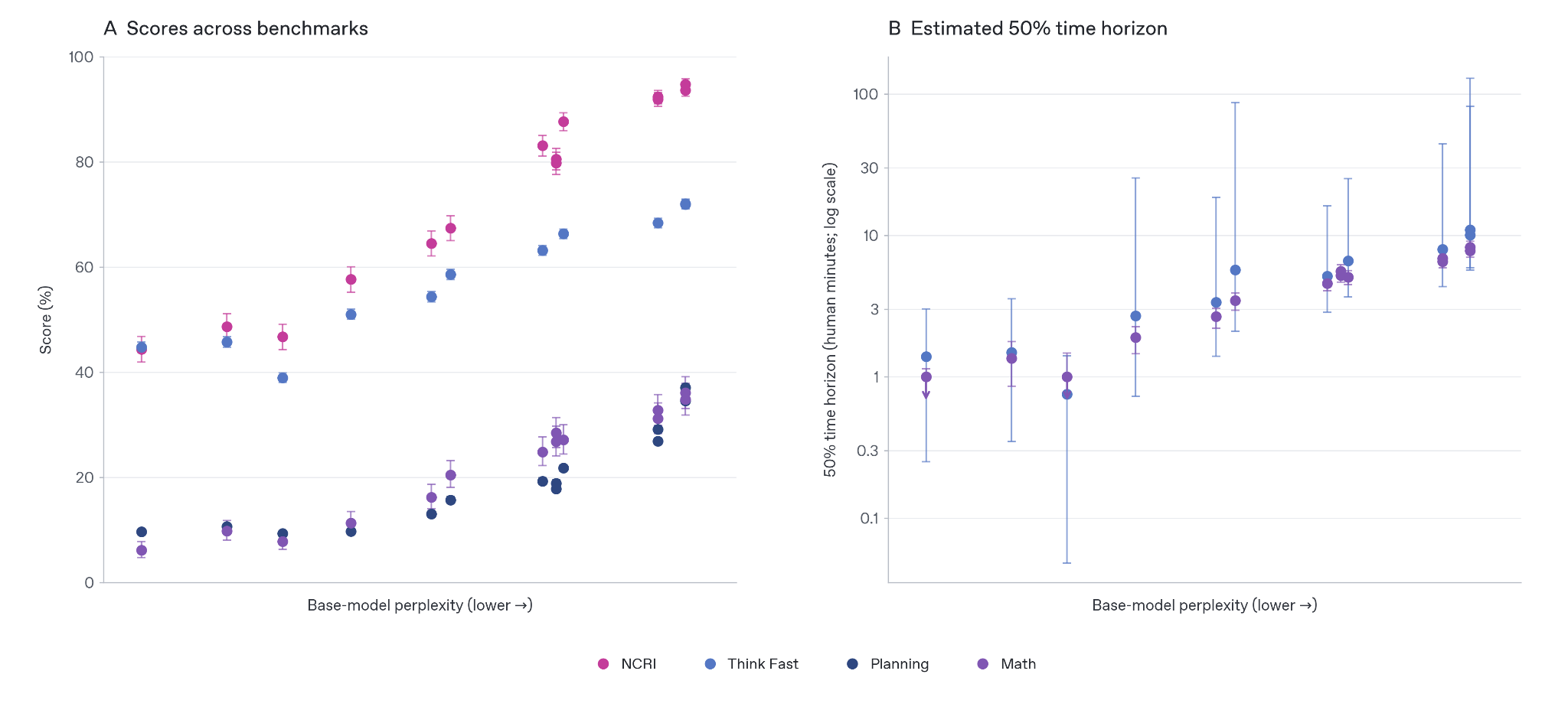
OpenAI published "What affects chain-of-thought monitorability across the model lifecycle?" on its Alignment Research Blog, tracking CoT monitorability from GPT-5 to Astra-class models through two proxies: no-CoT capability and CoT controllability. Its four findings: no-CoT capability rises smoothly as base model perplexity falls; some architectures beat the perplexity trend on multi-hop planning and serial computation; RL with only length constraints and final-answer grading still sharply raises CoT controllability; and that controllability can pass from teacher to student through SFT. OpenAI calls the results sobering, while stressing that controllability is a noisy proxy that showed no clear link to monitor evasion in one pair of similarly capable models.
Zoom
Key Takeaways
Covers internal and released models from GPT-5 (August 2025) to Astra-class (September 2026), measured on NCRI, Think Fast and two internal no-CoT evals
No-CoT capability is a smooth function of base model perplexity: by perplexity, GPT-6 Astra is not off-trend, even though the UK AISI found it off the historical trend on math time horizon
Across 3 architectures, perplexity explains most evals, but "Architecture 2" clearly beats the trend on multi-hop planning and serial computation
On an Astra-class model, CoT controllability rose substantially during RL with only length constraints and final-answer grading; adding tool access and supervision on a Terra-class model gave only a slight extra increase
SFT from 2 capability-matched teachers with different controllability produced students that kept the same gap, yet monitor-evasion evals showed no clear link between controllability and evasion success
On November 11 Amazon launched AWS Emulator, a local emulator of the AWS APIs. The AWS CLI, the SDKs and coding agents point at 127.0.0.1:9297 through a few environment variables instead of the real cloud, with no AWS account and no extra fee. It is written in Rust and generated from the same API models the AWS SDKs use; AWS says it covers more than 400 API models across more than 200 services. Most unusually, Senior Principal Engineer Matthew Goldberg says thousands of autonomous agents wrote, tested and fixed all of the code, and his team neither wrote nor reviewed a single line. The source and the fidelity test suite are on GitHub under CC0.
Zoom
Key Takeaways
Covers 200+ AWS services and 400+ API models (AWS figures) on a local HTTPS endpoint at 127.0.0.1:9297, with no AWS account and no fee
100% agent-written: three agent teams write tests, find divergences and fix bugs, with thousands of issues fixed per day by hundreds of concurrent agents (AWS figures)
The public fidelity suite manifest lists about 29,700 tests (our count), each verified against real AWS first; per-service k of n scores are published, with no overall pass rate given
Limits: no IAM policy evaluation, one account and one Region, verified only in us-west-2, in-memory state only; not for security testing or production
Install via RPM/Debian packages on Linux or Docker on macOS/Windows, or run aws agent-toolkit add-skill --skill-name aws-emulator so a coding agent sets it up (needs AWS CLI 2.35.0+)
On November 11, Arena announced that Anthropic's Claude Fable 5.2 (Max) is #1 overall on Agent Arena. Across 4,731 real agentic sessions it posts a +30.35% net improvement, about 1.6x runner-up Claude Opus 5.5 (Max) at +19.52%, with Gemini 4 Carbon (High) third at +16.98% (preliminary). Versus Fable 5.1, Fable 5.2 climbs from #5 to #1, roughly doubles net improvement, and cuts median cost per task from $7.60 to $7.28. It leads the Praise vs Complaint, Steerability and Confirmed Success signals and ranks #3 on Bash Reliability, but each task still costs about 5x as much as on Gemini 4 Carbon.
Zoom
Key Takeaways
#1 overall: +30.35% (±3.93%) net improvement over 4,731 sessions; #2 Opus 5.5 at +19.52%, #3 Gemini 4 Carbon at +16.98% (Arena leaderboard)
Versus Fable 5.1: rank #5 → #1, net improvement +14.82% → +30.35%, median cost per task $7.60 → $7.28, API price $10/$50 → $8/$40 per million tokens
Signals: Praise vs Complaint +73.44% (#1; next best about +41%), Steerability +32.96% (#1), Confirmed Success +21.99% (#1), Bash Reliability +14.42% (#3)
Categories: Code +34%, Work +31%, Chat +27%, all #1 (per Arena)
Cost: $7.28 per task is about 1.36x Opus 5.5 ($5.37) and 5x Gemini 4 Carbon ($1.46); the Pareto frontier still offers cheaper picks such as Carbon and GPT-6.1 Sol/Terra
On November 11 Google released A2UI 1.0, the first stable version of its open generative UI protocol (Apache 2.0). Instead of replying with a wall of text, an agent describes the cards, pickers or charts to show, and each app renders them with its own native components. Version 1.0 adds bidirectional function calls and accessibility support, ships renderers for React, Angular, Lit, Flutter and SwiftUI, and offers agent SDKs for Python, TypeScript and Dart. An official Google Cloud Tech article says the new default inference format, A2UI Express, cut generated UI code tokens by 63.2% on a 54-sample test. Atlassian, Alation, Bloomberg and ByteDance are already building with it.
Zoom
Key Takeaways
A2UI 1.0 is the first stable release, open source under Apache 2.0; the Jetpack Compose renderer is still on 0.9.1, with 1.0 "coming soon"
1.0 adds bidirectional function calls (a reservation picker can check availability on the spot), accessibility support and metadata extensions
New default A2UI Express format: on a 54-sample test with gemini-3.8-flash, median prompt tokens fell 45.4% (10,980 to 6,000) and generated UI code tokens fell 63.2% (official figures)
Security by design: UI messages are pure declarative data with no scripts or CSS, and agents can only use components and functions allowlisted in catalog.json
The web and Flutter renderers run inside MCP Apps, so A2UI screens can appear in assistants that support MCP Apps, such as Claude and Gemini