
On November 11 Google formally announced the Gemini Decisions API and its dedicated decision model Gemini Decision 1 (gemini-decision-1) through posts from Sundar Pichai, @Google, @GoogleAIStudio and Logan Kilpatrick. Instead of generating text token by token, it scores up to 1,000 yes/no, choice (2 to 255 options) and rubric questions in one forward pass and returns probabilities with confidence, across text, images, audio, video and PDFs with a 256K context. Google says end-to-end latency is 150 to 250 ms and stays nearly flat from 1 to 100 questions; input costs $0.10 per million tokens with output free, about one fifth of Gemini 3.5 Flash-Lite's total cost on the shared benchmark suite. In Google's table it ranks first on 7 of 9 evals, and its Top-1 calibration error across 7 shared evals is 0.0250, lower than TypeSafe Jev 1.14 and OpenAI's GPT-6 Luna. Our earlier report was based on the API changelog before any announcement; the launch is now official and the claim that the model had been pulled does not hold. Independent tester Artificial Analysis scores it 66 on its Decision Index, short of the leaders.
Key Takeaways
- ✓Official launch: announced together by Sundar Pichai, @Google, @GoogleAIStudio and Logan Kilpatrick; model ID gemini-decision-1
- ✓Up to 1,000 questions per request with a 256K context; median model compute 50 to 100 ms, 150 to 250 ms end to end (Google figures)
- ✓Google's table: first on 7 of 9 evals, e.g. JevBench 92.2% and Amazon ESCI 58.7%; it trails TypeSafe Jev 1.14 on Mind2Web Multimodal (86.2%) and When2Call (79.9%)
- ✓Top-1 calibration error 0.0250 vs 0.0494 for TypeSafe Jev 1.14, 0.0721 for GPT-6 Luna and 0.2104 for Gemini 3.5 Flash-Lite; independently, Artificial Analysis scores it 66 on Decision Index v2.1, 7 behind leaders Drex Max v1.1 and GLiDE v1.2 (73), Brier 0.18
- ✓Pricing: $0.10 per million input tokens, $0 output; $0.88 total across 7 shared evals vs $4.14 for Flash-Lite, while TypeSafe Jev 1.14 is cheaper at $0.68
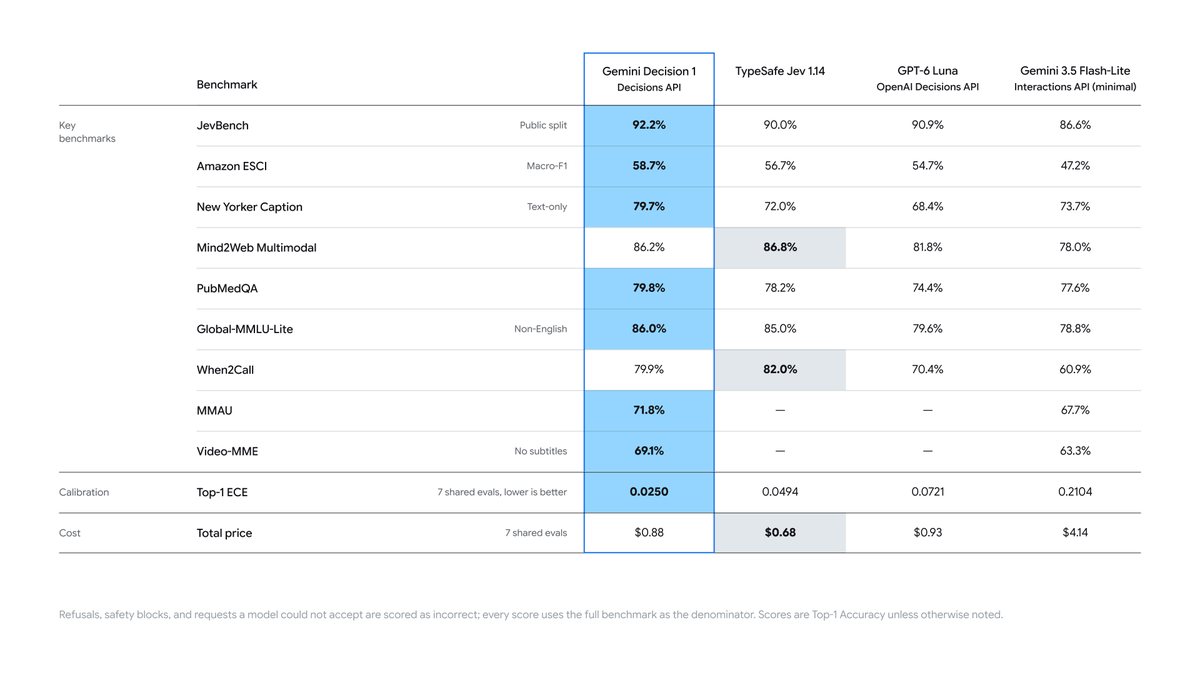
Key Decision Metrics at a Glance
Turn your technical choice into a development budget
Compare 40 dev plans & simulate token costs vs $20/mo subscriptions
Project Links & Resources
Direct AccessIn-Depth Technical Analysis
Background and the pain point
Agents and automation are full of closed questions: which model should take a request, whether a tool call is safe, whether a parcel in a photo is damaged. Having a generative model write text and then parsing it is slow, brittle and gives no trustworthy probability. OpenAI and others shipped decision endpoints this autumn. Google's model first surfaced in the Gemini API changelog on November 11 (our first report was based on that). Hours later Sundar Pichai, @Google and Logan Kilpatrick made it official, so the claim that it had been pulled does not hold.
How it works
Google says Gemini Decision 1 is built on Gemini's native multimodal architecture and scores every candidate in a single forward pass without token-by-token decoding. There are three question types: noul (yes/no), choice (one of 2 to 255 options) and score (ordered rubric). Every answer carries a 0 to 1 confidence. Questions are independent, and the shared input is billed once per request.
Benchmarks
All figures are Google's. It ranks first on 7 of 9 evals: JevBench 92.2% (GPT-6 Luna 90.9%), Amazon ESCI 58.7%, PubMedQA 79.8%, Global-MMLU-Lite 86.0% and Video-MME 69.1%. It trails TypeSafe Jev 1.14 on Mind2Web Multimodal (86.2% vs 86.8%) and When2Call (79.9% vs 82.0%). Its Top-1 calibration error across 7 shared evals is 0.0250, the lowest of the four, and its total cost is $0.88 vs $4.14 for Flash-Lite, though TypeSafe costs only $0.68. Artificial Analysis has since published independent results: 66 on its Decision Index v2.1, level with Elephant 9B and Jev 1.14 and 7 points behind leaders Drex Max v1.1 and GLiDE v1.2 (both 73). It leads knowledge and reasoning evals but gets all answers right on only 33% of documents in AA-Paperclip vs 63% for Drex Max, and costs $345 per million tasks, about 3x Drex Max ($103).
Getting started
Get an API key in AI Studio and call client.decisions.create on v1beta in google-genai with model gemini-decision-1. You can start with Google's Doorstep Parcels and Speed Sketch demo apps. Google says Gemini Notebook uses it for model routing and cut everyday latency by up to 40%. OpenRouter, LangChain, LiteLLM, Pipecat, LiveKit and OpenCode integrations are rolling out. Set thresholds on the confidence score and send uncertain requests to a human.
Benchmark side-by-side against alternatives, or calculate monthly token cost vs subscription break-even.
Discussion & Comments
0Sign in to join the discussion
Connect with AI developers to exchange benchmark insights.