AI Coding Live News

Ornith-1.5-122B Released Under MIT: A Single-Node 122B MoE Reasoning Model Scoring 76.9 on SWE-bench Pro

The Ornith AI team officially released Ornith-1.5-122B under the permissive MIT license, a 122-billion parameter mixture-of-experts (MoE) reasoning model optimized to execute on a single GPU node (such as a single DGX). The model is immediately available across vLLM (0.19.1+), SGLang (0.5.9+), Hugging Face, and Ollama (ornith-1.5:122b) with native FP8, GGUF, and MLX quantization. Across independent agentic evaluations in the OpenHands harness, Ornith-1.5-122B registered 84.5 on SWE-bench Verified, 76.9 on SWE-bench Pro (surpassing Qwen3.8-Flash-Next's 43.9 by 33 points), 81.2 on TerminalBench 2.1, and 74.6 on MCP-Atlas.
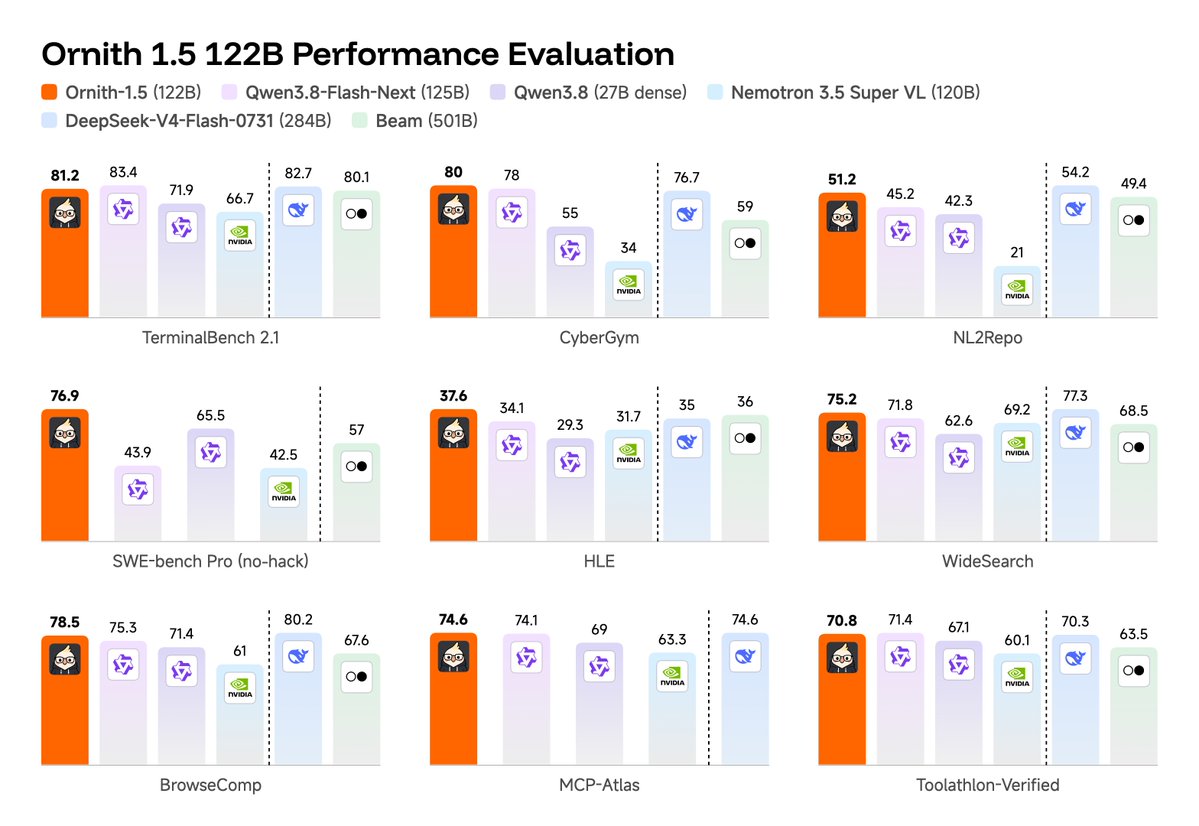
Ornith-1.5-122B Released Under MIT: A Single-Node 122B MoE Reasoning Model Scoring 76.9 on SWE-bench Pro

Key Takeaways

  • Ornith-1.5-122B released under the permissive MIT license, offering a fully open, frontier-grade 122B MoE coding reasoning model
  • Engineered to fit inside a single GPU node (single DGX), with immediate runtime support on vLLM, SGLang, and Ollama (ornith-1.5:122b)
  • Achieves 76.9 on SWE-bench Pro, drastically outperforming the comparable open-weight baseline Qwen3.8-Flash-Next (43.9)
  • Delivers balanced agentic performance with 81.2 on TerminalBench 2.1, 80.0 on CyberGym, and 74.6 on MCP-Atlas
Read full story
Linked Models & Agents:
⚡ Ornith-1.5-122B⚡ Qwen3.8-Flash-Next🤖 OpenHands🌐 Ornith

AWS & UIUC Introduce Lean4AgenticRL: Verifiable Multi-Level Process Rewards in Lean4, Reaching 77.3% on TerminalBench

Researchers from Amazon Web Services (AWS) and UIUC unveiled Lean4AgenticRL (arXiv:2610.22448). Tackling the limitations of conventional agentic reinforcement learning relying on sparse, binary outcome rewards, the framework grounds multi-level process rewards within a formal Lean4 verification schema. Utilizing workflow-stage-normalized GRPO, the resulting LAR-27B model reaches 77.3% on TerminalBench-2.1, outperforming base models by 9.89% and surpassing comparable open models by 5.07%.

AWS & UIUC Introduce Lean4AgenticRL: Verifiable Multi-Level Process Rewards in Lean4, Reaching 77.3% on TerminalBench

Key Takeaways

  • AWS and UIUC introduced Lean4AgenticRL (arXiv:2610.22448), the first framework grounding multi-level process rewards in Lean4 formal proofs
  • Overcomes sparse outcome reward bottlenecks using workflow-stage-normalized GRPO to stabilize multi-turn credit assignment
  • LAR-27B hits 77.3% on TerminalBench-2.1, outperforming base models by 9.89% and outscoring comparable baselines by 5.07%
  • Ablations show verifiable process rewards accelerate RL convergence by over 42%, establishing a rigorous paradigm for terminal coding agents
Read full story
Linked Models & Agents:

Ant Group Open-Sources Mara Chain: Rethinking Failure as a Stepping Stone for Autonomous Agent System Evolution

Modern AI agent systems and autonomous frameworks rely heavily on greedy search or reinforcement learning for self-evolution (such as harness synthesis, workflow routing, and prompt optimization). However, in non-convex and deceptive optimization landscapes, greedy pruning prematurely discards mutations that temporarily underperform, stranding systems in local optima. Researchers from Ant Group Research, Peking University, and Beijing Academy of Artificial Intelligence (BAAI) unveil Mara Chain (arXiv:2609.35855), an evolutionary optimization framework that rethinks failures as essential stepping stones. Mara Chain operates via three interconnected mechanisms: a stepping-stone archive combining semantic embeddings and execution traces for novelty preservation, a hierarchical mutator driven by backward failure attribution, and a Pareto-optimal non-dominated sorting selection module. On the AppWorld benchmark, Mara Chain achieves up to a 20.5% performance improvement over leading baselines (GEPA, ACE, SkillOpt-Lite) while requiring 65.5% fewer rollouts. On TerminalBench 2.1, it outstrips AHE and Meta-Harness by 20.2 and 22.5 percentage points respectively. The team has open-sourced the implementation under the AntOmniEvo repository.

Key Takeaways

  • Ant Group, PKU, and BAAI unveil Mara Chain, rethinking failed mutations as stepping stones to bypass local optima in agent self-evolution
  • Outperforms GEPA and ACE by up to 20.5% on AppWorld with 65.5% fewer rollouts, and beats AHE by 20.2 percentage points on TerminalBench 2.1
  • Open-sources the complete AntOmniEvo framework with AST-aware stepping-stone buffering and hierarchical failure mutators
Read full story

Mid-Harness Scales Action Compute at Model-Harness Boundary for Terminal Agents, Driving Pass@1 from 50% to 68%

Terminal agents execute stochastic model outputs directly in real bash environments, where an erroneous command (e.g., misconfigured dependency install, file deletion) irreversibly corrupts system state and derails downstream progress. Researchers introduce Mid-Harness, a paradigm that allocates test-time compute precisely at the boundary between model generation and the evaluation harness. By sampling and verifying candidate actions before sending them to the terminal—rather than expensively generating multiple full rollout trajectories—Mid-Harness elevates Pass@1 on TerminalBench-Lite from 50.00% to 68.03% under action scaling, achieving vastly higher reliability at substantially lower token cost.

Mid-Harness Scales Action Compute at Model-Harness Boundary for Terminal Agents, Driving Pass@1 from 50% to 68%

Key Takeaways

  • Pioneers Mid-Harness to allocate test-time compute at the model-harness boundary before terminal execution
  • Catapults Pass@1 on TerminalBench-Lite from 50.00% to 68.03% via 8-action sampling under capable verification
  • Proves action scaling achieves superior success rates at lower token budgets compared to full trajectory scaling
Read full story
ADSponsored

Aleph Alpha open-sources Kolibri-1: 78B MoE (3.46B active), bilingual DE/EN Apache-2.0; SWE-Verified 66.4

On 3 Oct 2026, Aleph Alpha released open-weight Kolibri-1 (HF, Apache-2.0): 78B MoE / ~3.46B active, bilingual DE/EN, 262k native context (1M extrapolated), reasoning effort + tools. Official card: LiveCodeBench v6 85.9, SWE-Bench Verified 66.4, TerminalBench 2.1 27.7. Serve via aleph-alpha-inference + vLLM.

Aleph Alpha open-sources Kolibri-1: 78B MoE (3.46B active), bilingual DE/EN Apache-2.0; SWE-Verified 66.4

Key Takeaways

  • Shipped 2026-10-03; weights Aleph-Alpha/Kolibri-1 Apache-2.0; blog on aleph-alpha.com
  • 78B total / ~3.46B active; ~78GB FP8; native 262k context (validated to 1M)
  • Official card: LiveCodeBench v6 85.9 · SWE-Verified 66.4 · TerminalBench 2.1 27.7 · HumanEval+ 92.7
  • Serve: aleph-alpha-inference + vllm serve Aleph-Alpha/Kolibri-1 with kolibri1 parsers
  • Sovereign DE/EN on-prem focus — not a Terminal-Bench leader vs denser peers
Read full story
Linked Models & Agents:
⚡ Kolibri-1⚡ Kolibri⚡ Kolibri Origin🌐 Aleph Alpha

Mid-Harness Scales Actions at Model-Harness Boundary: Action Verification Lifts TerminalBench Pass@1 by 18%

Terminal agents operate through stochastic model generations, but a single errant command can irreversibly degrade sandbox environments. Mid-Harness introduces test-time compute scaling at the boundary between model and harness. By sampling and verifying candidate actions before terminal dispatch without modifying the underlying generator or harness, Mid-Harness boosts Pass@1 on TerminalBench-Lite from 50.00% to 68.03% under a GPT-5.6 Sol verifier, outperforming whole-trajectory scaling at lower token expenditure.

Mid-Harness Scales Actions at Model-Harness Boundary: Action Verification Lifts TerminalBench Pass@1 by 18%

Key Takeaways

  • Allocates test-time compute at model-harness boundary, lifting TerminalBench-Lite Pass@1 from 50.00% to 68.03%
  • Pairwise action verification and distillation enable compact local models to filter errant commands effectively
  • Reduces estimated token overhead by over 35% compared to whole-trajectory sampling while increasing task completion
Read full story

OpenAI Launches GPT-6 Astra, a SOTA Computer-Use Model

OpenAI launched GPT-6 Astra, calling it the world's most intelligent and aligned model, able to perform nearly any computer task for the user. It sets new state of the art on FrontierMath Tier 4, ARC-AGI 3, and TerminalBench-4.0, with major gains in software engineering, cybersecurity, science, and professional workflows. It is now live for Pro, Enterprise, Business, and API customers, with Plus rollout underway.

Key Takeaways

  • Sets SOTA on computer use, browsing, software engineering, and science benchmarks
  • Live in ChatGPT Work, Codex, the OpenAI API, and AWS
  • Plus and Business access is rolling out over the coming days
Read full story

OpenAI: GPT-6 Astra SOTA on Agents’ Last Exam, AutomationBench, and ScreenSpot Pro

OpenAI says GPT-6 Astra is state-of-the-art on Agents’ Last Exam, AutomationBench, and ScreenSpot Pro—benchmarks for cross-profession computer workflows and screen grounding—adding computer-use evidence beyond the already announced TerminalBench / ARC-AGI / FrontierMath results.

Key Takeaways

  • Claims SOTA on Agents’ Last Exam, AutomationBench, and ScreenSpot Pro for computer workflows/screen ops.
  • Framed as cross-profession computer use, not just repo-fix coding.
  • Complements already-announced TerminalBench / ARC-AGI / FrontierMath agentic evidence.
Read full story
Linked Models & Agents:

OpenAI: GPT-6 Astra SOTA on FrontierMath, ARC-AGI 3, and TerminalBench-4.0

OpenAI says GPT-6 Astra is state-of-the-art on FrontierMath Tier 4, ARC-AGI 3, and TerminalBench-4.0, and also leads on Terminal-Bench Science 0.1 and HealthBench Pro—highlighting agentic terminal and scientific discovery strength.

Key Takeaways

  • Claims SOTA on FrontierMath Tier 4, ARC-AGI 3, and TerminalBench-4.0.
  • Science side: also claims lead on Terminal-Bench Science 0.1 and HealthBench Pro.
  • Companion to the launch post, framing coding/terminal-agent and research workflows.
Read full story
Linked Models & Agents:

Meta introduces Muse Glimmer: 30B open-weight local agent model under Apache 2.0

Meta released Muse Glimmer in August, a 30B open-weight local agent model under Apache 2.0 whose quantized weights fit under 20 GB for consumer Macs and single-GPU PCs. On October 19 Meta published its technical report: a ~29.6B dense design distilled from Muse Spark that, by Meta's figures, beats Gemma4-31B and Qwen3.6-27B on tool-use and agent benchmarks such as MCPAtlas, tau3-Banking and SWE-Bench Pro, while still trailing Qwen3.6-27B on SWE-Bench Verified, TerminalBench 2.1 and OSWorld.

Meta introduces Muse Glimmer: 30B open-weight local agent model under Apache 2.0

Key Takeaways

  • Technical report (Oct 19): ~29.6B dense parameters, 52 layers, ~1.8B vision encoder, 128K+ context, distilled from Muse Spark.
  • Under a 32 GB budget, dense was 2-2.5x more compute-efficient than MoE; BF16 weights are 55.7 GB, quantized LM weights under 20 GB.
  • Official scores: MCPAtlas 75.5 (Gemma4-31B 54.2, Qwen3.6-27B 62.5), SWE-Bench Pro 51.2, AA-LCR 80.0.
  • Not a clean sweep: SWE-Bench Verified 76.0 trails Qwen's 77.2; TerminalBench 2.1 is 51.7 vs 60.7.
  • Apache 2.0 weights; with a DFlash draft head it runs at practical speeds on a single RTX 5090.
Read full story
ADSponsored