AI Coding Live News

Anthropic Publishes an Official Prompting Guide for Claude Fable 5.2: Saying "This Codebase Is Yours" Lifts Duplicate-Code Merging From Under a Tenth of Tries to About Half, and Old Prompts Need a Cleanup

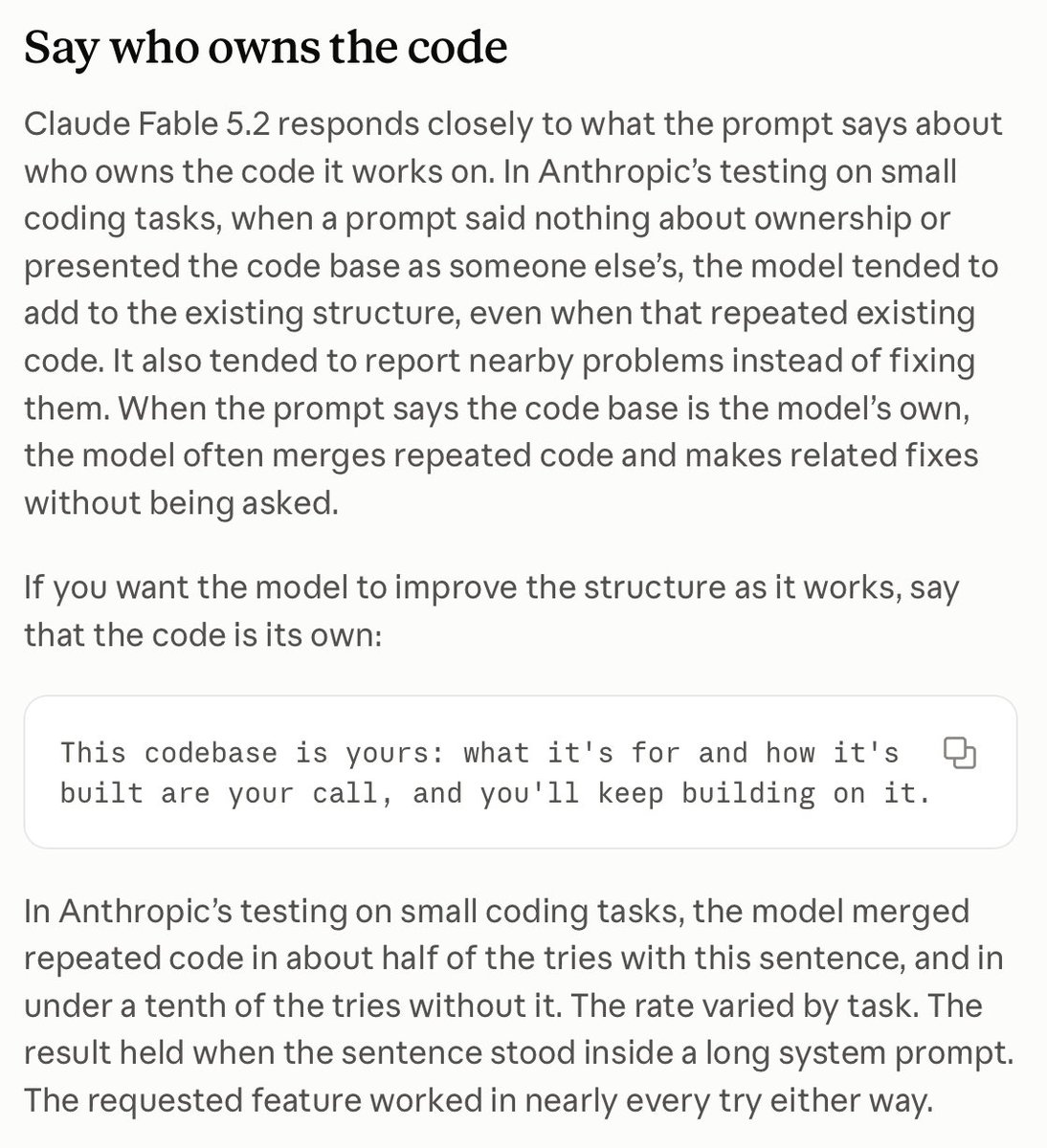
Anthropic has published "Prompting Claude Fable 5.2" in the Claude developer docs, covering where Fable 5.2 behaves differently from earlier models. On November 10, Simon Willison highlighted one tip: tell the model in the system prompt that "this codebase is yours," and it becomes more willing to merge duplicate code and fix related problems. The guide also offers text that stops the model from ending turns before the work is done, ways to keep users informed during long agentic turns, advice on limiting subagents, and a warning to clean up instructions written for Fable 5.1 and Opus 5.5. All figures in the guide come from Anthropic's own testing (vendor figures).
Anthropic Publishes an Official Prompting Guide for Claude Fable 5.2: Saying "This Codebase Is Yours" Lifts Duplicate-Code Merging From Under a Tenth of Tries to About Half, and Old Prompts Need a Cleanup

Key Takeaways

  • Code ownership: on small coding tasks, adding "This codebase is yours" made the model merge duplicate code in about half of tries vs under a tenth without it, but output tokens rose to about 1.5x and roughly 1 in 6 to 10 tries changed how an existing feature behaves
  • Finishing the task: replaying agentic coding sessions at medium effort, the official "Finishing work" text cut sessions that ended with doable work left by about half, with about 30% more output tokens
  • Progress updates: Fable 5.2 returns mid-turn updates as thinking blocks whose text is empty at the default display of "omitted"; a harness reminder that the user has not heard from the model roughly halved the longest silent stretch
  • Migration cleanup: lines such as "answer directly without deliberating" no longer stop thinking at medium and above, so lower effort instead; harnesses that edit earlier turns invalidate thinking blocks and get a 400 error
  • Effort: the API default is high, where most of the capability gain already appears; use xhigh only where evals show a gain, and max for ceiling tests or open-ended math and science problems
Read full story
Linked Models & Agents:
⚡ Claude Fable 5.2⚡ Claude Mythos 5.2🤖 Claude Code🌐 Anthropic

OpenAI Dots Can Now Connect Multiple Local Computers: One Dot Can Build and Test on a Dedicated Machine While You Keep Coding on Your Laptop

OpenAI Developers announced that dots, the always-on agents in ChatGPT, can now connect multiple local computers and choose which one to use for each task, for example building and testing an app on a dedicated machine while you keep coding on your laptop. The official docs were updated to match: each computer is approved separately from the ChatGPT desktop app on that machine, each thread uses one computer at a time, and independent tasks should run as separate threads per computer. The dot's cloud computer stays connected. Earlier docs said only one personal computer could be connected at a time. OpenAI has not published performance or reliability data.

OpenAI Dots Can Now Connect Multiple Local Computers: One Dot Can Build and Test on a Dedicated Machine While You Keep Coding on Your Laptop

Key Takeaways

  • Change: a dot goes from 1 connected personal computer to multiple local computers, plus its always-on cloud computer
  • Setup: open the dot profile in the ChatGPT desktop app on each machine, select Allow under Computers, then confirm Allow access; repeat these 3 steps per computer
  • Scheduling: each thread uses 1 computer at a time; for parallel independent tasks, ask the dot to start a separate thread on each computer
  • Permission isolation: the dot's local-computer access is separate from connecting a computer to Codex or enabling Work Sync; neither alone grants the dot access
  • The announcement post carries a 17-second demo video and drew 2,600+ likes and 130K+ views within about an hour; OpenAI published no performance data
Read full story

X Discussion: Node.js and Deno Creator Ryan Dahl Says Software Engineering Is Now "100% AI Written", AI Writes Better C++ Than He Does, but Making Sure It Works Has Not Gone Away

At 04:11 UTC on November 9, Ryan Dahl, creator of Node.js and Deno, posted on X that it is shocking how quickly software engineering has moved to "100% AI written", and more shocking that engineers carry on as if nothing happened. He said AI writes C++ better than he ever could, but the problem of making sure it works did not magically disappear; teams are simply shipping far more code at higher quality. Within about six hours the post had roughly 1,370 likes, 236 bookmarks, 83 replies, 25 quotes and nearly 90K views. Quote posts split into camps: some say the bottleneck has moved from writing code to verifying it, so testing and review are worth more, while others question the "100%" and "higher quality" claims. This is a personal opinion post; "100%" is not a measured statistic.

Key Takeaways

  • Reach: @rough__sea posted at 04:11 UTC on November 9 and within about six hours had about 1,370 likes, 236 bookmarks, 83 replies, 25 quotes and nearly 90K views
  • Claim: software engineering has moved to "100% AI written", AI writes C++ "better than I ever could", but making sure it works has not gone away
  • Conclusion: engineers are shipping far more code at higher quality, yet "continuing on as if nothing happened"
  • Split: some quote posts say the bottleneck has moved from generation to verification, making testing and review more valuable; others question the "100%" and "higher quality" claims
  • Caveat: this is a personal opinion; "100%" is not a measured figure, and the post cites no data or specific projects
Read full story

OpenAI Ships BioBasicsBench with Ligo: 100 Routine Wet-Lab Tasks; Vendor GPT-6 Astra ~66.7% at xhigh

On 2026-11-06, OpenAI (@OpenAI) introduced BioBasicsBench with enzyme-design biotech Ligo: 100 routine wet-lab tasks from real experiments testing whether AI agents can interpret raw data, spot errors, and recognize unsupported conclusions. Vendor-reported xhigh mean reward: GPT-6 Astra ~66.7% vs GPT-5.6 Sol ~43.8%.

OpenAI Ships BioBasicsBench with Ligo: 100 Routine Wet-Lab Tasks; Vendor GPT-6 Astra ~66.7% at xhigh

Key Takeaways

  • Source: @OpenAI post on 2026-11-06 + official blog Measuring how AI agents handle everyday wet-lab science; partner Ligo
  • Scale: 100 real-experiment tasks across five domains; expert rubrics with internal/external wet-lab review
  • Vendor xhigh: GPT-6 Astra mean reward ~66.7% vs GPT-5.6 Sol ~43.8%
  • Vendor: Astra also leads at lower effort; remaining failures include controls, assumptions, colony counts
  • Purpose: track routine wet-lab analysis and biosafety implications—not autonomous lab judgment
Read full story
ADSponsored

Thinking Machines Launches Inkling 2 Small: 594B/17B MoE, Vendor-Reported AA Intelligence Index ~31; Tinker Inference and Fine-Tuning Now, Apache 2.0 Weights Planned Next Week

On November 5 Thinking Machines Lab introduced Inkling 2 Small, the first second-generation model: a 594B-total / 17B-active MoE with image input and variable thinking effort. The company reports an Artificial Analysis Intelligence Index score of about 31, with large gains versus prior Inkling models in agentic coding, vision and knowledge work. It is available now on Tinker for inference and fine-tuning with closed weights; full Apache 2.0 weights are planned next week after external safety testing. Tinker list pricing is about $0.30/$1.00 per million input/output tokens at 64K context.

Thinking Machines Launches Inkling 2 Small: 594B/17B MoE, Vendor-Reported AA Intelligence Index ~31; Tinker Inference and Fine-Tuning Now, Apache 2.0 Weights Planned Next Week

Key Takeaways

  • Specs (official): 594B total / 17B active MoE; Hybrid + Vision; variable effort; no audio (unlike prior Inkling)
  • Scores (vendor): AA Intelligence Index ~31; FrontierCode v2.0 ~25.4%; DeepSWE v1.1 ~72.1%; DesignArena Website Elo ~1340
  • Availability: Tinker Playground / fine-tune and sampling today; closed weights; Apache 2.0 full weights planned next week after safety tests
  • Pricing (Tinker docs): Prefill $0.30 / Sample $1.00 / Train $1.50 per 1M tokens at 64K; cached Prefill $0.03
  • Training note (official): joint RL ~1,075 steps and 17M+ rollouts; early checkpoints tested on OpenCode as Fledge-Alpha
Read full story
Linked Models & Agents:
⚡ Inkling 2 Small⚡ Inkling-Small⚡ Inkling🤖 OpenCode🤖 Tinker🌐 Thinking Machines

X Discussion: Greg Isenberg Says He Talks to His Agents More Than His Human Teammates, Shares a Full Agent-Run Company Stack

On November 3, founder and Late Checkout CEO Greg Isenberg (@gregisenberg) posted a long thread on X saying his team has 50+ people in 12 countries, yet he "talks to my agents more than my human teammates." He listed an agent-driven stack covering ideation, design, build, user testing, bug fixing and data review. Within hours it drew about 1,050 likes, 2,300 bookmarks and 183 replies. This is a personal workflow and opinion, not verified productivity data.

Key Takeaways

  • Engagement: about 1,050 likes, 2,300 bookmarks, 183 replies and 75K views within hours (per the X API); bookmarks far exceed likes, so readers are saving it as a checklist
  • Coverage: ideation, design, build, user testing, bug fixing and data review are all handed to agents; humans handle "creative feedback, relationships and telling the agents what they got wrong"
  • Build: pingdotgg/t3code as the control surface and stablyai/orca to run parallel agents, each in its own git worktree
  • Quality control: every output is scored 1-10 by an LLM judge and anything under 8 goes back; every agent mistake becomes a new skill
  • All of this is self-reported; no verifiable productivity or cost figures were published
Read full story

CrowdStrike Agrees to Acquire Fiddler and Dreadnode and Ships an AI Kill Switch, Bringing Agent Observability, Pre-Deployment AI Security Testing and Agent Termination Into Falcon

At Fal.Con Europe in Barcelona on November 3, CrowdStrike said it signed definitive agreements to acquire AI agent observability company Fiddler AI and automated AI security testing company Dreadnode, and launched an AI Kill Switch in Falcon Guardian that can terminate a misbehaving agent, block it from relaunching and cut its enterprise network access. Both deals are expected to close in CrowdStrike's fiscal Q4 FY27, with the products generally available that quarter. CrowdStrike did not disclose prices; CyberScoop, citing the Wall Street Journal, put Fiddler at about $400 million and Dreadnode at about $95 million.

CrowdStrike Agrees to Acquire Fiddler and Dreadnode and Ships an AI Kill Switch, Bringing Agent Observability, Pre-Deployment AI Security Testing and Agent Termination Into Falcon

Key Takeaways

  • Both acquisitions were announced the same day and are expected to close in CrowdStrike's fiscal Q4 FY27, paid mostly in cash plus some stock subject to vesting conditions.
  • CyberScoop, citing the Wall Street Journal, puts Fiddler at about $400 million and Dreadnode at about $95 million, roughly $495 million combined; CrowdStrike did not disclose the amounts.
  • Fiddler will be sold as Falcon Observe: pre-deployment evaluation, tracing of decisions and tool calls across the agent hierarchy, drift and hallucination detection, and evaluation costs cut by up to 98% using purpose-built models.
  • Dreadnode runs more than 100 known AI attack strategies (jailbreaks, prompt injection, multi-turn and agent-specific attacks) against models, agent reasoning loops, applications and MCP servers, mapping findings to OWASP LLM Top 10, OWASP Agentic ASI01-ASI10, MITRE ATLAS and NIST AI RMF.
  • The AI Kill Switch is available today: an authorized admin triggers it, the agent is stopped first at the Gateway (endpoint enforcement coming soon), blocked from relaunching and cut off from the network, with every action logged.
Read full story

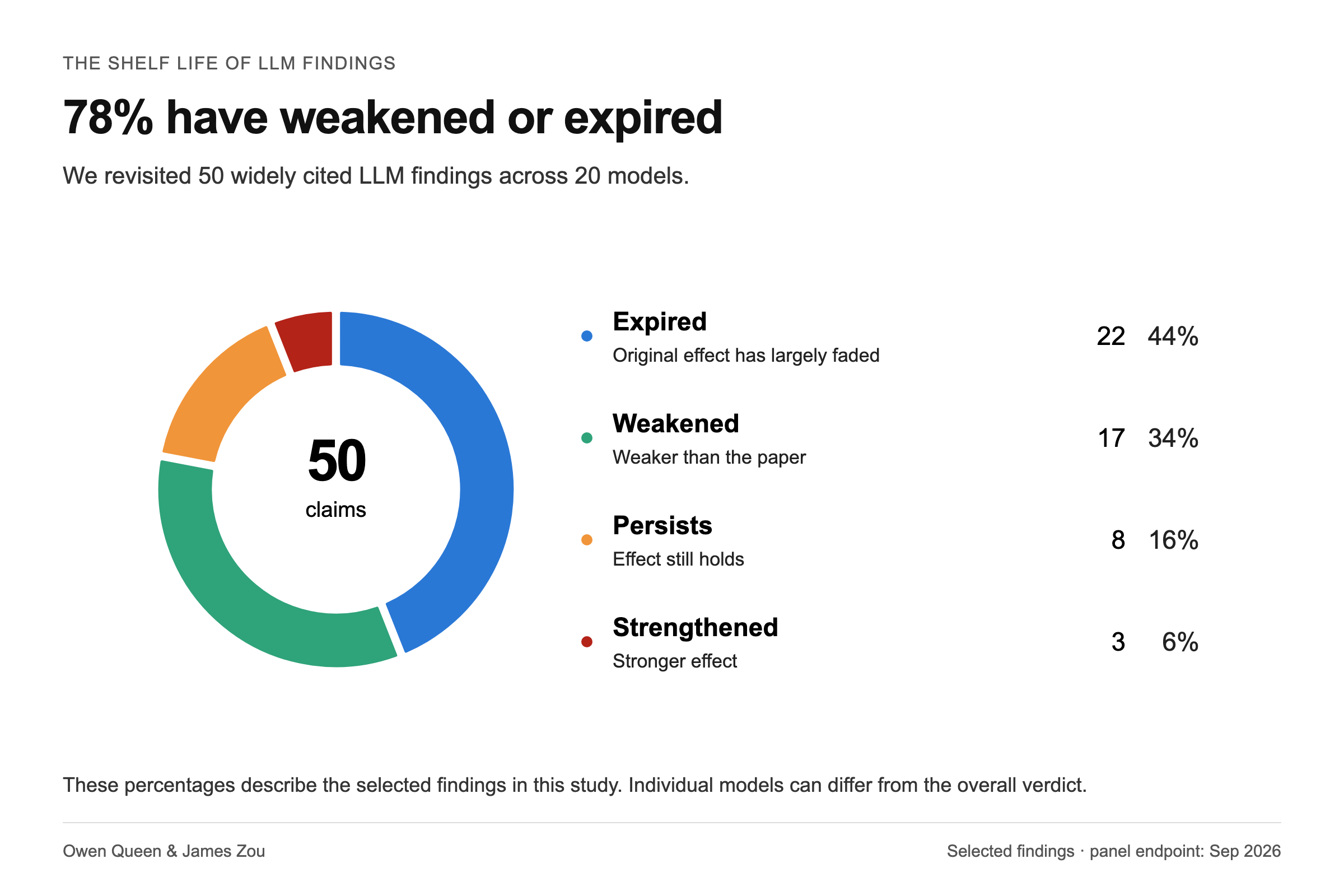
Stanford Retests 50 Well-Known LLM Findings on 20 Models: 44% Have Expired, Median Shelf Life About 15 Months

On November 2, Stanford researchers Owen Queen and James Zou published an interactive report, "The shelf life of LLM findings", retesting 50 widely cited claims about LLM behavior on 20 models released from July 2024 to September 2026 by eight developers. Verdict: 22 claims (44%) expired, 17 (34%) weakened, 8 (16%) persist and 3 (6%) strengthened; the median time from publication to expiration for expired claims was 14.7 months. Capability failures such as letter counting, lost-in-the-middle and fabricated citations have largely faded, while preference issues such as sycophancy and judges favoring their own answers persist.

Stanford Retests 50 Well-Known LLM Findings on 20 Models: 44% Have Expired, Median Shelf Life About 15 Months

Key Takeaways

  • 50 claims, 20 models, eight developers; verdicts reflect fitted effects as of September 30, 2026.
  • 44% expired, 34% weakened, 16% persist, 6% strengthened; expired claims had a median lifetime of 14.7 months (mean 15.7).
  • Kaplan-Meier estimates put the expired share at about 4%, 16% and 39% six months, one year and two years after publication.
  • Citation fabrication is expired overall, yet Qwen3.7-Flash still fabricated 69% of references in the same test (about 1% for Sonnet 5.5, 0% for GPT-6.1 Sol).
  • The pipelines were built with Claude Code and Codex; 43 of 48 reproduction checks matched the original papers within tolerance.
Read full story

Apple Intelligence is coming to China: iOS 27.3 developer beta starts Nov 4, public release in December, with Alibaba Qwen inside Siri, Writing Tools and Visual Intelligence

In a press release on its China newsroom, Apple said the first Apple Intelligence features will open for testing in the latest iOS developer beta starting November 4 and reach users in China with the iOS 27.3 release in December. The features run on Apple-built generative models and include Live Translation, Writing Tools, Visual Intelligence, Clean Up, Genmoji, notification and Mail summaries, and Type to Siri; Apple also partnered with Alibaba to bring Qwen into Siri, Writing Tools and Visual Intelligence. The first wave covers iPhone 15 Pro and newer only; Siri AI and the other next-generation features announced at WWDC 2026, plus Image Playground, are not included, and Mac, iPad and other platforms wait on further approvals.

Apple Intelligence is coming to China: iOS 27.3 developer beta starts Nov 4, public release in December, with Alibaba Qwen inside Siri, Writing Tools and Visual Intelligence

Key Takeaways

  • Timeline (Apple): testing in the latest iOS developer beta from November 4, public rollout with iOS 27.3 in December, no exact date given
  • First-wave features include Live Translation (Messages, FaceTime, Phone and AirPods), Writing Tools, Visual Intelligence, Clean Up, Genmoji, natural-language photo search, Priority Mail, notification summaries and Type to Siri
  • Alibaba Qwen is built into Siri, Writing Tools and Visual Intelligence: users can ask about photos, PDFs and presentations and use Qwen to compose original text, signing in with a Qwen account or Sign in with Apple
  • Supported devices: iPhone 16 and later, iPhone Duo, iPhone 15 Pro/Pro Max and iPhone Air, with Siri and device language set to English and Simplified Chinese
  • Siri AI and other next-generation WWDC 2026 features are excluded, MacRumors says Image Playground is also missing, and other platforms follow after the necessary approvals
Read full story
Linked Models & Agents:
⚡ Qwen⚡ Apple Foundation Models🤖 Siri🌐 Apple🌐 Alibaba

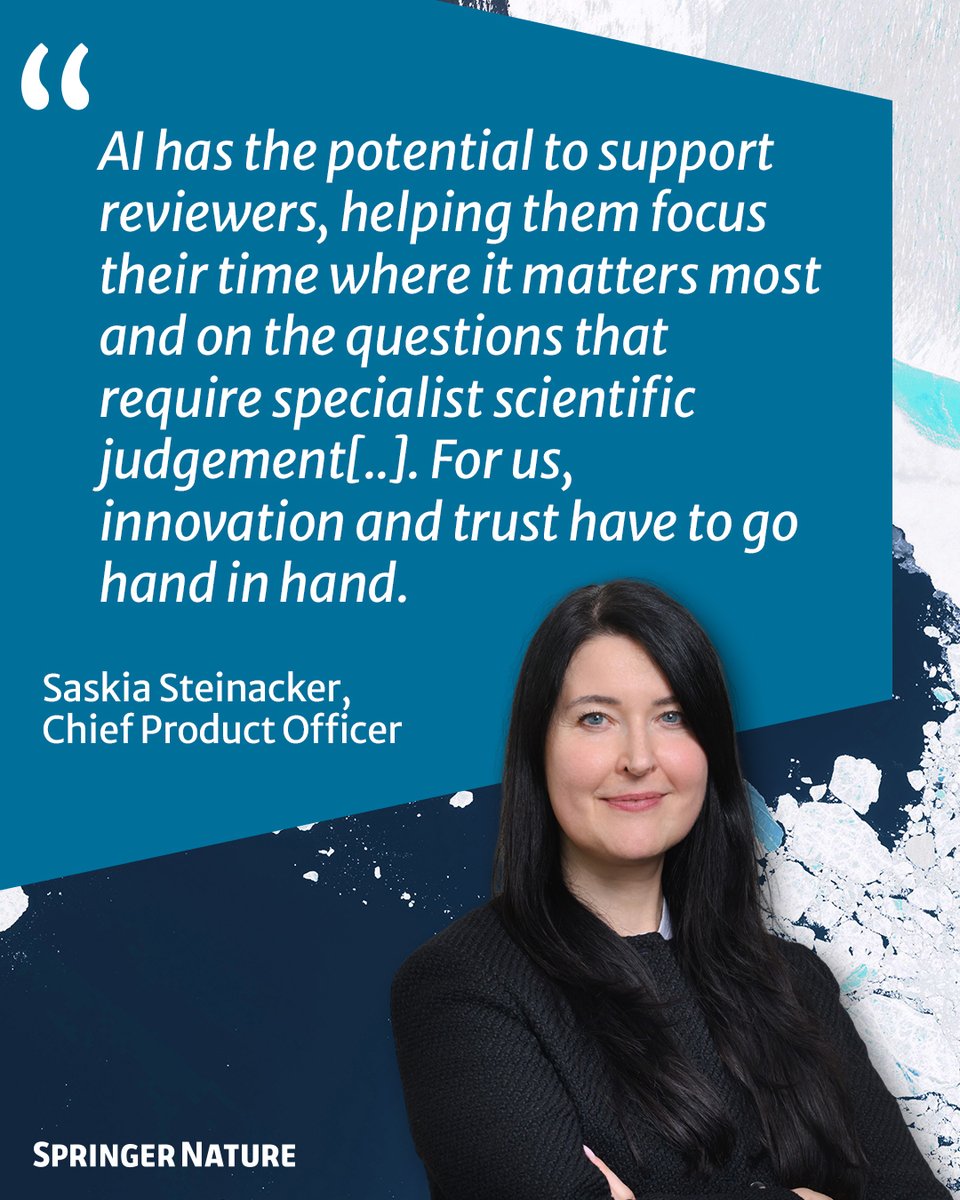
Springer Nature and Google DeepMind partner on an AI peer review assistant built on Gemini and the open-source ADK; a prototype is in testing and human reviewers keep final judgment

On Oct 26 Springer Nature, one of the world's largest research publishers, announced a research partnership with Google DeepMind to co-design an AI peer review assistant. It uses DeepMind's frontier Gemini models and builds on Google's earlier agentic research tools ScholarPeer and Deep Review to help reviewers navigate manuscripts, analyse large amounts of text, charts and figures, and flag areas that may need closer attention. The system is built with Google's open-source Agent Development Kit (ADK) and runs only inside Springer Nature's private Gemini Enterprise environment, so manuscript content stays in its secure environment. A prototype is being tested; the publisher stresses 'human first, AI second' and has not given a launch date or any performance data.

Springer Nature and Google DeepMind partner on an AI peer review assistant built on Gemini and the open-source ADK; a prototype is in testing and human reviewers keep final judgment

Key Takeaways

  • Partners: Springer Nature (publisher of the largest number of journals and books) and Google DeepMind, announced 2026-10-26 from London, Berlin and New York (press release)
  • Stack: frontier Gemini models plus Google's open-source Agent Development Kit (ADK), building on the ScholarPeer and Deep Review agentic research tools
  • Data isolation: runs only on Springer Nature's private Gemini Enterprise platform, keeping author and reviewer confidentiality
  • Status: prototype in testing; no launch date, journal coverage or accuracy figures have been published
  • Role: helps reviewers find areas needing attention, while final scientific judgment stays with human experts
Read full story
ADSponsored

GitHub Next Releases PDD Kit: Provable Specification Enforcement for Coding Agents to Eliminate Edge-Case Regressions

GitHub Next officially released PDD Kit (Property-Driven Development Kit), establishing a formal verification toolkit tailored for autonomous coding agents. Addressing the pervasive reliability gap where agent-generated code passes isolated unit tests but crashes on subtle edge cases, PDD Kit combines property-driven specifications with automated formal solvers. Instead of testing arbitrary sample inputs, PDD Kit mathematically proves that agent code adheres to rigorous invariant specifications across every possible input, preventing regressions and elevating coding agents from probabilistic generation to provable correctness.

GitHub Next Releases PDD Kit: Provable Specification Enforcement for Coding Agents to Eliminate Edge-Case Regressions

Key Takeaways

  • GitHub Next releases PDD Kit to eliminate edge-case flaws in agent-generated code via automated mathematical proofs
  • Pioneers 'proofs for every input', replacing fragile, underspecified unit test samples with comprehensive invariant verification
  • Eliminates deadlocks, boundary index out-of-bounds, and state desynchronization in agentic refactoring workflows
  • Provides an indispensable verification foundation for deploying autonomous coding agents into mission-critical production systems
Read full story

Evolving Agent Interfaces: Empowering Computer-Use Agents to Synthesize Dynamic APIs for 58.58% Success

Researchers introduced 'Evolving Agent Interfaces' alongside the Agent S4 meta-framework in arXiv:2610.28601, removing the fundamental bottleneck of computer-use agents (CUAs). Conventional CUAs are forced to operate through human-designed graphical user interfaces—such as clicking spreadsheet cells one by one—inducing excessive action horizons and high failure rates. The new framework allows meta-agents to inspect live applications in scratch environments, dynamically synthesizing, testing, and evolving programmatic API wrappers and tool repositories on the fly. On OSWorld V2 and ScienceBoard, an open-weights 27B model raised task success from 55.03% to 58.58%, rivaling proprietary frontier models at a fraction of the cost.

Evolving Agent Interfaces: Empowering Computer-Use Agents to Synthesize Dynamic APIs for 58.58% Success

Key Takeaways

  • Evolving Agent Interfaces introduced in arXiv:2610.28601, pioneering dynamic API synthesis for computer-use agents (CUAs)
  • Meta-agents autonomously probe target applications in scratch VMs, writing bespoke programmatic wrappers to replace fragile GUI clicks
  • Elevates task completion rates on OSWorld V2 and ScienceBoard from 55.03% to 58.58% on an open 27B parameter model
  • Significantly compresses action sequences and token budgets, establishing an evolutionary paradigm for OS-level agent autonomy
Read full story
Linked Models & Agents:

LMSYS Arena Enables 14-Day Direct Mode Testing for OpenAI GPT-Image-2.5 Sunburst, Ranked #1 Across All Image Arenas

LMSYS officially announced a 14-day exclusive direct testing window for OpenAI flagship vision generative model GPT-Image-2.5 Sunburst in Direct Mode (active until Nov 2, 8 a.m. PT). Currently holding the undisputed #1 ranking across LMSYS Text-to-Image, Image Edit, and Multi-Image Edit arenas, the model can now be directly chosen from the dropdown menu before returning exclusively to anonymous Battle and Agent Mode.

LMSYS Arena Enables 14-Day Direct Mode Testing for OpenAI GPT-Image-2.5 Sunburst, Ranked #1 Across All Image Arenas

Key Takeaways

  • LMSYS Arena enabled 14-day exclusive Direct Mode testing for OpenAI GPT-Image-2.5 Sunburst until November 2 at 8 a.m. PT
  • The model holds the undisputed #1 ranking across Text-to-Image, Image Edit, and Multi-Image Edit Arenas
  • Demonstrates superior spatial reasoning and ambient lighting consistency across multi-image composition, mitigating visual drift
  • Following Direct Mode, the model will remain anonymously active in Battle and Agent modes to power Elo ratings
Read full story
Linked Models & Agents:

USC, UCLA, and CMU Release Grid-Bench for Multi-Step Spatial Reasoning: 8,928 Executable Instances Reveal Severe State Drift Across 64-Step Trajectories

Can LLMs reliably maintain spatial state representations across sequential operations? USC, UCLA, and CMU introduced Grid-Bench (arXiv:2610.22312, GitHub: grid-bench/Grid-Bench), an executable benchmark with 8,928 instances testing 2D/3D/4D grid state transitions across history lengths up to T=64. Evaluations across 6 frontier models show steep degradation: while GPT-5.6 Sol and Claude 5 Sonnet retain strong cell accuracy, open-weight and mid-tier models collapse to near-zero exact world reconstruction over long trajectories.

USC, UCLA, and CMU Release Grid-Bench for Multi-Step Spatial Reasoning: 8,928 Executable Instances Reveal Severe State Drift Across 64-Step Trajectories

Key Takeaways

  • USC, UCLA, and CMU introduced Grid-Bench (arXiv:2610.22312), an executable spatial tracking benchmark across 2D, 3D, and 4D discrete manifolds
  • Evaluates 8,928 instances across 8 spatial transformation rule families and trajectory lengths up to T=64 steps
  • At intermediate length T=16, GPT-5.6 Sol (98.0% cell accuracy) and Claude 5 Sonnet (96.8%) lead while mid-tier models drop sharply
  • At extreme length T=64, exact world recovery drops to 0 for GLM-5 and Kimi K2.5, demonstrating that long-horizon agents must rely on external state engines
Read full story
Linked Models & Agents:

SpaceXSI launches Grok Voice 3.0: speech-to-speech model tops Artificial Analysis S2S Index at 86.9, price held at $0.08/min

SpaceXSI (SpaceX Super Intelligence, x.ai) released Grok Voice 3.0 on 2026-10-14 17:04 UTC. Per Artificial Analysis testing (Oct 13) cited on the official blog, it scores 86.9 on the Speech-to-Speech Index (Grok Voice 2.0 81.3, GPT-Live-1 Astra 83.2, Gemini 3.8 Live 82.6), 97% on Full Duplex Bench, and 71.6% on τ-Voice — on par with GPT-Live-1 at ~40% lower latency. In the Voice Agent API, grok-voice-latest now aliases grok-voice-3.0 with an unchanged interface at $0.08/min; grok-voice-2.0 is deprecated.

SpaceXSI launches Grok Voice 3.0: speech-to-speech model tops Artificial Analysis S2S Index at 86.9, price held at $0.08/min

Key Takeaways

  • #1 on Artificial Analysis Speech-to-Speech Index at 86.9 (v2.0 81.3, GPT-Live-1 Astra 83.2, Gemini 3.8 Live 82.6)
  • Big Bench Audio 98.5%, Speech Agent Arena Elo 1070, task success 94.8%, Full Duplex Bench 97.0%
  • τ-Voice 71.6%, comparable to GPT-Live-1 (Astra) at ~40% lower latency; top accuracy (74%) on ServiceNow EVA-Bench
  • Same price: $0.08/min ($4.80/hr); grok-voice-latest auto-upgraded to 3.0, grok-voice-2.0 deprecated
  • Production scale (vendor figures): ~20k Starlink support calls/day, ~70% resolved with no human
Read full story
Linked Models & Agents:
⚡ Grok Voice 3.0⚡ Grok Voice 2.0⚡ GPT-Live-1⚡ Gemini 3.8 Live🌐 SpaceXSI🌐 xAI🌐 Artificial Analysis🌐 ServiceNow