AI Coding Live News

Anthropic Releases Claude Fable 5.2 and Mythos 5.2: Price Cut to $8/$40 per Million Tokens, a Record 49.1% on FrontierCode 2.0 Among Released Models, and 1,000 Agents Formalizing Fermat's Last Theorem in 30 Hours

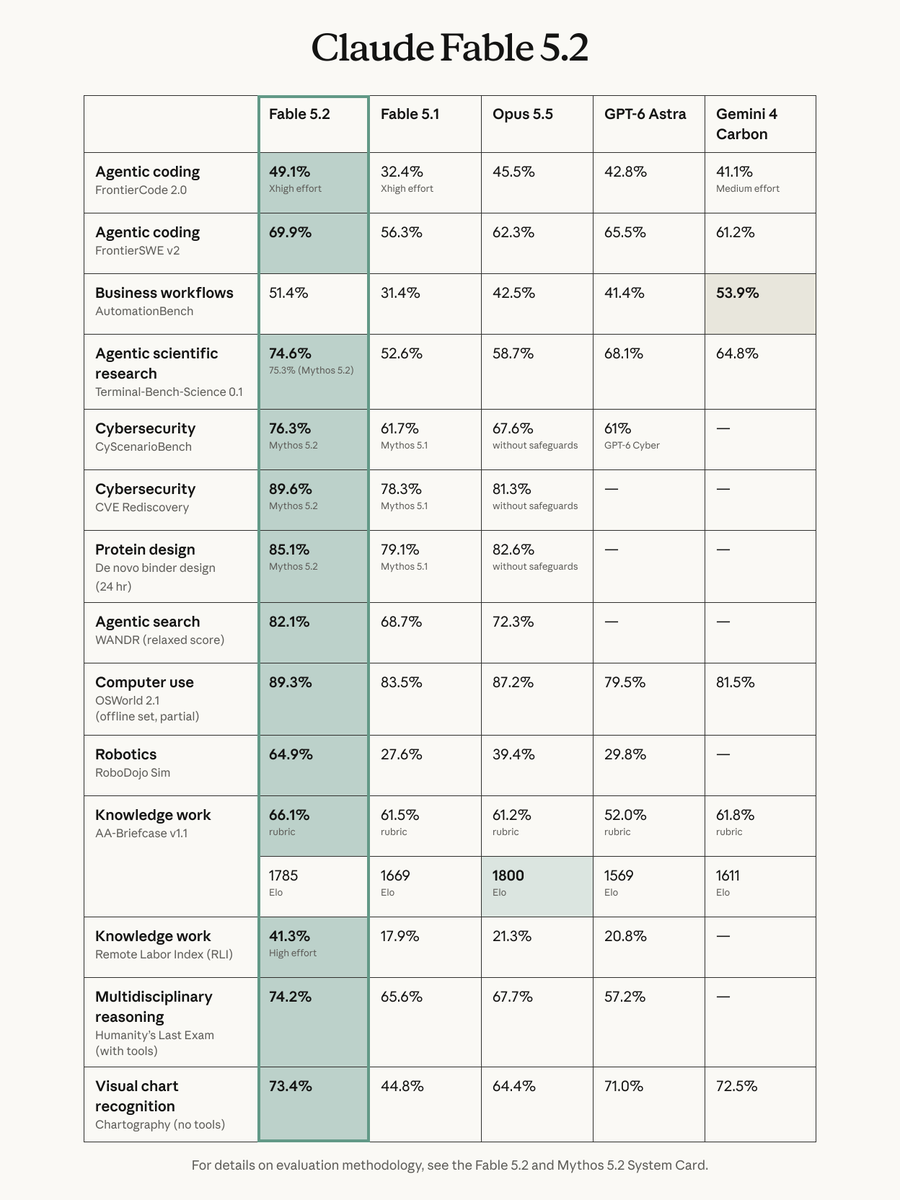
At 18:58 UTC on November 9 (2:58 a.m. on November 10 SGT), the official Claude account released Claude Fable 5.2 and Claude Mythos 5.2. They are the same underlying model: Fable ships with cybersecurity and biology safeguards and is open to all paid plans, the Claude Platform and the major clouds, while Mythos drops some of those safeguards and is offered only to vetted organizations through the Cyber and Life Sciences Verification Programs. Pricing falls from Fable 5.1's $10/$50 to $8/$40 per million input/output tokens, output is up to 30% faster, and an optional fast mode generates up to 2.5x faster for $16/$80. By Anthropic's numbers, Fable 5.2 at Xhigh effort scores 49.1% on FrontierCode 2.0, ahead of Opus 5.5 (45.5%) and GPT-6 Astra (42.8%); at High effort it matches Opus 5.5's best for about half the cost per task. The API model name is claude-fable-5-2.
Anthropic Releases Claude Fable 5.2 and Mythos 5.2: Price Cut to $8/$40 per Million Tokens, a Record 49.1% on FrontierCode 2.0 Among Released Models, and 1,000 Agents Formalizing Fermat's Last Theorem in 30 Hours

Key Takeaways

  • Pricing: $8 / $40 per million input/output tokens, 20% cheaper than Fable 5.1's $10 / $50; fast mode generates up to 2.5x faster at $16 / $80
  • Coding (Anthropic's numbers): FrontierCode 2.0 at Xhigh effort 49.1% (Opus 5.5 45.5%, GPT-6 Astra 42.8%); at High effort 45.3%, matching Opus 5.5's best for about half the cost per task; FrontierSWE v2 69.9%
  • Long-running agents: 1,000 Fable 5.2 agents formalized Fermat's Last Theorem in Lean in 30 hours, while Opus 5.5 in the same setup finished only 26% in 18 hours; one engineer had it coordinate over 1,000 subagents for 8 days to build a prototype OS that boots on a laptop
  • Other scores (Anthropic's numbers): RoboDojo Sim 64.9% (Fable 5.1 27.6%), HLE with tools 74.2%, OSWorld 2.1 89.3%, Remote Labor Index 41.3%; Mythos 5.2 CVE Rediscovery 89.6%
  • Safeguards: Fable and Mythos are the same model; Fable 5.2's classifiers block about 55% less often than 5.1's; the preserved thinking anti-distillation feature now applies to all accounts
Read full story

Stripe Opens Agent Data Analysis to All Users via MCP, Queries and Reports APIs; Queries Free Through Jan 31, 2027

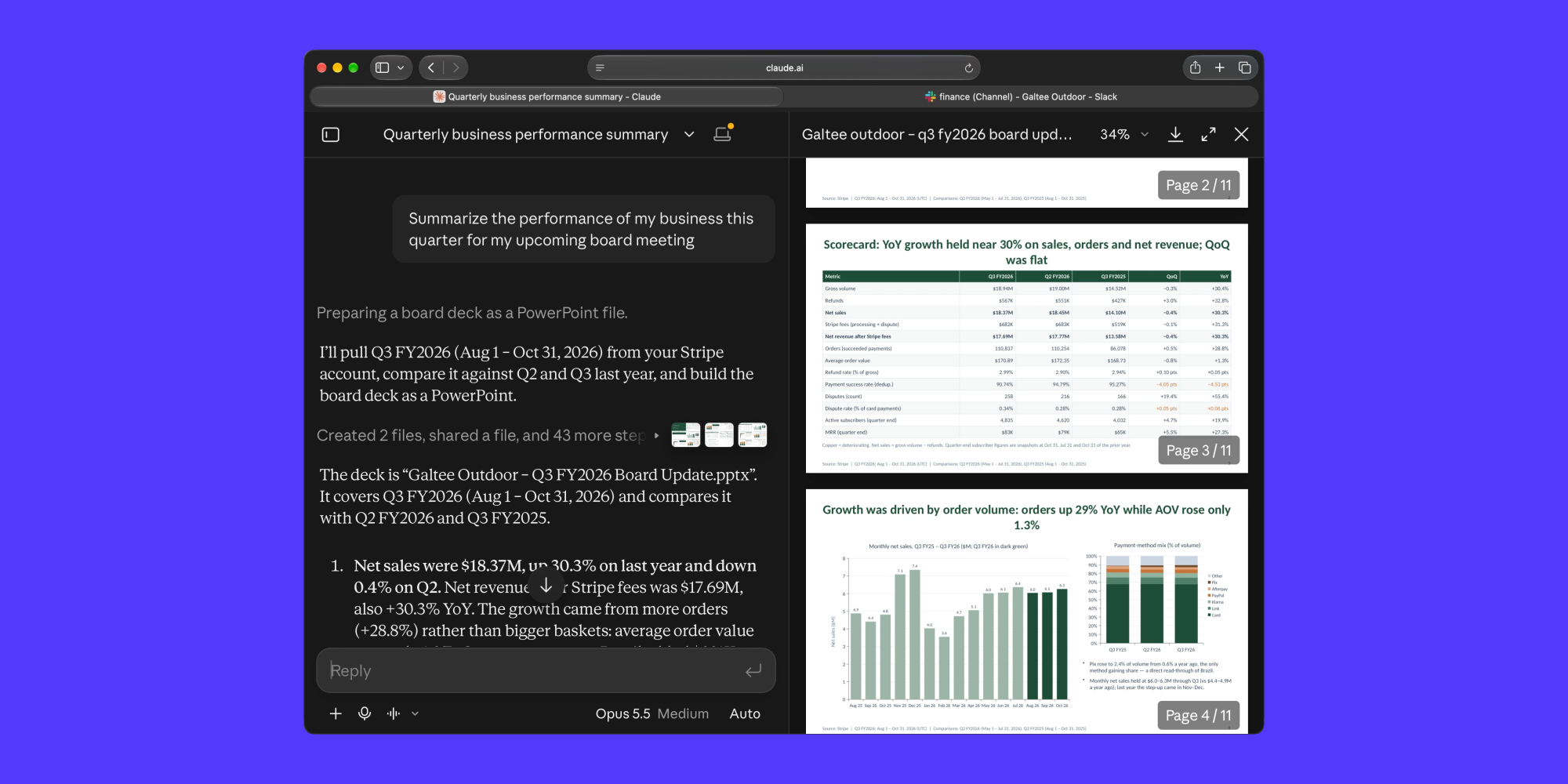
On November 5 Stripe made agent access to Stripe analytics available to all users via the Stripe MCP or the Queries and Reports APIs directly. Compatible agents such as Claude and Cursor can answer natural-language questions about MRR, churn, fraud and reconciliation. The Reports API ships a modeled schema of 300+ tables with built-in guidance; Queries API is free through January 31, 2027 then usage-based, while Reports API stays free. Every analysis exposes the underlying SQL for verification.

Stripe Opens Agent Data Analysis to All Users via MCP, Queries and Reports APIs; Queries Free Through Jan 31, 2027

Key Takeaways

  • Availability: all Stripe users; connect via Stripe MCP or Queries/Reports APIs to Claude, Cursor and other compatible agents
  • Capabilities: natural-language MRR, expansion/contraction/churn, fraud, reconciliation and payments performance; can combine with tools like PostHog
  • Data model: Reports API includes 300+ modeled tables with usage guidance; every analysis exposes editable underlying SQL
  • Pricing (vendor): Queries API free through Jan 31, 2027 then per-credit with no monthly fee; Reports API remains free
  • Safety: read-only Data Metrics/Queries/Reports; do not paste secret keys into chat—use agent API keys or OAuth
Read full story

X Discussion: Vercel CEO Guillermo Rauch Says AI Will Rewrite All Human-Made Software, Sparking Debate on Formal Verification and Rewrite Risk

On November 5 Guillermo Rauch posted on X that most human-made software was slow, insecure and under-specified, and that AI will rewrite it all, many times, then formally verify, load test and harden it: "the true birth of software engineering." The post drew 3,000+ likes, 270+ reposts and nearly 100K views. Supporters cite from-scratch AI rewrites; critics warn that missing specs and human review still matter. This is a personal opinion, not a Vercel announcement.

Key Takeaways

  • Rauch's post (Nov 5, 02:22 UTC) had about 3,060 likes, 272 reposts, 681 bookmarks and ~99K views when fetched
  • Core claim: AI will rewrite human software "many times", formally verifying, load testing and hardening it, and replacing memory-unsafe foundations
  • An hour earlier he shared Vercel Security Review figures: 6,817 vulnerabilities found in 24 hours, 580 critical/high, 1,411 already patched by Agent (vendor-reported)
  • Pushback: rewriting under-specified code can just ship the same wrong behavior faster, and formal verification moves bugs up an abstraction level rather than eliminating them
  • This is an opinion thread, not an established fact or official roadmap
Read full story
Linked Models & Agents:

X Discussion: Grok Bot Engineer poteto Calls Adversarial Agent Code Reviews "Mostly a Waste of Tokens" and Argues for Empirical Plus Formal Verification Instead

On November 3, @poteto (lauren), whose bio says she works on Grok @bot at SpaceXSI, is on the React Compiler core team, and previously worked at Cursor, Meta and Netflix, posted what she called "maybe a hot take": she now considers adversarial reviews mostly a waste of tokens and thinks those tokens are far better spent on empirical combined with formal verification. She says she has updated her agent skill pack pstack to use its interrogate (multi-model adversarial review) skill less and may eventually remove it. She adds that she has found very little value in code review in the abstract, because agents tend to get lost in nitpicks and YAGNIs. The post drew about 906K views, 9,227 likes and 5,538 bookmarks. It is a personal opinion that sparked debate over the value of AI code review.

Key Takeaways

  • Opinion (personal, not an official finding): adversarial reviews are "mostly a waste of tokens"; empirical plus formal verification is the better use of them
  • Action: the author says she has made pstack use the interrogate skill less and may remove it; at fetch time the public pstack folder in GitHub cursor/plugins had no commits after October 27, so the change is not visible there yet
  • What interrogate is: per its public SKILL.md, it spawns one read-only reviewer per configured model (defaults Claude Opus 5.5 xhigh and Grok 4.7 xhigh fast) to attack the diff, then sorts findings into Act on, Consider, Noted and Dismissed without auto-applying fixes
  • Author (per her X and GitHub bios): engineer on Grok Bot at SpaceXSI, React Compiler core team, previously at Cursor, Meta and Netflix
  • Reach: about 906K views, 9,227 likes, 5,538 bookmarks, 668 replies, 356 reposts and 210 quotes
Read full story
ADSponsored

X Discussion: Addy Osmani of Claude Code Warns of "Cognitive Surrender" and Urges Developers to Keep Critical Thinking When Agents Do the Work

Addy Osmani (@addyosmani), whose X bio lists Claude Code at Anthropic, posted a long article on X on November 3 titled "Critical thinking when agents do the work." He describes a spectrum of working with AI: cognitive offloading (delegating a task but owning the result), deferral (the tool output becomes your new input), and "cognitive surrender" (the AI output quietly becomes your own and you feel no need to check it), a term he credits to Steven Shaw and Gideon Nave at Wharton. He offers self-check questions and verification habits. Within about three hours the post drew roughly 1,400 likes, 2,400 bookmarks and more than 72,000 views and reached X trending. These are the author's views, not an Anthropic announcement.

Key Takeaways

  • The spectrum: cognitive offloading (delegate but keep ownership, which the author says he does all day), deferral (the output stops being a hypothesis), and cognitive surrender (no more checking; it becomes your conclusion). Read the X article.
  • His argument: as models improve there are fewer obvious errors, so well-written, mostly correct output no longer demands a second look, and even with many agents running you still have only one pair of eyes on the results.
  • Self-check questions: write down your hypothesis before asking; know whether the AI is helping you think or thinking for you; ask what would make it wrong and test it; have several models argue the other side; ask whether you would bet on it in front of the person who maintains it.
  • Verification habits: define "verified" up front (a passing test, a screenshot, a log); a green check proves one property, so ask what it did not prove; have Claude Code critique its work with a fresh-context subagent, and finish by asking "Did I miss anything?"
  • Delegate fully where being wrong is cheap, but keep the reasoning for decisions whose consequences land on others, such as what to build and whether it is safe to ship.
Read full story
Linked Models & Agents:

OpenAI unveils three AI-produced results: a claimed refutation of the Exponential Time Hypothesis, local smoothing in every dimension, and an existence proof for QCD

In an Oct 26 blog post, OpenAI said its internal models produced three new results: a proof of Sogge's local smoothing conjecture in every dimension (which implies the Kakeya and Stein restriction conjectures), a Lean-verified proof that the Exponential Time Hypothesis (ETH) is false, and a rigorous existence proof for four-dimensional QCD and related quantum field theories including pure Yang-Mills. The math and CS papers and Lean proofs are in the openai/math GitHub repo; the physics artifacts are being held back while an external group led by David Gross writes them up. All of this is OpenAI's own claim and still awaits independent verification.

OpenAI unveils three AI-produced results: a claimed refutation of the Exponential Time Hypothesis, local smoothing in every dimension, and an existence proof for QCD

Key Takeaways

  • Computer science (per OpenAI): the paper gives a deterministic algorithm that exactly counts satisfying assignments of fixed-width CNF formulas in subexponential time and polynomial space, and the 3-SAT case refutes ETH; the AI found the proof on Oct 16 and it was formalized in Lean on Oct 17
  • ETH was proposed by Impagliazzo, Paturi and Zane and has been used in hundreds of papers for conditional lower bounds; the verification group is led by Impagliazzo, Paturi (UC San Diego) and Ryan Williams (MIT), and OpenAI has committed to fund a conference
  • Math: local smoothing is proved in every spatial dimension n>=2, which yields the Kakeya and Nikodym maximal conjectures and Stein restriction estimates; earlier work only covered two dimensions (2019) and three-dimensional Kakeya (2025)
  • Physics: the natural-language Yang-Mills existence proof was produced on Sep 9 and the QCD proof on Sep 18, with the Yang-Mills Lean formalization finished Oct 16; a five-person group led by David Gross will write it up and the artifacts are not public yet
  • OpenAI says it seeks no academic credit, and outside participants are unpaid volunteers with no NDAs; the openai/math repo withdrew 3 manuscripts on Oct 7 over a sign error, so these claims still need independent checking
  • Physics follow-up (Oct 28): KITP published the Yang-Mills Working Group statement. The committee is Michael Douglas, David Gross (chair), Arthur Jaffe, Igor Klebanov and Nikita Nekrasov; OpenAI asked Gross on Oct 16 to take custody of the proof, and the committee says it has no responsibility to OpenAI. It will first check that the Lean formalization matches standard definitions before releasing the Lean proof, then publish the full 1,147-page proof with its assessment once satisfied; confinement and the mass gap remain open
Read full story
Linked Models & Agents:

X discussion: Matt Pocock sketches the ideal "language for agents" (Rust speed, Go-sized design space, strictest verification) and names Bend; Chris Lattner replies with Mojo

At 17:23 UTC on 2026-10-25, TypeScript educator Matt Pocock (@mattpocockuk, author of Total TypeScript and AI Hero) posted (post) that the next great "language for agents" should be as fast as Rust, have as little design space as Go, and have the strictest type/verification system ever written, calling Bend "an interesting first effort". When we pulled it, the post had about 3,130 likes, 84 reposts, 264 replies, 786 bookmarks and 220K views, and it reached X's trending stories. Mojo creator Chris Lattner replied (reply) recommending Mojo and suggesting "can target all hardware" be added to the list. This is an opinion debate, not a verified conclusion.

Key Takeaways

  • Main post: post, published 17:23 UTC on 10-25, with about 3,130 likes, 84 reposts, 264 replies, 786 bookmarks and 220K views when we pulled it
  • Three criteria: Rust-level speed, a Go-sized design space (few ways to write the same thing), and the strictest type/verification system ever written, so the compiler rather than a human catches agent mistakes
  • Chris Lattner replied recommending Mojo, citing advanced type features such as linear types and symbolic constraints, and suggested adding "can target all hardware" (reply, about 40 likes when pulled)
  • Bend creator Victor Taelin (@VictorTaelin) also joined the thread, saying Bend blocking an agent from breaking an app is "working as intended"
  • No benchmarks or controlled comparisons were shared; whether Bend or Mojo suits agent coding remains personal opinion
Read full story
Linked Models & Agents:

X discussion: engineer Arpit Bhayani says "no human will ever write code better than LLMs", drawing 7K+ likes, 240+ replies and a debate over AI coding ability

At 13:37 UTC on 2026-10-25, engineer Arpit Bhayani (@arpit_bhayani) posted: "No human will ever write code better than LLMs. Accept this fact, stop pretending, and move on." (post). When we pulled it, the post had about 7,193 likes, 496 reposts, 104 quotes, 241 replies, 529 bookmarks and 174K views, and it reached X's trending stories. Replies are split: some agree LLMs already write code faster and better, while others push back that LLMs often produce more code than a task needs and that production edge cases, architecture and final verification still depend on people. This is an X discussion presented as opinions, not a proven conclusion.

Key Takeaways

  • Main post: Arpit Bhayani's post, published 13:37 UTC on 10-25, with about 7,193 likes, 496 reposts, 104 quotes, 241 replies, 529 bookmarks and 174K views when we pulled it
  • The wording is "No human will ever write code better than LLMs. Accept this fact, stop pretending, and move on"; it is a personal opinion with no data or experiment attached
  • For: one reply says the author coded for years and LLMs now code better and faster than they do
  • Against: other replies say LLMs tend to generate far more code than a simple use case needs, and that browser quirks, accessibility and production edge cases still need human judgment
  • Common ground: many replies place human value in design, supervision and verification; layoff and hiring-ratio figures circulating online were not verified here, so we do not use them
Read full story
Linked Models & Agents:

GitHub Next Releases PDD Kit: Provable Specification Enforcement for Coding Agents to Eliminate Edge-Case Regressions

GitHub Next officially released PDD Kit (Property-Driven Development Kit), establishing a formal verification toolkit tailored for autonomous coding agents. Addressing the pervasive reliability gap where agent-generated code passes isolated unit tests but crashes on subtle edge cases, PDD Kit combines property-driven specifications with automated formal solvers. Instead of testing arbitrary sample inputs, PDD Kit mathematically proves that agent code adheres to rigorous invariant specifications across every possible input, preventing regressions and elevating coding agents from probabilistic generation to provable correctness.

GitHub Next Releases PDD Kit: Provable Specification Enforcement for Coding Agents to Eliminate Edge-Case Regressions

Key Takeaways

  • GitHub Next releases PDD Kit to eliminate edge-case flaws in agent-generated code via automated mathematical proofs
  • Pioneers 'proofs for every input', replacing fragile, underspecified unit test samples with comprehensive invariant verification
  • Eliminates deadlocks, boundary index out-of-bounds, and state desynchronization in agentic refactoring workflows
  • Provides an indispensable verification foundation for deploying autonomous coding agents into mission-critical production systems
Read full story

OpenAI Discloses PHP Zero-Day Critical Flaws Found via GPT-5.6 Sol, Open-Sources Scanner and Pledges $1B Defense Fund

OpenAI announced a critical coordinated vulnerability disclosure in the core PHP runtime discovered by cybersecurity firm Calif utilizing GPT-5.6 Sol, alongside independent verification by Wiz. Because PHP powers roughly 70% of all websites globally, the vulnerability represented an existential risk to internet infrastructure. Following coordinated patching, OpenAI committed $1B in subsidized Daybreak security access and open-sourced openai/php2shell-checker, an automated Codex inspection tool enabling site administrators worldwide to audit their deployments.

OpenAI Discloses PHP Zero-Day Critical Flaws Found via GPT-5.6 Sol, Open-Sources Scanner and Pledges $1B Defense Fund

Key Takeaways

  • Cybersecurity firm Calif used GPT-5.6 Sol to identify critical remote code execution (RCE) vulnerabilities in the core PHP interpreter
  • PHP powers an estimated 70% of active web properties globally; patches have been coordinated and safely distributed
  • OpenAI commits $1 billion in subsidized Daybreak program access to support security research across foundational open-source projects
  • Open-sources openai/php2shell-checker on GitHub, providing an automated Codex-powered scanner for site vulnerability assessments
Read full story
ADSponsored

Scale AI Open-Sources Sauron: Evidence-First Agentic Verification Slashing Evaluation Costs by 85% with 0.97 Recall

Scale AI Research introduced Sauron (arXiv:2610.17724), an open-source evidence-first agentic verification framework. Overcoming the severe failure modes of standard LLM-as-a-judge approaches—which hallucinate justifications and guess outcomes over long agent trajectories—Sauron enforces bounded, adaptive interrogation of agent traces with cryptographic-grade execution receipts. Evaluated on the PA100 benchmark across eight backbones, it delivers 0.94 precision and 0.97 recall at roughly 15% the cost of state-comparison baseline Archipelago, completing 10-episode grading 4.2x faster.

Scale AI Open-Sources Sauron: Evidence-First Agentic Verification Slashing Evaluation Costs by 85% with 0.97 Recall

Key Takeaways

  • Scale AI open-sourced Sauron (arXiv:2610.17724), an evidence-first verification architecture eliminating LLM-as-a-judge hallucinations
  • Employs bounded adaptive queries and verifiable evidence receipts to extract targeted execution proofs without scanning full transcripts
  • Sweeps top F1 scores across eight backbones on PA100, reaching 0.94 Precision and 0.97 Recall at 1/7th the cost of snapshot comparisons
  • Completes 10-episode benchmark runs in 17 minutes vs 71 minutes (4.2x speedup), with full open code on GitHub
Read full story
Linked Models & Agents:

AWS & UIUC Introduce Lean4AgenticRL: Verifiable Multi-Level Process Rewards in Lean4, Reaching 77.3% on TerminalBench

Researchers from Amazon Web Services (AWS) and UIUC unveiled Lean4AgenticRL (arXiv:2610.22448). Tackling the limitations of conventional agentic reinforcement learning relying on sparse, binary outcome rewards, the framework grounds multi-level process rewards within a formal Lean4 verification schema. Utilizing workflow-stage-normalized GRPO, the resulting LAR-27B model reaches 77.3% on TerminalBench-2.1, outperforming base models by 9.89% and surpassing comparable open models by 5.07%.

AWS & UIUC Introduce Lean4AgenticRL: Verifiable Multi-Level Process Rewards in Lean4, Reaching 77.3% on TerminalBench

Key Takeaways

  • AWS and UIUC introduced Lean4AgenticRL (arXiv:2610.22448), the first framework grounding multi-level process rewards in Lean4 formal proofs
  • Overcomes sparse outcome reward bottlenecks using workflow-stage-normalized GRPO to stabilize multi-turn credit assignment
  • LAR-27B hits 77.3% on TerminalBench-2.1, outperforming base models by 9.89% and outscoring comparable baselines by 5.07%
  • Ablations show verifiable process rewards accelerate RL convergence by over 42%, establishing a rigorous paradigm for terminal coding agents
Read full story
Linked Models & Agents:

Rule-Governed World Modeling Breakthroughs: OmniVerifier-C1 Graded Verifier, Meituan's WorldCast (72.8 vs 20.1 Open-Source Gap), and NUS's 4x Faster RPO Diffusion RL

Three new studies tackle verification, evaluation, and RL alignment for rule-governed generative world models: OmniVerifier-C1 (arXiv:2610.22355, 32 upvotes) uses Decoupled RL to train a decomposed graded visual verifier that reaches 0.684 on ViVerBench and boosts FLUX.1-dev GenEval from 0.68 to 0.79 while enabling Maze and Sudoku world modeling; Meituan's WorldCast benchmark (arXiv:2610.20731, 30 upvotes) evaluates 12 models across 320 multi-step world state prediction cases, finding GPT-Image-2.5 System at 72.8 vs. 42.8 for Nano Banana Pro and 20.1 for the top open model; and NUS's Routing Policy Optimization (RPO, arXiv:2610.22282, 23 upvotes) turns attention routing into an internal exploration action to train video/image diffusion RL 3.1x–4.2x faster than Flow-GRPO and DanceGRPO.

Rule-Governed World Modeling Breakthroughs: OmniVerifier-C1 Graded Verifier, Meituan's WorldCast (72.8 vs 20.1 Open-Source Gap), and NUS's 4x Faster RPO Diffusion RL

Key Takeaways

  • OmniVerifier-C1 uses Decoupled RL (DAPO) to jointly optimize sub-question binary judgments and global continuous scoring, reaching 0.684 on ViVerBench and boosting FLUX.1-dev GenEval from 0.68 to 0.79
  • Meituan's 320-case WorldCast benchmark reveals a massive gap in multi-step visual state prediction: GPT-Image-2.5 System scores 72.8 vs. 42.8 for Nano Banana Pro and 20.1 for the best open-source model
  • NUS's Routing Policy Optimization (RPO) uses internal attention routing exploration to align Wan2.2-TI2V-5B in just 24.1 GPU-hours—3.1x faster than Flow-GRPO and 4.2x faster than DanceGRPO
Read full story
Linked Models & Agents:

Judge-Free Test-Time Scaling Tops WebArena Infinity at 74.6%: Salesforce Introduces CLIFT, Alongside MMSearch-OPD and SCOPED-8B Beating 32B VLMs

Three new frameworks advance web and multimodal agent post-training: Salesforce AI Research's CLIFT (arXiv:2610.06829) certifies URL-conditional self-verification questions for dense RL rewards and judge-free Conformal Trajectory Selection (CTS), propelling Gemma-4 31B to a 74.6% SOTA on WebArena Infinity (beating Gemini 3 Flash at 70.1%) and lifting GPT-5.5 to 53.7% on VisualWebArena. Meanwhile, MMSearch-OPD (arXiv:2610.22240) boosts 9B multimodal deep search by +15.3 points to 60.2%, and Northeastern University's SCOPED-8B (arXiv:2610.22217) uses skill-decoupled on-policy expert distillation to reach 73.13% across 8 benchmarks—surpassing Qwen3-VL-32B (72.01%) and Claude Opus 4.6 (72.86%).

Judge-Free Test-Time Scaling Tops WebArena Infinity at 74.6%: Salesforce Introduces CLIFT, Alongside MMSearch-OPD and SCOPED-8B Beating 32B VLMs

Key Takeaways

  • Salesforce's CLIFT conformal self-verification propels Gemma-4 31B to 74.6% on WebArena Infinity (+12.8 pts over base, beating Gemini 3 Flash at 70.1%) with judge-free test-time trajectory selection
  • Transferring the open-trained CLIFT question bank to GPT-5.5 sets a 53.7% SOTA on VisualWebArena, while MMSearch-OPD boosts 9B multimodal deep search accuracy by +15.3 points to 60.2%
  • Northeastern University's SCOPED-8B reaches 73.13% average accuracy across 8 VLM benchmarks via skill-decoupled on-policy expert distillation, beating Qwen3-VL-32B (72.01%) and Claude-Opus-4.6 (72.86%)
Read full story
Linked Models & Agents:

Zero-Human-Label Step Accuracy Jumps from 48.2% to 74.7%: LeanPRM Grounds Process Supervision in Lean 4, While Cornell's CPLM Matches Full Attention at w=128

Tackling step-level verification in mathematical reasoning and in-context copying bottlenecks in Transformers, NYU/UCLA/Stanford researchers introduce LeanPRM (arXiv:2610.17697)—using the Lean 4 theorem prover to automatically label 152K steps across 10,634 natural-language proofs with zero human annotation, boosting Qwen3-4B step accuracy on LeanPRM-Bench from 48.2% to 74.7% (vs. 60.3% for PRM800K). Meanwhile, Cornell University's Copy-Paste Language Models (CPLMs, arXiv:2610.19247) add a lightweight Copy-Paste head (~3% compute overhead) that relieves the LM head gradient bottleneck, boosting LAMBADA accuracy by +2.5-4.0 points and allowing a w=128 sliding-window CPLM to match full-attention perplexity.

Zero-Human-Label Step Accuracy Jumps from 48.2% to 74.7%: LeanPRM Grounds Process Supervision in Lean 4, While Cornell's CPLM Matches Full Attention at w=128

Key Takeaways

  • LeanPRM uses the Lean 4 proof assistant and a syntax-error filter to generate 152K step-level labels across 10,634 proofs with zero human annotation
  • A Qwen3-4B verifier trained on LeanPRM reaches 74.7% step accuracy on LeanPRM-Bench (vs. 48.2% base and 60.3% with PRM800K) and improves 0.6B-8B verifiers on Hard2Verify and IMO-GradingBench
  • Cornell's Copy-Paste Language Models (CPLMs) add a ~3%-overhead copy head that relieves the LM head gradient bottleneck, boosting LAMBADA by +2.5-4.0 points and matching full-attention perplexity with a w=128 sliding window
Read full story
Linked Models & Agents: