

At 18:58 UTC on November 9 (2:58 a.m. on November 10 SGT), the official Claude account released Claude Fable 5.2 and Claude Mythos 5.2. They are the same underlying model: Fable ships with cybersecurity and biology safeguards and is open to all paid plans, the Claude Platform and the major clouds, while Mythos drops some of those safeguards and is offered only to vetted organizations through the Cyber and Life Sciences Verification Programs. Pricing falls from Fable 5.1's $10/$50 to $8/$40 per million input/output tokens, output is up to 30% faster, and an optional fast mode generates up to 2.5x faster for $16/$80. By Anthropic's numbers, Fable 5.2 at Xhigh effort scores 49.1% on FrontierCode 2.0, ahead of Opus 5.5 (45.5%) and GPT-6 Astra (42.8%); at High effort it matches Opus 5.5's best for about half the cost per task. The API model name is claude-fable-5-2.
Key Takeaways
- ✓Pricing: $8 / $40 per million input/output tokens, 20% cheaper than Fable 5.1's $10 / $50; fast mode generates up to 2.5x faster at $16 / $80
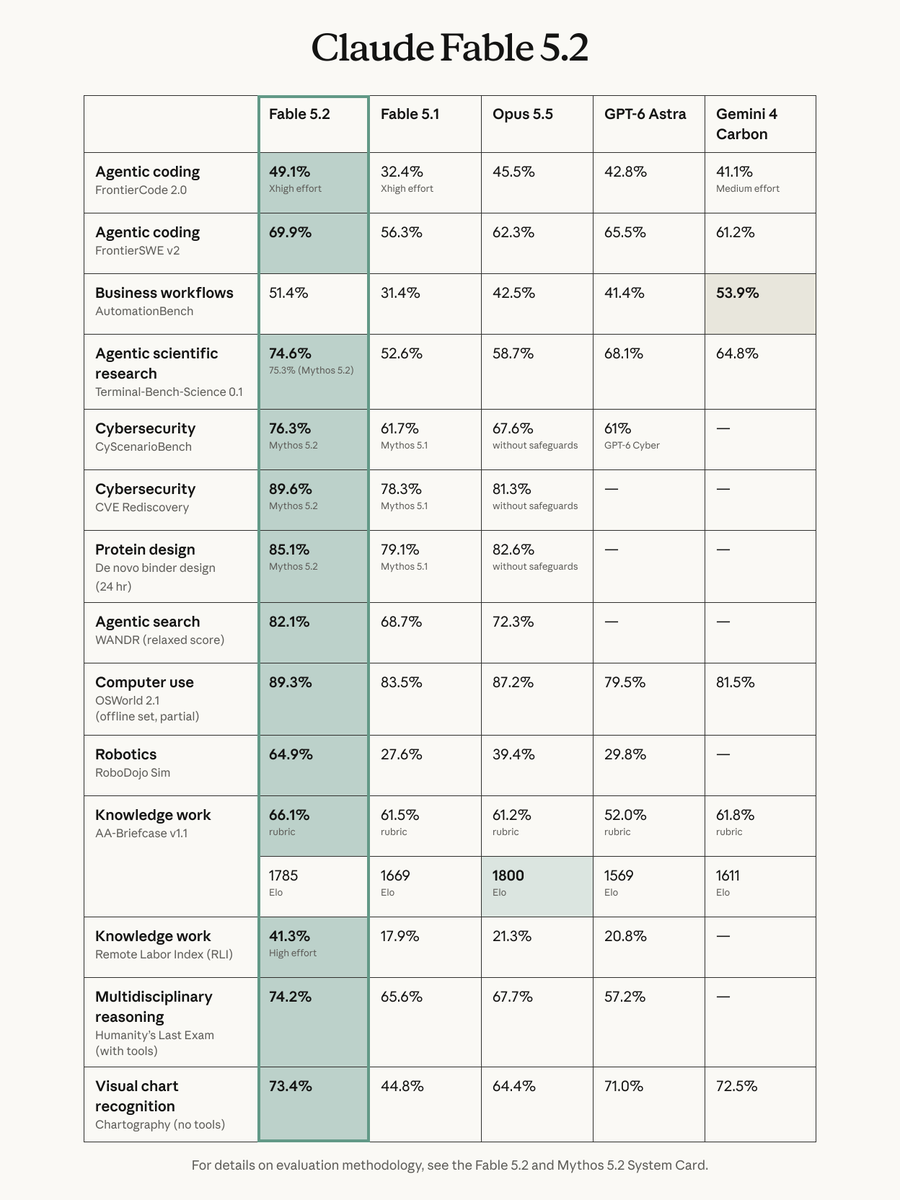
- ✓Coding (Anthropic's numbers): FrontierCode 2.0 at Xhigh effort 49.1% (Opus 5.5 45.5%, GPT-6 Astra 42.8%); at High effort 45.3%, matching Opus 5.5's best for about half the cost per task; FrontierSWE v2 69.9%
- ✓Long-running agents: 1,000 Fable 5.2 agents formalized Fermat's Last Theorem in Lean in 30 hours, while Opus 5.5 in the same setup finished only 26% in 18 hours; one engineer had it coordinate over 1,000 subagents for 8 days to build a prototype OS that boots on a laptop
- ✓Other scores (Anthropic's numbers): RoboDojo Sim 64.9% (Fable 5.1 27.6%), HLE with tools 74.2%, OSWorld 2.1 89.3%, Remote Labor Index 41.3%; Mythos 5.2 CVE Rediscovery 89.6%
- ✓Safeguards: Fable and Mythos are the same model; Fable 5.2's classifiers block about 55% less often than 5.1's; the preserved thinking anti-distillation feature now applies to all accounts
Key Decision Metrics at a Glance
Heavy Claude Code use: compare subscription limits and API bills
Compare 40 dev plans & simulate token costs vs $20/mo subscriptions
Project Links & Resources
Direct AccessIn-Depth Technical Analysis
Background and Pain Points
Anthropic's lineup now has two tiers: Opus 5.5 is the recommended daily driver, while Fable and Mythos are meant for the hardest, most open-ended technical work. The complaints about Fable 5.1 were cost ($10/$50 per million tokens) and frequent false blocks from its safety classifiers, which kept many developers out of cybersecurity and biology work. Early on November 10 SGT, Anthropic released Fable 5.2 and Mythos 5.2 with a lower price, faster output and fewer false blocks. They are the same underlying model: Fable carries safeguards and is open to all paid users, while Mythos drops some of them and is only offered to organizations vetted through the Cyber and Life Sciences Verification Programs.
Architecture Highlights
Anthropic has not disclosed parameter counts or architecture details. The stated changes: output is up to 30% faster than 5.1, a new fast mode speeds generation by up to another 2.5x, and at the default Medium effort it uses fewer tokens than Fable 5.1 for the same tasks. Fable 5.2 can act as an Advisor (Haiku, Sonnet or Opus consult it on hard problems) or an Orchestrator (it delegates simpler tasks to smaller models). During training Anthropic deliberately limited gains in accelerator kernel optimization and LLM architecture research, where it performs at about Opus 5.5's level. On distillation, preserved thinking now applies to all accounts, so prior context cannot be edited to extract its reasoning.
Benchmarks
All figures below are Anthropic's own. On FrontierCode 2.0, which checks whether code changes would be merged by open-source maintainers, Fable 5.2 at Xhigh scores 49.1%, versus 45.5% for Opus 5.5, 42.8% for GPT-6 Astra and 41.1% for Gemini 4 Carbon; at High it scores 45.3%, matching Opus 5.5's best for about half the cost per task. FrontierSWE v2 is 69.9% (Opus 5.5 62.3%). AutomationBench is 51.4%, still behind Gemini 4 Carbon's 53.9%. RoboDojo Sim is 64.9%, more than double GPT-6 Astra's 29.8%. Humanity's Last Exam with tools is 74.2% and OSWorld 2.1 is 89.3%. Mythos 5.2 scores 89.6% on CVE Rediscovery. The headline demo: 1,000 Fable 5.2 agents formalized Fermat's Last Theorem in Lean in 30 hours, while Opus 5.5 in the same setup completed only 26% in 18 hours. No independent third-party results have been published yet.
Getting Started
The API model name is claude-fable-5-2. It is live on the Claude Platform, AWS, Google Cloud and Azure, and in paid Claude plans and Claude Code, where Medium effort is the default. Pricing is $8 input and $40 output per million tokens; fast mode costs $16/$80 and is available in Claude Code, the Claude Platform, Google Cloud and Microsoft Foundry. This week, paid subscribers get one to three Fable usage resets, and Pro plans can spend up to 50% of their weekly limit on Fable. Anthropic still recommends starting most coding work on Opus 5.5 and switching to Fable for large migrations or long multi-agent jobs. Fable blocks most penetration testing and exploit work; blocked cyber queries are answered by Opus 4.8 instead.
Benchmark side-by-side against alternatives, or calculate monthly token cost vs subscription break-even.
Discussion & Comments
0Sign in to join the discussion
Connect with AI developers to exchange benchmark insights.