
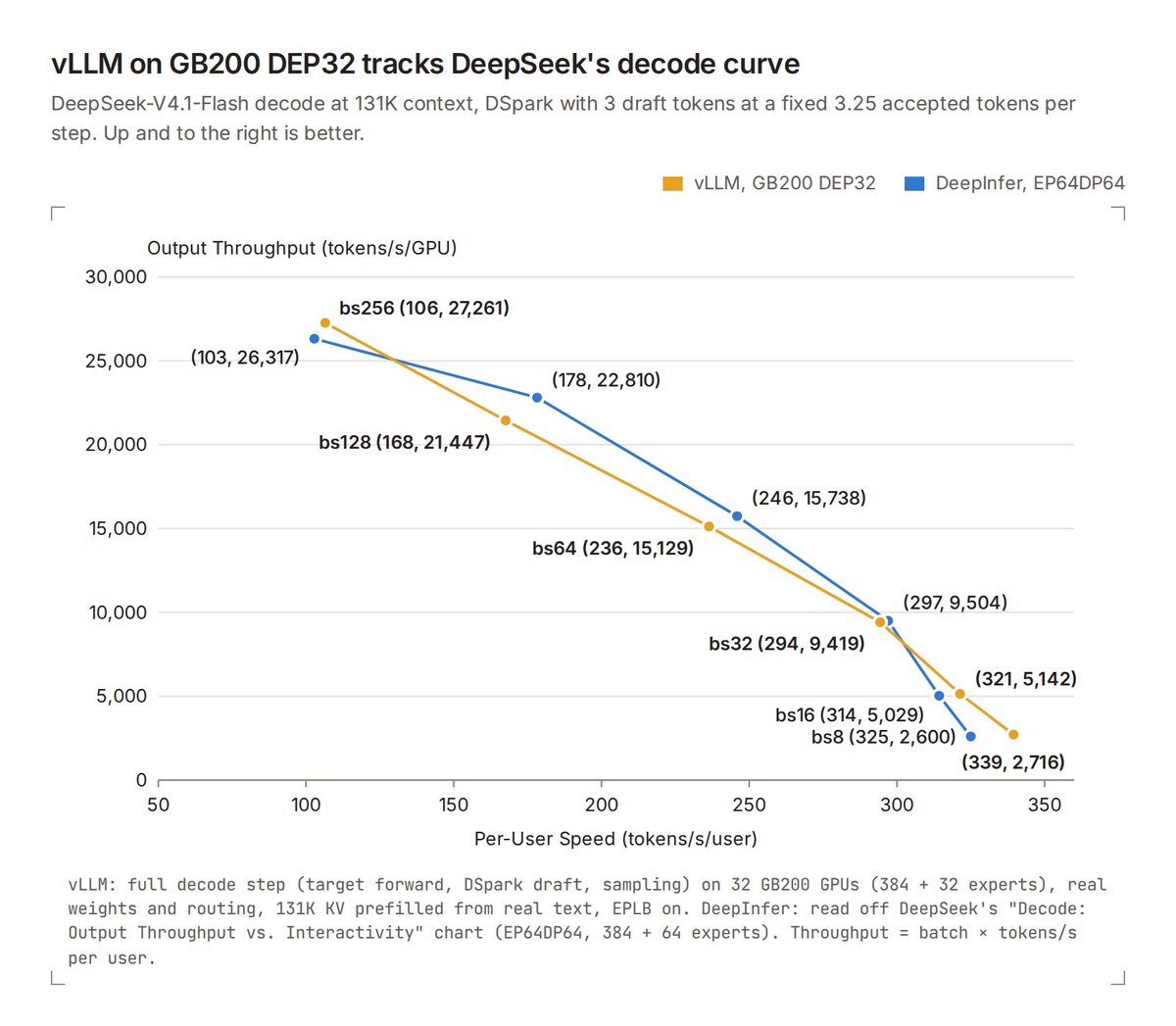
Hours after DeepSeek open-sourced DeepInfer, the vLLM project team released official benchmark parity data serving DeepSeek-V4.1-Flash. Utilizing DeepSeek's identical decoding setup (131K context window, nextn=3 speculative decoding), vLLM closed its throughput performance delta to within 6% of DeepInfer across batch sizes 8 through 256 on NVIDIA GB200 systems. On GB300 hardware, vLLM attained up to 1,000,000 tokens/second per GPU and 826 tokens/second per user, generating $38.96 in hourly GPU revenue at DeepSeek off-peak rates. vLLM simultaneously shipped day-0 runtime support for FastH3-Omni and Spark-X2.6-4B.
Key Takeaways
- ✓vLLM published direct benchmark comparisons, demonstrating that its serving throughput on NVIDIA GB200 is within 6% of DeepInfer
- ✓Achieves unprecedented scaling on NVIDIA GB300: up to 1,000,000 tokens/second per GPU and 826 tokens/second per active user stream
- ✓Generates up to $38.96 per GPU-hour in revenue when mapped to DeepSeek's production off-peak API pricing schedule
- ✓Delivers immediate Day-0 support for the FastH3-Omni video model and the 1M-token Apache 2.0 model Spark-X2.6-4B
Key Decision Metrics at a Glance
Not enough VRAM? Compare cloud API and self-hosting costs
Compare 40 dev plans & simulate token costs vs $20/mo subscriptions
In-Depth Technical Analysis
Background and the Problem
As DeepSeek-V4.1-Flash solidifies its status as a foundational backbone for high-throughput coding agents, the performance delta between vendor-specific serving stacks (such as DeepSeek's newly open-sourced DeepInfer) and open general-purpose runtimes (such as vLLM) ignited intense industry debate. Infrastructure teams feared proprietary engines, heavily optimized with specialized fused kernels and tailored scheduling, would outpace general frameworks by 30% to 50%, forcing vendor lock-in. Countering this narrative, the vLLM core engineering team published verified benchmark results demonstrating near-parity on October 21, 2026 (@vllm_project, Status #2112703311933747347).
Architecture and How It Works
- Parity with Production Topologies:
- Evaluated under DeepSeek's identical configuration: full 131,072 (131K) sequence length with
nextn=3multi-token speculative decoding;
- NVLink-Optimized Kernel Pipeline on GB200 & GB300:
- Re-architected Multi-Head Latent Attention (MLA) decoding and MoE expert dispatch kernels to saturate the NVLink fabric of NVIDIA GB200 and GB300 systems;
- Interleaves MoE all-to-all collectives directly behind dense GEMM execution, effectively eliminating inter-device communication bubbles;
- Day-0 Multi-Model Ecosystem Enablement:
- Added immediate day-0 serving for FastH3-Omni (real-time video generation) and Spark-X2.6-4B (an Apache 2.0, 1M-context lightweight backbone).
Benchmarks and Measured Results
Disclosed in official comparative figures (Status #2112703311933747347):
- GB200 Production Throughput Delta:
- Across production concurrency windows spanning batch sizes 8 to 256, vLLM's end-to-end token output closed within 6% of DeepInfer's published throughput;
- GB300 Peak Ceiling:
- Single-GPU sustained throughput surpassed 1,000,000 tokens/second;
- Single-user streaming velocity surged to 826 tokens/second, enabling instant multi-thousand-line codebase transformations;
- Unit Economics:
- Based on DeepSeek's published off-peak API pricing tiers, a single GPU yields $38.96 per hour in gross serving revenue, proving unmatched ROI for infrastructure providers.
Getting Started for Developers
- Announcement Link: Access official thread at
https://x.com/vllm_project/status/2112703311933747347; - Runtime Upgrade: Upgrading to vLLM's latest release activates optimized MLA and MoE communication pipelines for DeepSeek models;
- Infrastructure Strategy: Enterprise teams operating large GPU estates can remain anchored on standard vLLM without incurring stack migration debt, capturing frontier-grade serving performance while preserving cross-hardware flexibility.
Benchmark side-by-side against alternatives, or calculate monthly token cost vs subscription break-even.
Discussion & Comments
0Sign in to join the discussion
Connect with AI developers to exchange benchmark insights.